Garden Blog - Top Tropicals

Date: 24 Oct 2016

Overwintering Adeniums outside of tropics
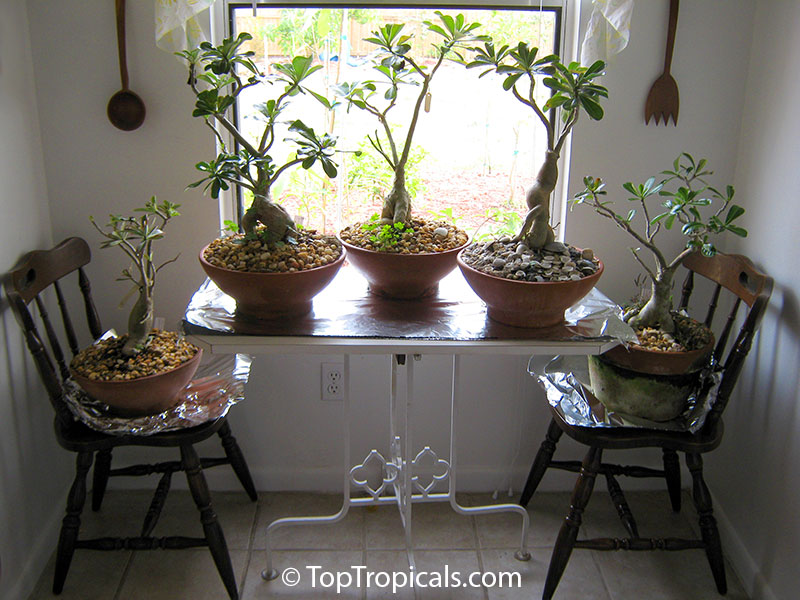
Q: We bought several adenium plants from you. We are moving to the Denver area of Colorado. How can we make sure the plants survive? Should we use a green house?

A: Adeniums are perfect container plants, and house plants. They can be easily grown outside of tropical climate. During winter, Adeniums drop leaves and go into dormancy which makes it easy to keep these plants in a dormant stage in a warm location of your house, or possibly even in well-lit spot of garage (with a window), with temperatures above 50-60F.
Here in South Florida, during time of cold, when chances of freeze are high, we move our own Adenium collection into lanai, with plastic sheet protection around lanai.

In colder climates, Adeniums can be kept indoors as house plants during winter. There are some requirements/tips for you:

  • Temperature. Move Adeniums indoors when temperature starts dropping below 45F.
  • SUNSHINE. Use SUNSHINE boosters to improve cold resistance of Adeniums, and essure healthy plant throughout winter. SUNSHINE-BC formula is specifically designed for plants with caudex, and bonsai.
  • Water. Reduce watering to minimum, especially when plants drop leaves - this means they went into dormancy. Once a week light watering is enough. Water very carefully during cooler months. When it is hot (85-100F), excessive water usually won't harm adeniums: it will be partially used by a plant, and partially will evaporate. Especially be careful with water when temperatures drop below 65F - then tropical plants simply stop growing process and go dormant. Once adeniums start losing leaves, this is a sign to reduce watering to once a week to once a month, and in very small quantity (couple tablespoons per pot).
  • Light. Bright light is not necessary, but do not keep them in dark either, even if all leaves dropped. Good light is necessary to maintain healthy stems and caudex. Keep in mind, the less light, the less watering too. Ideal spot is a windowsill, however if your space is limited and all windows occupied by other "leafy" plants, location close to window will be enough as long as watering is reduced, to avoid rot. We keep our big collection specimens on a roofed porch during winter, where level of light is very low. Last winter we haven't lost a single plant due to low light. They take shade pretty well considering minimum or no water. However bright light is always better - it creates healthier environment for a plant. We all know about space limitations for our large collections, especially in winter. So if you can afford a bright spot for adenium during winter - the plant will be lucky!
  • Soil. Use only well drained mix with much higher content of perlite than you would use for most tropical plants. For adeniums, we use mix with 30-40% of perlite in it, while regular mix has 10-15%. Adeniums like alkaline soil, unlike most of tropical plants (hard to say what else likes alkaline... Ficus for sure!). This means, regular mix with high content of peat moss may cause root rot. To increase alkalinity, you may add dolomite. Here in Florida where we have natural supply of shell rock handy, it is easy to add some shell to a potting mix (shell sand, rather than quartz sand). We always add a few large shells on top of a pots with a big specimen. Besides increasing soil pH (making it more alkaline), shells look very decorative.
  • Fertilizer. No fertilizer until Spring when plants start showing new growth and new leaves.
  • Move your Adeniums outside in Spring, when chances of freeze are zero. More sunlight and air circulation is beneficial for breaking the dormancy and providing plants with a quick growth start.
Date: 30 Mar 2016

Spring time fun: fertilizing and pruning

Q: When is a proper time to start fertilizing my garden in Spring? Also, when can I cut back cold damaged branches? Should I wait until end of April?

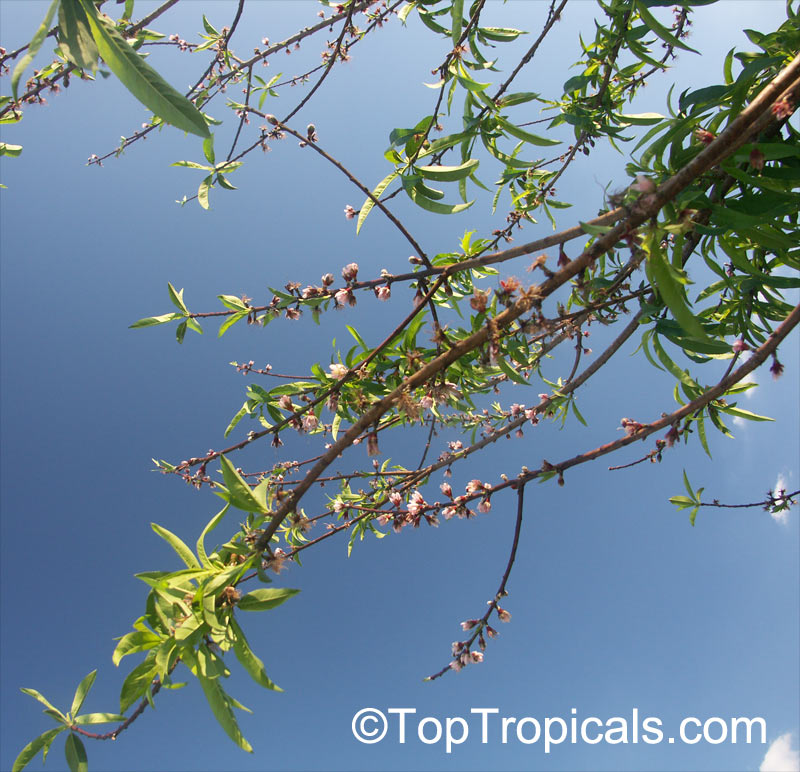
A: As a rule of thumb, fertilizer can be applied during period of active growth, when a plant needs additional nutrients. With indoor plants, you can fertilize pretty much year round as long as the plant continues growing and not dormant. For in-ground tropical plants, start fertilizing when new growth appears. In subtropical areas, with cooler winter months, most tropical plants slow down their metabolism when temperature drops below 65F. Many of them become dormant, and may even lose leaves (especially deciduous plants like Annona, or Peaches/Plums). In spring, tropical plants wake up as soon as outside temperature stays above 65F for at least one week (including night time). Once you see new growth, this is a signal for you to start fertilizing.

As far as trimming dead branches - wait until you see new leaves completely opened up. This way you won't cut too much, as some parts of the plant may take longer to re-leaf than others.

Date: 10 Mar 2016

Do-It-Yourself Support Structure for Dragon Fruit

This interesting do-it yourself project was sent to us by our customer from South Florida. Many tropical gardeners want to grow fascinating Dragon Fruit, and their most common question is - what kind of support I should use for this amazing fruiting cactus? We hope you find this information very useful. Happy Gardening!

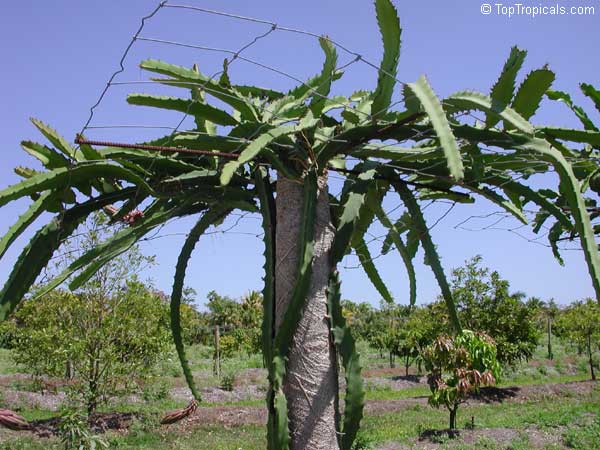
Dragon fruit is a terrestrial/epiphytic fruit baring cactus, which may grow fleshy stems up to 30 ft high, given sturdy support. However, downward hanging or horizontal branches stimulate production of flowers at the tips of the branches. Commercial groves in different parts of the world use different method to achieve this. The traditional Vietnamese way is to train the plant into a “fountain”, which consists of a vertical central trunk about 8ft tall and a horizontal structure, such as a wagon wheel on top of it to support the horizontal branches (see picture on the right).

This picture served as my inspiration to build my own structure. I used five 4”x4” 10ft wood beams as the trunk, shaped as a cross. I attached the beams to each other with 10” long screws.

I dug a 2 ft deep 12”x12” hole in the ground and positioned the trunk inside, such that about 8ft are above ground. I covered it with several layers of burlap top to bottom.

The horizontal structure on top is made of four 4ft long 2”x2” wood beams and two 12”x12” wood plates to hold them together. I attached this structure to the top of the trunk.

I used old watering pipe to form two rings around the trunk to support the branches. Here is the result!... See step-by-step full size pictures and the rest of the article...

Date: 6 May 2020

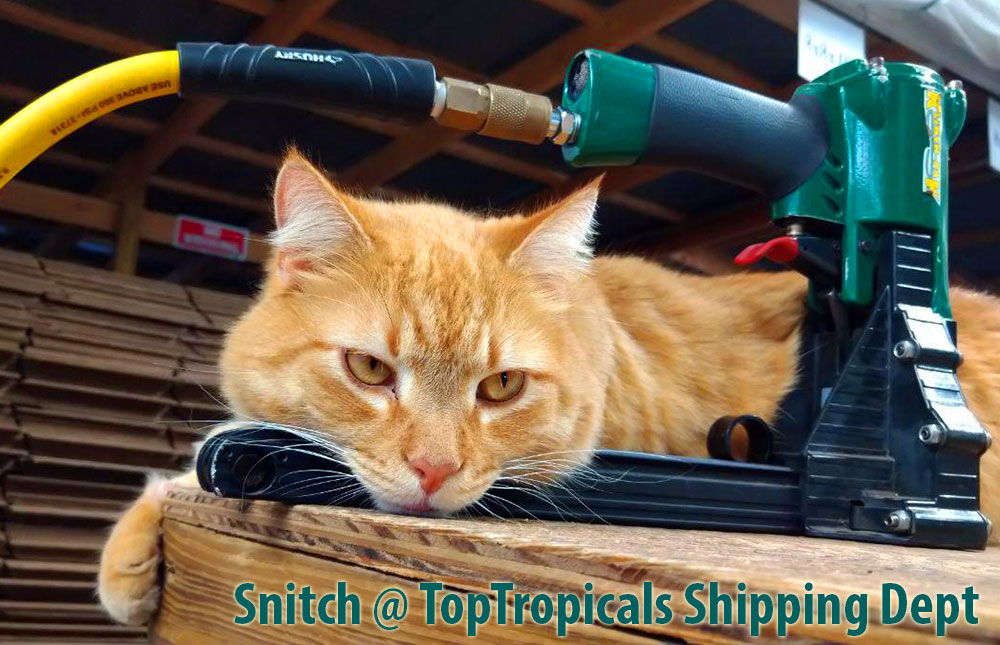
PeopleCats of TopTropicals. Cat of the day: Snitch - here, there, and everywhere

Everyone who visited TopTropicals Garden Center, most likely met Snitch. He greets customers at the front office door, and often helps them with checking out in the office. Snitch is an expert on fragrant plants and herbs. He is a great office assistant who is always there when you need him! A Purrrfect multi-tasker, Snitch even find time to give a hand in Shipping department, so don't be surprised if you find his whisker in the box! :)

TopTropicals PeopleCat Club

Thank you everybody for supporting us in helping PeopleCat Community!
Make your kind donation today and receive a surprise gift from us. Every little bit helps! Thank you and God bless you and your pets!

Date: 8 Feb 2026

How to grow Chinese Hat Flower

Holmskioldia sanguinea - Chinese Hat Flower

🎩 How to grow Chinese Hat Flower - when winter colors most needed


The Holmskioldia sanguinea, better known as the Chinese Hat Flower, gets its name honestly. Each bloom looks like a tiny hat or parasol - a little tube backed by a flat, round disc. Once you notice it, you cannot unsee it!

Chinese hat Plant Facts

Botanical name: Holmskioldia sanguinea
Also known as: Chinese hat, Cup and Saucer, Parasol Flower, Mandarins hat
USDA Zone: 9 - 11
Highligths Large shrub 5-10 ft tallVine or creeper plantSemi-shadeFull sunKeep soil moistRed, crimson, vinous flowersPlant attracts butterflies, hummingbirdsSubtropical plant. Mature plant cold hardy at least to 30s F for a short timeSeaside, salt tolerant plant
Get personalized tips for your region


What really makes this plant special is when it blooms. While most gardens slow down, Chinese Hat Flower kicks into gear from winter through early spring. The branches fill with flowers first, and the leaves follow later. It is one of those plants that quietly steals the show when everything else is taking a break.

More than one color


Most people know the classic red form, but there are several color varieties worth mentioning:
🔴 Red - the most common and bold
🟡 Yellow - Holmskioldia citrina, bright and cheerful, harder to find
🟠 Bronze / orange-bronze - warm tones that glow in winter light
Having different colors makes it easy to mix them or use just one as a winter focal point.

How it grows and where it works best


Chinese Hat Flower is a fast-growing, scrambling shrub. It is not stiff or formal. Think loose, graceful branches that like support. It does great when trained on:
· Trellises
· Fences
· Arbors
· Large containers with a support
· You can also let it grow as a free-form shrub and lightly prune to keep it tidy.

Care, the practical version


· Light: Full sun to light shade
· Water: Regular watering, especially while establishing
· Soil: Well-drained, not picky
· Pruning: After flowering to shape and encourage new growth
Once established, it is easygoing and forgiving.

Bonus points


· Blooms when the garden needs color most
· Attracts butterflies and hummingbirds
· Works as a flowering screen or accent plant
· Looks tropical without being high-maintenance

If you like plants that earn their space and do something interesting in winter, Chinese Hat Flower is one to keep in your garden.

🛒 Explore varieties of winter-blooming Chinese Hats

📚 Learn more:


· Holmskioldia - Chinese Hat - in Plant Encyclopedia
· This is the bush you should let flower for you: Chinese Hat is in bloom
· Why is it called Chinese Hat Flower
· Colorful varieties of Holmskioldia sanguinea - Chinese Hat Flower
· 13 festive shrubs with bright flowers that bring color to your Winter Garden when everything else is dormant
· Ten shrubs you need to have for winter colors

#Butterfly_Plants #How_to #Hedges_with_benefits

🟢 Join 👉 TopTropicals