Date: 9 May 2017
Secrets of flowering of Jasmine Sambac
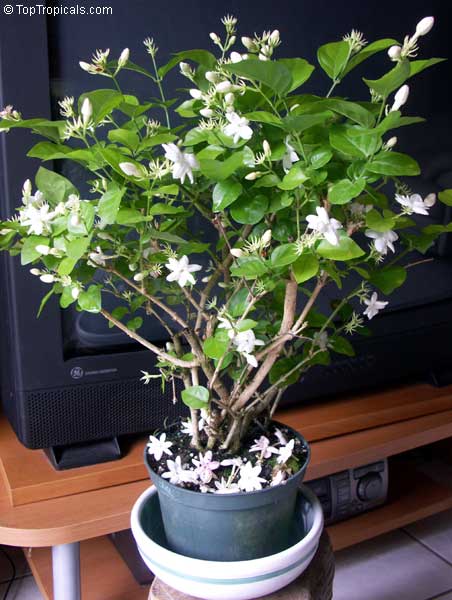
Q: Q: My Jasmine sambac Maid of Orleans is growing very fast and produced lots of branches and dark green leaves, when will I see flowers? I only saw 2 or 3 flowers since since Spring. I is planted by East wall of the house. Should I use some special fertilizer perhaps?
A: Jasmine sambac is a tropical bush or vine that enjoys hot summers. Since it
tolerates wide range of light conditions, it can be grown both in shade or sun; this is why it is highly recommended for indoor
culture where light level is limited. Remember though that profuse blooming directly depends on the light level. Your Eastern
exposure location may not be providing enough light for the flowering. Dark green leaves are also a sign of a filtered light
sitution. Extra fertilizing may not help to induce flowering if the light is low, although it is always beneficial for a plant
(it may just start producing even more leaves and branches). The ideal conditions for Sambac's flowering are - full sun all
day long, high temperatures (upper 80's-90's, even over 100F is fine), and very good drainage. Some gardeners call Jasmine
sambac "almost a succulent", referring to its low watering needs. To be exact, this plant requires regular watering, but will
produce lots of flowers only providing perfect drainage. You may never see flowers if the plant has wet feet or water-logging
occurs. If your summers are rainy (like in Florida), make sure your jasmine is planted with at least 4-5"elevation and not in a
low/wet spot.
See Top Tropicals Video about jasmine Sambac:
Date: 24 Oct 2016
Overwintering Adeniums outside of tropics
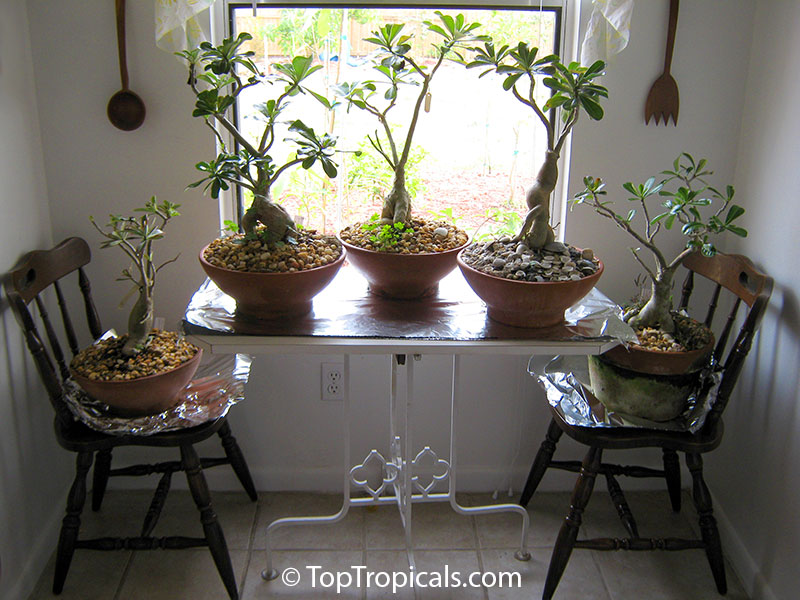
Q: We bought several adenium plants from you. We are moving to the Denver area of Colorado. How can we make sure the plants survive? Should we use a green house?
A: Adeniums are perfect container plants, and house plants. They can be easily grown outside of tropical climate. During winter, Adeniums drop leaves and go into dormancy which makes it easy to keep these plants in a dormant stage in a warm location of your house, or possibly even in well-lit spot of garage (with a window), with temperatures above 50-60F.
Here in South Florida, during time of cold, when chances of freeze are high, we move our own Adenium collection into lanai, with plastic sheet protection around lanai.
In colder climates, Adeniums can be kept indoors as house plants during winter. There are some requirements/tips for you:
- Temperature. Move Adeniums indoors when temperature starts dropping below 45F.
- SUNSHINE. Use SUNSHINE boosters to improve cold resistance of Adeniums, and essure healthy plant throughout winter. SUNSHINE-BC
Date: 30 Mar 2016
Spring time fun: fertilizing and pruning
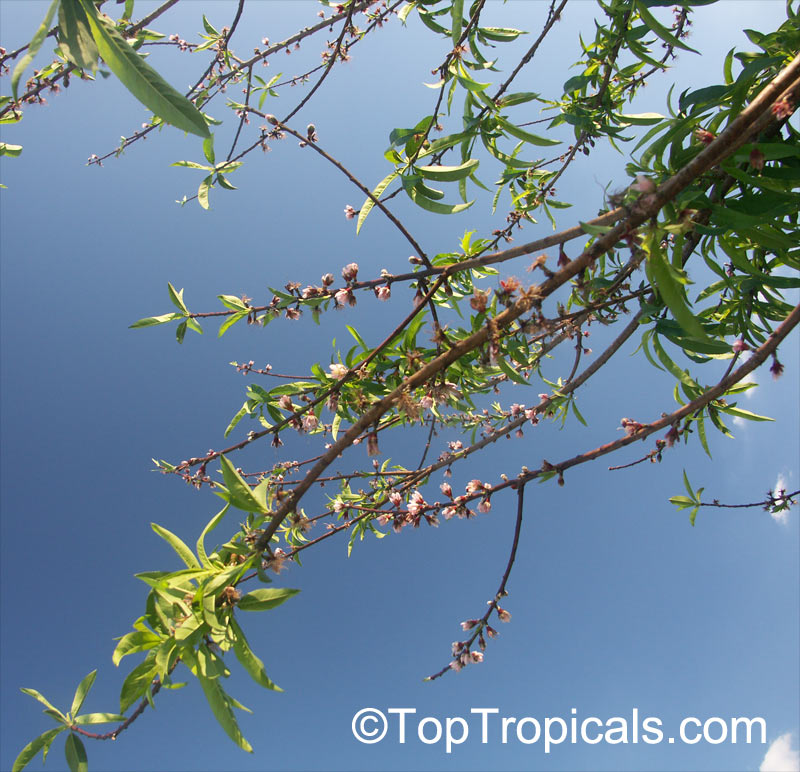
Q: When is a proper time to start fertilizing my garden in Spring? Also, when can I cut back cold damaged branches? Should I wait until end of April?
A: As a rule of thumb, fertilizer can be applied during period of active growth, when a plant needs additional nutrients. With indoor plants, you can fertilize pretty much year round as long as the plant continues growing and not dormant. For in-ground tropical plants, start fertilizing when new growth appears. In subtropical areas, with cooler winter months, most tropical plants slow down their metabolism when temperature drops below 65F. Many of them become dormant, and may even lose leaves (especially deciduous plants like Annona, or Peaches/Plums
Date: 10 Mar 2016
Do-It-Yourself Support Structure for Dragon Fruit
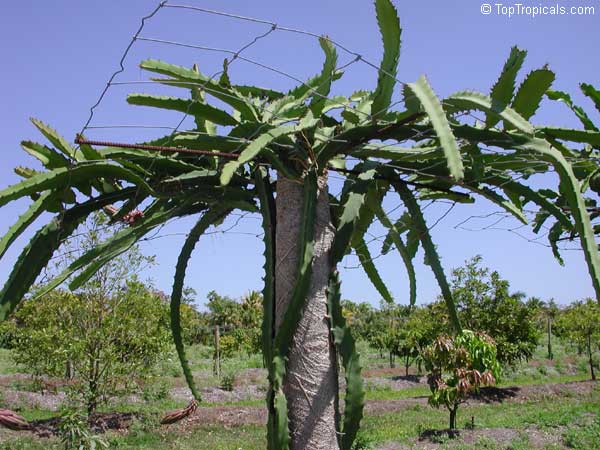
This interesting do-it yourself project was sent to us by our customer from South Florida. Many tropical gardeners want to grow fascinating Dragon Fruit, and their most common question is - what kind of support I should use for this amazing fruiting cactus? We hope you find this information very useful. Happy Gardening!
Dragon fruit is a terrestrial/epiphytic fruit baring cactus, which may grow fleshy stems up to 30 ft high, given sturdy support. However, downward hanging or horizontal branches stimulate production of flowers at the tips of the branches. Commercial groves in different parts of the world use different method to achieve this. The traditional Vietnamese way is to train the plant into a “fountainâ€, which consists of a vertical central trunk about 8ft tall and a horizontal structure, such as a wagon wheel on top of it to support the horizontal branches (see picture on the right).
This picture served as my inspiration to build my own structure. I used five 4â€x4†10ft wood beams as the trunk, shaped as a cross. I attached the beams to each other with 10†long screws.
I dug a 2 ft deep 12â€x12†hole in the ground and positioned the trunk inside, such that about 8ft are above ground. I covered it with several layers of burlap top to bottom.
The horizontal structure on top is made of four 4ft long 2â€x2†wood beams and two 12â€x12†wood plates to hold them together. I attached this structure to the top of the trunk.
I used old watering pipe to form two rings around the trunk to support the branches. Here is the result!... See step-by-step full size pictures and the rest of the article...
Date: 22 Jun 2024
Need more ideas for compact and showy flowering trees? Try Rainbow Cassias
Rainbow cassia - Cassia Marginata.
🌈 Need more ideas for compact and showy flowering trees? Try Rainbow Cassias.
- ♦️ Some hybrid cassias have spectacular color combinations and are called Rainbow Cassias.
- ♦️ We mentioned earlier some sunny, yellow-flowering cassias: Senna surattensis (Cassia glauca) - Scrambled Egg Bush, and Cassia siamea - Kassod Tree.
- ♦️ Other cassias can be pink or with multi-color flower combination, so-called Rainbow cassias (which are hybrids between yellow and pink cassias): Cassia grandis - Red Cassia
- ♦️ Cassia trees are compact, fast growing, tolerant to drought and poor soils, free-flowering and relatively cold hardy. Always a great choice!
Cassia javanica - Apple Blossom Tree
Cassia marginata - Rainbow Shower Tree
Cassia roxburghii - Ceylon Senna
Cassia x nodosa - Pink Shower, Appleblossom.
❓ What cassias do you have in your garden? Share photos in comments👇
🎥 Rainbow cassia - Cassia Marginata.
🛒 Shop showy Cassia trees
#Butterfly_Plants #Trees
🏵 TopTropicals