New article by
Jane Jordan
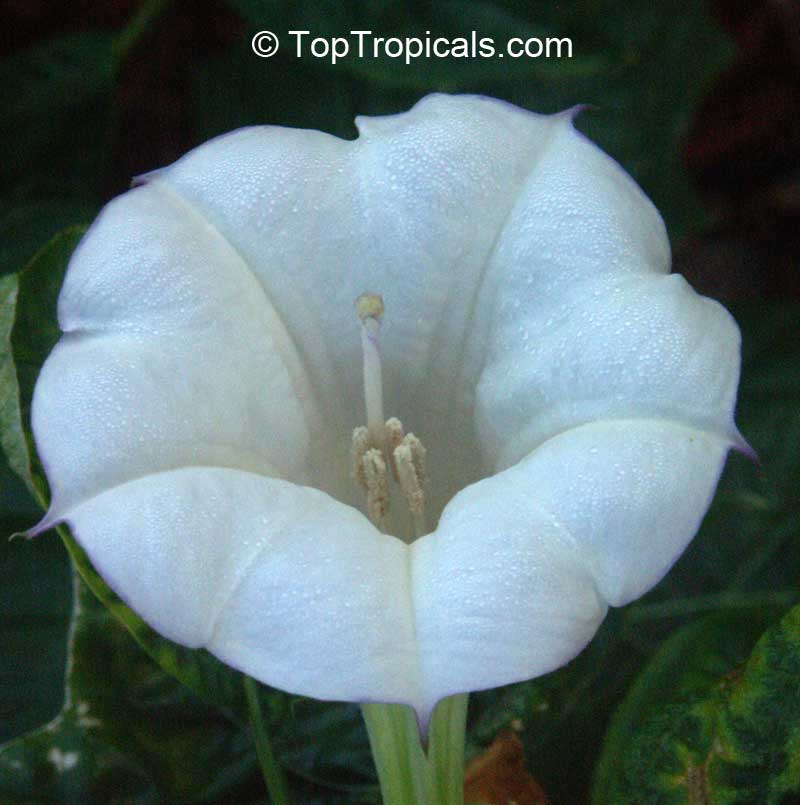
"...Commonly known as the Devils trumpet, Datura has long
been associated with witchcraft and voodoo rituals.
Ideally suited for moon or night gardens, the blooms are
fragrant and particularly so at night..." Continue reading...
5 important
tips for successful growing Datura and
Brugmansia;
1. Full sun
2. Use fertile soil that must be vewry well-drained. Plant
in elevation
3. Ample water encourages fast growth, but never allow wet
feet!
4. Fertilize heavily during hot season
5. Propagate Brugmansia with semi-woody cuttings, Datura -
with seeds that have a long shelf live
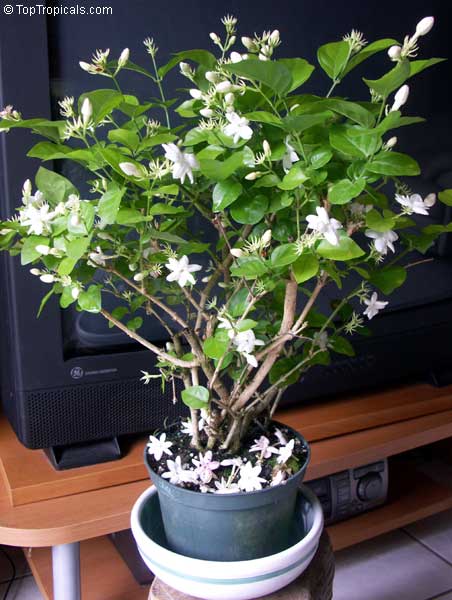
Q: Q: My Jasmine sambac Maid of Orleans is
growing very fast and produced lots of branches and dark green leaves, when will I
see flowers? I only saw 2 or 3 flowers since since Spring. I is planted by East wall of the house. Should I use some special fertilizer perhaps?
A:Jasmine sambac is a tropical bush or vine that enjoys hot summers. Since it
tolerates wide range of light conditions, it can be grown both in shade or sun; this is why it is highly recommended for indoor
culture where light level is limited. Remember though that profuse blooming directly depends on the light level. Your Eastern
exposure location may not be providing enough light for the flowering. Dark green leaves are also a sign of a filtered light
sitution. Extra fertilizing may not help to induce flowering if the light is low, although it is always beneficial for a plant
(it may just start producing even more leaves and branches). The ideal conditions for Sambac's flowering are - full sun all
day long, high temperatures (upper 80's-90's, even over 100F is fine), and very good drainage. Some gardeners call Jasmine
sambac "almost a succulent", referring to its low watering needs. To be exact, this plant requires regular watering, but will
produce lots of flowers only providing perfect drainage. You may never see flowers if the plant has wet feet or water-logging
occurs. If your summers are rainy (like in Florida), make sure your jasmine is planted with at least 4-5"elevation and not in a
low/wet spot.
See Top Tropicals Video about jasmine Sambac:
- varieties, history and use.
Date: 18 Jan 2017
10 plants that can make you happy.
3D garden ideas.
3D garden ideas. Q: Can you make my yard bigger and prevent it from freezing?
A:Yes, we can make your backyard bigger by adding a 3rd dimension - trees as a upper level, shrubs as a second level, vines in between, low growing perennials below them. Add ground covers and potted plants as separate specimens in between in-ground planted trees and shrubs. One more separate dimension is orchids and other epiphytes that happily grow on the trees. This multi-level structure will allow you not only collect so many plants, but also maintain them in a natural environment, similar to how they grow in a wild.
As far as preventing from freezing - it depends. You can use greenhouse, cover plants, create microclimate under large canopies, etc. Some tropical plants are tolerant to light frost, once established. If it gets below freezing in your area for more than a few hours, and especially if you have numerous nights with frost throughout winter, we recommend to keep plants in pots (BTW, this way you save space and can collect even more!). Pots can be moved to protected area during cold nights. The more established the tree, the more chances to survive colder temperatures. You may also use propane heaters during cold nights.
We also use plant booster SUNSHINE boosters to increase plants cold tolerance.
Cold protection is a lengthy subject. Here is some more information on cold protection.
Also, we recommend to check out our magazine Tropical Treasures (about pushing the limits of tropical gardening) for a detailed article on cold protection.
These are specific articles on Zone-Pushing in different issue #s regarding dealing with cold. See downloadable issues:
(#1) Growing Tropicals in Nontropical Climate, Three Freezing Nights in Southwest Florida
(#2) Temperature drops - an alert or a rehearsal?
(#5) Dealing with cold snaps, Cold hardy beauties
(#7) When winter is around the corner, Growing exotic Cordyline in colder climate
(#8) When the weather outside is frightful
(#9) Winter champions
(#11) Ready-for-winter checklist for in-ground plants
(#13) Winter checklist
(#18) Dealing with cold damaged plants
You may also order hard copies.
If temperatures drop below freezing in your area, remember to add Heat Pack to your order!
10 plants that will make you happy.
Everyone wants to be happy. Did you know that growing plants is not only fun but can also make you happy? In our new series we will introduce to you 10 plants for your tropical collection that will make you happy.
Visit our Facebook, YouTube Channel and stay happy!
Stay updated with TopTropicals Videos by subscribing to our channel at YouTube.com/TopTropicals and get our latest video news of what's fruiting and blooming!
Date: 24 Oct 2016
Overwintering Adeniums outside of tropics
Q:
We bought several adenium plants from you. We are moving to the Denver area of Colorado. How can we make sure the plants survive? Should we use a green house?
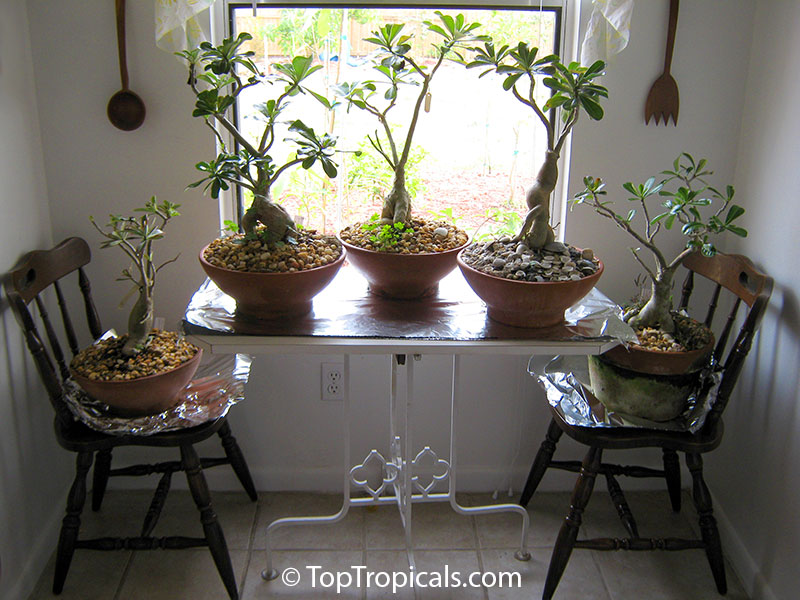
A:Adeniums are perfect container plants, and house plants. They can be easily grown outside of tropical climate. During winter, Adeniums drop leaves and go into dormancy which makes it easy to keep these plants in a dormant stage in a warm location of your house, or possibly even in well-lit spot of garage (with a window), with temperatures above 50-60F.
Here in South Florida, during time of cold, when chances of freeze are high, we move our own Adenium collection into lanai, with plastic sheet protection around lanai.
In colder climates, Adeniums can be kept indoors as house plants during winter. There are some requirements/tips for you:
Temperature. Move Adeniums indoors when temperature starts dropping below 45F.
SUNSHINE. Use SUNSHINE boosters to improve cold resistance of Adeniums, and essure healthy plant throughout winter. SUNSHINE-BC formula is specifically designed for plants with caudex, and bonsai.
Water. Reduce watering to minimum, especially when plants drop leaves - this means they went into dormancy. Once a week light watering is enough. Water very carefully during cooler months. When it is hot (85-100F), excessive water usually won't harm adeniums: it will be partially used by a plant, and partially will evaporate. Especially be careful with water when temperatures drop below 65F - then tropical plants simply stop growing process and go dormant. Once adeniums start losing leaves, this is a sign to reduce watering to once a week to once a month, and in very small quantity (couple tablespoons per pot).
Light. Bright light is not necessary, but do not keep them in dark either, even if all leaves dropped. Good light is necessary to maintain healthy stems and caudex. Keep in mind, the less light, the less watering too. Ideal spot is a windowsill, however if your space is limited and all windows occupied by other "leafy" plants, location close to window will be enough as long as watering is reduced, to avoid rot. We keep our big collection specimens on a roofed porch during winter, where level of light is very low. Last winter we haven't lost a single plant due to low light. They take shade pretty well considering minimum or no water. However bright light is always better - it creates healthier environment for a plant. We all know about space limitations for our large collections, especially in winter. So if you can afford a bright spot for adenium during winter - the plant will be lucky!
Soil. Use only well drained mix with much higher content of perlite than you would use for most tropical plants. For adeniums, we use mix with 30-40% of perlite in it, while regular mix has 10-15%. Adeniums like alkaline soil, unlike most of tropical plants (hard to say what else likes alkaline... Ficus for sure!). This means, regular mix with high content of peat moss may cause root rot. To increase alkalinity, you may add dolomite. Here in Florida where we have natural supply of shell rock handy, it is easy to add some shell to a potting mix (shell sand, rather than quartz sand). We always add a few large shells on top of a pots with a big specimen. Besides increasing soil pH (making it more alkaline), shells look very decorative.
Fertilizer. No fertilizer until Spring when plants start showing new growth and new leaves.
Move your Adeniums outside in Spring, when chances of freeze are zero. More sunlight and air circulation is beneficial for breaking the dormancy and providing plants with a quick growth start.
Date: 28 Sep 2016
Helping plants to survive winter:
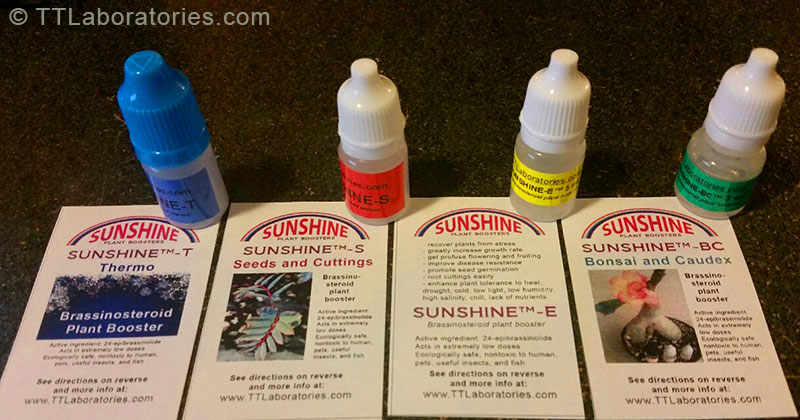
SUNSHINE BOOSTERS - FROM SUNSHINE STATE
A magic plant hormone so wanted by gardeners, is finally here! When people purchase plants and trees either on-line, or from their local nursery, expectation and anticipation for their new find is high. Many times, however, disappointment is encountered due to a variety of reasons. These reasons include changes in light, temperature, water, soil conditions and transportation; just to name a few. So how can the stress on newly transported and transplanted plants be mitigated? Easy! There are plant stimulators able to reduce the shock encountered.
One such plant stimulator, produced at TT Laboratories is SUNSHINE, a revolutionary, broad spectrum, plant stress reliever. Extracted initially from plant pollen, SUNSHINE can bring back and keep the vigor to stressed plants in both the home and garden. Sunshine is indeed a plant stimulator on the cutting edge of plant care technology. Reasonably priced, and easy to use, SUNSHINE will be your plants' best friend, next to yourself, of course.
SUNSHINE will help your plants:
- recover from stress
- dramatically increase growth rate
- get profuse flowering and fruiting
- improve disease resistance, cold hardiness, and heat resistance
- promote seed germination and root cuttings easily
Great for indoor plants and improving cold tolerance!
Line of products: SUNSHINE-E - general plant booster, growth stimulator and immune booster
SUNSHINE-BC - Bonsai and Caudex developer
SUNSHINE-S - seeds and cuttings pre-treatment
SUNSHINE-T - Thermo-protection for overwintering tropical plants
SUNSHINE-Micro - ultimate micro-element mix from TT Laboratories
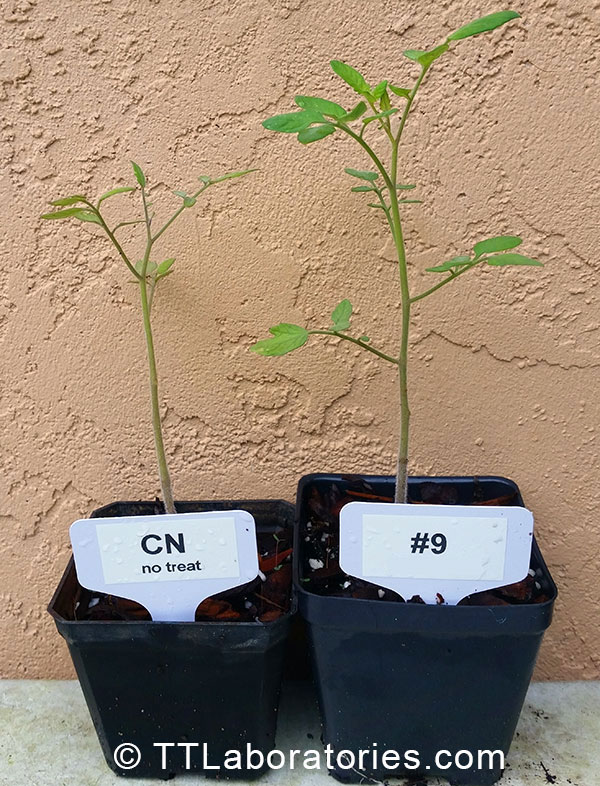
On the photo: Tomato seedlings, with and without Sunshine-E treatment; 1 week after treatment, 09-01-2016. Continue reading...