Garden Blog - Top Tropicals

Date: 7 Aug 2025

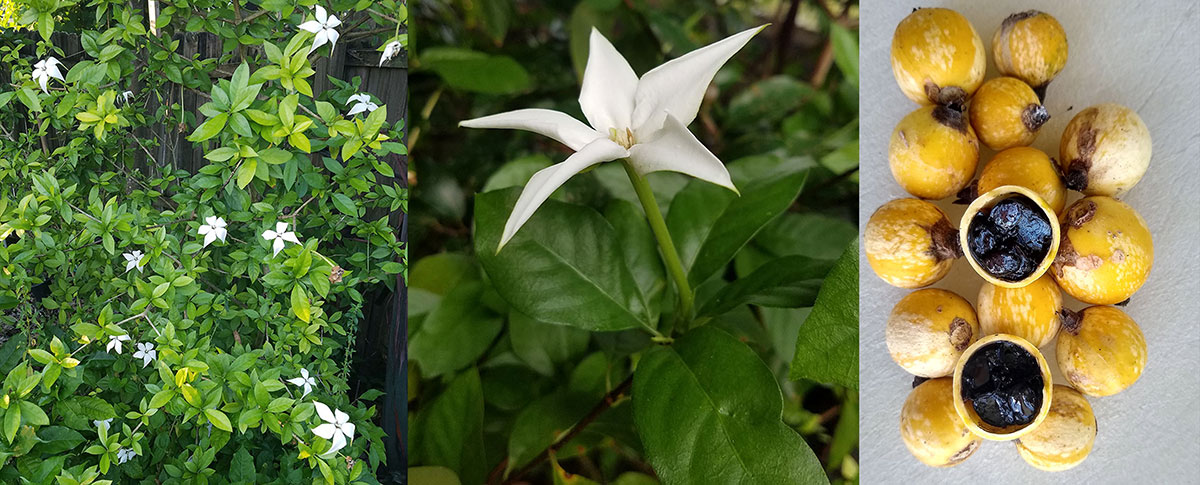
Randia  formosa  shrub  in  bloom  with  white  star-shaped  flowers,  close-up  of  single  bloom,  and  ripe  yellow  fruit  with  black  pulp  that  looks  like  blackberry  jam

Randia formosa - Blackberry Jam Fruit Tree with Flowers and Ripe Fruit

You know how some plants just surprise you?

That's Randia formosa - the Blackberry Jam Fruit Tree. At first, it just looks like a cute little gardenia-type shrub. Glossy leaves, sweet white flowers. Nice enough. But then the fruit shows up… and you crack one open and go, “Wait - this tastes like jam?!”

And not just any jam - like real, fresh blackberry jam. No sugar, no cooking. Just soft black pulp inside this golden little fruit. It's weirdly satisfying. One of those things you make everyone taste just to see their face.

What's even cooler is how easy it is. This thing starts blooming and fruiting when it's barely 2 feet tall. You can grow it in a pot on your porch, or even inside if it gets enough light. And while most of your other plants take the winter off, this one keeps going - flowers, fruit, the whole show.

If you've got a spot with filtered light and a little curiosity, it's absolutely worth a try. Honestly, it's just… fun.

This rare South American evergreen shrub checks all the boxes: fragrant, compact, easy, and edible.

✅ Grows in pots ✅ Indoors ✅ Small yards

Randia formosa – Blackberry Jam Fruit Tree – FAQ

What is Randia formosa?

Randia formosa, also known as Blackberry Jam Fruit or Jasmin de Rosa, is a compact tropical shrub that produces fragrant white flowers and small yellow fruits filled with soft, black pulp that tastes remarkably like blackberry jam. It belongs to the Rubiaceae family, the same as Gardenia and Coffea.

Why gardeners love Randia

  • Delicious jam-flavored fruit – no sugar needed.
  • Compact grower – perfect for patios and indoor spaces.
  • Fast results – blooms and fruits within 1–1.5 years.
  • Big yield in a small pot – 25–30 fruits at once!
  • Fall–Winter performer – keeps going when others stop.
  • Kid favorite – fun to grow, fun to eat.

What does the fruit taste like?

The pulp inside the fruit tastes just like fresh blackberry jam - sweet, tangy, and rich. It is edible fresh, without any processing or sweeteners, and is loved by both kids and adults.

How big does the plant get?

In the ground, Randia formosa typically reaches 4 to 5 feet tall. In containers, it usually stays smaller, around 3 to 4 feet, making it perfect for small gardens, patios, or indoor growing.

How soon will it fruit?

Very quickly! This is one of the fastest fruiting tropicals. Plants begin to flower and produce fruit within two years from seed. Еstablished plants in 3 gallon containers may begin fruiting at just 2 feet tall.

Does it need full sun?

No. It actually prefers filtered light or partial shade, especially in hot climates. Leaves tend to look healthier and greener when grown in dappled light.

Can I grow Randia formosa indoors?

Yes! Its compact size and shade tolerance make it an excellent choice for bright indoor spaces. Just be sure to provide good air circulation, high humidity if possible, and avoid cold drafts.

How cold-hardy is it?

Mature plants can tolerate temperatures down to about 26F for short period of time, but young plants are more sensitive and should be protected from frost. It is best grown outdoors in USDA zones 9b and up or kept as a container plant that can be brought indoors in winter.

What kind of soil does it need?

Randia formosa requires acidic, well-draining soil. Avoid alkaline soils, which may cause leaf chlorosis (yellowing with green veins).

How often should I water it?

Keep soil evenly moist but not soggy. It is sensitive to overwatering, especially in cooler weather. During winter, reduce watering. Underwatering may cause sudden leaf drop - but the plant usually recovers quickly once watered again.

What fertilizer does it need?

Yes. Use a slow-release fertilizer formulated for acid-loving plants. Regular applications of micronutrients (especially iron and magnesium) help prevent chlorosis. Foliar sprays can also be helpful. Apply Sunshine C-Cibus Booster or Green Magic controlled release fertilizer to keep your plant happy: Blackberry Jam Fruit is a heavy feeder!

When does it flower and fruit?

This plant can bloom and fruit for several months, often from summer through winter. It is known to bloom off-season, making it a fun and productive plant when others are dormant.

Are the flowers fragrant?

Yes, the white star-shaped tubular flowers have a light, sweet fragrance, similar to gardenias but less intense. The flowers open at night.

Is it self-pollinating?

Yes. A single plant can set fruit on its own, although insect activity can improve fruit set.

Are there any common problems?

The most common issue is chlorosis, which shows up as yellowing leaves with green veins - usually due to overwatering, poor drainage, or alkaline soil. It's fixable with acidification and micronutrients. The plant may also drop leaves suddenly if underwatered but tends to bounce back.

Is this plant related to Gardenia?

Yes. It is in the same plant family (Rubiaceae) as Gardenia and Coffee. That's why the flowers look similar and why it tolerates similar care needs.

Can it be used for bonsai or miniature tree styling?

Yes, due to its slow growth and branching habit, Randia formosa can be shaped into a miniature tree form and is quite attractive when trained.

Is it drought-tolerant?

Once established, it shows moderate drought tolerance. However, young plants need regular watering and are more vulnerable to drying out.
Read Garden Blog about Blackberry Jam Fruit

Get your Blackberry Jam Fruit

Date: 18 Aug 2023

Does Size Matter?

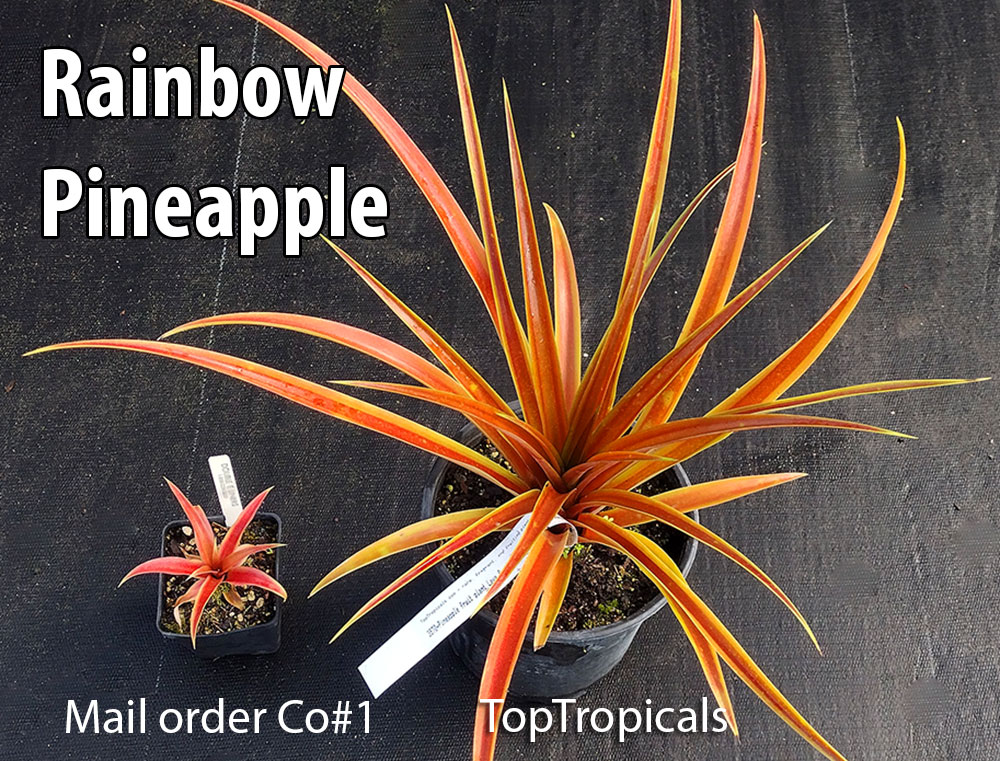
TopTropicals plants vs other mail order plants

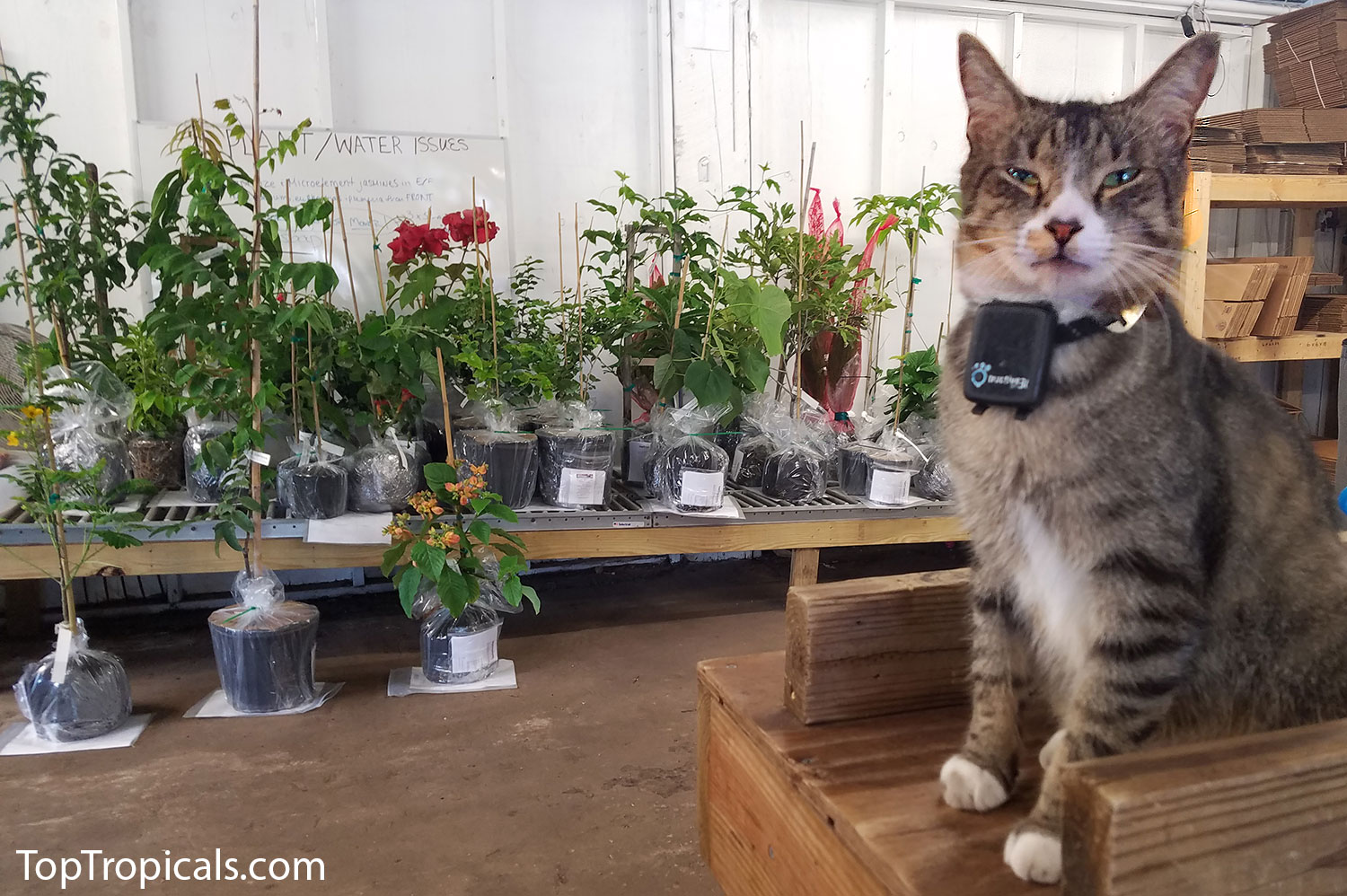
Cat  shipping  plants

Q: I purchased various plants via mail order (including a Coffee tree and some flowering vines) from companies *** and ***, but they did not survive, possibly due to their small size and the stress of shipping. Could you provide information about the size of your plants, their resilience to shipping stress and the time required for establishment?

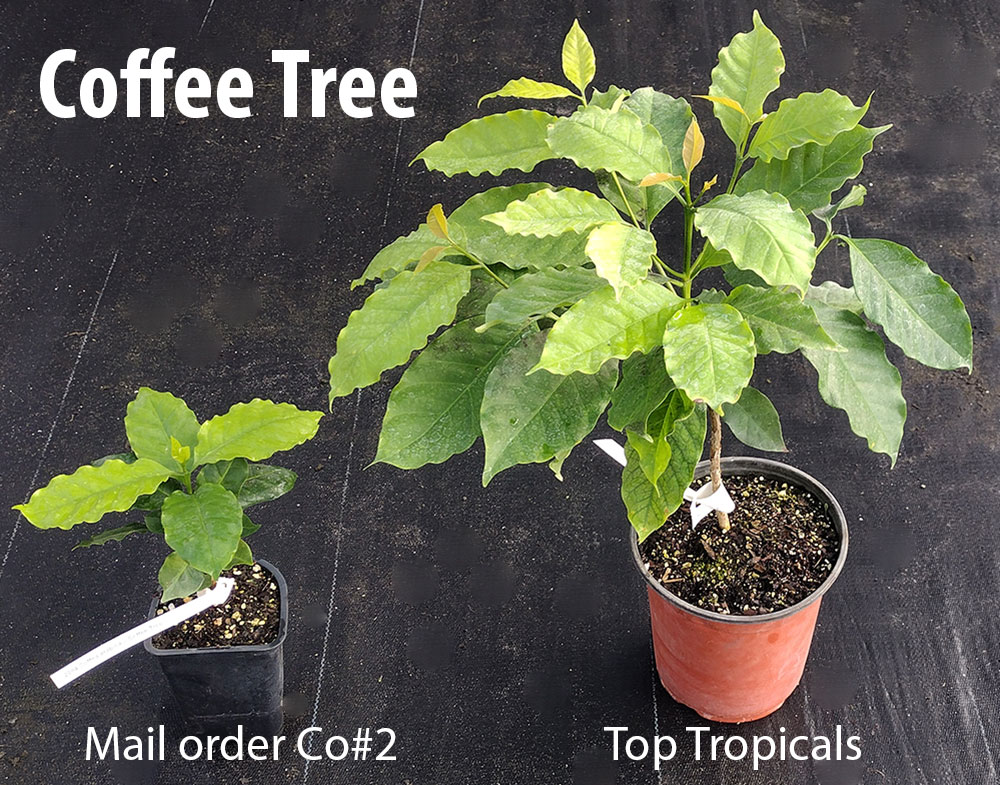
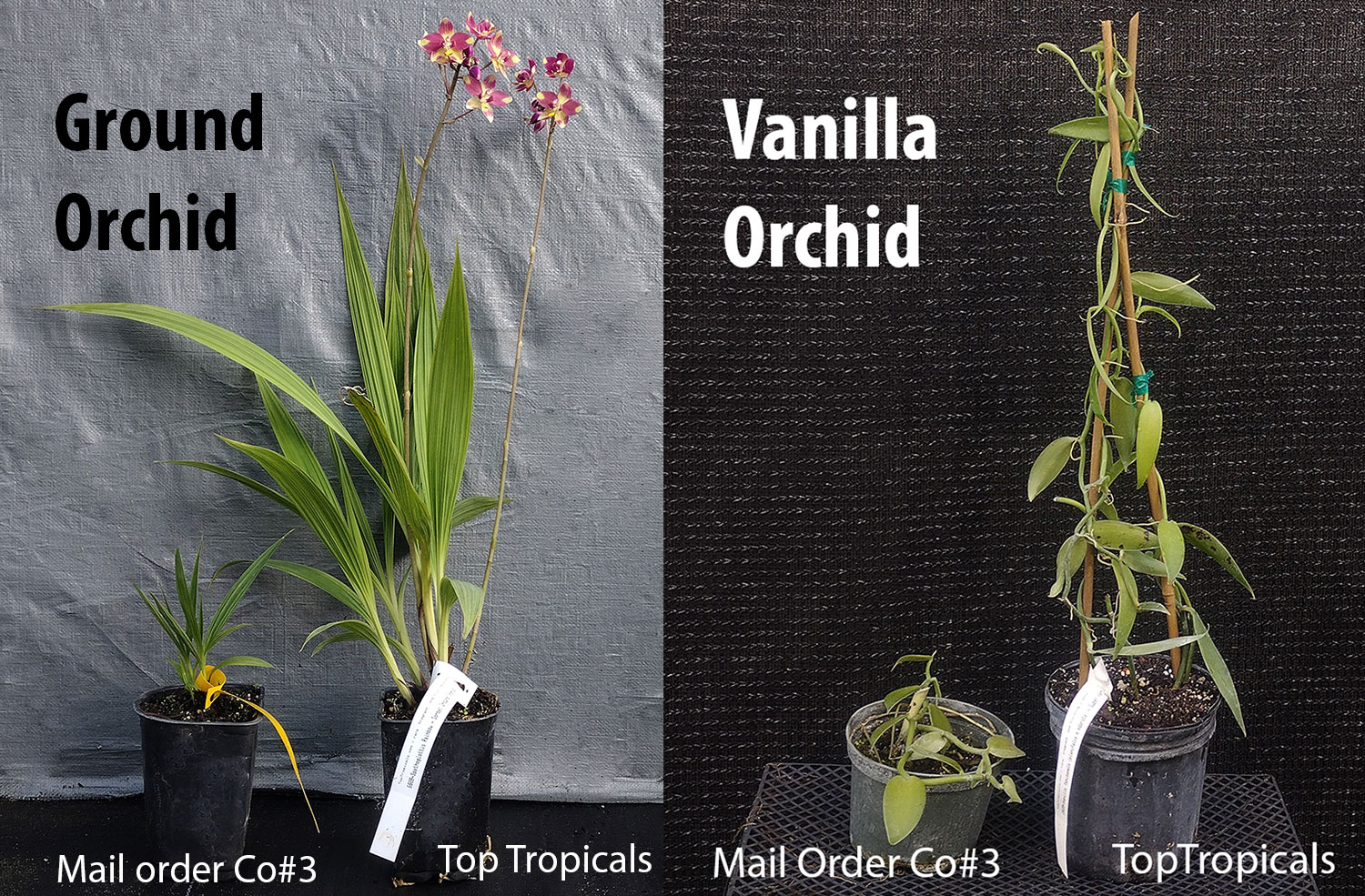
A: Plants, as living beings, may experience stress during a few days of travel in a dark box. However, the critical factor influencing their survival is the plant's size. Most of our plants are grown in pots ranging from 1 to 3 gallons, have established root systems and developed branches. Some even feature flowers and fruit, although these may drop during transit. We've included images comparing our 1 gallon size plants with those from other mail-order firms we previously obtained for our own collection.

Understanding that post-shipping plant establishment is a gradual process is crucial. Yet, most plants handle shipping well and commence new growth within days to a couple of weeks post-arrival. Here are some success pointers:

1) Opt for a container matching the root ball size, avoiding excessive sizing until growth initiates.
2) Begin in a shaded area, progressively transitioning to brighter spots.
3) Apply Sunsine Epi spray to lessen stress and enhance vitality. 4) Initiate fertilization once the plant displays fresh growth.

For more information on how to establish mail order plants, simply download our Plant Care Guide.

Side-to-side  pineapple  plant  from  Top  Tropicals

Side-to-side  coffee  tree  from  Top  Tropicals

Side-to-side  orchids  from  Top  Tropicals

Date: 17 May 2023

NEW VIDEO:
ABC7 Fort Myers News:
Rare Tropical Fruit Trees at Top Tropicals

We received lots of orders from our customers for butterfly attracting plants after our recent . We are glad you liked the story and the plants!

Today's topic is on tropical fruit. Enjoy this quick tour and learn more about different varieties of rare tropical fruit and what can be grown in your yard. We have them all! And we can ship them to your door.

Fruit and plants introduced in the video:

Persimmon
Coffee
Sapodilla
Sapote
Vanilla
Pomegranate
Yellow Dragon fruit
Litchi
Tamarind
Chocolate Tree
Raspberry
Grape

Watch the news segment by Rachel Anderson for ABC-7: Rare fruit trees at Top Tropicals.

Subscribe to our Channel:

Stay updated with TopTropicals Videos by subscribing to our channel at YouTube.com/TopTropicals and get our latest video news of what is fruiting and blooming!

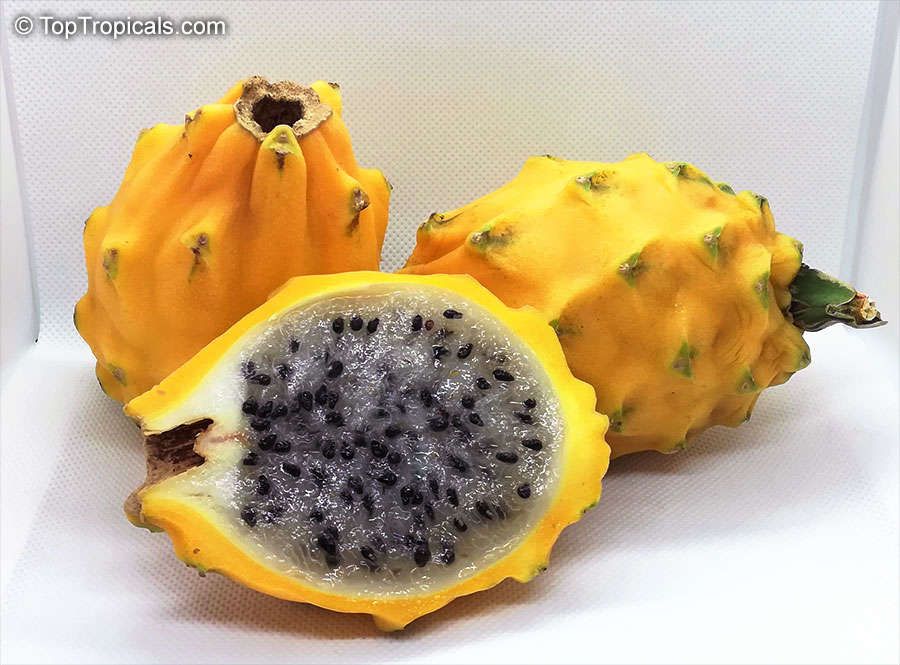
Yellow  Dragon  Fruit,  Selenicereus  megalanthus,  fruit

In the photo: Yellow Dragon Fruit, Selenicereus megalanthus, the sweetest and the most flavorful rare Yellow Pitaya. The taste is said to be superior to most cactus fruits.

Date: 7 Aug 2025

Blackberry Jam Fruit - the sweetest surprise

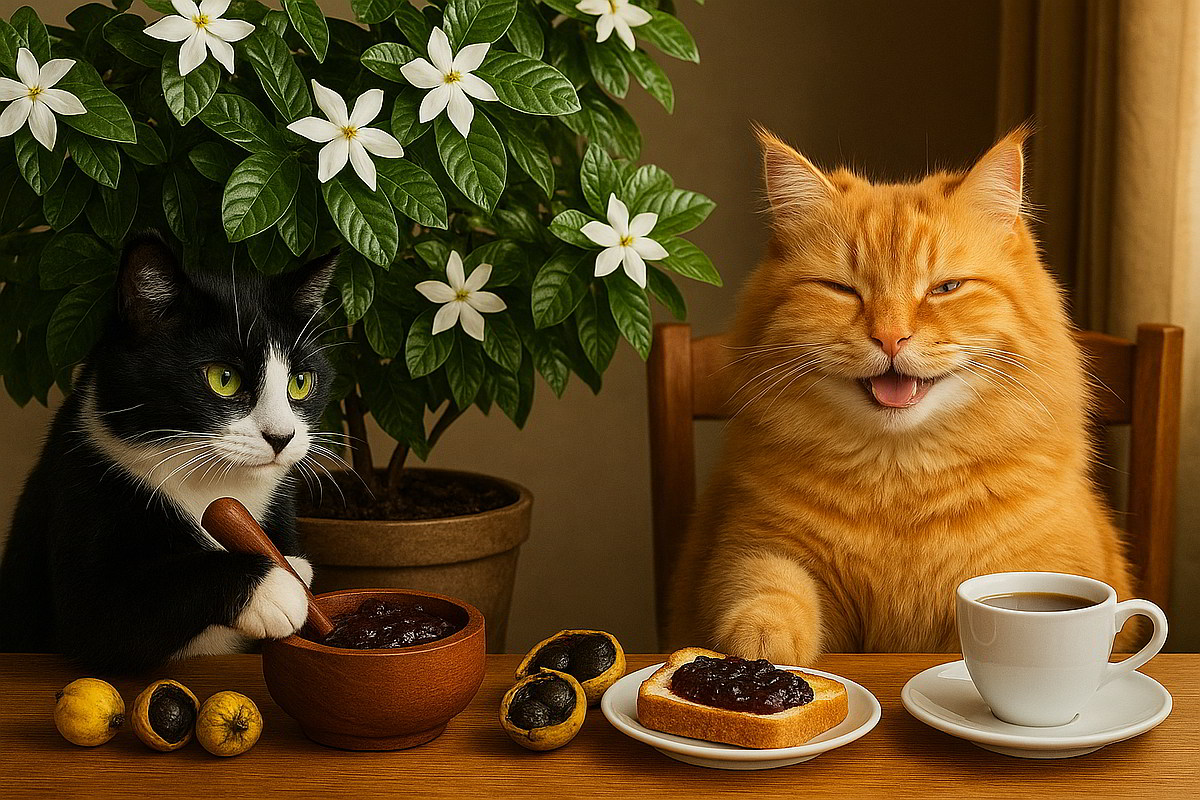
A  tuxedo  cat  making  jam  from  Blackberry  Jam  Fruit  (Randia  formosa)  while  an  orange  cat  smiles  in  a  chair,  sipping  tea  beside  a  large  flowering  Randia  plant  in  a  cozy,  sunlit  room.

Tea and Jam with the PeopleCats – A Tropical Afternoon Beneath the Randia

Meet the cats behind the jam! The tuxedo cat is none other than Google-the-cat - our beloved elder and one of the original cat-fathers of Top Tropicals PeopleCats.garden. At 18 years old, he’s still sharp, curious, and very much in charge. The orange fluffball? He represents the universal image of cat joy - and we’ve got a few real-life orange sunshine residents just like him.

Why do you include cats in a plant newsletter?

Because they’re part of the garden. Our rescued PeopleCats live among the plants, nap under the mango trees, inspect new arrivals, and occasionally steal a sunspot meant for seedlings. They’re not mascots — they’re part of our team. Sharing their presence is like showing a part of the soul of our space.🐈

Are the cat images real or AI-generated?

All our cats are real! We take lots of pictures and videos. And a few images are AI-generated illustrations inspired by our real PeopleCats.garden residents. While not literal photographs, they are creative interpretations that capture the spirit of our tropical home and its furry citizens.🐾

Are the stories about the cats true?

Mostly! The jam-making, tea-drinking, and greenhouse meetings are creative interpretations - but inspired by real personalities. We use AI scenes to bring their spirit to life. Real cats. Real plants. Imagined adventures.🐱

Watch Top Tropicals videos about PeopleCats

Shop Blackberry Jam Plants

Date: 17 Nov 2025

❄️Cold Night Survival Guide

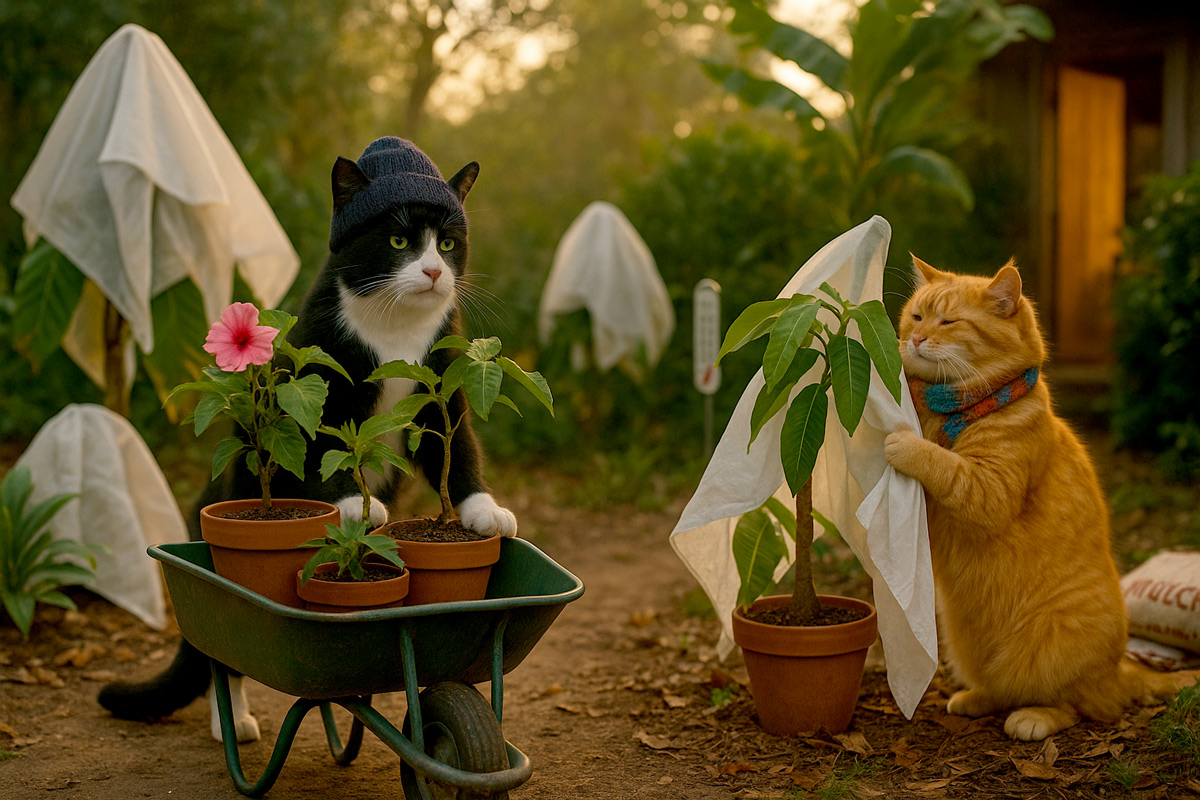
Smokey,  a  black-and-white  tuxedo  cat,  loads  a  wheelbarrow  with  potted 
 tropical  plants  while  Sunshine,  a  fluffy  orange  tabby,  pretends  to  cover  a 
 mango  tree  with  frost  cloth  as  evening  light  warms  the  tropical  garden.

Smokey and Sunshine Prepare Plants for the Cold Night.

Smokey: Come on, Sunshine, help me move these plants inside before it gets dark!
Sunshine: I am helping... see? I’m supervising the mango tree.
Smokey: You call that supervising? The frost cloth’s upside down!

When the forecast drops into the 30s, panic is not a plan. This is your simple, clear checklist to protect every tropical in your garden. Think of it as the quick emergency manual that goes hand in hand with the previous cold-weather newsletter.

"We all love our tropical flowers, mangoes, bananas, and rare fruit trees. A single cold night does not have to be a disaster. The key is knowing what to do, when to do it, and what mistakes to avoid." - Tatiana Anderson, Top Tropicals Plant Expert

🌡️ FROST AND FREEZE

A frost and a freeze are not the same. A frost is when you see ice crystals on leaves or grass, while a freeze is when the air temperature drops below 32 F. The tricky part is that you can get frost even when the air is above freezing, and you can have a freeze with no frost at all. It all depends on humidity and the dew point. If the dew point is below freezing, the ground can cool faster than the air, letting frost form even when your thermometer reads 35 or 36 F. And once the air itself drops below 32 F, even for an hour, tender tropicals can be damaged. For plants, a freeze is far more dangerous, because freezing air pulls heat out of stems, branches, and roots. Frost usually burns leaves, but a true freeze can injure wood, kill buds, and damage the entire plant.

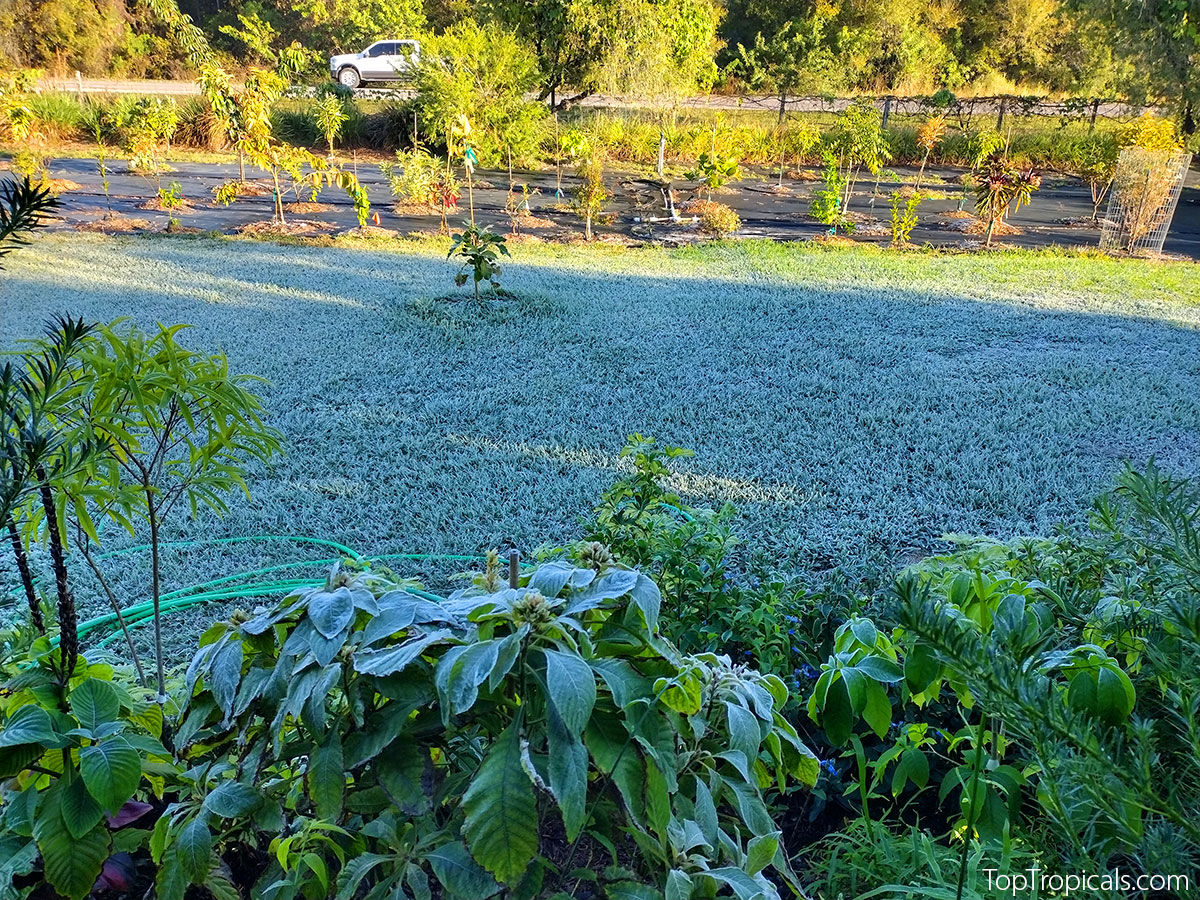
Frost  on  grass  and  leaves

Frost on the grass and leaves on Winter morning in Central Florida

WHAT TO DO AND NOT TO DO BEFORE A COLD SNAP

✔️ 5 THINGS TO DO:

  1. Water well. Hydrated plants tolerate cold better than dry, stressed ones.
  2. Add mulch. A thick layer around the base keeps roots warm.
  3. Block the wind. Move pots to a sheltered corner or patio.
  4. Cover at night, uncover in the morning. Let plants breathe and get light.
  5. Add gentle heat if needed. Non-LED Christmas lights or a small old style 15-20W light can raise temps a few degrees.

❌ 5 THINGS NOT TO DO:

  1. Do not prune or trim. Fresh cuts freeze first.
  2. Do not overwater. Wet, cold soil invites root rot.
  3. Do not let plants dry out either. Wilted plants freeze more easily.
  4. Do not use dry fertilizer. Gentle liquid feeds like Sunshine Boosters are safe to use with every watering: its intake naturally slows down as watering decreases.
  5. Do not look only at the thermometer. A long, windy night can be worse than a short freeze.

TEMPERATURE ACTION GUIDE (40 to 25 F)

  • 40 to 38 F: Move potted plants to shelter, water soil, and cover tender tropicals.
  • 37 to 33 F: Use frost cloth and anchor it down so the wind does not lift it.
  • 32 to 30 F: Add a heat source like non-LED lights.
  • 29 to 25 F: Double-cover sensitive plants, wrap trunks, and protect roots heavily.

COLD TOLERANCE BY PLANT TYPE

Before a cold night, it really helps to know your plant’s exact cold limits. Every species is different, and young plants are always more sensitive than mature ones. Take a few minutes to look up your varieties in our Tropical Plants Encyclopedia — it will tell you the safe temperature range, how much protection each plant needs, and which ones must be covered or moved before the next cold snap hits.

  • Bananas: leaf burn below 37 F
  • Mango, Annona: hurt around 32 F
  • Cold hardy avocados: Mature tree can take about 25 F. Young trees must be protected
  • Olives, Citrus, Guava, Jaboticaba: usually OK outside with mulch

QUICK-ACTION TABLE

Before the cold arrives, make yourself a quick list of every plant and what action each one needs. It saves time when temperatures start dropping and keeps you from scrambling in the dark. Check that you have enough frost cloth, blankets, and supplies on hand so you can cover everything without rushing. Planning ahead makes cold nights much less stressful.

  • Bring Indoors: Cacao, Bilimbi, Coffee. They need warm, bright light.
  • Cover Outdoors: Mango, Jackfruit, Banana, Annona. Use frost cloth, not plastic on leaves.
  • Leave Outside: Eugenias, Peaches, Persimmons, Longan, Lychee, Papaya, Citrus, Loquat, Hardy Avocado. Add mulch and monitor overnight lows.

🛒 Check out cold tolerant tropicals

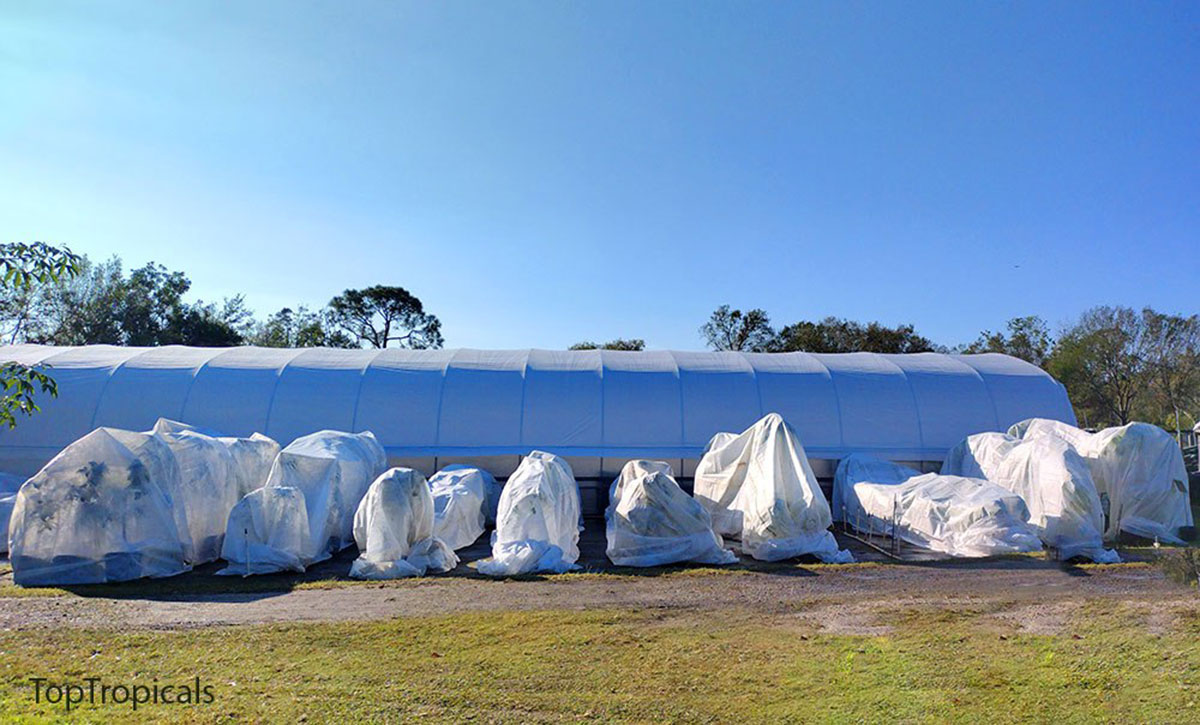
Covering  large  mango  and  avocado  trees  in  pots

Covering large mango and avocado trees in pots at TopTropicals during cold nights

GADGETS AND TOOLS THAT HELP

  • Indoor helpers: LED lights, small heaters, bottom-heat mats, timers.
  • Outdoor helpers: frost cloth rolls, mini greenhouses, non-LED Christmas lights or small incandescent lights, smart thermometers.

Always keep electrical safety in mind, especially if you are using extension cords outdoors. Use only weather-rated cords, keep all connections off the ground, and protect plugs from moisture. Make sure heaters and lights are stable, secured, and never touching fabric covers. A few minutes of safety check can prevent a dangerous situation on a cold, wet night.

And if you want to keep plants strong through winter, add Sunshine Boosters to your watering routine. It is gentle, safe in cold weather, and gives plants an extra edge.

AFTER THE COLD PASSES

In the morning, uncover plants. Leaving covers on during the day can trap heat and cook the tender new growth, especially under the sun. The only exception is true frost cloth designed for all-day use, which allows air, light, and moisture to pass through. Regular blankets, sheets, and plastic must come off as soon as the sun rises.

Do not cut anything yet. A plant can look completely dead after a freeze, but many branches are still alive under the bark. Cutting too soon removes wood that would recover on its own. Wait until new growth begins in spring. That is when you can see exactly which branches are truly dead.

Use the scratch test. Gently scratch the bark with your nail or a small knife. If the layer underneath is green, the branch is alive. If it is brown and dry, it is likely dead. But even then, wait until warm weather to be sure, because sometimes only the tips die back while the lower part of the branch survives.

Once the weather stabilizes, resume light feeding. Plants coming out of cold stress need gentle support, not heavy fertilizer. A mild liquid feed like Sunshine Boosters helps them rebuild roots and push new growth without burning tender tissue.

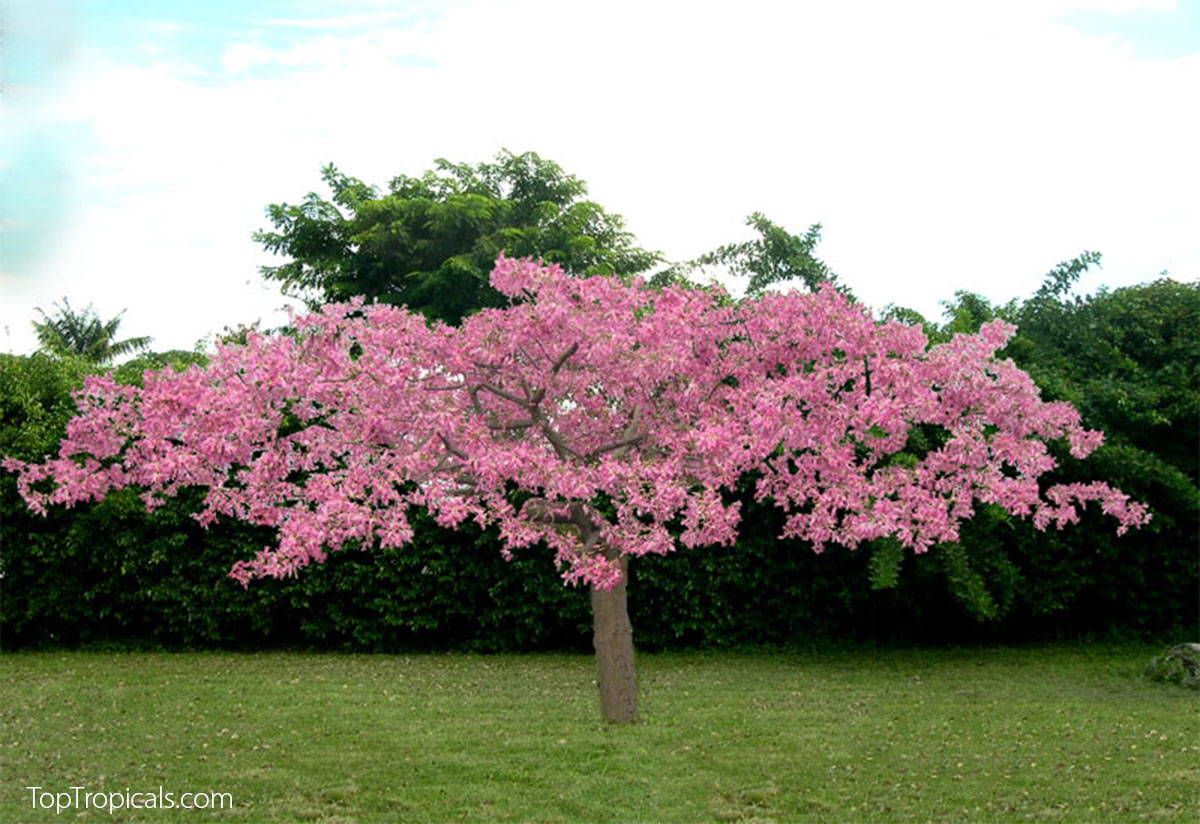
Dwarf  Ceiba  Pink  Princess  in  full  bloom

Dwarf Ceiba Pink Princess (Grafted) - a unique compact cultivar covered with pink flowers in Winter. Watch short video: How this breath-taking flowering tree stays so compact.

WHAT NOT TO DO

  • Do not prune right after a freeze.
  • Do not overwater cold soil.
  • Do not fertilize heavily until spring.
  • Do not leave covers on in full sun.

CLOSING THOUGHT

Your tropical garden can survive any cold night if you prepare right. Cold snaps always feel stressful in the moment, but once you know your plants, have the right supplies, and follow a simple plan, it becomes routine. A few minutes of preparation before dark can save months of growth and keep your collection healthy all winter.

Frost cloth is the true workhorse of cold protection: it keeps heat in, keeps frost off, and will not suffocate plants the way plastic or blankets can. Having a few rolls ready means you never have to scramble at the last minute. Sunshine Boosters give your plants gentle support during the colder months so they stay strong enough to bounce back quickly when warm weather returns.

A little planning now will pay off in spring, when your mango, banana, citrus, and all your favorite tropicals come back happy and ready to grow.

🛒 Shop Garden Supplies

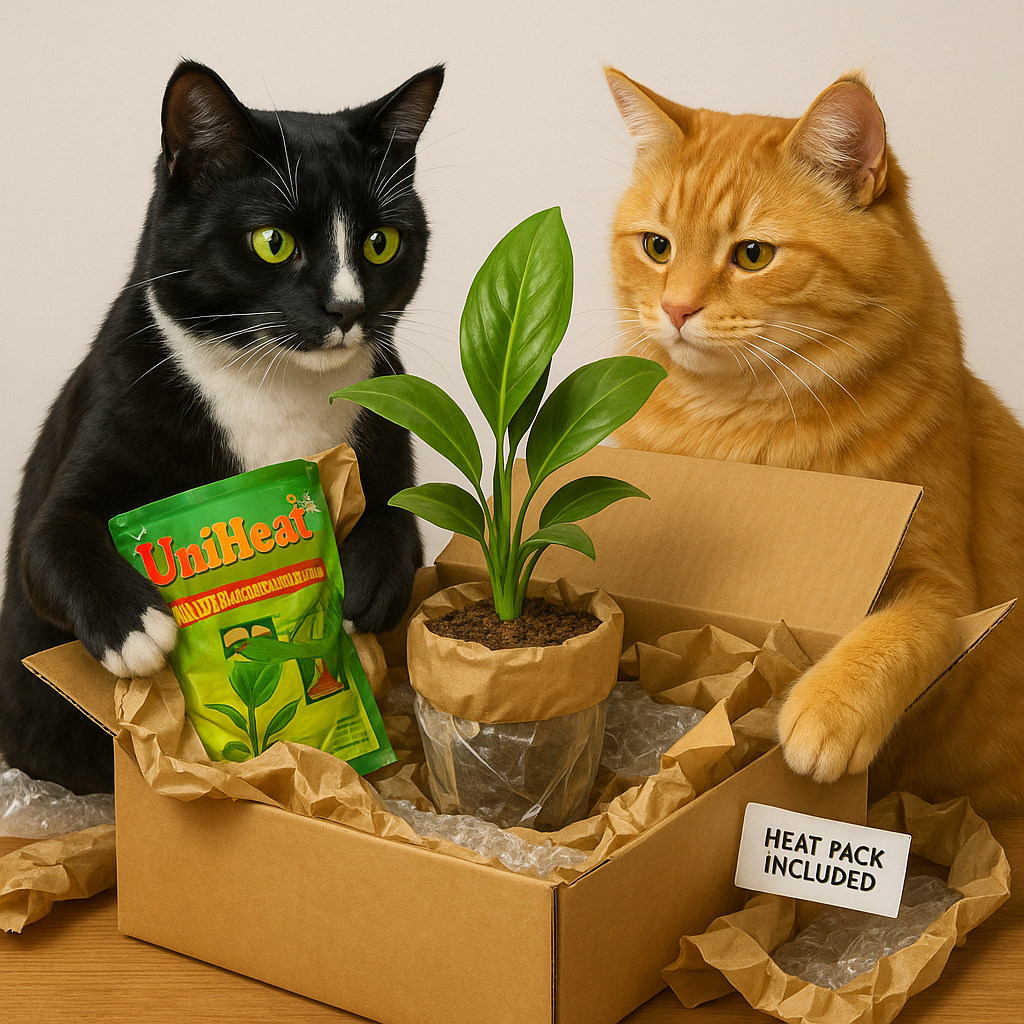
Add Heat Pack to your plant order

Cats  adding  heat  pack  to  plant  shipment