Garden Blog - Top Tropicals

Date: 7 Oct 2025

⭐ The Winter Stars: 8 Flowering Trees That Steal the Show
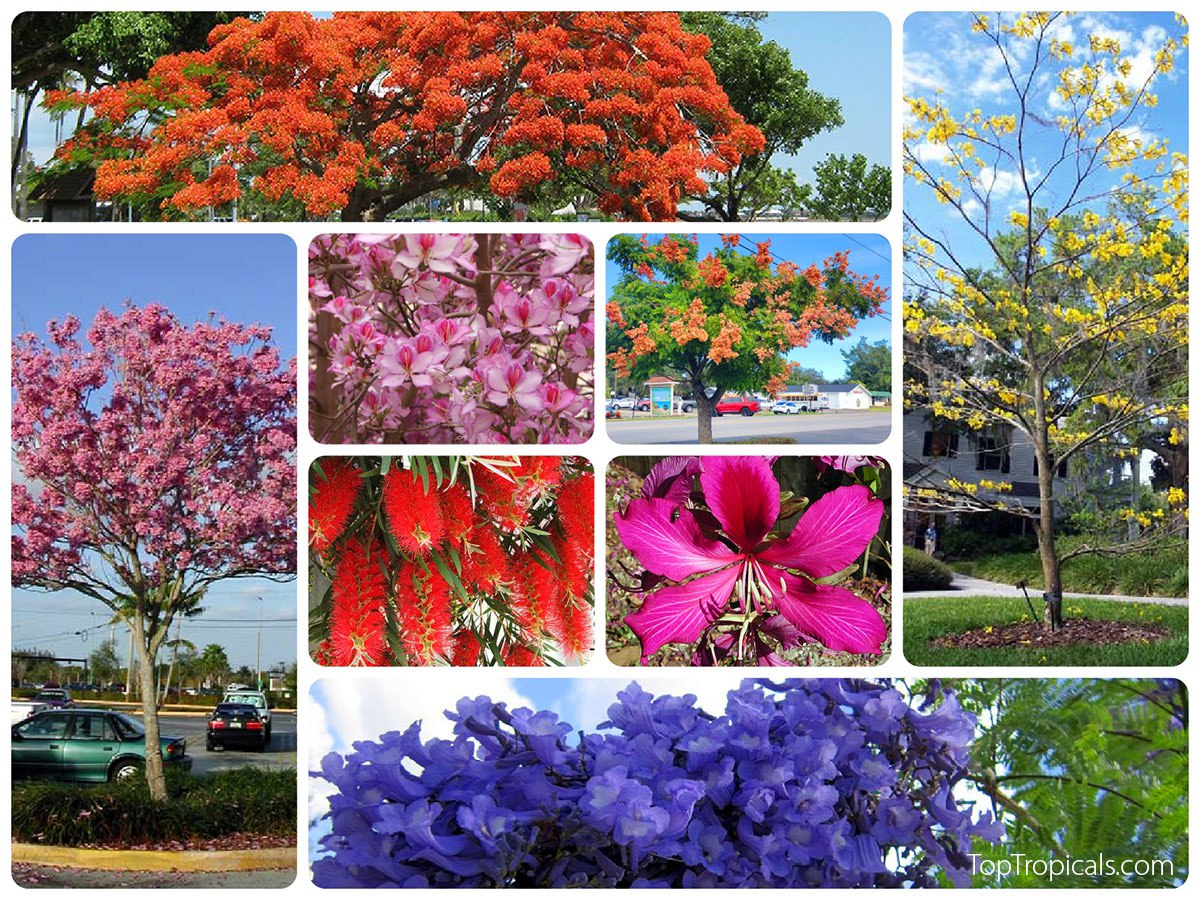
Collage  showing  eight  tropical  and  subtropical  winter-flowering  trees: 
 Royal  Poinciana  with  red-orange  canopy,  Dwarf  Pink  Tabebuia,  Dwarf  Golden 
 Tabebuia,  Pink  Butterfly  Orchid  Tree,  Golden  Rain  Tree,  Weeping  Red 
 Bottlebrush,  Hong  Kong  Orchid  Tree,  and  Jacaranda  with  purple 
 flowers.

8 Best Flowering Trees That Bloom in Winter: Royal Poinciana with red-orange canopy, Dwarf Pink Tabebuia, Dwarf Golden Tabebuia, Pink Butterfly Orchid Tree, Golden Rain Tree, Weeping Red Bottlebrush, Hong Kong Orchid Tree, and Jacaranda with purple flowers.

Royal Poinciana (Delonix regia)

The diva of tropical trees. Huge red-orange flowers blanket the branches from late winter through summer. If you’ve ever seen one in full bloom, you know — it stops traffic. Best in large yards or open spaces, but young ones do great in big pots for a few years. 🛒 Shop
Tatiana: “If you want a tree that makes people say ‘wow,’ this is it.”

Tabebuia chrysotricha – Dwarf Golden Tabebuia

Small tree, big drama. It turns solid gold just before new leaves appear. Blooms while completely bare — a stunning contrast of yellow on brown wood. Perfect for patios, courtyards, and containers. Handles cool nights down to the mid-20s F. Bright, cheerful, and forgiving — the kind of tree that always looks like it’s celebrating. 🛒 Shop

Tabebuia impetiginosa – Dwarf Pink Tabebuia (Pau D’Arco)

The Florida “cherry blossom.” Pink-lavender flowers smother the branches each winter, often before any leaves return. Thrives in sandy soil, tolerates drought, and grows beautifully in large planters or pots indoors near a sunny window. Ideal for seasonal residents or anyone who wants color when everything else is asleep. 🛒 Shop

Jacaranda mimosifolia

If color had music, this would be jazz. Soft, fern-like leaves and cascades of violet-blue trumpet flowers — airy, elegant, unforgettable. Outdoors, it makes a graceful shade tree; in containers, it stays compact with regular pruning. Jacarandas reward patience — they bloom bigger each year. 🛒 Shop

Koelreuteria paniculata – Golden Rain Tree

A favorite for its surprises — golden blooms in summer, pink paper lantern pods in fall, and bronze leaves before rest. Fast-growing, tough, and easy. Loves full sun and moderate water. Great for open lawns or patio tubs. The kind of tree that gives you something new to look at every month. 🛒 Shop

Callistemon citrinus – Bottlebrush Tree

The hummingbird magnet. Bright red, brush-shaped flowers bloom several times a year — sometimes even in cool weather. The dwarf form, ‘Little John,’ stays about 4 feet tall, perfect for pots or small borders. Trim lightly after flowering to keep it compact and colorful. 🛒 Shop
Tatiana: “If you’ve never grown a tropical tree before — start here. It’s the friendliest one.”

Bauhinia variegata – Pink Butterfly Tree

Graceful, fragrant, and forgiving. Its pink-lavender orchid-like flowers open from late winter through spring, filling the garden with color and pollinators. It’s fast-growing, drought-tolerant, and excellent for both ground and pots. Even the buds are edible — a fun bonus for adventurous gardeners. 🛒 Shop

Bauhinia blakeana – Hong Kong Orchid Tree

The queen of them all. Huge magenta-purple blooms that last for months, from fall through spring. Fragrant, clean (no messy seed pods), and perfect for patios or large decorative containers. Give it sun, a little water, and it will reward you with bloom after bloom. 🛒 Shop
Tatiana: “It’s the one tree that never lets winter win.”

A note on grafted Hong Kong Orchid Trees: Most Hong Kong Orchid Trees are grafted, and that’s actually a big advantage. Because they don’t grow from seed, grafted plants mature faster and begin blooming while still small — sometimes within the first year. That makes them perfect for patio pots or small gardens where space is limited.

Bringing the Tropics Home

Whether your garden faces the Gulf or your window faces the snow, these trees let you live in color year-round. Plant them outdoors in warm zones or grow them in pots indoors — they adapt, they bloom, they brighten every corner.

Gardening isn’t about waiting for spring — it’s about finding joy in every season. And when a tree blooms in January, that joy feels twice as sweet.

🛒 Shop Winter Flowering Plants
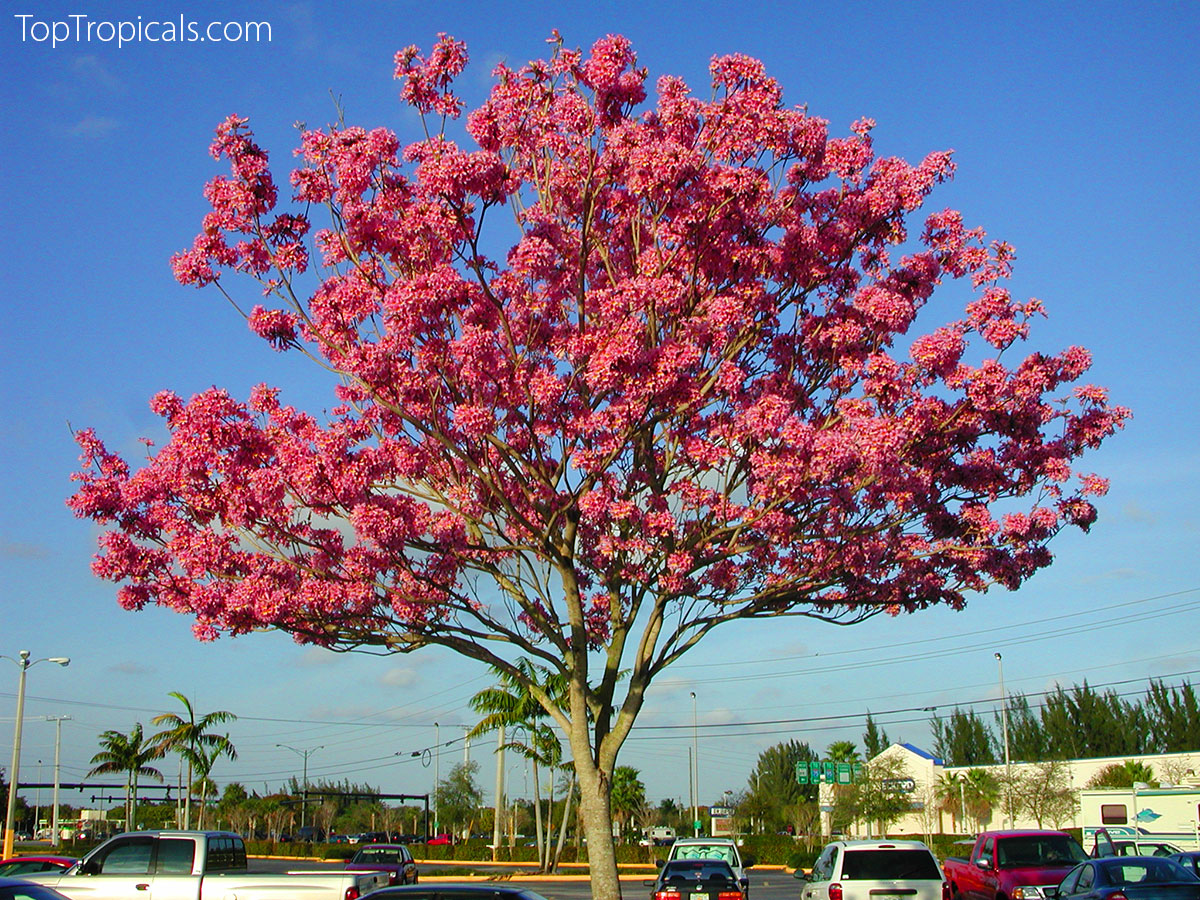
Tabebuia  impetiginosa  -  Dwarf  Pink  Tabebuia,  Pau  DArco,  Taheebo

✍️ Winter Bloomer Q&A

Q: Can these trees really bloom indoors?

Yes! Smaller species like Bottlebrush ‘Little John,’ Dwarf Tabebuias, and many Bauhinias bloom beautifully in pots with bright light or grow lamps.

Q: Do they lose their leaves in winter?

Some, like Tabebuias and Jacarandas, drop leaves right before blooming — it’s normal and part of their charm. Others, like Bottlebrush, stay evergreen.

Q: What fertilizer works best?

We use Sunshine Boosters — gentle, balanced, and perfect for tropicals. Feed every 2–3 weeks during active growth.

Q: How do I know when to water?

Touch the soil! If it’s dry an inch or two down, water deeply. Overwatering is the main mistake with tropicals.

Q: Can they handle frost?

A quick dip into the upper 20s F is fine for most mature trees. Cover young ones or move containers under shelter if colder.

Q: Which are best for beginners?

Start with Bottlebrush ‘Little John’ or Golden Tabebuia — compact, colorful, and nearly foolproof.

Q: When will they bloom?

Usually within few years if they get enough sun and warmth. Grafted plants blooms much sooner

Q: Which of these trees are best for pot growing?

For patios, balconies, or indoor sunrooms, choose the compact or grafted types:

🎥 Watch videos of Dwarf trees in bloom:

Dwarf Golden Tabebuia

Dwarf Pink Tabebuia

🛒 Shop Winter Flowering Plants

Date: 31 Oct 2025

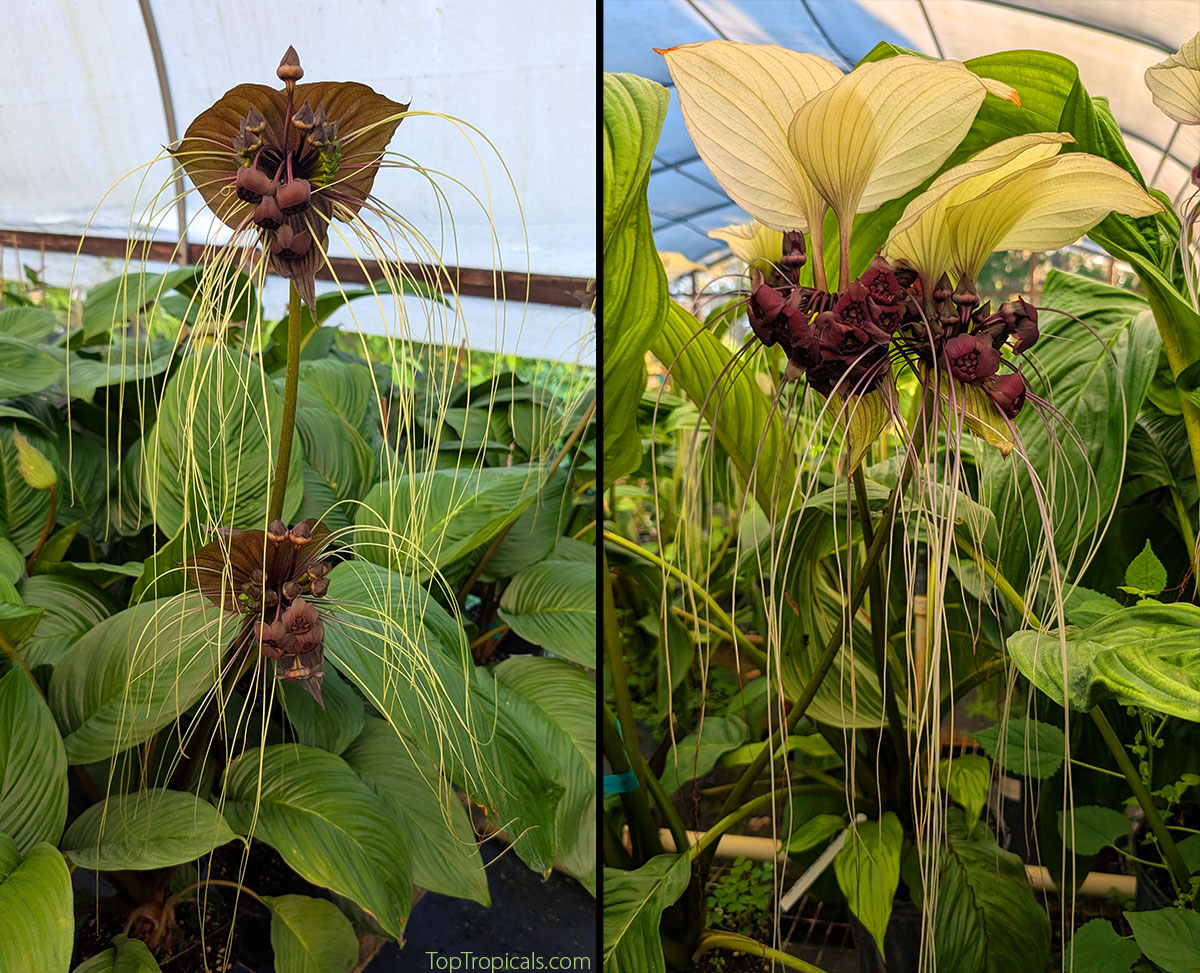
Black  Bat  Lily  and  White  Bat  Lily  plants  blooming  together  in  the  Top 
 Tropicals  greenhouse,  showing  contrast  between  dark  maroon  and  ivory  bracts 
 with  long  trailing 
 whiskers.

Black and White Bat Lilies (Tacca chantrieri and Tacca nivea) side by side in bloom

How to Care for Bat Lilies

by Top Tropicals Plant Expert Tatiana Anderson

🌞 Light

  • Bright, filtered light. Morning sun or dappled shade is perfect.
  • Avoid direct midday sun outdoors — it can scorch the leaves.
  • Indoors, place near a bright window with sheer curtains or use a grow light.

🌡️ Temperature

  • Warm and stable, ideally 70-85 F during the day.
  • Protect from cold drafts or sudden chills.
  • Ideally, do not let temperature drop below 45 F, although Taccas can tolerate short period of upper 30's.

💧 Watering

  • Keep soil evenly moist but not soggy.
  • Water when the top inch feels barely dry.
  • Use lukewarm water.
  • Avoid letting the pot sit in water.

💨 Humidity

  • High humidity (60-80%) is key.
  • Mist leaves often, use a humidity tray, or keep near a humidifier.
  • In greenhouses or bathrooms with a skylight, it thrives naturally.

🌱 Soil

  • Use rich, loose, well-draining mix
  • Combine bark, peat, and perlite for ideal airflow around the roots.
  • Best mix for growing tropical Tacca in pots - soilless potting mix Abundance . It provides perfect drainage and has a texture similar to a jungle rainforest media.

🍽️ Feeding

  • During growth season (Spring through Fall), feed with Green Magic controlled release fertilizer every 6 months. For even better results, you may apply liquid fertilizer Sunshine Boosters Rubusta.
  • Stop feeding dry fertilizer in cooler months when growth slows. Liquid Sunshine Boosters are safe to use with every watering, year around.

🏡 Indoor Growing

  • Great for bright bathrooms, sunrooms, or any warm, humid corner.
  • Rotate pot occasionally for even growth.
  • Keep away from heating vents and AC drafts.

🌴 Outdoor Growing (in warm climates)

  • Partial shade or filtered light under trees.
  • Excellent in large containers that can be brought inside for winter.
  • Shelter from heavy rain and wind.

Sunshine: "So… it’s a diva?"
Smokey: "Exactly. But take care of it - and it rewards you with wings!"
Smokey and Sunshine: "Happy Halloween!"

🎥 Watch Short Videos:

🛒 Grow your own gothic masterpiece:
Shop Bat Head Lily Tacca

Date: 15 May 2026

The Tropical Survivor: Why This Pink Plume Defied a 25F Freeze

The Tropical Survivor: Why This Pink Plume Defied a 25F Freeze The Tropical Survivor: Why This Pink Plume Defied a 25F Freeze

The Tropical Survivor: Why This Pink Plume Defied a 25F Freeze


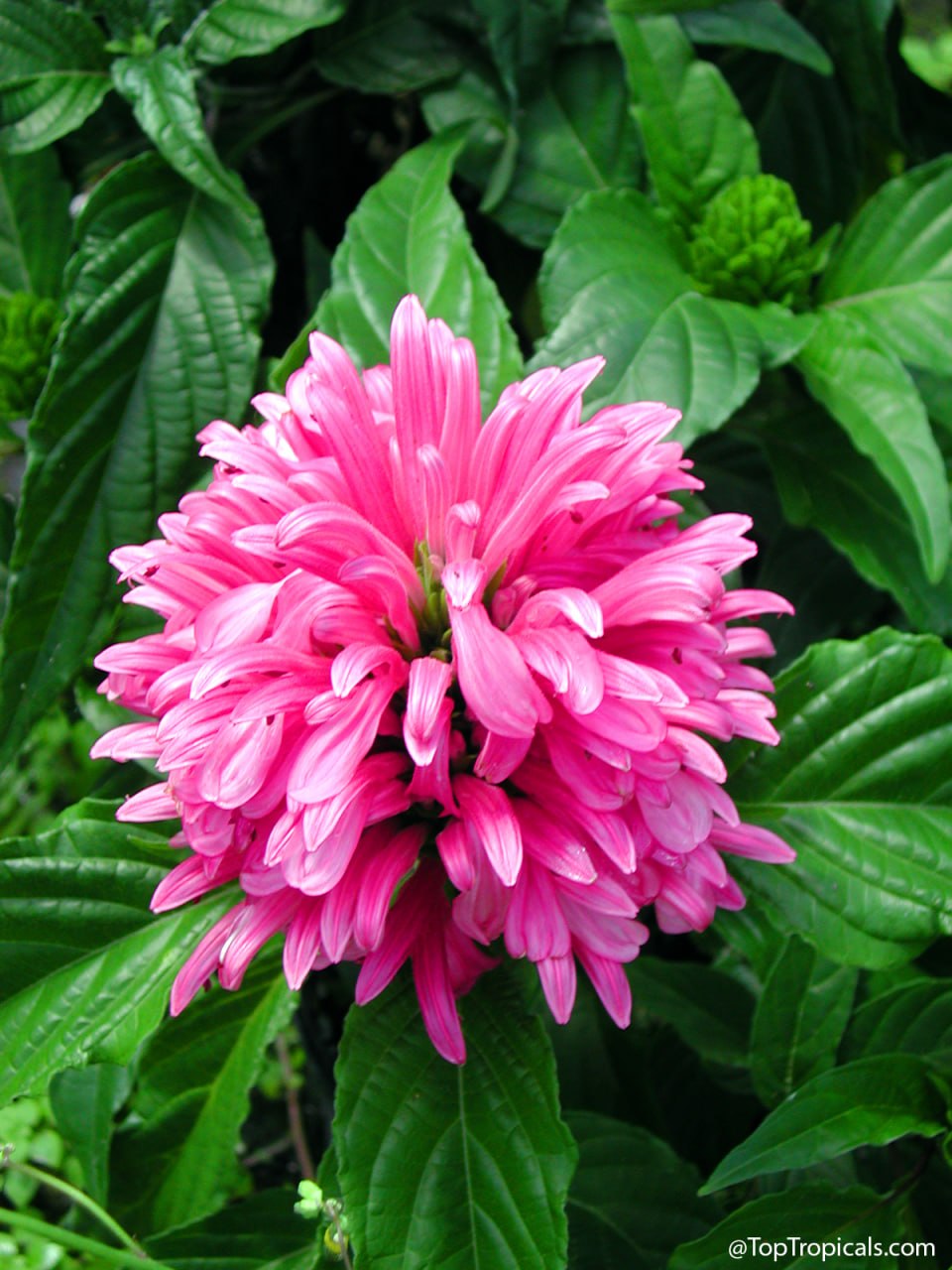
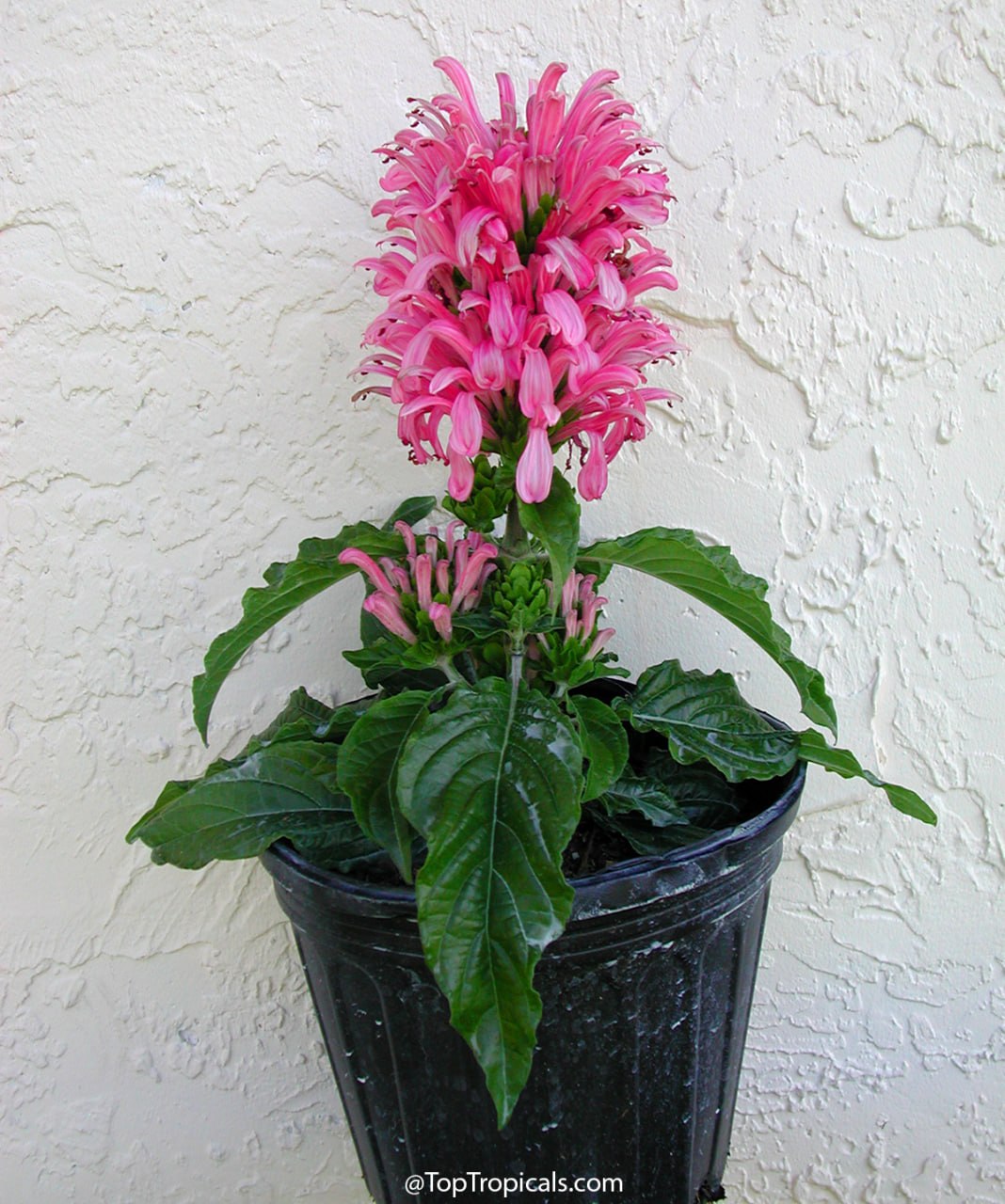
When Central Florida temperatures plummeted to 25F for two days, many gardeners braced for a total loss; and while most tropicals melted into black mush, Justicia carnea - the Pink Brazilian Plume or Jacobinia - proved that looks can be deceiving.

Tougher Than it Looks


As many other tropical plants from Acanthaceae family - Justicia plants are much hardier than they look.

At first glance, the Brazilian Plume looks like a greenhouse diva. It boasts huge, lush leaves and giant, cotton-candy pink flower clusters. However, it harbors a secret: it behaves more like a hardy perennial than a delicate shrub.

Even when a hard freeze burns the top growth to the ground, the root system remains remarkably resilient. Once the soil warms, fresh shoots often push through the dirt faster than expected.

A Hummingbird Magnet for the Shade


The real draw of Justicia carnea isn't just its survival skills - it’s the show-stopping blooms.

Large upright plumes can reach the size of a football. The tubular flowers are a primary target for hummingbirds and butterflies. Unlike most tropical bloomers, it thrives in filtered light and bright shade, making it perfect for understory planting.

  • 👉 Gardener’s Tip:


Don't dig it up too soon! Freeze-damaged stems may look finished for weeks, but patience usually rewards you with new growth by late spring.

🌱 Quick Care Guide


Light: Bright shade or filtered sun
Soil: Rich, well-draining
Water: Regular moisture during heat
Best For: Pool areas, woodland gardens, and pollinator beds

For gardeners wanting that high-impact tropical aesthetic without the heartbreak of constant replanting, this Jacobinia is the ultimate comeback kid.

🛒 Plant beautiful and hardy Jacobinia

📚 Learn more:

Hummingbird Plant Plant Facts

Dicliptera suberecta, Justicia suberecta
Hummingbird Plant, Uruguayan Firecracker Plant
USDA Zone: 9-11
Small plant 2-5 ftSemi-shadeFull sunModerate waterRegular waterYellow, orange flowersRed, crimson, vinous flowersPlant attracts butterflies, hummingbirds

#Butterfly_Plants #Discover #Container_Garden

🟢 Join 👉 TopTropicals

Date: 20 Sep 2025

How to make lots of Insulin Ginger plants quickly and get more health benefits

Costus igneus (Chamaecostus cuspidatus) - Fiery Costus or Spiral Flag

💚 How to make lots of Insulin Ginger plants quickly and get more health benefits

  • Costus igneus (Chamaecostus cuspidatus) - Fiery Costus or Spiral Flag is believed to help lower blood glucose levels naturally and managing diabetes.
  • Have you heard of Insulin Ginger? Everyone wants to have it in the garden!
  • Gardeners in India grow it not just for its pretty spiral leaves, but for what those leaves do. People with diabetes often chew them fresh or brew them into tea, saying it helps keep their blood sugar under control.
  • Researchers have found something interesting: the leaves contain an insulin-like compound, along with antioxidants and anti-inflammatory properties. In animal studies, extracts from the plant lowered blood sugar, protected the liver and kidneys, and even made the body more sensitive to insulin.
  • The way folks use it is simple. You can chew a leaf right off the plant, steep dried leaves for tea, or find it in powders and capsules. It's one of those plants that shows how tradition and science sometimes meet in the garden.
  • Its lush, turmeric-like leaves spiral around upright stems, with a glossy dark green top and a striking light purple underside. In warm months, it produces bright orange, cone-like flowers that stand out beautifully in the garden.
  • Beyond its beauty and natural insulin effects, the insulin plant is credited with aiding digestion, reducing cholesterol, boosting energy, improving skin health, supporting weight loss, relieving stress, and promoting heart wellness. A real botanical multitasker!


🎥 In this video, we’ll show you how to multiply Insulin Ginger fast, so you’ll have plenty of plants for yourself and even extras to share with friends and family.

✅ Don’t forget to use Green Magic fertilizer for the best results. Gingers absolutely love this plant food - they thrive on it and respond better than any other plant, with vigorous growth, lush foliage and loads of leaves you’ll need for all the benefits.

🛒 Grow your own sugar-fighter - the Insulin Ginger

📚 Learn more:


#Food_Forest #Remedies #Shade_Garden #Discover

🟢 Join 👉 TopTropicals

Date: 8 Feb 2024

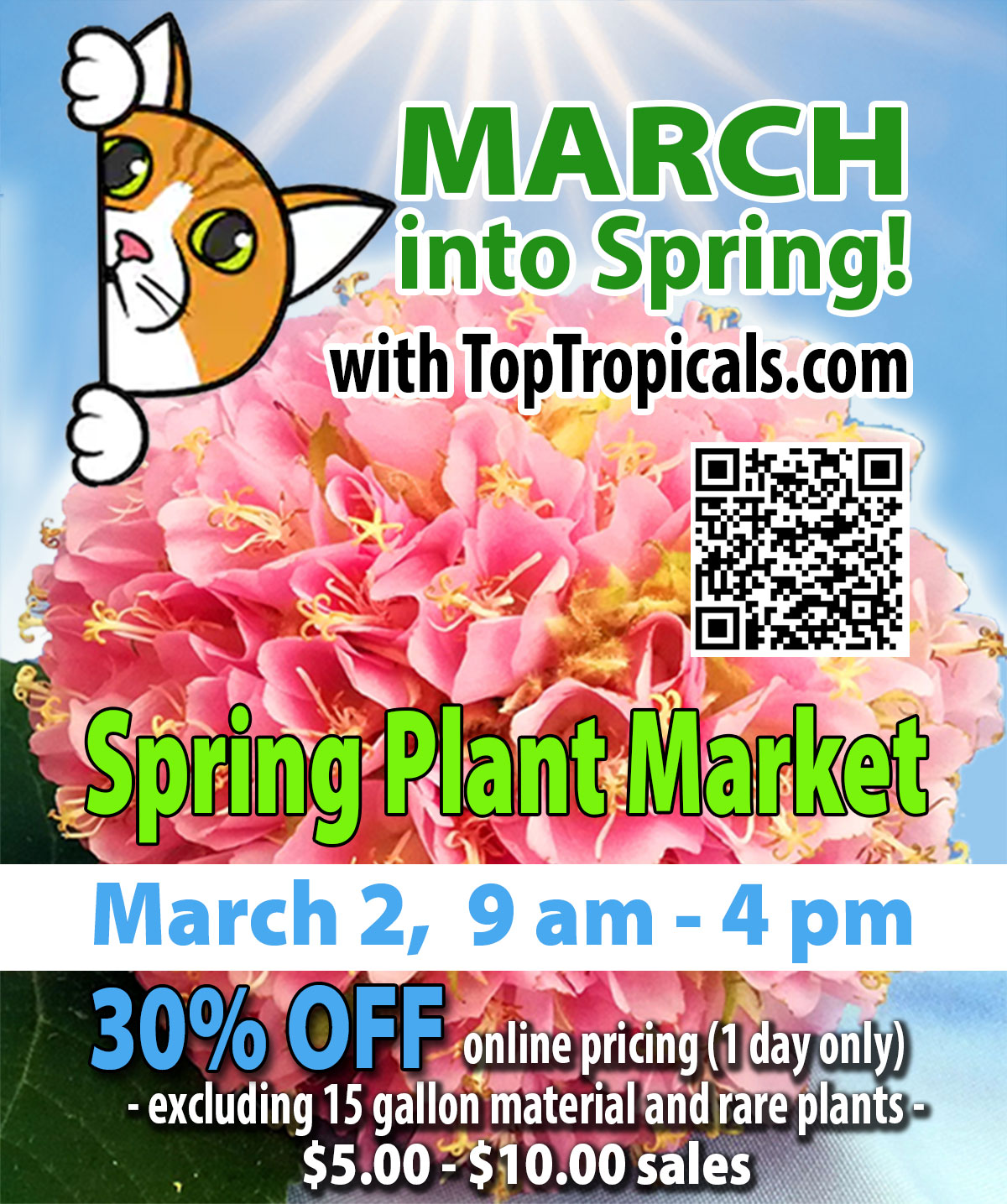
Mark your calendars: March 2, 2024

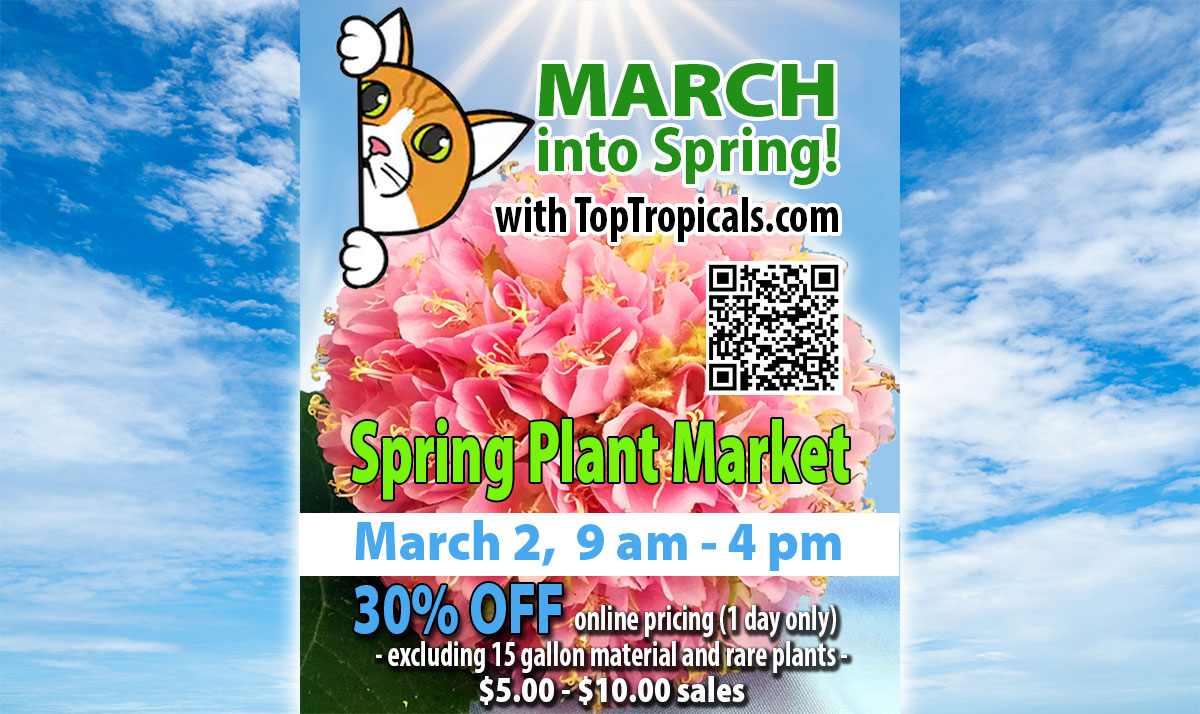
March  2,  2024  -  SATURDAY  -  Spring  Plant  Market:  March  into  Spring!

Plant Festival "March into Spring!"
Saturday, March 2, 9 am - 4 pm

Save the date! On March 2, 2024, join us for our vibrant Plant Festival, "March into Spring!"
Dive into a world of lush greenery, blooming delights, and rare fruit trees at our garden event. Discover unbeatable sales, exclusive deals, delightful gift bags, and receive free plants with every purchase.
Don't miss out on this opportunity to embrace the beauty of spring and elevate your garden to new heights!

Highlights of the event:

30% OFF online prices, one day only! (excluding 15 gallon material and rare plants)
Gift bags - for first 25 customers with $50 order
Secret Garden: Super savings area 50-70% off
$5 and $10 plants
Raffle
Free plant with any purchase as a token of our appreciation

Event discounts valid at both locations:

Ft Myers Garden Center: 13890 Orange River, Ft Myers, FL
Sebring B-Farm: 9100 McRoy Rd, Sebring, FL

Facebook event page - Download invitation

Cat  with  plants  in  a  bag