Garden Blog - Top Tropicals

Date: 11 Aug 2018

From Anna Banana: Shipping and planting during hot weather
TopTropicals

Q: I received email notification that my order was delayed due to hot weather. Why? And do I need to do anything special if I plant when it is hot?

A: When plants are shipped via FedEx Ground, it is hot in the truck! According to our FedEx area manager information, if outside temperature is 100 degrees, inside the truck it can be 130! We don't want to put your plants through that much stress. We monitor the weather at destination, and as soon as it cools down a little bit, your order will be shipped.

Planting during hot weather:
1. For a mail-ordered plant follow planting instructions and never plant it from the box directly into the ground. Keep it in a pot the size of a root ball until the plant recovers from shipping stress, re-grows root system and adjusts from several days of darkness to a bright light. Move the pot gradually into brighter light, eventually into a spot of its permanent home. Do not over water the pot. Once you see new growth - the plant is ready to be transplanted into the ground.
2. Use only quality soil, containing lots of organic matter (compost, peat moss); soil conditioner is beneficial (pine bark). Plant it on a little hill, so growing point is elevated 1-1.5"above the rest of the surface.
3. Put a good layer of mulch around the plant, at least 1-2" thick, and not too close to the trunk as it may cause stem rot on contact.
4. Water daily with a garden hose until the plant shows active growth - then watering may be reduced every other day or less, or you may rely on sprinklers and/or rains.
5. If the sun is too hot, use shade cloth (or simply a white bed sheet) to cover the plant for the first few days (use bamboo sticks for support). It will help the plant to establish without heat stress. If leaves start dropping - this may be a sign of excessive light and heat. Shading is the way to reduce it.
6. Use SUNSHINE booster to help plants overcome heat stress, and shipping stress. It really works!

Remember that a plant has a very slow nature, unlike creatures from animal world. Give it some time and never rush it into new conditions. Go slowly and patiently - this is the only way to get a reward of a fruit crop or a beautiful flower.

Date: 24 Jun 2018

Growing tropicals from seeds.

From Kristi the Wizard of Rose: I grow many plants from seeds, both for my personal collection, and for TopTropicals. I receive many questions from customers who want to grow tropical plants from seeds. Some of them live in colder climates and try to extend growing season of their tropical collections by starting new varieties early in the year from seeds. These are a few tips that may be helpful.

Q: What do I need to do to speed up germination process?

A: Many factors affect germination. Considering you get fresh seeds (for example from TopTropicals) and Mother Nature gives them a good kick start, there are a few things that may speed up germination:
1) Scarification. Large seeds with a hard outer shell can be slightly sanded down just enough for moisture to get inside to wake up the seed during the pre-soaking. Be careful not to damage the seed. See example of Lotus seed scarification.
2) Pre-soaking. We recommend pre-soaking most of the seeds for only a few hours (3-8 depending on species. Some seeds are very sensitive to moisture and may start rotting if stay wet without air circulation. Small seeds, especially tiny ones like dust, should not be soaked.
3) SUNSHINE-S treatment. Adding a few drops of SUNSHINE-S booster when pre-soaking seeds increases their germination rate 3-5 times.
4) Temperature. Warm temperatures help germination. If grown indoors, put seeds containers or trays in the warmest spot of your house; you may use heat pads. Outdoors, putting them in full sun helps a lot, just don't let soil to dry out.

Use only special porous seed germination mix to provide air circulation and prevent seeds from rotting.

Q: Should I keep seeds in refrigerator before planting?

A: Do not refrigerate tropical seeds. Stratification (treatment with cold) works only for temperate species, and some subtropical (like non-tropical Magnolias)

Q: How do you grow eucalyptus from seeds? I tried a few times with no success.

A: The secret of germinating tiny seeds like eucalyptus is - to sow them on top of the moist soil surface (soil must be very fine and soft), without covering. Keep container covered with clear plastic, in bright light. Use spray bottle to keep surface moist but not soggy. I have a customer who germinates eucalyptus seeds using an old fish tank, covered with a glass. Perfect environment - bright light and moist all the time.

Date: 7 Oct 2018

Featured Plant. Jasminum sambac Belle of India


Lovely Jasmine Belle of India makes you feel pretty and loved!

This one is the most wanted variety with elongated petals that are sweetly scented. Compact and slow growing shrub, it makes a great houseplant and flowers freely throughout the year. The most profuse flowering is from Spring to Summer.
Called pikake in Hawaii, Jasmine sambac is the plant used to flavor the jasmine tea and making perfumes. Perfect houseplant takes both sun or shade, it is a beautiful fragrant everbloomer for your home and garden.
Belle of India is a slow grower, with pale green pointed leaves and double flowers with elongated narrow petals. Prefers filtered light for a better look of the leaves, but will tolerate full sun. In fact the more sun the more flowers you get.

Secrets of successful culture:

1) use only well-drained potting soil
2) keep the plant a little bit on a dry side so roots don't get too wet. Water again when the soil gets slightly dry.
3) Use micro-element mix - SUNSHINE Superfood works the best. It will keep leaves nice and green and induce more profuse flowering.

Stay updated with TopTropicals Videos by subscribing to our channel at YouTube.com/TopTropicals and get our latest video news of what is fruiting and blooming!

Check out this plant...

Date: 18 Aug 2025

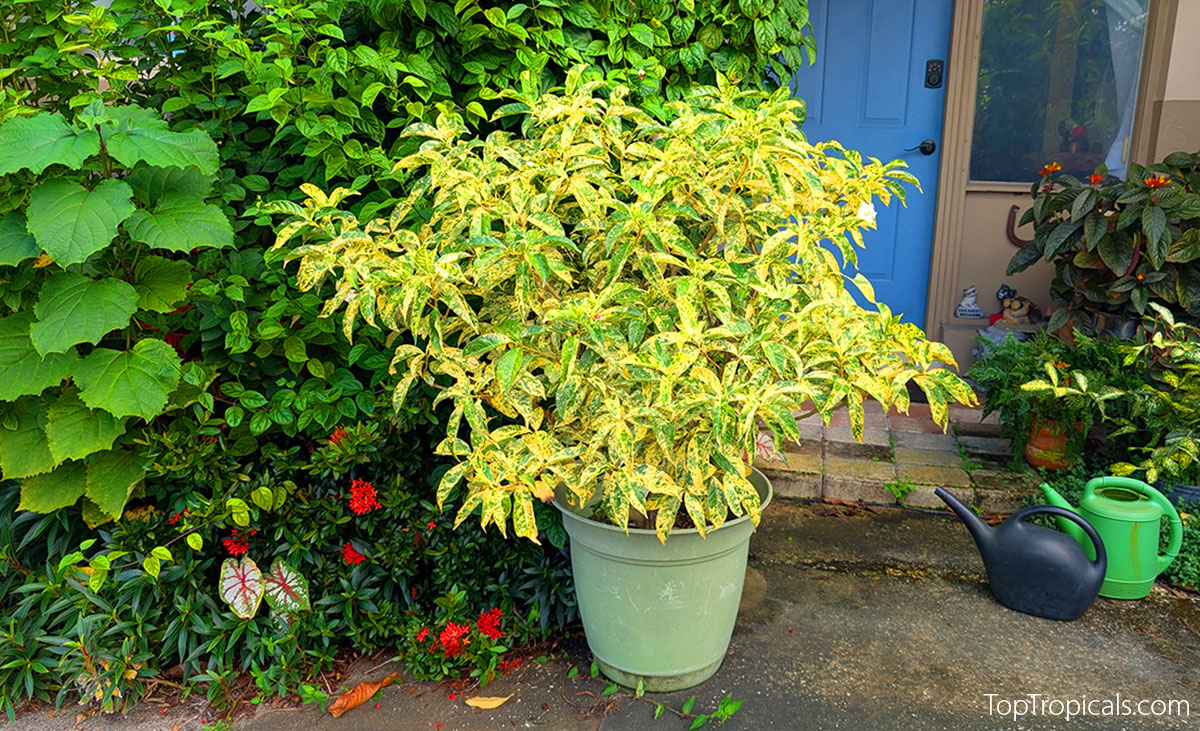
🌟Repotting FAQ

Tabernaemontana  variegated  in  container

Q: How big should the new pot be?

A: Only a few inches larger than the old one. Oversized pots hold too much moisture and may cause root rot.

Q: Why are plastic pots better than ceramic?

A: Plastic pots are lighter, easier to handle, and you can cut them if a root-bound plant is stuck. Ceramic pots are heavy, breakable, and often lack drainage.

Q: How do I safely remove a plant from its pot?

A: Turn the pot upside down and let gravity help. Never pull by the stems or leaves. If stuck, lay the pot on its side and squeeze or tap it. Cut the pot if needed.

Q: Should I remove old soil from the roots?

A: No. Roots have tiny hairs that absorb water and nutrients. Shaking off soil damages them and sets the plant back.

Q: Why must the plant sit at the same soil level?

A: Planting too deep suffocates the stem, and planting too high exposes roots. Keeping the same level protects the root crown.

Q: How soon should I water again after repotting?

A: Water thoroughly right after repotting, then wait until the top inch of soil dries before watering again.

🌱 Done! Your plant now has room to grow stronger before fall.

Shop Garden Supplies

Date: 31 Jul 2025

Anthurium Collector Set

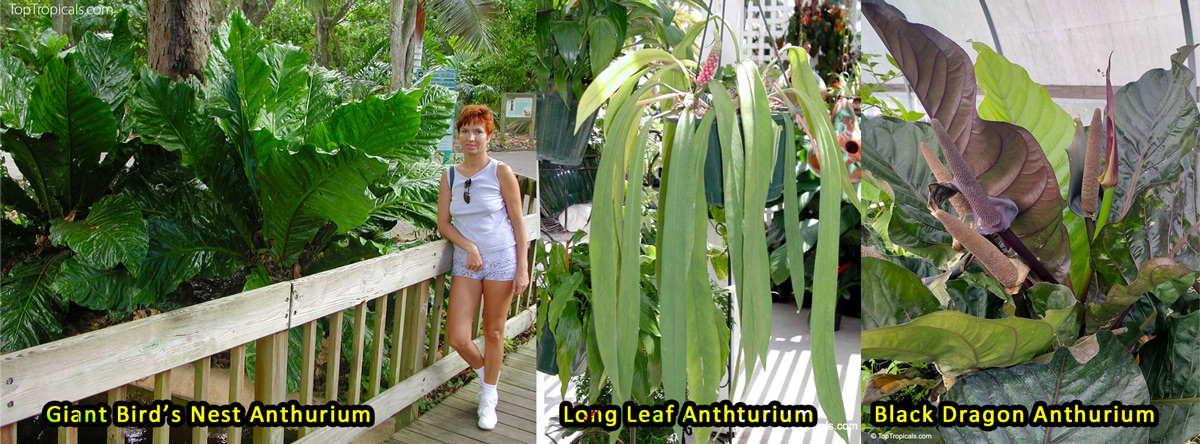
Giant  Bird's  Nest,  Long  Leaf,  and  Black  Dragon  Anthuriums  side  by 
 side,  showcasing  their  dramatic  foliage  and  size

These aren't your typical tropicals - they're collector-grade Anthuriums grown for foliage and texture. Each one brings something different, but they all thrive in the same kind of setting: shade or filtered light, warmth, and humidity. Perfect for growing in containers indoors or out.

Anthurium Black Dragon

This is the most dramatic of the trio. Upright, leathery leaves shift from dark green to nearly black depending on light. Instead of bright flowers, it produces a dark brown spadix and glowing red berries. A hybrid not found in the wild, it's grown from seed - no two are exactly alike.

  • Best for: Indoor focal plant, shaded patio, black ceramic pot
  • Height: 2–4 ft in container
  • Texture: Thick, architectural leaves
  • Highlight: Color shifts with light intensity

Grow Your Own Black Dragon

Read more about Black Dragon Anthurium

Anthurium hookeri – Giant Bird's Nest

This one's about scale. Broad, crinkled leaves with a cardboard-like texture form a bold rosette. It can get huge with time - up to 6 feet across. Perfect for gardeners who want the "instant jungle" look.

  • Best for: Shaded garden, large pots on porches
  • Height: Up to 5 ft; width even more
  • Texture: Wrinkled and leathery
  • Highlight: Bright red berries in maturity

Buy Giant Bird's Nest Anthurium

Read more about Giant Bird's Nest Anthurium

Anthurium vittariifolium – Long Leaf Anthurium

Graceful and rare, this species sends out narrow strap-like leaves that can reach 5–6 ft long. Ideal for hanging baskets or mounting. Bonus: it produces small pink fruit against deep green foliage.

  • Best for: Hanging displays, vertical planters, bright bathrooms
  • Height: Leaf length, not upright height - up to 6 ft
  • Texture: Smooth, ribbon-like
  • Highlight: Cascading growth and color contrast

Buy Long Leaf Anthurium

Read more about Long Leaf Anthurium

✅ How to Care for Anthuriums

  • Light: Bright, indirect light is best. Avoid direct sun, especially mid-day. These plants evolved in rainforest understory - think "dappled light under trees."
  • Water: Keep the soil lightly moist but not soggy. Let the top inch dry before watering. They hate wet feet.
  • Humidity: These are tropicals - they'll do fine in 50-60% humidity, but thrive at 70%+. Use pebble trays or place near other plants. Bathrooms with windows work great.
  • Soil: Use an airy mix: orchid bark + perlite + peat or coco coir. Drainage is key. Never use plain potting soil.
  • Fertilizer: Feed with SUNSHINE Robusta every 2–4 weeks during warm seasons. It's formulated for aroids and won't burn roots.
  • Potting: Use shallow, wide containers. Repot only every 2–3 years, or when roots crowd the pot. They don't like frequent disruption.
  • Temperature: Ideal: 65–85 F. Short dips to the 30s F are tolerated by mature plants, but avoid cold drafts.

Shop All Anthuriums