Date: 24 Jun 2018
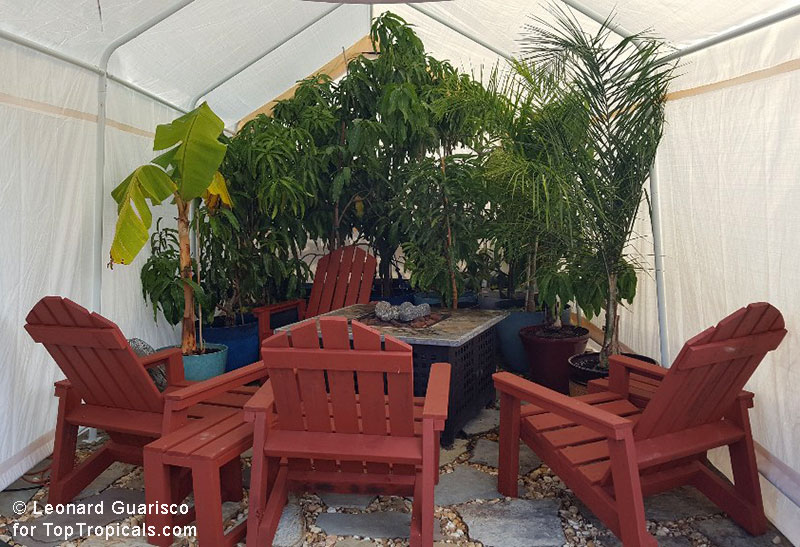
Mangos in portable garage
A
word from our customer: I wanted to let you know
how happy I was with my latest order, Mesk Mango. It
arrived this past Saturday in EXCELLENT condition only
losing 3 leaves while in transit to Morgan City, LA. I
like the idea of the root ball dry, loosely packed and no
Styrofoam peanuts compared to the old wet tightly packed
root ball.
The attached pictures show where my container Mango
collection (list below) will spend this winter so I don't
lose any of my prized possessions! Again, thanks for
supplying a great product and happy you survived the
storm! 2 Nam Doc Mai, 2 Jakarta, 2 Valencia Pride, 2 Keitt, Pina Colada, Orange Sherbet, Cat Hoaloc, Spirit of 76, Carrie, Glenn, Coconut Cream, Mesk
Date: 31 Jan 2017
Plants of Love. TopTropicals Webinars
Plants of Love - Valentines Day Sale. For Valentines day, look beyond roses for a plant that will last a lifetime! It is not a surprise that the most popular plants that has been ordered from TopTropicals for Valentines day for the past 3 years, are: Vanilla, Chocolate, Grape, Strawberry tree, Rose apple - all things you get for your Valentines!
This year we are celebrating Valentines day with our special local event - "Aphrodisiacs, or Plants of Love".
When: Saturday, February 11, 2017, from 10 am to 2 pm
Where: Toptropicals Garden Center, 13890 Orange River Blvd, Ft Myers, FL 33905
Agenda:
10:00 am - Explore the grounds: Customers can come in to look through the nursery and guided tours through gardens.
12:00 pm - Aphrodisiac plants. Class on plants used for aphrodisiacs throughout history.
1:00 pm - Plant giveaway. Must be present to win one of the aphrodisiac plants in lecture.
2:00 pm - sale ends.
Special Love Discounts for local visitors! Snacks and drinks.
Just a few examples of the most famous plants of love that we will be talking about -
Coffea arabica - in East Africa and Arabia it was a sacred beverage to African sufis. For aphrodisiac results mix in cardamom and honey.
Banisteriopsis caapi, Ayahuasca - giant liana from tropical Amazon forests psychedelic, ritual inebriant that promotes potency. Drink is made from the bark and is taken in love rituals to revive the mythical past of the tribe.
Areca catechu, Betel Nut - seeds have stimulating effect on the entire body and eros. It's a traditional aphrodosiac in Ayurvedic medicine and is counted among the eight types of pleasure in the Brahmanic tradition. It has magical and religious properties and used as an offering to the Gods.
Theobroma cacao, Chocolate - mild stimulant, beans contain aphrodisiac. Antient Indian "recipe of chocolati" will be shared at the event! Cocoa was considered the "food of gods".
Cinnamon - in Southern Asia used as stimulant, in food or massage oil for erotic stimulation.
Cola nitida, Cola nut - used in love magic, was used as currency in W Africa.
Cananga odorata, Ylang-Ylang - increases eroticism with oil inhaled. Prescribed to treat impotency and frigidity.
Butea monosperma, Flame of The Forest - is traditionally used to manage male sexual disorders.
Mimosa pudica, Sensitive Plant - significantly increases the libido and hormonal levels of testosterone.
Satureja Viminea, Kama Sutra Mint Tree - used for love gel...
- and much more!
TopTropicals Webinars. Welcome to Top Tropicals Webinar!
Date: 8 Jul 2020
Grafted fruit trees for Hawaiian gardens
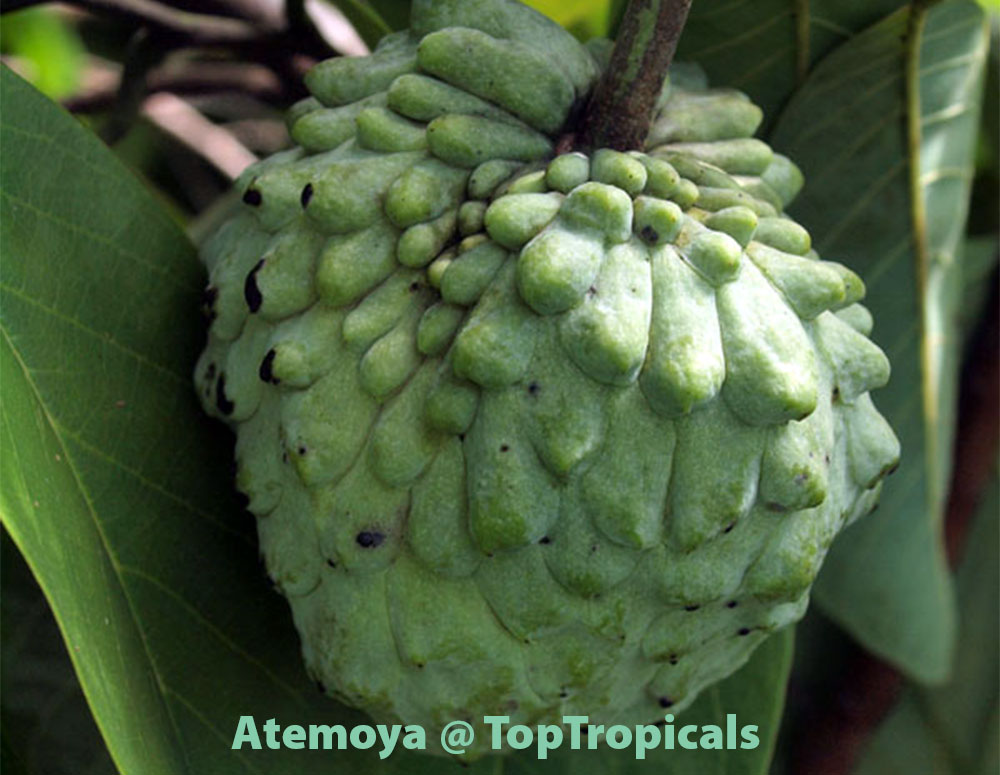
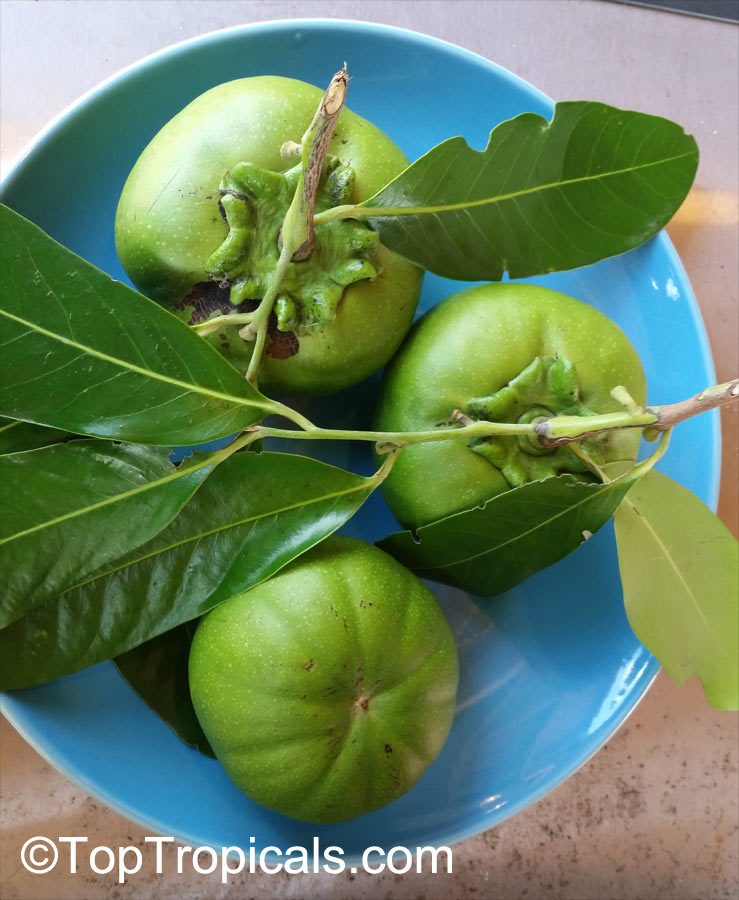
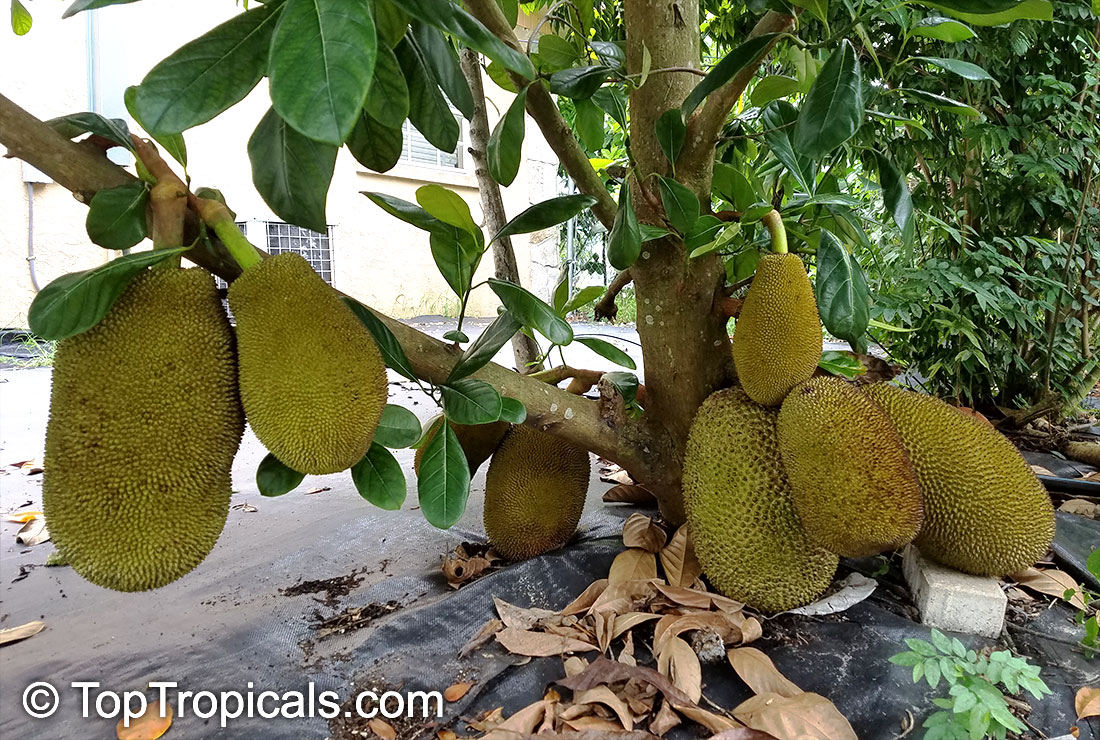
Q: Aloha guys, I purchased a Diospyros digyna - Black Sapote grafted var. Black Beauty from you and am checking to make sure it will fruit by itself and not need both sexes. Also checking to see if the grafted atemoya I bought from you will fruit at sea level (where I'm at) or if I should give it to a friend who is above 1,000 so it will fruit? My grafted Maimi soursop is thriving! Looking at getting a grafted jackfruit from you all next.
A: Black sapote Black Beauty does not need a second plant to produce
fruit. Grafted trees should be flowering and setting fruit right away, or
sometimes on the second year.
Atemoya does not require high elevation for fruiting. It is a hybrid
Annona squamosa x Annona cherimola (A. cherimola species prefers higher
elevation) so Atemoya is usually is happy at sea level.
Congratulations with your Soursop! It should be really happy in your location.
As for grafted Jackfruits, this is the list of varieties we usually carry. Since many of them are very rare, they sell out quickly once we get new arrivals. If you are looking for a specific variety, I strongly recommend to add it to your wishlist (click on "Notify me when available") and you will receive email from us as soon as we have it in stock, so you will be the first one to know about it!
Our favorite Jackfruit varieties (and also hot sellers)
Black Gold
Borneo
Red
Crispy
Dang
Rasimi
We also suggest to get a Kwai Muk (while we still have it!) - the most delicious fruit, and it should do well in Hawaii.
Date: 24 Jun 2018
Cold hardy tropical fruit trees for Luisiana
Q: I've just moved to Louisiana and have been wondering whether it would make sense to plant some tropical fruit trees in our garden. Average lows in New Orleans are 41 deg F in January and February, although we did hit 25 once with the Arctic vortex. I'm interested in litchi, longan, rambutans, and persimmons. Do you have varieties that can tolerate Louisiana's temperature range? I'd love mangosteen but I don't suppose they will survive. Do you have any suggestions on tropical fruit trees that I could try?
A:
Average temperatures are for statistics only; it is actual
temperatures that may hurt your cold sensitive plant. This
is what you should keep in mind when starting your
tropical fruit collection:
1) Ultra-tropical plants like Rambutan can not survive
winters below 45-50F. However, they can be successfully
grown in containers in a greenhouse or moved indoors into
a sun room during cold periods.
2) Tropical plants like Litchi and Longan may take some light
frost once established. Still, for areas with freeze our
advice is - keep them in pots and move inside in case of
cold.
3) There is a number of subtropical fruit trees that are
hardy enough to take some freeze. Persimmon, Feijoa, Fig, Cattley Guava, Jujube, Kiwi, some Eugenias and others. Please
refer to our Tropical Fruit Sensitivity Chart.
4) Remember that plant's ability to survive winter depends
on several factors, not only temperature itself. Important
factors are: wind protection (chill wind kills rather than
low temperature itself), exposure, how close the tree is
planted to the house, plant maturity and its overall
strength and health. If a plant had received good
nutrients during summer, has well established root system,
planted in enclosed area protected from winds and has
plenty of bright sunlight - it has better chances to
survive than a weak plant in warmer conditions.
5) Use SUNSHINE plant boosters
Date: 22 Mar 2021
The most rewarding hardy fruit trees
Q: Recently I started working remotely and I kinda like it, no need to commute, it saves me so much time so I can have life now! My friend got me involved into growing some small houseplants but I really want to take advantage of our Florida climate and sun. I want to plant some cool fruit trees since I have a decent size yard. But I live in Florida Panhandle and we do have some occasional freeze in winter, although not for too long. But it gets very hot in summer! Are there any tropical fruit trees that will be happy here? Or should I keep everything in pots? I am excited to have my own tropical plant collection!
A: There is a perfect plant for everyone, and a perfect tree for every climate. Many tropical and especially subtropical plants can be much hardier than they are believed to be, both flowering and fruiting trees among them. You may keep the most sensitive species in pots and bring them inside for winter, while there are so many trees that will be happy in your area. Start with these that are perfect for climates with hot summers and cool winters:
1. Peaches and Plums
Low-chill, Heat-tolerant Peaches, Nectarines, Plums are especially selected for Florida hot summers. They produce well and do not require many "chill" hours like temperate fruit trees. They only need 150 chill hours and grow well in even in Arizona, so you know they are taking the heat.
2. Figs
2) Fig trees - they are easy to grow, heat- and drought- resistant trees. They are prized for their delicious fruit, which can be one to three inches in length, violet, brown or black. There are even varieties with yellow fruit. Most fruits are borne from early summer to late fall on new growth, and the fruits generally mature very quickly. These trees are sensitive to frost only when actively growing, but can withstand 10F when dormant. Read more about Fig trees.