Date: 29 Oct 2024
How to overwinter tropical plants indoors
10 key tips for successful overwintering
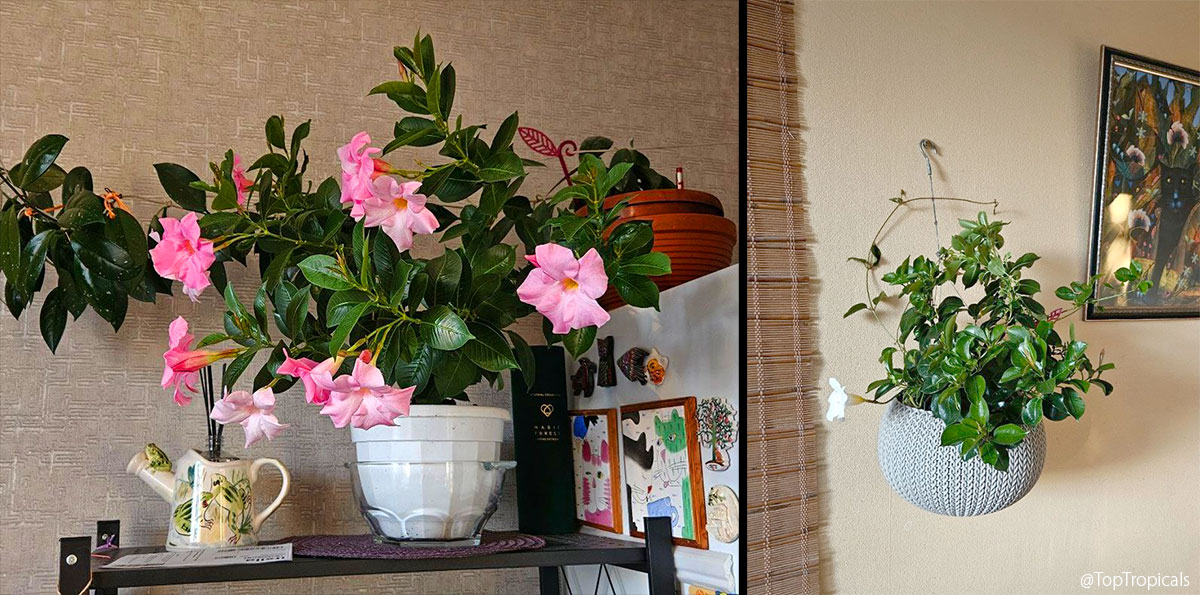
Q: I have two Mandevillas that thrived on my balcony all summer. Now that cold weather is approaching, I've moved them indoors to bright spots, but they're dropping and wilting leaves. How can I keep them healthy until spring? Should I fertilize them? Can Mandevillas grow indoors year-round?
A: First, keep in mind that the plants we call "indoor plants" or "house plants" are all tropical. However, not all tropical plants are suitable for indoor living. Some, especially shade-loving ones, thrive in indoor conditions, which is why we refer to them as "house plants" (philodendrons, monsteras, calatheas, peperomias, and many others, including some succulents). Others are less adaptable to the lower light and humidity typical of indoor spaces, but with a little extra care, you can overwinter them inside and move them back outdoors in spring. Mandevillas are no exception! Even tropical trees, including fruit trees, can tolerate a few months indoors if given the right conditions for semi-dormancy. Below are the 10 key tips for successfully overwintering tropical plants indoors.
1. Maximize Light: The more light, the better. There's no such thing as too much indoor light. If windows aren't enough, use LED grow lights, which stay cool and won't dry the air. Rotate plants every few days to prevent uneven leaf loss.
2. Reduce Watering: Less light and cooler temperatures mean plants need less water. Allow the soil to dry between waterings, and avoid overwatering - combination of cold + wet is especially harmful.
3. Maintain Moderate Temperatures: Most tropicals are happy with daytime temperatures around 75F and nights at 50-60F. In sunrooms or greenhouses, some can handle 45F if watering is kept to a minimum.
4. Boost Humidity: Avoid placing plants near heaters or vents that dry the air. Misting daily helps, or place pots on trays filled with water and pebbles to raise humidity around them.
5. Monitor for Pests: Check leaves weekly to catch insect problems early, as pests can cause serious damage or even kill the plant indoors.
6. Fertilize Smart: Use ONLY liquid, amino-acid-based fertilizers like Sunshine Boosters throughout winter; they won't burn roots since their dosage adjusts with reduced watering. Avoid dry, granulated, and EDTA-based fertilizers during winter and dormancy.
7. Use Micro-Nutrients: Along with macro-elements (fertilizers), supplement with micro-elements like Sunshine Superfood and bio-stimulants such as Sunshine Epi to build strong plants with robust immune systems, better able to withstand unfavorable conditions and resist diseases.
8. Hold Off on Pruning: Leaf drop and leggy growth are normal responses to winter. Wait until spring to prune, when new growth starts, to encourage branching and healthy foliage.
9. Don't Repot Yet: During dormancy, roots slow their growth. Repotting too soon risks root rot. Wait until spring when new growth appears to transplant into a larger container. Typically, roots grow in proportion to the above-ground parts.
10. Let Them Rest: Winter is a natural resting period. Avoid forcing growth - your plants will reward your patience with vibrant leaves and flowers when spring returns.
Date: 13 Sep 2025
🌸 Meet the Most Colorful Ground Orchids
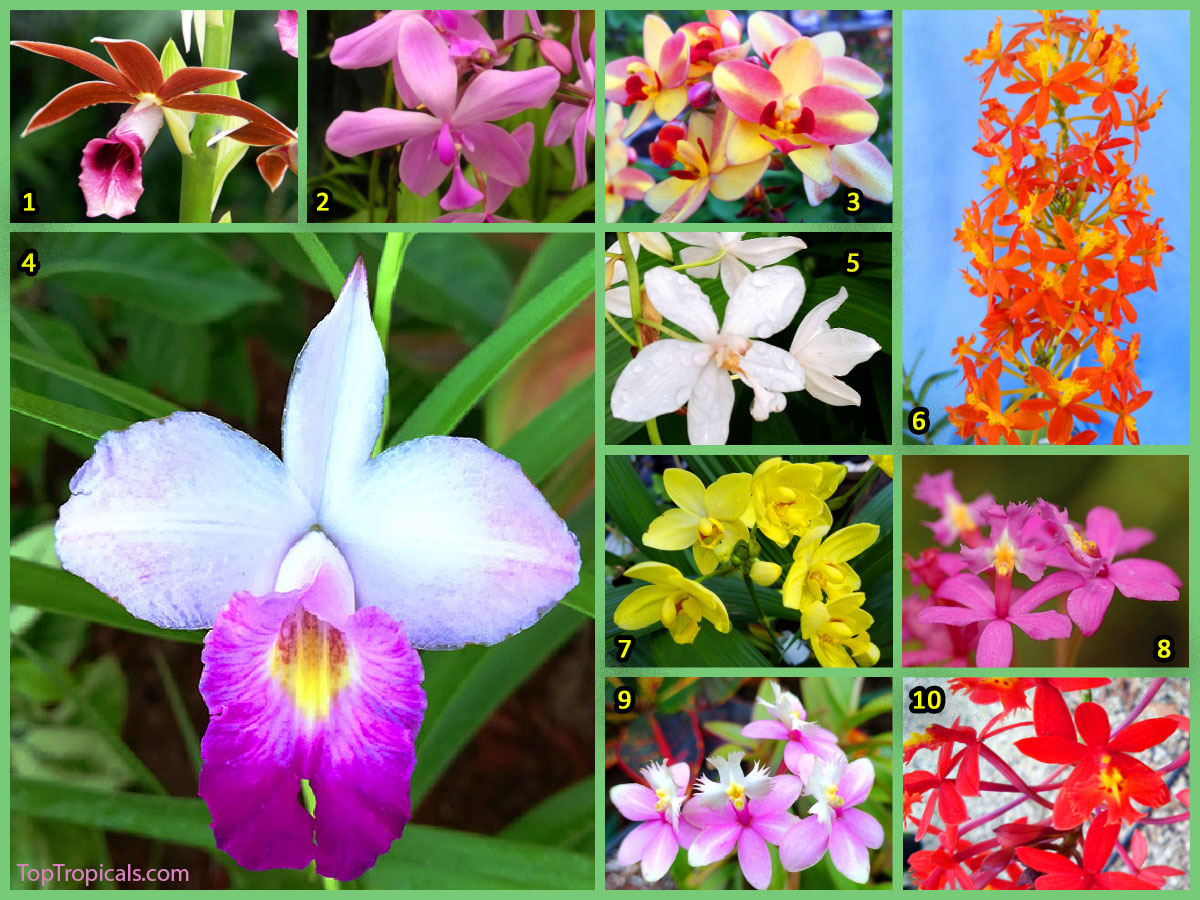
Ground Orchids – Spathoglottis, Phaius, Arundina, Epidendrum
- Chinese Nun Ground Orchid (Phaius tankervilleae)
- Yokohama Ground orchid Kate (Bletilla striata x formosana)
- Tropical Punch, Sorbet Ground Orchid (Spathoglottis plicata)
- Bamboo Orchid (Arundina graminifolia)
- Snow Angel, Coconut Cloud Ground Orchid (Spathoglottis alba)
- Orange Reed Ground Orchid (Epidendrum radicans Sunrise)
- Lemon Kiss, Sorbet Ground Orchid (Spathoglottis chrysanta)
- Pink Reed Ground Orchid, Violet Queen (Epidendrum radicans Fuchsia)
- Lavender Reed Ground Orchid (Epidendrum elongatum x radicans)
- Red Raspberry Reed Ground Orchid (Epidendrum radicans Red Glow)
Orchids have a mystique that sets them apart — elegant, exotic, almost unreal in their perfection. But let’s be honest, not everyone has luck with the fancy ones that cling to trees or need greenhouse tricks.
Ground orchids are different. They grow in regular garden soil, bloom in sun or shade, and come in all sorts of shapes and colors. They’re the orchids you don’t have to fuss over.
Nun Orchid (Phaius tankervilleae) – Ever wonder why it’s called the Nun Orchid? The flowers really do look like the white veil and brown habit nuns used to wear. The plants send up spikes 3–4 ft tall with 10–20 fragrant blooms that open one after another for weeks. I like them best tucked under trees where they just keep spreading year after year.
Spathoglottis – The nonstop bloomer – If you want flowers that just don’t quit, this one’s it. Spathoglottis clumps up and throws spikes of purple, pink, or yellow that last for weeks, then keep coming back through the summer. In warm spots they’ll bloom almost year-round. Honestly, it’s one of the easiest orchids you’ll ever grow.
💲 Special Offer – 20% off Ground Orchids!
Get 20% OFF ground orchids with code
ORCHID2025
Min order $100. Excluding S/H, valid online only, cannot be combined with other offers.
Hurry, offer expires September 17, 2025!
Date: 11 Aug 2018
From Anna Banana: Shipping and planting during hot weather

Q: I received email notification that my order was delayed due to hot weather. Why? And do I need to do anything special if I plant when it is hot?
A: When plants are shipped via FedEx Ground, it is hot in the truck! According to our FedEx area manager information, if outside temperature is 100 degrees, inside the truck it can be 130! We don't want to put your plants through that much stress. We monitor the weather at destination, and as soon as it cools down a little bit, your order will be shipped.
Planting during
hot weather:
1. For a mail-ordered plant follow planting instructions and never
plant it from the box directly into the ground. Keep it in a pot the size of a
root ball until the plant recovers from shipping stress, re-grows root system
and adjusts from several days of darkness to a bright light. Move the pot
gradually into brighter light, eventually into a spot of its permanent home. Do
not over water the pot. Once you see new growth - the plant is ready to be
transplanted into the ground.
2. Use only quality soil, containing lots of organic matter (compost, peat
moss); soil conditioner is beneficial (pine bark). Plant it on a little hill,
so growing point is elevated 1-1.5"above the rest of the surface.
3. Put a good layer of mulch around the plant, at least 1-2" thick, and not
too close to the trunk as it may cause stem rot on contact.
4. Water daily with a garden hose until the plant shows active growth -
then watering may be reduced every other day or less, or you may rely on
sprinklers and/or rains.
5. If the sun is too hot, use shade cloth (or simply a white bed sheet) to
cover the plant for the first few days (use bamboo sticks for support). It
will help the plant to establish without heat stress. If leaves start dropping
- this may be a sign of excessive light and heat. Shading is the way to
reduce it.
6. Use SUNSHINE booster
Date: 24 Jun 2018
Date: 9 May 2017
Secrets of flowering of Jasmine Sambac
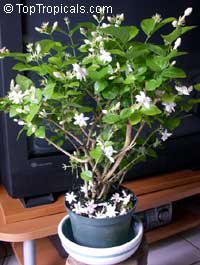
Q: Q: My Jasmine sambac Maid of Orleans is growing very fast and produced lots of branches and dark green leaves, when will I see flowers? I only saw 2 or 3 flowers since since Spring. I is planted by East wall of the house. Should I use some special fertilizer perhaps?
A: Jasmine sambac is a tropical bush or vine that enjoys hot summers. Since it
tolerates wide range of light conditions, it can be grown both in shade or sun; this is why it is highly recommended for indoor
culture where light level is limited. Remember though that profuse blooming directly depends on the light level. Your Eastern
exposure location may not be providing enough light for the flowering. Dark green leaves are also a sign of a filtered light
sitution. Extra fertilizing may not help to induce flowering if the light is low, although it is always beneficial for a plant
(it may just start producing even more leaves and branches). The ideal conditions for Sambac's flowering are - full sun all
day long, high temperatures (upper 80's-90's, even over 100F is fine), and very good drainage. Some gardeners call Jasmine
sambac "almost a succulent", referring to its low watering needs. To be exact, this plant requires regular watering, but will
produce lots of flowers only providing perfect drainage. You may never see flowers if the plant has wet feet or water-logging
occurs. If your summers are rainy (like in Florida), make sure your jasmine is planted with at least 4-5"elevation and not in a
low/wet spot.
See Top Tropicals Video about jasmine Sambac: