Date: 31 Aug 2025
🌿 The Jungle Cactus with a secret life
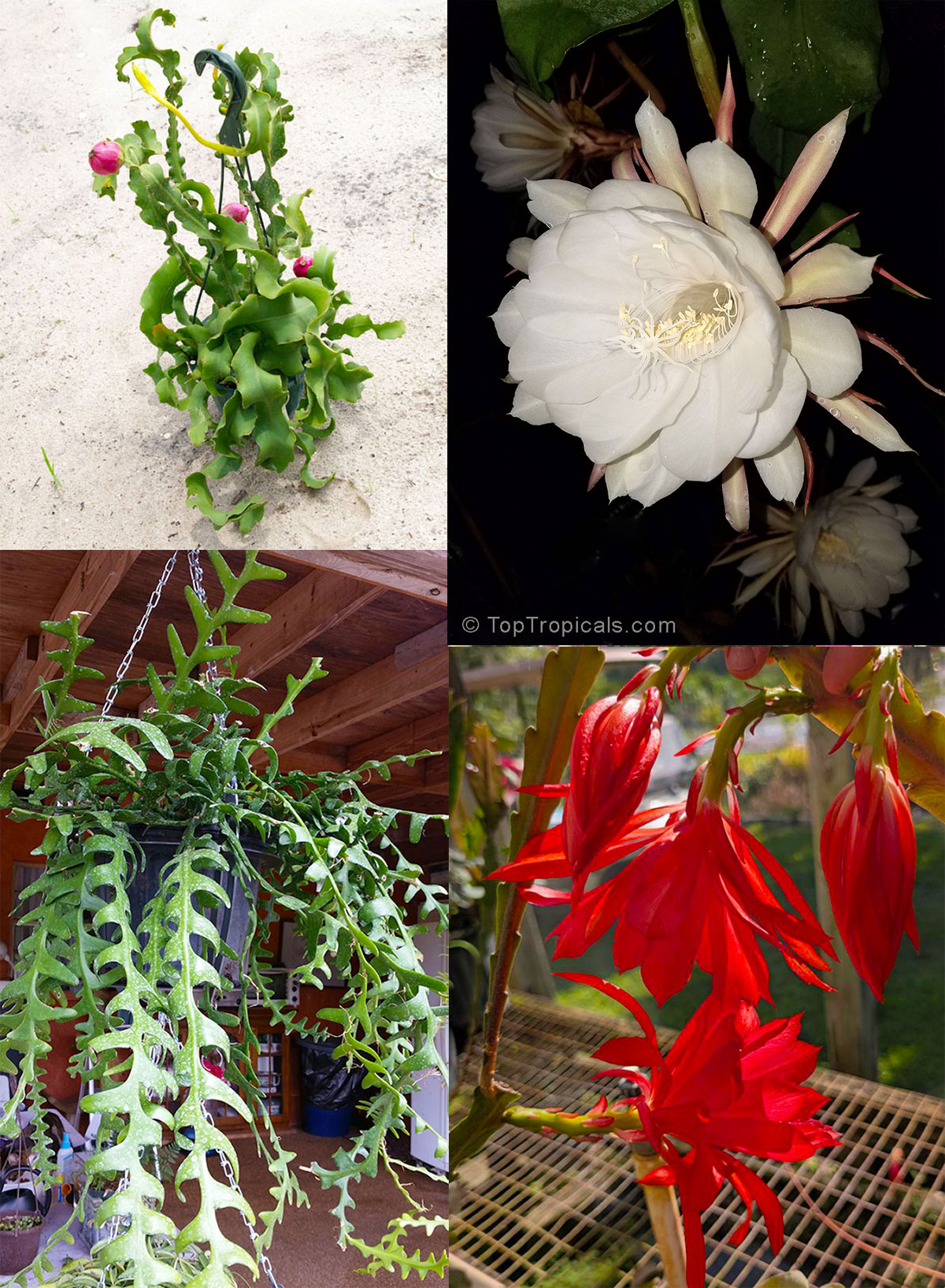
Jungle cactus collage: top left Epiphyllum guatemalense Monstrosa (Curly Locks Orchid Cactus), top right Epiphyllum oxypetalum (Queen of the Night), bottom left Cryptocereus anthonyanus (Zig-Zag Cactus), and bottom right Disocactus ackermanni (Red Orchid Cactus)
Most people picture cactus as desert plants: hot sun, sharp spines, dry sand. But that’s only half the story. There’s another branch of the family that lives in the shade of rainforests. These are the jungle cacti — epiphyte plants that climb trees, trail from branches, and throw out flowers so big and showy they look closer to orchids than to cactus blooms.
See one up close and it’s a surprise. The stems can be flat, zig-zagged, or even curly. Some trail like ferns, others pile into a shaggy basket. And when the flowers open — often at night — they’re wide, fragrant, and gone by morning. It’s no wonder gardeners like them from a first sight.
✔️ Jungle Cactus Q&A
Aren’t all cacti desert plants?
Not these. Jungle cacti are epiphytes and grow in rainforests, clinging to trees and catching rain. They never touch desert sand.
What kind of light do they need?
Outdoors, filtered sun under a tree works best. Indoors, give them bright but indirect light — east or north windows are usually safe. Direct summer sun can scorch the stems, whether inside or out.
How much water is safe?
They take more water than desert cactus but still hate wet feet. Outdoors, a rain shower is fine if the pot drains fast. Indoors, water when the top inch of soil feels dry. Always use a loose mix like Adenium mix so roots get some air.
Do they bloom indoors?
Yes. In fact, many bloom better inside where conditions are steady. They set buds when a little root-bound, and cooler nights help. Outdoors in frost-free zones, flowers come with seasonal shifts. Indoors, expect surprise buds after a cool spell by the window.
Best way to display them?
Hanging baskets show off trailing stems both inside and out. Shallow pots work well on shelves or ledges indoors. In warm climates, they can even be tied to a tree branch outside — exactly how they grow in the wild.
Extra note on indoor vs. outdoor care?
Indoors, watch for dry heated air in winter — they like a bit of humidity. A tray of pebbles and water under the pot helps. Outdoors, protect from heavy midday sun and bring them in if nights dip below the mid 30s F.
Jungle cacti are easy to keep and full of surprises. Whether trailing from a basket or blooming after dark, they prove that not every cactus belongs in the desert.
Date: 5 Sep 2025
The crown of thorns with no thorns
Euphorbia geroldii - Thornless Crown of Thorns
- ⭕️ Euphorbia geroldii, also called the Thornless Crown of Thorns, is a rare gem from Madagascar. Unlike its spiny cousins, this semi-succulent grows smooth stems. The branches are soft, graceful and droopy, with wide glossy leaves.
- ⭕️ The real show comes from its blooms - pairs of scarlet bracts with golden centers that appear almost all year long.
- ⭕️ Easy in pots, even shaped as bonsai, it's a collector's plant that looks both exotic and approachable.
- ⭕️ Surprisingly for Euphorbias, it loves shade and water!
- ⭕️ And yes - no thorns, just flowers.
🛒 Add the thornless crown to your garden
#Container_Garden
🟢 Join 👉 TopTropicals
Date: 13 Oct 2025
Sweet and crunchy fruit with a rose fragrance
🌹 Sweet and crunchy fruit with a rose fragrance
🌹Syzygium jambos - Rose Apple - is a fragrant delight fruit! Also known as Malabar Plum or Pomme Rosa, the Rose Apple produces crisp, juicy fruits with a distinct rose scent, highly prized for jellies and confections.
🌹This easy-to-grow plant is moderately cold-hardy and can tolerate poor soils.
🌹 Rose Apple trees are versatile – they make attractive, wide-spreading shade trees and can also thrive as compact, bushy fruiting plants in containers. Watch the video:
📱
🛒 Enjoy rose-smelling fruit in your garden
📚 Learn more:
What fruit smells like roses?
Date: 26 Apr 2023
Cat Horoscope
By Alex Butova, the Witch of Herbs and Cats
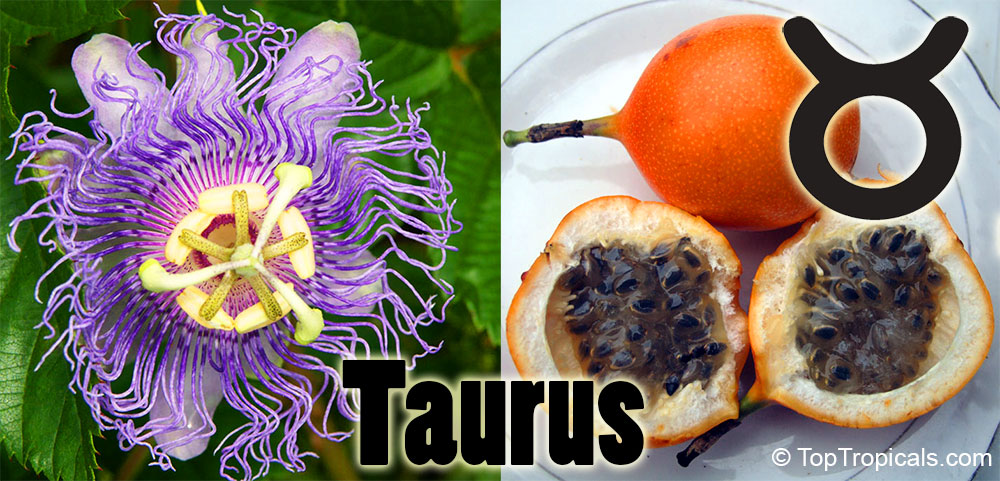
Taurus Cats 4/21-5/20

The astrological sign of a cat can be determined by either their date of birth or adoption...More >>
...Taurus Cats are real sybarites! They are relaxed and seeming not to
be worried about anything. It is pragmatic, the Cat who comes down to earth.
They enjoy being petted, groomed, and they're not likely to pass up a meal.
They enjoy their food...
...One of the overriding characteristics of Taurus Cats is that they are
gourmands. They are greedy pussy cats who put on layers for winter… all year
around. They also have impeccable taste in food as they prefer human food to
cat food, likely because human food costs more...
...They may also enjoy dreaming in a garden, nestled in the shade of plants
with soft, broad leaves ...may listen the chirping birds with half-opened
eyes, observing them at the same time - just in case...
CONTINUE READING >>
Taurus Plant Zodiac for humans
Date: 4 Jun 2016
Desert rose winter care
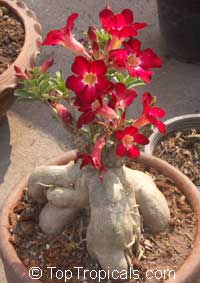
Q: I purchased several packets of desert rose seeds last year. I now have 45 very healthy seedlings some of them in bud. Almost all of my seeds grew but I lost most of them when I rook them in during winter. I did not water them for a month , kept them in their pots and set them by the window. they either dried up and died or rotted and died. I noticed when you send me grafted specimens that you bareroot them. Is this a better way to keep them inside in winter, bareroot? I hate to lose these plants come winter time. Pls advise me. I live in Houston, Tx. where we get temps below 40 degrees and sometime a day or more of freezing temps.
A: Thank you for your question. Rot is pretty common problem with Desert Roses. We monitor our Adeniums closely and have a special set up of watering environment and schedule, in dedicated greenhouses just for them. Nevertheless - every now and then we see a rotten caudex and can't help it to say "oops! over-watered!" These plants are very sensitive to environment changes, especially when it comes to a combination of water and temperature. These are a few tips that should help you to reduce risk of plant loss to a minimum:
1) Use only well drained mix with much higher content of perlite than you would use for most tropical plants. For adeniums, we use mix with 30-40% of perlite in it, while regular mix has 10-15%.
2) Adeniums like alkaline soil, unlike most of tropical plants (hard to say what else likes alkaline... Ficus for sure!). This means, regular mix with high content of peat moss may cause root rot. To increase alkalinity, you may add dolomite. Here in Florida where we have natural supply of shell rock handy, it is easy to add some shell to a potting mix (shell sand, rather than quartz sand). We always add a few large shells on top of a pots with a big specimen. Besides increasing soil pH (making it more alkaline), shells look very decorative.
3) Water very carefully during cooler months. When it is hot (85-100F), excessive water usually won't harm adeniums: it will be partially used by a plant, and partially will evaporate. Especially be careful with water when temperatures drop below 65F - then tropical plants simply stop growing process and go dormant. Once adeniums start losing leaves, this is a sign to reduce watering to once a week to once a month, and in very small quantity (couple tablespoons per pot).
4) We do not bareroot adeniums for winter storage. They are not bulbs. Barerooting of this plant is recommended only during shipping. Adeniums can stay without soil for up to a week without hardly any stress, sometimes even longer.
5) We keep our big collection specimens on a roofed porch during winter, where level of light is very low. Last winter we haven't lost a single plant due to low light. They take shade pretty well considering minimum or no water. However bright light is always better - it creates healthier environment for a plant. We all know about space limitations for our large collections, especially in winter. So if you can afford a bright spot for adenium during winter - the plant will be lucky!