Garden Blog - Top Tropicals

Date: 20 Feb 2026

What tropical plants survived Floridas historic freeze without protection

Florida historic freeze

What tropical plants survived Florida's historic freeze without protection

In the first week of February 2026, arctic air pushed deep into Florida. For many areas, this was the coldest event in over a century.
We received one question over and over: How did your gardens do?
Top Tropicals Farm in Sebring, Florida is up and running - and this freeze became a real-world hardiness test for tropical and subtropical plants. Below is our initial field report after inspecting established plantings.

📊 Weather data - February 1-6, 2026


Sebring, Florida - 132 years of recorded observations
This was not a light frost. It was prolonged, windy, penetrating hard freeze.


🌡 Minimum temperature: 25F
❄️ Wind chill: 14F
⏳ Duration: 3 nights of 8-10 hour hard freeze
☀️ Daytime temperatures: around 50F for 7 days
🌀 Wind: sustained 20 mph, gusts 40-50 mph
  • Cold protection


    In-ground trees: selected plants covered with frost cloth, especially mango and young avocado trees.
    Tender container plants: moved into greenhouses with propane heat above 34F.
    Hardy container plants: frost cloth and wind protection only - no plastic
    Nutrition support: plants fertilized regularly during the growing season with Green Magic and Sunshine Boosters to maintain vigor and hardiness.

    However, the plants listed below had no protection at all.
    All were established trees 2-3 years in the ground.
  • The plants below had NO PROTECTION, established trees 2-3 years old


✅ Survived with no damage
:
  • 🍑 Tropical Fruit Trees and Edibles:


    Citrus
    Loquats
    Mulberries
    Macadamia Nut
    Jaboticabas
    Pomegranates
    Avocado - cold hardy varieties
    Feijoa - Pineapple Guava
    Psidium littorale - Cattley Guavas
    Eugenias (Grumichama, Rio Grande, Surinam and more)
    Olive trees
    Bay Leaf (Laurus nobilis)
    Fig trees (Ficus carica)
    Prunus sp - Peaches, Plums, Nectarines
    Persimmons
    Rubus (Blackberries) including Tropical Mysore Raspberry
    Elderberry (Sambucus)
    Yerba Mate - Ilex paraguariensis
    Opuntia - Nopal Cactus, Prickly Pear


🌸 Flowering Trees and Shrubs:


Beaucarnea recurvata - Pony Tail
Callistemon - Bottlebrush
Yucca
Tabebuias
Magnolia figo and Little Gem
Calliandra tweedii - Red Powderpuff
Sophora tomentosa
Galphimia gracillis - Thriallis
Acacia trees
Osmanthus fragrans
Abutilon trees
Erythrina - several species
Monkey Ear tree - Enterolobium cyclocarpum
Bauhinia Orchid Trees - several species
Pseudobombax ellipticum - Shaving Brush Tree
Bulnesia arborea- Vera Wood
Caesalpinia mexicana, Mexican Bird of Paradise
Sansevieria - Snake Plant
Foxtail fern - Asparagus densiflorus
Lonicera - several varieties
Jacaranda tree
Eucalyptus
Plumbago Imperial Blue
Philodendron bipinnatum
Gardenias
Gingers (dormant rhizomes)

✳️ Minimal leaf damage only:
(These plants showed light cosmetic damage but no structural injury)

🍑 Tropical Fruit Trees and Edibles:


Glycosmis pentaphylla - Gin Berry
Black sapote tree
Tamarind tree
Syzygiums: Rose Apple and Java Plum

🌸 Flowering Trees and Shrubs:


Pandora vine
Jasminum - several species
Stenocarpus sinuatus - Firewheel Tree
Xanthostemon
Quisqualis indica
Schotia tree
Eranthemum pulchellum - Blue Sage
Hiptage benghalensis - Helicopter Flower

🏡 What this means for Florida gardeners


This freeze was a stress test few gardens are prepared for. Yet many species handled 25F, wind, and multi-night freeze conditions without protection.
Choosing proven survivors, planting in smart microclimates, and maintaining strong plant health during the growing season makes a measurable difference.
More updates will follow as full recovery continues - but these early results already help define a stronger plant palette for future winters.

🛒 Explore cold tolerant tropical plants and cold hardy Avocados

📚 Learn more:


🎥 These Avocados survived 3 nights of 25F hard freeze, Florida Record Freeze

#Discover #How_to

🟢 Join 👉 TopTropicals
Date: 13 Jan 2017

January kaleidoscope: Top Tropicals plants... and cats

Plants in Winter

Q:
My plants Mango and Sapodilla (I got from Top Tropicals) got cold frost recently up to the roots recently in a cold wave in NJ. The leaves are dry. The plant was kept in a green house. But the heater was off for a night. During that time the in the pot got frozen. Will the plants survive? Will they come back during spring?

A: Unfortunately, the chances are slim. It is hard to determine now if they will survive. Those plants can take a very short cold. They might survive when the root system was not frozen solid. To ensure your plants cold protection in the future, this is what we recommend:
1) Use temperature alarm. Nowadays they're very cheap, they can send a message to your email or cell phone.
3) Heaters like any other piece of machinery may fail. Redundancy is the keyword. Instead of one large heater use two of smaller capacity. If one fails, then second one will prevent catastrophic failure
4) Insulation. Extra layer of insulation helps greatly.
5) If you leave for vacation, then plan ahead. Have somebody to watch over your greenhouse. Move plants or at least the most sensitive ones inside of your house if possible.

Meet Top Tropicals Team. Part 1 - PeopleCats! Did you know that here at Top Tropicals we care not only about plants, but also animals? Most of our PeopleCats and PeopleDogs either came to us from nowhere in hope of survival, or have been rescued. TopTropicals is proud to support all of our People. A portion of every dollar you spend on a plant purchase goes to our Cat Community maintenance, food and other needs of these Little People. We will keep you updated with more pictures and videos on our PeopleCats (that also includes one dog Bob). They all are members of our Team, helping us to grow plants for you, pack them and send to you from our Shipping Department. Visit our Facebook, YouTube Channel and LIKE all of our People!

Stay updated with TopTropicals Videos by subscribing to our channel at YouTube.com/TopTropicals and get our latest video news of what's fruiting and blooming!

Date: 23 Nov 2016

Growing tropical fruit trees in containers in winter

Q: Please give me your advice. The winter is here. I bought mango tree, jackfruit tree, sugar apple tree and planned them for spring. What can I do to keep them no frost bite? My home in Bonifay FL.

A: In subtropical areas with occasional hard freeze in winter, we recommend you to keep tropical plants in pots. The plants you purchase are tender to frost. For cold protection, container growing has several advantages:
1) easy to move into wind-protected and sun-exposed locations as needed: for example, on a different side of the house. In many areas, seasonal prevailing winds have opposite directions in Summer and Winter.
2) easy to cover with frost cloth, sheets, or blankets in case of immediate cold spells. Container plants' growth is easier to control and trim, and those plants naturally stay more compact.
3) easy to move indoors, inside garage, or in covered lanai/patio.
We also recommend to keep these trees in their original pots until Spring, in containers size of the rootball. Step them up in Spring, when plants start active growth of root system. This will help you to avoid root rot due to possible overwatering in Winter. Reduce watering in any case, and keep your plants in bright, wind-protected spot. Do not fertilize until Spring. Protect from cold when night temperature drops below 35-40F.

Use SUNSHINE plant boosters to provide additional cold tolerance.

Cold protection is a lengthy subject. You may also use propane heaters during cold nights. Here is some more information on cold protection.

Black Friday starts Wednesday! Use this discount code in your shopping cart from Wednesday through end of Friday. Enter THANKS2016 in your shopping cart for 20% off on all plants and seeds from our store - no minimum order! Offer is not valid for previous purchases

Date: 14 May 2016

Top Tropicals Video: Ambarella - delicious June Plum

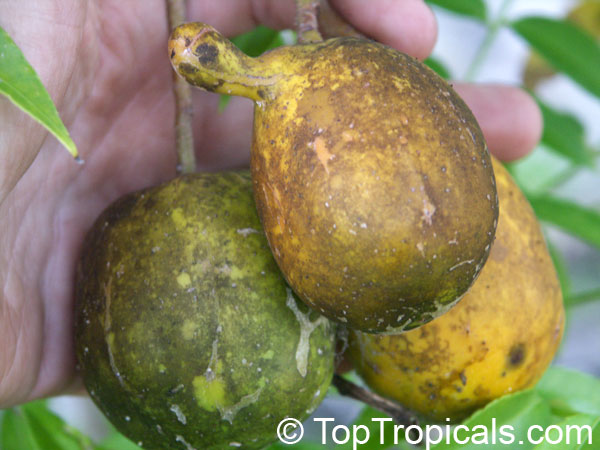
Golden Apple, or June Plum - Spondias cytherea.

This exciting fruiting plant will amaze you with its ability to flower and fruit at a young age. It fruits in winter and holds the fruit up to 6-8 months, long after the leaves have dropped. The fruit appears in pairs and will turn a brushed-golden color as it ripens. Its feel and juiciness resembles that of a mango but with completely different flavor. The Golden apple is used both in sweet and savory dishes depending on its ripeness. When green, the fruit is commonly eaten as is (with or without skin just like green mangoes) with salt and other salty/spicy dips, made into salsas, chutneys, and into juices and smoothies. When fully ripe, the Golden Apple will be deep yellowish-orange in color. When yellow, the fruit is eaten just like an apple or stewed with sugar to make an applesauce-like dessert.

Check out this video: ...

Stay updated with TopTropicals Videos by subscribing to our channel at YouTube.com/TopTropicals and get our latest video news of what's fruiting and blooming!

Date: 9 Apr 2026

*️⃣ Stop Babysitting Your Trees - Grow Cold Hardy Avocados Instead

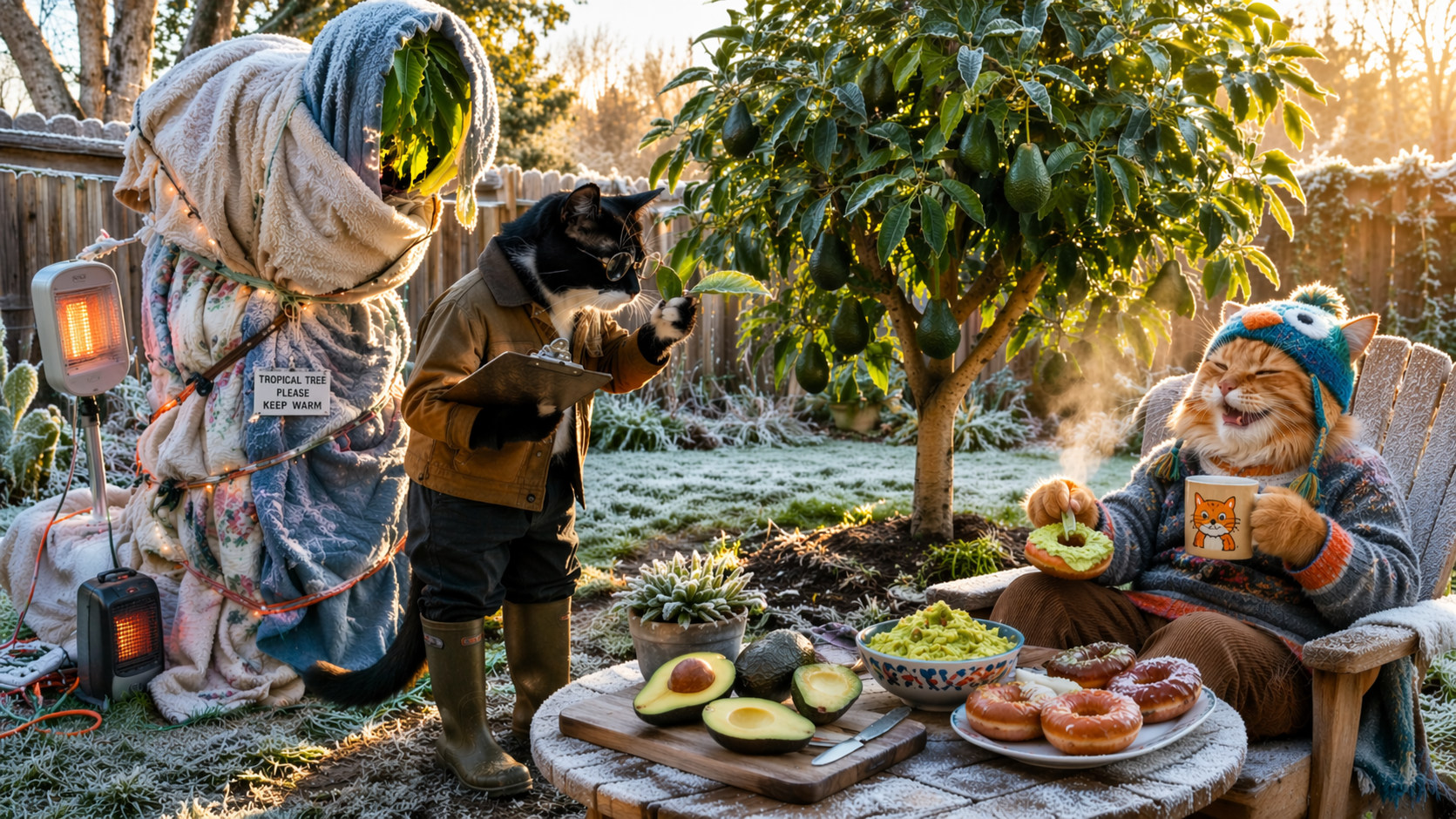
Smokey  the  black-and-white  cat  with  glasses  sits  on  a  patio  taking 
 notes  while  Sunshine,  a  fluffy  orange  cat  wearing  bunny  ears,  holds  a  small 
 potted  mango  tree  with  light  yellow  flowers.
Sunshine: I love these crazy guacamole donuts… but I’m tired babysitting trees during cold.

Smokey: Then stop planting trees that need babysitting. Plant cold hardy avocado.

Read more about Smokey & Sunshine

You always wanted an avocado tree. Not in Miami - right there in Central Florida, in your own yard. You planted one, it grew well for a few years, and it felt like you finally figured it out. Then 2026 hit. A few cold nights, temperatures dropped below what your area usually sees, and the tree was gone.

Here is the part most people miss: USDA zones are based on average minimums, not the worst freezes. One bad night can erase years of growth.

That does not mean avocado will not work. It means you planted the wrong variety. Cold hardy avocados are built for exactly this kind of surprise.

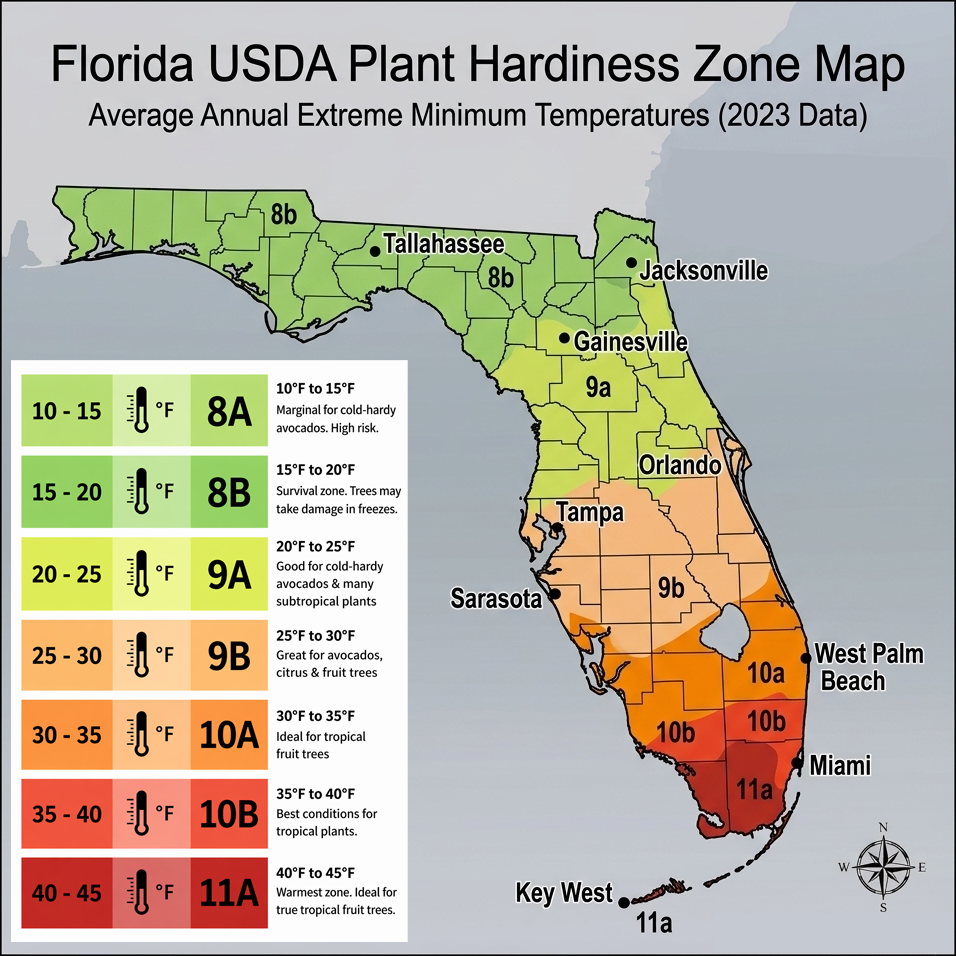
Florida  USDA  plant  hardiness  zone  map  showing  zones  8a  through  11a  with
    temperature  ranges

USDA zone map

This USDA Zone map makes one thing clear: all of Florida can grow avocado. The question is not if - it is which variety. From North Florida (8b) to South Florida (11a), there is always an option that fits your conditions.

If you are outside Florida - in Texas, Louisiana, California, or anywhere else - the same rule applies. Start with your USDA zone, then choose the right type of avocado for it. You can check your local zone here

So what does this mean for your yard? It is not about trying again and hoping for a warmer winter. It is about choosing a tree that actually matches your zone.

Cold Hardy Avocado Varieties for Reliable Harvests

Swipe left/right to see all data <->
🌡️ Threshold 🛡️ Resistance Profile Primary Varieties & Type Culinary Profile 📍 Geographic Best Fit
15°F+ High Resistance: Mexican-type selections. Short freezes near 15°F are survivable with minor leaf burn. Fantastic (A), Joey (B), Lila (A), Poncho (B) High Oil / Nutty USDA Zone 8b / 9a transition regions. Central/North Florida, Texas, Arizona
20°F+ Moderate: Brief freezes usually survivable. Full recovery may take an entire growing season. Bacon (B), Brogdon (B), Day (A), Fuerte (B), Mexicola Grande (A), Ulala "Super Hass" (A), Winter Mexican (B) Medium Oil / Creamy Coastal 9a. Inland Florida and colder microclimates.
25°F+ Light: Visible canopy damage and branch dieback are common. Survival depends on wind protection. Choquette (A), Oro Negro (B), Lula (A) Rich / "Black Gold" Zone 9b/10a. Coastal Central Florida and protected microclimates.
30°F+ Frost Tolerant Only: Even brief freezes cause rapid damage. Best for South Florida. Simmonds (A), Black Prince (A) Mild / Large Slicing USDA Zone 10a / 10b. S. Florida, Miami, Keys, Coast.
  Compact: Move inside during cold Dwarf Wurtz (A&B) and Fuerte (B) Rich / High Oil Patio Growers & Containers

See more varieties in our Master Avocado Varieties table

Microclimate matters more than your zone. The same yard can have warm and cold pockets. Plant near a south-facing wall, under light canopy, or in a spot protected from wind, and you gain a few critical degrees on cold nights.

Young avocado trees need protection during their first winters. They have not built enough wood or root strength yet, so even a short cold snap can damage them. Simple steps like frost cloth, wind protection, or temporary covers can make the difference between a setback and a loss.

You may see avocados labeled as Type A or Type B. This refers to how the flowers open, not cold hardiness. Some people mix both types to improve pollination, and while a single tree can still produce fruit, having two different types is beneficial and can increase your harvest.

Practical Planting Advice

  • Plant on a mound
    Raise the root zone 4-8 inches for fast drainage.
  • Avoid low spots
    Standing water is worse than drought for avocados.
  • Full sun
    Maximum light = stronger growth and better recovery.
  • Use microclimate
    South-facing wall, light canopy, or wind protection adds critical warmth.
  • Do not overwater
    Let the top layer dry slightly between watering.
  • Protect first winter
    Cover young trees during cold nights.

✅ Stop Guessing. Plant What Works.

Cold hardy avocados are not theory - they are proven to handle real conditions. Choose the right variety for your zone, plant it correctly, and you stop replacing trees after every cold snap.

🎥 Watch cold hardy avocado videos

✨ Grow More. Save More.

Get 10% off when you buy 2 or more 3 gal avocado trees. Mix varieties, combine Type A and Type B, and set yourself up for better pollination and bigger harvests.
Offer valid through 04/15/2026. No code needed - discount applied automatically at checkout.
Discount applies to 3 gal avocado plants only. Not valid on previous purchases and cannot be combined with other promotions or discounts. Offer subject to change without notice.
🛒 Shop cold hardy avocado

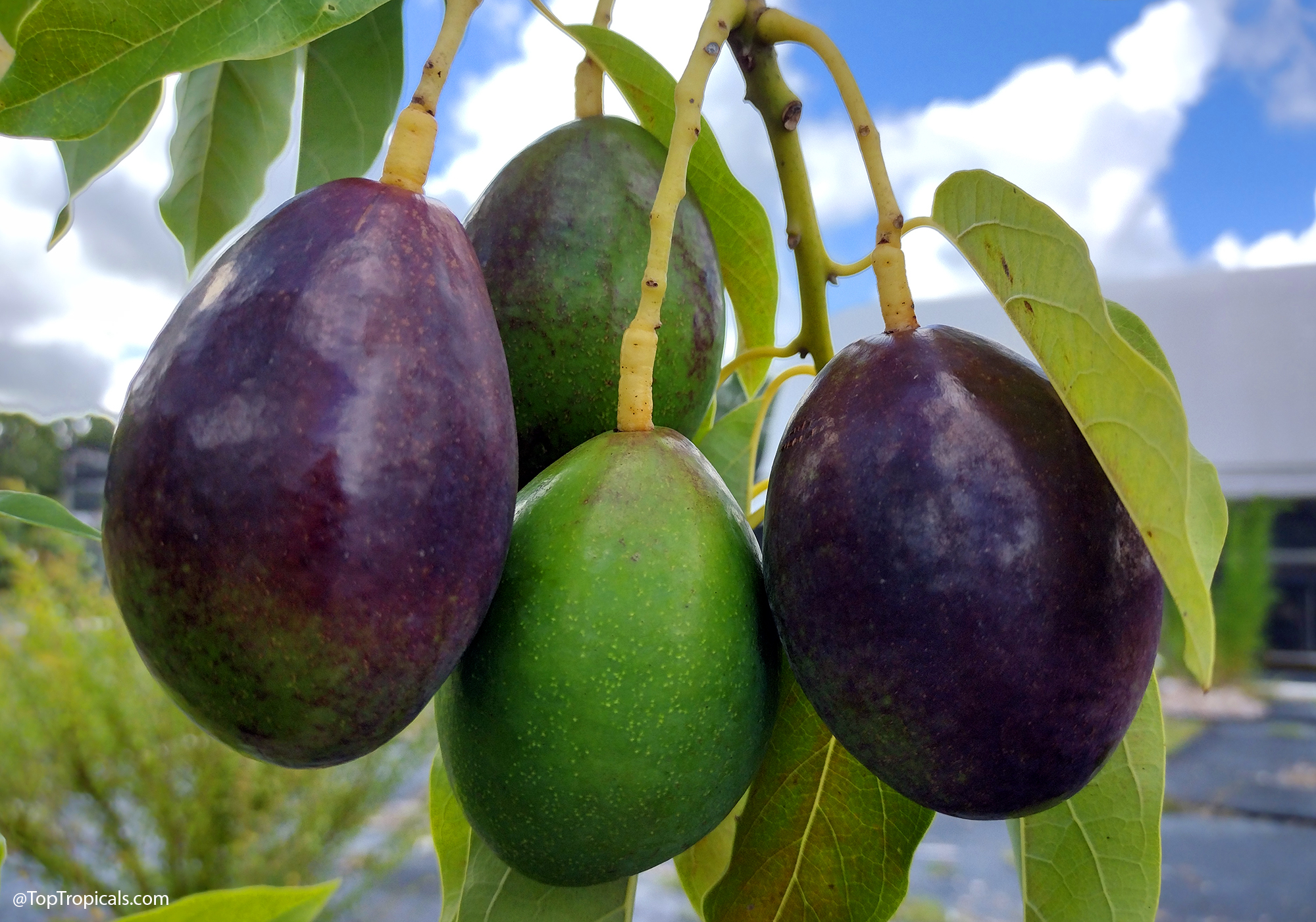
Avocado  tree  Joey,  Semi-Dwarf,  Cold  Hardy  (Persea  americana)  -  purple 
 and  green  fruit  on  a  branch

Joey is one of the most cold hardy Avocado trees with a compact habit and very pretty fruit. The flesh is nutty, smooth, and mildly sweet.

📚 Learn from our Blog:
Avocado for cold areas

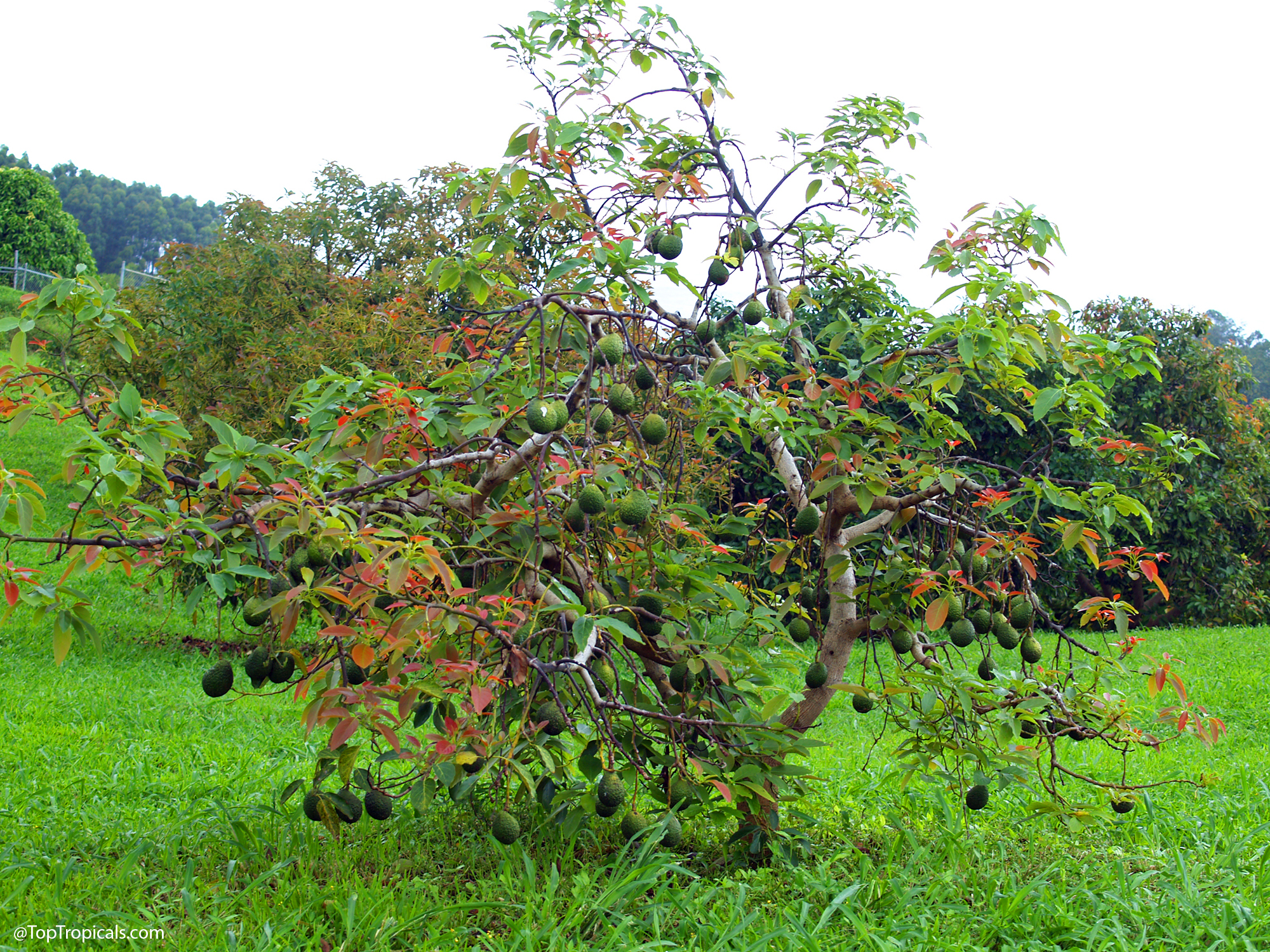
Fuerte  avocado  tree  compact  dwarf  growth  with  green  fruit  in  garden 
 setting

Fuerte is very productive, cold hardy, and is one of very few dwarf avocado varieties that stay compact in the garden and easy to grow in container.