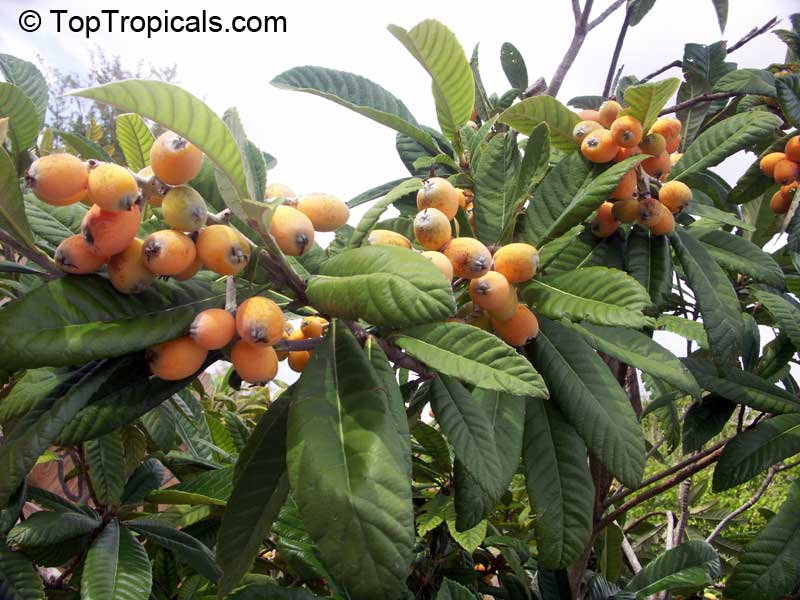
Loquat is one of the easiest tropical/subtropical fruit trees to grow,
with delicious fruit resembling Apricots (in fact, from the same family!).
This video presented by our video host David Mortimer.
Stay updated with TopTropicals Videos by subscribing to our channel at
YouTube.com/TopTropicals
and get our latest video news of what is fruiting and blooming!
This one is the most wanted variety with
elongated petals that are sweetly scented. Compact and
slow growing shrub, it makes a great houseplant and
flowers freely throughout the year. The most profuse
flowering is from Spring to Summer.
Called pikake in Hawaii, Jasmine sambac is the plant
used to flavor the jasmine tea and making perfumes.
Perfect houseplant takes both sun or shade, it is a
beautiful fragrant everbloomer for your home and garden.
Belle of India is a slow grower, with pale green pointed
leaves and double flowers with elongated narrow petals.
Prefers filtered light for a better look of the leaves,
but will tolerate full sun. In fact the more sun the
more flowers you get.
Secrets of successful culture:
1) use only well-drained potting soil
2) keep the plant a little bit on a dry side so roots
don't get too wet. Water again when the soil gets
slightly dry.
3) Use micro-element mix - SUNSHINE Superfood works
the best. It will keep leaves nice and green and induce
more profuse flowering.
Stay updated with TopTropicals Videos by
subscribing to our channel at
YouTube.com/TopTropicals and get our latest video
news of what is fruiting and blooming!
The most asked-about tree in the Sunshine State: Bauhinia
Purple Orchid tree - Bauhinia purpurea
🌸 The most asked-about tree in the Sunshine State: Bauhinia
🌸 If you visit Florida in winter, chances are you will notice a tree covered in orchid-like flowers and wonder what it is. That tree is often an orchid tree, most commonly Bauhinia purpurea. It is fast growing, wide spreading, and blooms from late winter through spring, sometimes with a second round in summer. The flowers range from magenta to lavender, are lightly fragrant, and stand out even from a distance. The leaves are just as distinctive - split into two halves like butterfly wings, which is why these trees are also called butterfly trees.
🌸 Orchid trees are easygoing and practical. They thrive in full sun, tolerate many soil types as long as drainage is good, and need little water once established. Growth is quick, often 2–3 feet per year, making them excellent shade trees for hot climates. The flowers attract bees, butterflies, and hummingbirds, and in some cultures the buds and blossoms are used in cooking, while the bark has a long history in folk remedies. Beautiful, useful, and low maintenance, orchid trees are a perfect fit for Southern landscapes.
🎩 How to grow Chinese Hat Flower - when winter colors most needed
The Holmskioldia sanguinea, better known as the Chinese Hat Flower, gets its name honestly. Each bloom looks like a tiny hat or parasol - a little tube backed by a flat, round disc. Once you notice it, you cannot unsee it!
What really makes this plant special is when it blooms. While most gardens slow down, Chinese Hat Flower kicks into gear from winter through early spring. The branches fill with flowers first, and the leaves follow later. It is one of those plants that quietly steals the show when everything else is taking a break.
More than one color
Most people know the classic red form, but there are several color varieties worth mentioning:
🔴 Red - the most common and bold 🟡 Yellow - Holmskioldia citrina, bright and cheerful, harder to find 🟠 Bronze / orange-bronze - warm tones that glow in winter light
Having different colors makes it easy to mix them or use just one as a winter focal point.
How it grows and where it works best
Chinese Hat Flower is a fast-growing, scrambling shrub. It is not stiff or formal. Think loose, graceful branches that like support. It does great when trained on:
· Trellises
· Fences
· Arbors
· Large containers with a support
· You can also let it grow as a free-form shrub and lightly prune to keep it tidy.
Care, the practical version
· Light: Full sun to light shade
· Water: Regular watering, especially while establishing
· Soil: Well-drained, not picky
· Pruning: After flowering to shape and encourage new growth
Once established, it is easygoing and forgiving.
Bonus points
· Blooms when the garden needs color most
· Attracts butterflies and hummingbirds
· Works as a flowering screen or accent plant
· Looks tropical without being high-maintenance
If you like plants that earn their space and do something interesting in winter, Chinese Hat Flower is one to keep in your garden.