Garden Blog - Top Tropicals

Date: 1 Aug 2016

Growing gardenias indoors

From Brian B, WI: Just wanted to share this photo of one of the plants my parents got from you 3 months ago.

Q: Gardenia taitensis is my favorite gardenia. I would need to keep it indoors under a grow light. Is it worth trying to grow indoors or is really difficult? If so, can you recommend and indoor plant that has big fragrance and blooms often?

A: When growing gardenias indoors, four most important factors must be taken in consideration:
1. Bright light (Southern window and/or proper lighting set up)
2. Proper watering (gardenias love water, but roots are very sensitive to excessive water)
3. Rich organic soil with perfect drainage characteristics, regular feeding with high phosphate component and micro-elements containing Iron or Ferovit.
4. Insect control (inspect underneath leaves regularly and apply systemic or on-contact treatments as needed). See Top Tropicals video on easy insect control.

We definitely recommend Gardenia taitensis (both single and double flower varieties) for indoor culture. Another species, Gardenia vietnamensis, is even easier in cultivation as it takes wide range of conditions and may tolerate slight overwatering (unlike other varieties which are more sensitive). These three mentioned gardenias are somewhat tolerant to low light conditions. Under a proper care, they will grow successfully even in bright shade, however for blooming they require as much light as you can provide. Properly adjusted growing light may be helpful. You may refer to our article about indoor plant lighting in our magazine Tropical Treasures, Issue # 15, or website page.

Date: 18 Apr 2016

Seeds germination in summer

Q: What is the best way to germinate seeds in summer? Should I keep trays indoors or put them outside?

A: Summer is the best growing season for plants, and for their propagation. Seed germination process of tropical plants usually benefits from warm, and even hot temperatures, so keeping pots with seeds outside in full or partial sun can be the best way. However some seeds may be more sensitive than others, or require slightly cooler or higher temperature for germination. These are a few tips that may help:

- For seed germination, use only well drained mixes, containing either peat moss or coconut fiber to retain moisture. Some succulents may require adding sand to the germination mix. You may also try our Professional Formula Seed Germination Mix.

- Large tropical seeds, like palms, or seeds of Fabaceae (Bean) family, can be grown in full sun. Their germination will benefit from higher temperatures (up to 90-95F). Make sure to keep soil moist. Cover them well, with 3/4 to 1 inch of soil.

- Fruit seeds (large size) should be germinated either in individual cells or small pots (3-4" diameter).

- Small to medium size seeds can be grown in so-called community pots. Seedlings can be separated after they establish their first roots.

- Tiny seeds should be planted closer to the surface, covered with only 1/4-1/8 inch of soil; some seeds require bright light for germination, so full sun will be a plus. Some small seeds like Ficus for example, prefer to be broadcasted on the surface, uncovered. Put containers with such seeds in bright shade, as you don't want the surface of the soil to dry out.

- Once your seeds sprouted, move them in filtered light - bright to medium shade depending on tenderness of the species. (Gingers prefer shade, while succulent sprouts can stay in brighter light). Regardless of water/sun needs of the species, all young sprouts and first leaves are sensitive to hot sun and may get burned or even killed. Once a baby plant has a few leaves and well-branched root system, you may start moving trays into a brighter light.

- Do not overwater young seedlings, keep soil slightly moist but not soggy.

See full list of available seeds.

Date: 1 Jul 2022

New video: Cheena
Jackfruit x Chempedak Natural Hybrid - Jackedak

Jack-edak is a highly recommended variety grown in TopTropicals garden from a seedling of Cheena (Jackfruit x Chempedak) that fruited for us within 3 years from planting. The fruit (20-25" size) is probably the best we ever tasted! It is super sweet, crunchy and has a rich, pleasant, excellent flavor. It has very little latex which makes it easy to handle when cutting up. The tree produces at the very base of the trunk, so you can prune it as short as you want. Our tree survived light frosts as well as 48 hours of 3 ft flooding, with no damage! Cheena is a natural hybrid between Jackfruit and Chempedak. The tree has an open, low and spreading growth habit and can be maintained at a height and spread of 8 ft with annual pruning. Cheena is a consistent producer. The fruit are up to 25 lbs, long, narrow and uniform in size and shape. The skin is green, with blunt spines that yellow and open slightly upon maturity. Comes true from seed.
Cheena  -  Jackfruit  x  Chempedak  Natural  Hybrid  -  Jackedak

Subscribe to our Channel:

Stay updated with TopTropicals Videos by subscribing to our channel at YouTube.com/TopTropicals and get our latest video news of what is fruiting and blooming!

YouTube  Top  Tropicals


Grow Your Own Food

Last chance to save 20% on all Jackfruits!

offer expires soon, hurry up!

Jackfruit

See all Jackfruits

Date: 21 Jun 2022

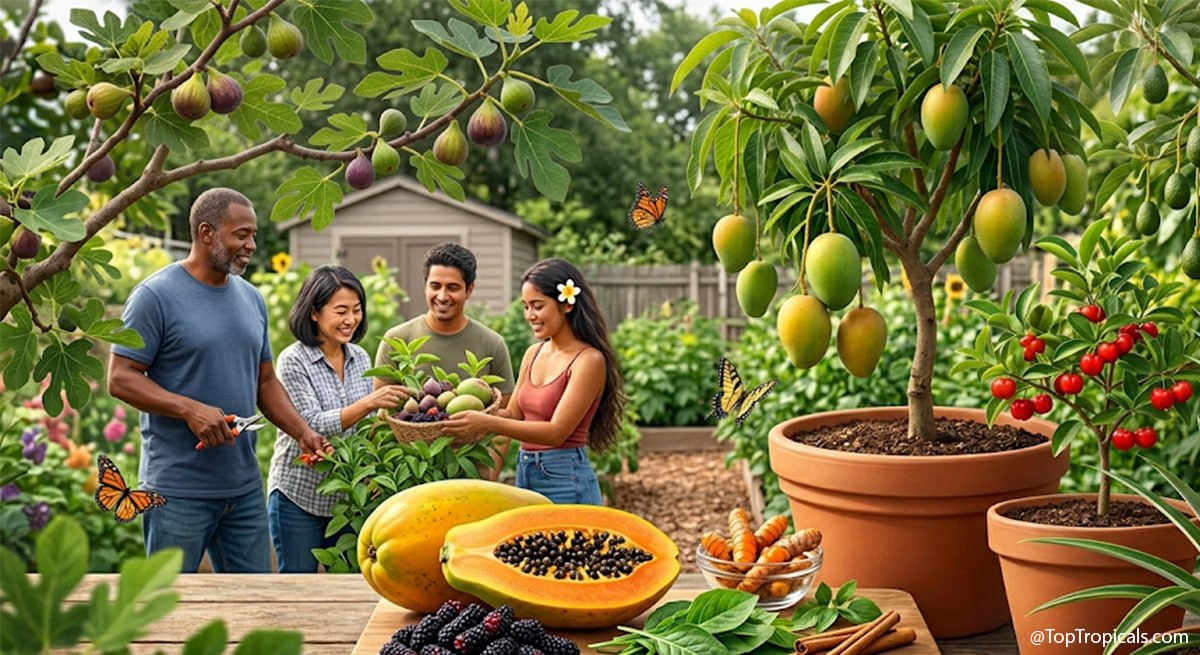
Grow Your Own Food...
Affordable for everyone!

Grow  your  own  food

Grow Food Not Lawns - this is the theme for our Garden party. But it's much more than that. It's a philosophy and a state of mind. One that more and more people are adopting as the world's food supply continues to dwindle and get more expensive...
Like all things plant and garden related, each of us can adopt this state of mind at whatever level we're capable of and comfortable with. Many of our customers just want to start small and see what it's all about. After all, the world of tropical plants can be more than just beautiful, it can be sustaining as well!

Growing your own food is more than just about price, it's also about quality, choices and availability. As you watch the choices, and quality of store bought food go down and prices continue to go up, maybe it's time to grow more of your own food?

Fun Facts

- A mature mango tree can produce 200 to 300 fruit per year
- A single avocado tree is capable of producing 500 avocados in one year
- A mature papaya plant can produce as many as 100 fruits per growing season
- One longevity spinach plant can provide you with a fresh supply of healthy spinach leaves all the time!

At Top Tropicals we offer a wide selection of fruit, including mango and avocado, and even spinach to get you started and to continue down the road on your own self sustaining journey. Even better, to help you with your food project, we have not only added to our varieties, but we have reduced prices on many items to make it even more affordable and enjoyable!

Who is cutting prices in today's world?! - We are, because...

...it's important that we do what we can to make it easier for our customers!

We have Avocados starting at only $49.95 and Mangos as low as $79.95, with dozens of varieties in stock! Use our discount coupons to save even more, and if you're local or in Fort Myers, stop by our Garden Center and save even more!

Mango  fruit

Date: 5 Jan 2022

Five Favorite Winter Bloomers

#5. Parrots Beak

Gmelina philippensis - Parrots Beak. An extraordinary fountain-like shrub with pendant branches, large long leaves and exotic flowers comprised of yellow blossoms which emerge at the end of a tube-like structure of overlapping bracts. The flower resembles parrot's beak!

#4. Royal Queens Wreath

Petrea - Royal Queens Wreath, Tropical Wisteria. Spectacular tall clusters of purple flowers similar to those of Wisteria come in racemes reaching over 1 foot long!

#3. Chinese Hat

Holmskioldia sanguinea - Bronze Chinese hat. Rare variety with orange-bronze flowers. Unique flowers are the main interest: each is a narrow tube backed by a broad, circular calyx, just like an oriental hat!

#2. Jacaranda

Jacaranda - all-time favorite winter flowering tree. Hypnotizing bluish-purple, trumpet-like flowers create the magical image of the tree...

#1. Royal Poinciana

Delonix regia - Royal Poinciana, Flamboyant. one of the most popular tropical trees covered with bright red orchid-like flowers from late winter through early summer. A must for any tropical garden, this tree however requires space since it spreads its branches 30-40 ft wide or more.