Garden Blog - Top Tropicals

Date: 5 Apr 2016

Jungle on Windowsill 101
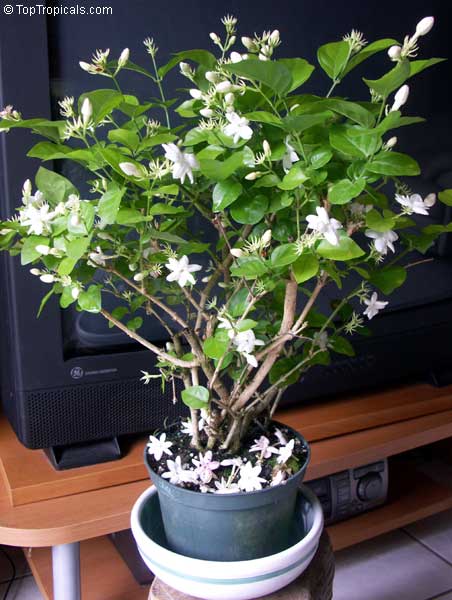
Q: I got a Jasmine Sambac and a Tahitian gardenia as presents, they are very cute plants with flowers and flower buds. I would like to be able to keep them alive and hopefully happy for a long time, but I don't know much about growing tropical plants, and I am not sure if my thumb is green enough to make everything right. What do they need? How much sun? How much water? What kind of soil? Sorry for all these (maybe silly) questions, but I want to keep them alive, please help! I live in Wisconsin and we had some snow again last week.

A: Growing tropicals is not a hard work, it is a lot of fun! These plants are actually a good starters for a beginner who wants to try growing tropical plants, no matter if you live in a mild frost-free climate, or up North where you can have these beauties as houseplants. Below are a few simple steps for you:

1. Read. Follow planting instructions included with your plants. Check plant names on the tags and learn more about them from our online catalog.

2. Soil. Plant in quality potting mix - it must be porous and well-drained, never use heavy soils (top soil or garden soil are no-no), in a pot exactly the size of the root system. You can step up your plants in the next size container once you notice vigorous new growth. Next size means: 4"pot can go into 6" pot, 6"pot into 10" pot, etc. Too big of a pot may create rotting environment, root system must fill the entire container to use all the moisture from the soil. Container must have good hole(s) for excess water to drain through. Put the pot in a saucer and get rid of excess water every time after watering.

3. Light. Most tropical plants require lots of light in order to produce flowers. If you ever visited Florida, remember the bright sun? - these are ideal light conditions for tropicals. Up North, provide as much light as possible: a bright spot on a windowsill of Southern or Western exposure would work the best. If the sun gets too hot in summer afternoon, you may shade the window a little bit with a sheet of white paper to avoid leaf burn.

4. Water. Keep soil slightly moist but not soggy. The best way is to wait until the top of the soil feels dry to touch - this is time to water again. Jasmines prefer to stay on a dry side; gardenias do not like soil to dry out - keep them slightly moist as long as soil is very porous and well-drained. The main reason of most problems with potted indoor plants is over watering. With experience, you will feel the right balance of moisture in the soil: the brighter the light, the more water is consumed by a plant; the less light, the less frequent you should water.

5. Trimming. In low light conditions, plants tend to become leggy. Trim branches as they become too long: the more you trim, the busier the plant gets. New growth promotes more profuse blooming in many species.

6. Fertilizing. Fertilize indoor plants with slow-release granulated fertilizer from march to November.

7. Insects. Check for insects at least once a month, especially underneath the leaf. If notice any problems (deformed leaves, residue, holes, or tiny insects) - clean the leaves/stems with a solution of warm water (1 cup), vegetable oil (2 table spoons), and a few drops of a dish soap.

8. Fresh air and air humidity. As soon as air temperature gets above 65F, bring your tropicals outside in the sun and fresh air: porch, balcony, outside in the yard. Air circulation is essential for your plant health. Bright light and high air humidity will promote vigorous growth, and lots of flowers for you to enjoy!

For more information on growing Tropical Plants 101, see Problem solving with potted plants - how can we help them?.
Date: 21 Apr 2026

13 tropical flowers to plant in spring to attract pollinators year around

13 tropical flowers to plant in spring to attract pollinators year around

13 tropical flowers to plant in spring to attract pollinators year around


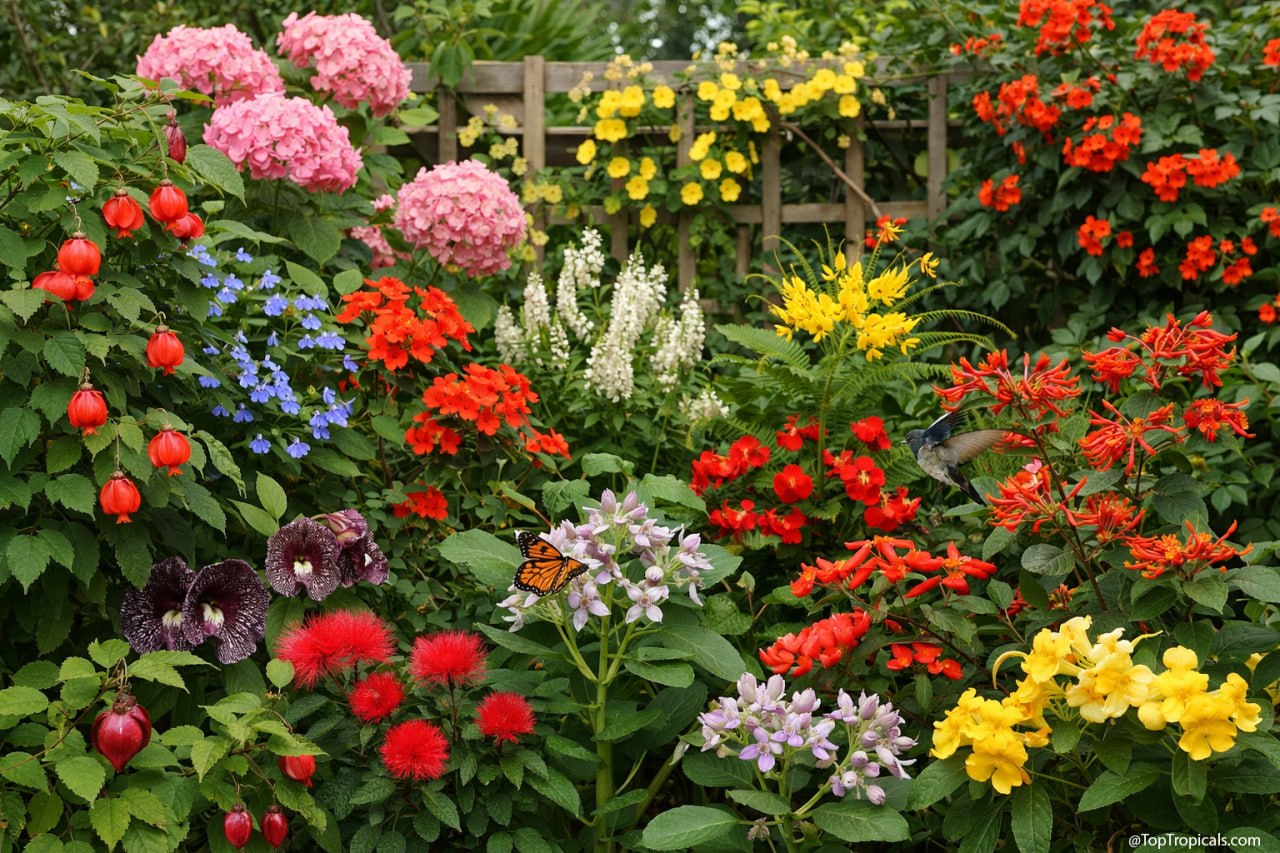
Spring is when everything wakes up - and if you plant smart now, your garden can stay alive with butterflies, bees, and hummingbirds all year long. The key is mixing tropical bloomers that flower in waves, not all at once. These plants don’t just look good - they keep pollinators coming back season after season, turning your yard into a living, moving ecosystem.

  • 1. Abutilon Fireball (Abutilon darwinii x striatum)

Bell-shaped flowers in warm red and orange tones hang like little lanterns. Very cold hardy, blooms on and off through the year, especially in mild climates. A steady nectar source for hummingbirds. More 👉

  • 2. Almond Bush (Aloysia virgata)

Light, airy clusters of tiny white flowers with a strong almond scent. Bees absolutely cover this plant when it’s in bloom. Flowers repeatedly through warm months. More 👉

  • 3. Calico Flower (Aristolochia littoralis)

One of the most unusual flowers you can grow - patterned like fabric. More importantly, it’s a host plant for butterflies, giving them a place to lay eggs. More 👉

  • 4. Pride of De Kaap (Bauhinia galpinii)

Bright orange-red blooms cover this shrub for months. Tough, fast-growing, and constantly visited by butterflies and bees. More 👉

  • 5. Mexican Bird of Paradise (Caesalpinia mexicana)

Sunny yellow flowers with a light fragrance. Handles heat, freeze, and poor soil easily. A reliable nectar plant for bees and butterflies. More 👉

  • 6. Red Tassel Flower (Calliandra tweedii With Love)

Very showy red-flowered powderpuff, fast-growing and spacey shrub. Cold tolerant to hard freeze, making it a strong choice for subtropical gardens. Forms a dense, many-stemmed plant with fine, feathery foliage that folds at night or by touch. Large scarlet tassel flowers bloom from spring to autumn and attract pollinators nonstop. More 👉

  • 7. Giant Milkweed (Calotropis gigantea)

A bold plant with thick leaves and waxy flowers. Important host plant for butterflies, especially monarchs. Handles heat and drought well. More 👉

  • 8. Blue Butterfly (Clerodendrum ugandense)

Flowers really do look like little blue butterflies. Blooms frequently and attracts actual butterflies along with bees. More 👉

  • 9. Tropical Hydrangea (Dombeya wallichii)

Large clusters of soft pink flowers appear in cooler months when little else is blooming. A major nectar source in winter. More 👉

  • 10. Fire Bush (Hamelia patens)

One of the best all-around pollinator plants and a tough bush - takes both cold and heat. Tubular orange-red flowers attract hummingbirds nonstop, plus butterflies and bees. More 👉

  • 11. Butterfly Orchid Vine (Mascagnia macroptera)

A climbing, cold hardy vine covered in bright yellow flowers and butterfly-like seeds. Great for fences or trellises, adding vertical color and feeding pollinators. More 👉

  • 12. Mexican Flame Vine (Senecio confusus)

Fast-growing, hardy vine with intense red blooms. Flowers heavily and brings in butterflies quickly. More 👉

13. Yellow Elder (Tecoma stans)


Bright yellow trumpet flowers that bloom over a long season. A dependable plant for both bees and hummingbirds. More 👉

✔️ Planting a mix of these gives you something in bloom almost every month.
That’s the real trick - not just planting for spring, but building a rotation of flowers that keeps pollinators fed all year long.

🛒 Transform your yard into a Butterfly Haven with exotic plants

📚 Learn more:


#Butterfly_Plants
Butterfly Haven or a Heaven on Earth?
Top 20 plants for a Butterfly Haven
Five best butterfly attractors for a Southern garden
Top Eight irresistible vines for a hummingbird haven: Part 1 - Part 2

#Hedges_with_benefits #Butterfly_Plants #How_to #Discover

🟢 Join 👉 TopTropicals

Date: 20 Sep 2025

How to make lots of Insulin Ginger plants quickly and get more health benefits

Costus igneus (Chamaecostus cuspidatus) - Fiery Costus or Spiral Flag

💚 How to make lots of Insulin Ginger plants quickly and get more health benefits

  • Costus igneus (Chamaecostus cuspidatus) - Fiery Costus or Spiral Flag is believed to help lower blood glucose levels naturally and managing diabetes.
  • Have you heard of Insulin Ginger? Everyone wants to have it in the garden!
  • Gardeners in India grow it not just for its pretty spiral leaves, but for what those leaves do. People with diabetes often chew them fresh or brew them into tea, saying it helps keep their blood sugar under control.
  • Researchers have found something interesting: the leaves contain an insulin-like compound, along with antioxidants and anti-inflammatory properties. In animal studies, extracts from the plant lowered blood sugar, protected the liver and kidneys, and even made the body more sensitive to insulin.
  • The way folks use it is simple. You can chew a leaf right off the plant, steep dried leaves for tea, or find it in powders and capsules. It's one of those plants that shows how tradition and science sometimes meet in the garden.
  • Its lush, turmeric-like leaves spiral around upright stems, with a glossy dark green top and a striking light purple underside. In warm months, it produces bright orange, cone-like flowers that stand out beautifully in the garden.
  • Beyond its beauty and natural insulin effects, the insulin plant is credited with aiding digestion, reducing cholesterol, boosting energy, improving skin health, supporting weight loss, relieving stress, and promoting heart wellness. A real botanical multitasker!


🎥 In this video, we’ll show you how to multiply Insulin Ginger fast, so you’ll have plenty of plants for yourself and even extras to share with friends and family.

✅ Don’t forget to use Green Magic fertilizer for the best results. Gingers absolutely love this plant food - they thrive on it and respond better than any other plant, with vigorous growth, lush foliage and loads of leaves you’ll need for all the benefits.

🛒 Grow your own sugar-fighter - the Insulin Ginger

📚 Learn more:


#Food_Forest #Remedies #Shade_Garden #Discover

🟢 Join 👉 TopTropicals

Date: 21 Nov 2024

How this breath-taking flowering tree stays so compact

🌸 How this breath-taking flowering tree stays so compact


  • 🌸 Ceiba hybrid - Dwarf Pink Princess - is one of the #Nature_Wonders that takes your breath away!

  • 🌸 A compact marvel of nature that redefines beauty in small spaces, this exquisite hybrid of the Pink Silk Floss Tree (Ceiba speciosa) grows to a manageable height of just 8-12 feet, making it perfect for small yards or container gardening.

  • In bloom, the tree is a spectacle: nearly leafless, with its crown exploding into tens of thousands of pink flowers, creating a vibrant, colorful mass.

  • 🌸 Its spreading crown and profusion of blossoms make it a showstopper, proving that you don’t need a giant tree to make a big impact.


🛒 Order Pink Princess

#Trees

🔴 Join 👉 TopTropicals

Date: 25 Sep 2025

How do we ship plants? Part 1: prepare the plant

How do we ship plants? Part 1: prepare the plant.

🚚 How do we ship plants? Part 1: prepare the plant.

  • 📦 We hear it all the time: "You guys ship plants? Wow! How do you ship a plant? It's... live!"
  • 📦 Well, we've been doing it for almost 25 years now - that's a quarter of a century! Top Tropicals was one of the first nurseries to figure out plant shipping, long before Amazon and all the big online platforms where today you can order just about anything.
  • 📦 After so many years, our Team worked it to perfection. Want to see how it's done?
  • 📦 Like they say, it's better to see once than hear a hundred times. In this video, we'll show you the tricks that keep plants safe on their journey from our nursery to your doorstep.


🎥 Part 1 covers how we prepare the plant before it goes into the box.

❗️Stay tuned for the next step in our upcoming video!

🛒 Shop plants online

📚 Learn more:


Shipping information page

#How_to

🟢 Join 👉 TopTropicals