Garden Blog - Top Tropicals

Date: 31 Oct 2025

👻 When plants grow wings...

Smokey  the  black-and-white  tuxedo  cat  stands  upright  holding  a  glowing 
 jack-o'-lantern  filled  with  tropical  fruit,  while  Sunshine  the  fluffy  ginger
    tabby 
 lounges  in  a  hammock  under  string  lights,  sipping  cocoa.  Around  them  are 
 pumpkins,  lanterns,  and  tropical  plants  under  a  warm  twilight  sky.

🌴 Twilight in the garden. Smokey is holding a glowing pumpkin. Sunshine is sipping cocoa.

Sunshine: "Smokey, why does that plant look like it wants to fly away?"
Smokey: "That’s the Bat Lily - Tacca. It’s rare, it’s weird, and it’s in bloom just in time for Halloween."
Sunshine: "Figures. You always find the spooky ones."

Meet the Bat Lily (Tacca)

Tacca is also called the Bat Lily or Devil Flower. This tropical wonder grows bat-shaped wings and foot-long whiskers. The black form (Tacca chantrieri) looks straight out of a gothic dream, while the white one (Tacca nivea) is ghost-like and elegant.

Some of our plants are blooming right now in the nursery — true Halloween magic! Blooms are delicate and may not travel, but the plants are strong and will flower again soon in your care.

Black  Bat  Lily  (Tacca  chantrieri)  plants  in  bloom  inside  the  Top 
 Tropicals  greenhouse,  showing  dark  maroon  bracts  and  long  pale  whiskers 
 rising  above  large  green 
 leaves.

Black Bat Lily (Tacca chantrieri) with dark maroon wings and long whiskers

Close-up  of  White  Bat  Lily  (Tacca  nivea)  plants  in  a  greenhouse  at  Top 
 Tropicals,  showing  large  white  bracts  and  long  trailing  whiskers  above 
 glossy  green 
 leaves.

White Bat Lily (Tacca nivea) in bloom with wide ivory wings

"The White Bat Lily (Tacca nivea) is bold and sculptural, with oversized ivory wings that command attention. Its pale bracts stretch wide above clusters of deep maroon flowers, and long, silvery whiskers spill gracefully through the foliage. In filtered light, the plant seems to glow from within — elegant, crisp, and perfectly balanced between the strange and the beautiful. If I could pick, I’d go with the White Tacca. It feels more architectural, more balanced — those oversized wings catch light in a way that shows off every vein and curve. It looks engineered by nature, almost like an alien design prototype that actually works.

The Black Bat Lily (Tacca chantrieri) feels alive with shadow. Its dark maroon wings and wiry whiskers make it look like something that fluttered out of the jungle at dusk. The bloom’s layered structure and near-black sheen give it a quiet power — mysterious, understated, but impossible to ignore. But if I were designing mood lighting for a greenhouse at night, the Black Tacca wins. It’s subtle, mysterious, like a secret only visible up close. Together, they’re perfect opposites — yin and yang of the tropical underworld: white for daylight, black for moonlight." — says Tatiana Anderson, Top Tropicals Plant Expert

Special Offer: Discounts on Rare Tacca Plants

Grow your own Bat Lilies — White or Black — at a special Halloween price!

Get 25% OFF Tacca plants with code

TACCA2025

Min order $25 (excluding S/H), valid online only, cannot be combined with other offers.

Hurry, offer expires November 03, 2025!

🎃 Storewide Halloween Sale – For Everything Beyond Tacca

Not into spooky plants? Enjoy savings on all other tropical plants across the store!

Get 15% OFF tropical plants with code

HALLOWEEN2025

Min order $100 (excluding S/H), valid online only, cannot be combined with other offers.

Hurry, offer expires November 03 2025!

👉 Collect Tacca plants:

Black - Tacca chantrieri

White - Tacca nivea

Green - Tacca leontopetaloides

Date: 15 Nov 2024

Where can I try a rare Abiu fruit and what does it taste like?

Abiu tree (Pouteria caimito), Harvest Moon Sapote

Abiu tree (Pouteria caimito), Harvest Moon Sapote

Abiu tree (Pouteria caimito), Harvest Moon Sapote

Abiu tree (Pouteria caimito), Harvest Moon Sapote

Where can I try a rare Abiu fruit and what does it taste like?

  • 🍋 Abiu tree (Pouteria caimito), or Harvest Moon Sapote - is a must-try rare tropical fruit with a striking appearance and incredible flavor.
  • 🍋 About the size of a medium apple, Abiu ripens to a bright, sunny yellow that hints at the deliciousness inside. Beneath its somewhat thick, sturdy skin, which contains a bit of sticky latex when cut, lies a jelly-like, ultra-juicy flesh that's sweet, smooth, and completely acid-free.
  • 🍋 Its flavor is often compared to the luscious taste of Chrysophyllum cainito (Star Apple that we mentioned earlier), making it a favorite among tropical fruit lovers.
  • 🍋 Each fruit typically has one elongated seed nestled within, and Abiu is often grown from seed.
  • 🍋 Abiu is very hard to find tropical fruit tree, and you won't find this fruit in supermarkets. So the only way to taste it - to grow your own!
  • 🍋 With its vibrant color, unique texture, and tropical sweetness, Abiu is a fantastic choice for anyone looking to add a touch of the exotic to their rare fruit collection!


🛒 Grow your own Abiu

#Food_Forest #Nature_Wonders

🔴 Join 👉 TopTropicals

Date: 24 Oct 2016

Overwintering Adeniums outside of tropics

Q: We bought several adenium plants from you. We are moving to the Denver area of Colorado. How can we make sure the plants survive? Should we use a green house?

A: Adeniums are perfect container plants, and house plants. They can be easily grown outside of tropical climate. During winter, Adeniums drop leaves and go into dormancy which makes it easy to keep these plants in a dormant stage in a warm location of your house, or possibly even in well-lit spot of garage (with a window), with temperatures above 50-60F.
Here in South Florida, during time of cold, when chances of freeze are high, we move our own Adenium collection into lanai, with plastic sheet protection around lanai.

In colder climates, Adeniums can be kept indoors as house plants during winter. There are some requirements/tips for you:

  • Temperature. Move Adeniums indoors when temperature starts dropping below 45F.
  • SUNSHINE. Use SUNSHINE boosters to improve cold resistance of Adeniums, and essure healthy plant throughout winter. SUNSHINE-BC formula is specifically designed for plants with caudex, and bonsai.
  • Water. Reduce watering to minimum, especially when plants drop leaves - this means they went into dormancy. Once a week light watering is enough. Water very carefully during cooler months. When it is hot (85-100F), excessive water usually won't harm adeniums: it will be partially used by a plant, and partially will evaporate. Especially be careful with water when temperatures drop below 65F - then tropical plants simply stop growing process and go dormant. Once adeniums start losing leaves, this is a sign to reduce watering to once a week to once a month, and in very small quantity (couple tablespoons per pot).
  • Light. Bright light is not necessary, but do not keep them in dark either, even if all leaves dropped. Good light is necessary to maintain healthy stems and caudex. Keep in mind, the less light, the less watering too. Ideal spot is a windowsill, however if your space is limited and all windows occupied by other "leafy" plants, location close to window will be enough as long as watering is reduced, to avoid rot. We keep our big collection specimens on a roofed porch during winter, where level of light is very low. Last winter we haven't lost a single plant due to low light. They take shade pretty well considering minimum or no water. However bright light is always better - it creates healthier environment for a plant. We all know about space limitations for our large collections, especially in winter. So if you can afford a bright spot for adenium during winter - the plant will be lucky!
  • Soil. Use only well drained mix with much higher content of perlite than you would use for most tropical plants. For adeniums, we use mix with 30-40% of perlite in it, while regular mix has 10-15%. Adeniums like alkaline soil, unlike most of tropical plants (hard to say what else likes alkaline... Ficus for sure!). This means, regular mix with high content of peat moss may cause root rot. To increase alkalinity, you may add dolomite. Here in Florida where we have natural supply of shell rock handy, it is easy to add some shell to a potting mix (shell sand, rather than quartz sand). We always add a few large shells on top of a pots with a big specimen. Besides increasing soil pH (making it more alkaline), shells look very decorative.
  • Fertilizer. No fertilizer until Spring when plants start showing new growth and new leaves.
  • Move your Adeniums outside in Spring, when chances of freeze are zero. More sunlight and air circulation is beneficial for breaking the dormancy and providing plants with a quick growth start.

Date: 20 Oct 2025

11 tropical fruits to eat instead of taking a fiber supplement

Tropical fruits to eat instead of taking a fiber supplement

Tropical fruits to eat instead of taking a fiber supplement

🍑 11 tropical fruits to eat instead of taking a fiber supplement

  • When we think of tropical fruit, we picture sweetness, sunshine, and exotic flavors packed with vitamin C. But beneath all that juicy goodness lies another gift: dietary fiber - quietly working to support digestion, feed the gut microbiome, and help keep blood sugar steady.
  • Avocado leads the pack among tropical fruits for fiber content. One creamy, ripe fruit can provide around 10 grams of fiber, roughly a third of an adult’s daily need. And there’s more to avocado than fiber - it’s also rich in healthy fats, micronutrients, and that silky texture everyone loves.
  • Other tropical fruits bring their own kind of fiber strength. Guava delivers up to 9 grams per cup, plus a burst of vitamin C.
  • Mango offers about 3 grams in half a fruit, especially when eaten with some of the skin.
  • Pineapple, though not always seen as a fiber powerhouse, still contributes around 2 grams per cup, along with bromelain, the enzyme that helps digestion.
  • Jackfruit’s fibrous pulp makes it another standout - it’s so meaty, it’s even used as a plant-based substitute in savory dishes.
  • Sapote fruit (Mamey, Canistel) and Sapodilla add fiber with a smooth, custard-like texture.
  • Adventurous tropical varieties like Annona (custard apple, soursop) may not top the charts in fiber numbers, but their soft, fibrous flesh still adds value: about 1.3 grams of fiber per 100 grams of fruit.
  • Bananas contain both soluble and insoluble fiber; the soluble part (mainly pectin) helps control blood sugar and appetite, while the insoluble fiber aids regularity.
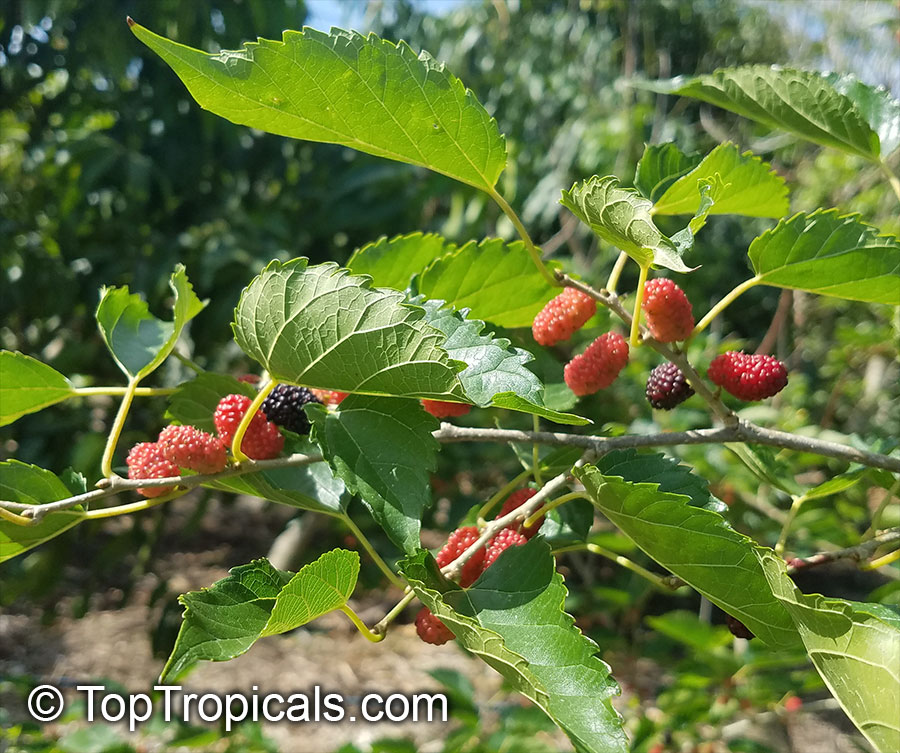
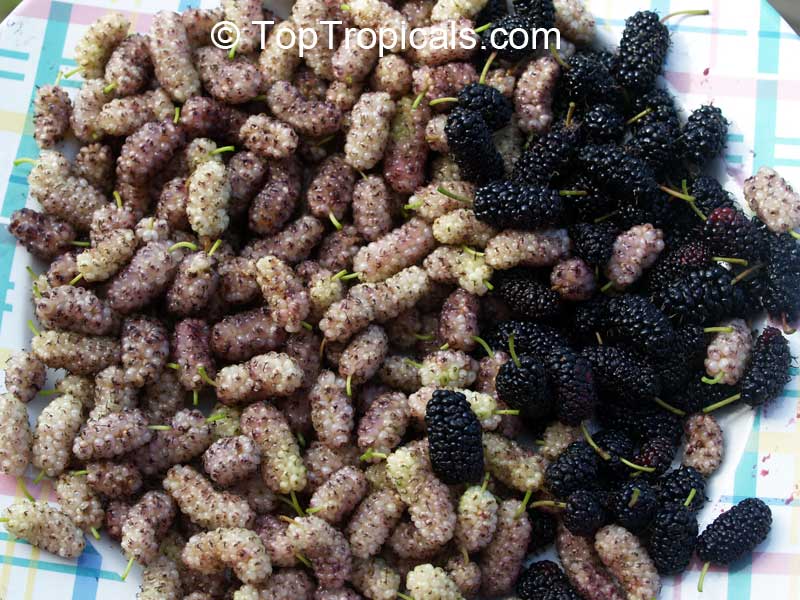
  • Mulberries are rich in insoluble fiber, especially in their skin, supporting digestion and promoting healthy bowel movements.
  • Dragon fruit offers a mix of soluble fiber in its juicy flesh and insoluble fiber from its tiny edible seeds, which help support gut health and feed good bacteria.

These fruits aren’t just delicious - they help you meet your daily fiber needs in ways that are far more enjoyable (and sustainable) than taking supplements. And when home gardeners, farmers, or tropical communities grow and share them, it’s a double win: nutrition and tradition hand in hand.

✔️ Tropical fiber power: tips for getting more fiber from tropical fruits

  • ⏺Eat whole, not juiced. Most of the fiber is in the pulp, skin, and seeds. Juicing removes much of that goodness.
  • ⏺Mix it up. Tropical fruits are great, but balance them with legumes, whole grains, nuts, and veggies for a full fiber range.
  • ⏺Take it slow. If your diet is low in fiber, increase gradually to avoid bloating or discomfort.
  • ⏺Drink plenty of water. Fiber works best when paired with hydration.
  • ⏺Mind the ripeness. Unripe fruits can have more resistant starch, another form of fiber.
  • ⏺Get creative. Toss tropical fruits into smoothies, salsas, breakfast bowls, or even desserts - a tasty stealth-fiber strategy.


🛒 Plant a fruit tree to harvest your fruit tomorrow

📚 Learn more:


Tropical fruit health benefits guide - what fruit and edibles can help with health issues and vitamin deficiencies, Part 1 and Part 2.

#Food_Forest #Remedies #Discover #How_to

🟢 Join 👉 TopTropicals

Date: 14 Jul 2019

A Cup of Tea Plant

By Onika Amell, tropical plant specialist

A: I live in Ave Maria, Florida. I want to try my hand at growing my own tea. Which plant do I need?

A: Most people do not realize they are actually enjoying camellias when they sip their cup of tea. True tea comes from the Camellia sinensis plant, an evergreen shrub or small tree.
In the fall and winter, the plant will produce small white flowers with a lovely fragrance. The foliage is shiny and dark green with a very nice informal and open look. Camellia sinensis (or tea plant, as it is commonly known) prefers a temperature between 65 and 86 degrees, which makes Florida an ideal area to grow them. However, if you live in colder zones, you can certainly succeed growing your own tea plants using a greenhouse. Alternatively, you can use containers which can be brought inside when temperatures start falling. Tea plants will usually survive a very slight freeze, though the leaves may be damaged or killed. It will not tolerate a hard freeze. They prefer full sun or light shade in the garden.
Tea plants will become small trees or large bushes if not pruned. Hardcore tea growers trim back the shoots repeatedly to a height of around 4 feet to encourage new growth and to contain the size.
Make sure to pick an area of your landscape where it does not flood or remain wet during our rainy season. Camellia sinensis does not like wet feet at all. They prefer well-drained, sandy and slightly acidic soil. If grown in a container, add some sphagnum moss to the potting mix. They will benefit from frequent applications of small amounts of fertilizer.
You will need some patience, too. Your plant should be around 3 years old before you start harvesting leaves.

Recommended fertilizers:

Tropical Greenhouse Plus - Plant Booster
Tropical Allure - Smart-Release Booster

Harvesting recipes

Now that you know how to grow the Tea, you need to check this out: the Harvesting recipes how to harvest and make different kinds of real tea: Green Tea, Japanese Style Green Tea, Oolong Tea, Black Tea, Orthodox Indian Tea... Continue reading...