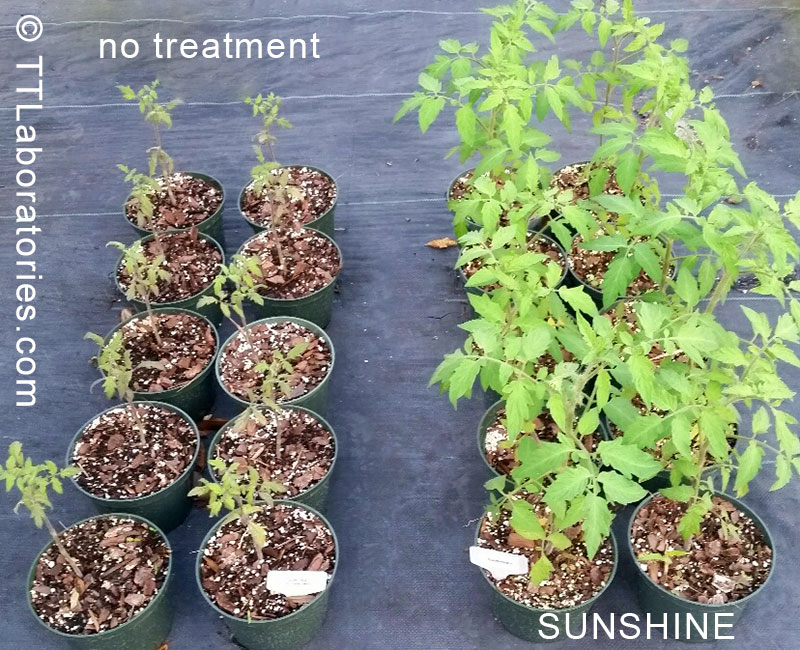
Photos of our experiments. These tomato seedlings potted 4 weeks ago, and batch on the right treated with standard recommended dose of SUNSHINEâ„¢ twice (within one week period). They are setting buds and flowers, while untreated plants (batch on the left) have much slower growth rate and are still far from flowering.
See TTLaboratories website and order SUNSHINE boosters.
Date: 24 Oct 2016
Overwintering Adeniums outside of tropics
Q:
We bought several adenium plants from you. We are moving to the Denver area of Colorado. How can we make sure the plants survive? Should we use a green house?
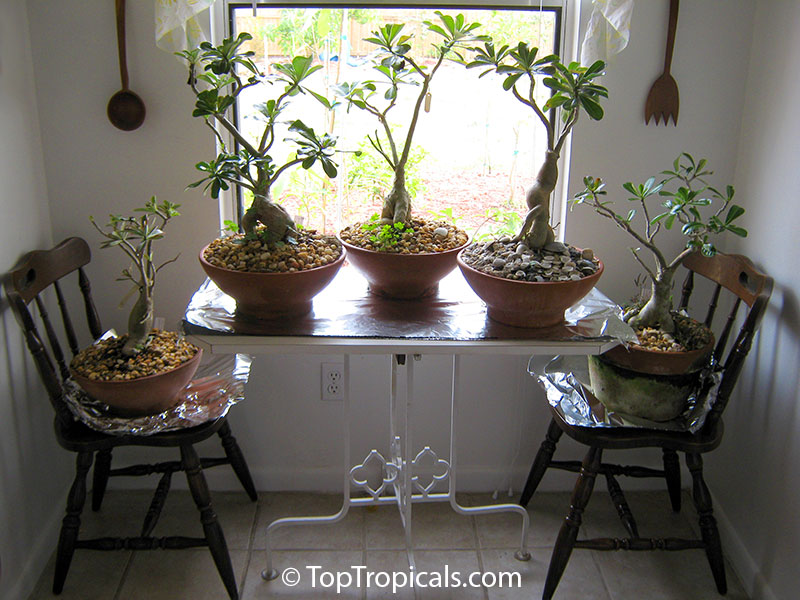
A:Adeniums are perfect container plants, and house plants. They can be easily grown outside of tropical climate. During winter, Adeniums drop leaves and go into dormancy which makes it easy to keep these plants in a dormant stage in a warm location of your house, or possibly even in well-lit spot of garage (with a window), with temperatures above 50-60F.
Here in South Florida, during time of cold, when chances of freeze are high, we move our own Adenium collection into lanai, with plastic sheet protection around lanai.
In colder climates, Adeniums can be kept indoors as house plants during winter. There are some requirements/tips for you:
Temperature. Move Adeniums indoors when temperature starts dropping below 45F.
SUNSHINE. Use SUNSHINE boosters to improve cold resistance of Adeniums, and essure healthy plant throughout winter. SUNSHINE-BC formula is specifically designed for plants with caudex, and bonsai.
Water. Reduce watering to minimum, especially when plants drop leaves - this means they went into dormancy. Once a week light watering is enough. Water very carefully during cooler months. When it is hot (85-100F), excessive water usually won't harm adeniums: it will be partially used by a plant, and partially will evaporate. Especially be careful with water when temperatures drop below 65F - then tropical plants simply stop growing process and go dormant. Once adeniums start losing leaves, this is a sign to reduce watering to once a week to once a month, and in very small quantity (couple tablespoons per pot).
Light. Bright light is not necessary, but do not keep them in dark either, even if all leaves dropped. Good light is necessary to maintain healthy stems and caudex. Keep in mind, the less light, the less watering too. Ideal spot is a windowsill, however if your space is limited and all windows occupied by other "leafy" plants, location close to window will be enough as long as watering is reduced, to avoid rot. We keep our big collection specimens on a roofed porch during winter, where level of light is very low. Last winter we haven't lost a single plant due to low light. They take shade pretty well considering minimum or no water. However bright light is always better - it creates healthier environment for a plant. We all know about space limitations for our large collections, especially in winter. So if you can afford a bright spot for adenium during winter - the plant will be lucky!
Soil. Use only well drained mix with much higher content of perlite than you would use for most tropical plants. For adeniums, we use mix with 30-40% of perlite in it, while regular mix has 10-15%. Adeniums like alkaline soil, unlike most of tropical plants (hard to say what else likes alkaline... Ficus for sure!). This means, regular mix with high content of peat moss may cause root rot. To increase alkalinity, you may add dolomite. Here in Florida where we have natural supply of shell rock handy, it is easy to add some shell to a potting mix (shell sand, rather than quartz sand). We always add a few large shells on top of a pots with a big specimen. Besides increasing soil pH (making it more alkaline), shells look very decorative.
Fertilizer. No fertilizer until Spring when plants start showing new growth and new leaves.
Move your Adeniums outside in Spring, when chances of freeze are zero. More sunlight and air circulation is beneficial for breaking the dormancy and providing plants with a quick growth start.
Date: 17 Sep 2025
Mulberry Care and Growing Tips
Mulberries are tough, low-maintenance fruit trees that adapt to many
conditions.
Climate: Hardy from USDA zone 5 to 10.
Soil: Grow well in almost any soil; prefer good drainage.
Watering: Regular watering during dry spells; drought tolerant
once etablished.
Growth: 3–5 feet per year, producing fruit early.
Pruning: Annual pruning controls size and improves
branching.
Pot culture: Dwarf types thrive in containers, staying 6–7
feet tall. Use a large pot, water consistently, and prune lightly. Use Abundance
potting mix for best results.
Fertilizer: For reliable production, fertilizer regularly. Apply
Sunshine C-Cibus liquid booster with every watering, or GreenMagic controlled release fertilizer every 5-6 months.
❓
Mulberry FAQ
How soon will a mulberry fruit?
One to two years, sometimes the very first season.
What climates are suitable?
USDA zones 5–10, from -20F winters to hot summers.
How tall do they get?
Standard trees 20–30 ft; dwarfs 6–10 ft in
pots.
Do I need more than one tree?
No, they are self-pollinating.
What do they taste like?
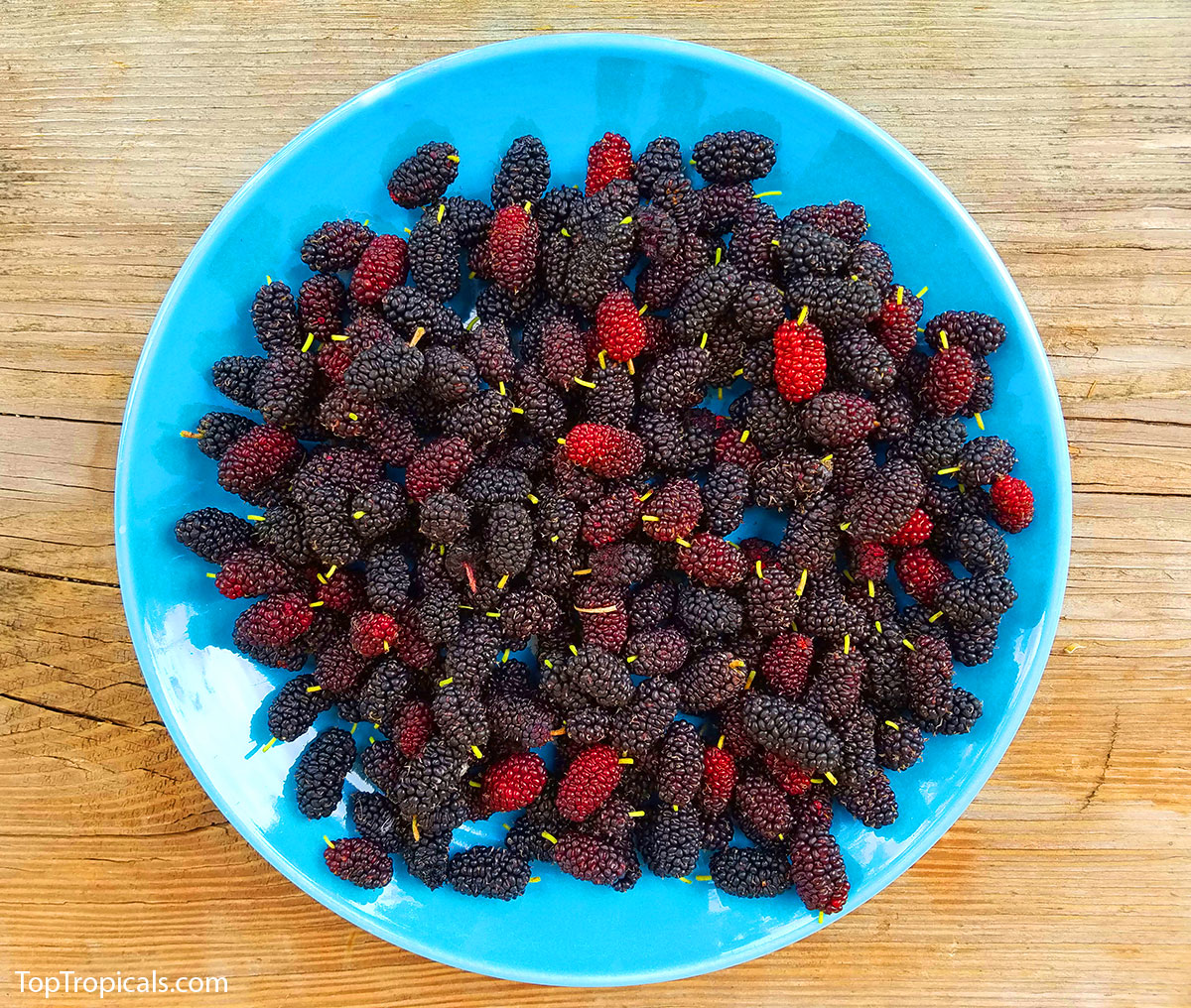
Sweet and juicy, like a blend of blackberry and raspberry.
How long is the harvest?
Everbearing types ripen gradually from summer into fall.
Do birds eat them?
Yes, but trees are so productive there’s plenty to
share.
Are they messy?
Dark-fruited varieties can stain; white mulberries do not.
By Tatiana Anderson, Horticulture Expert at Top
Tropicals
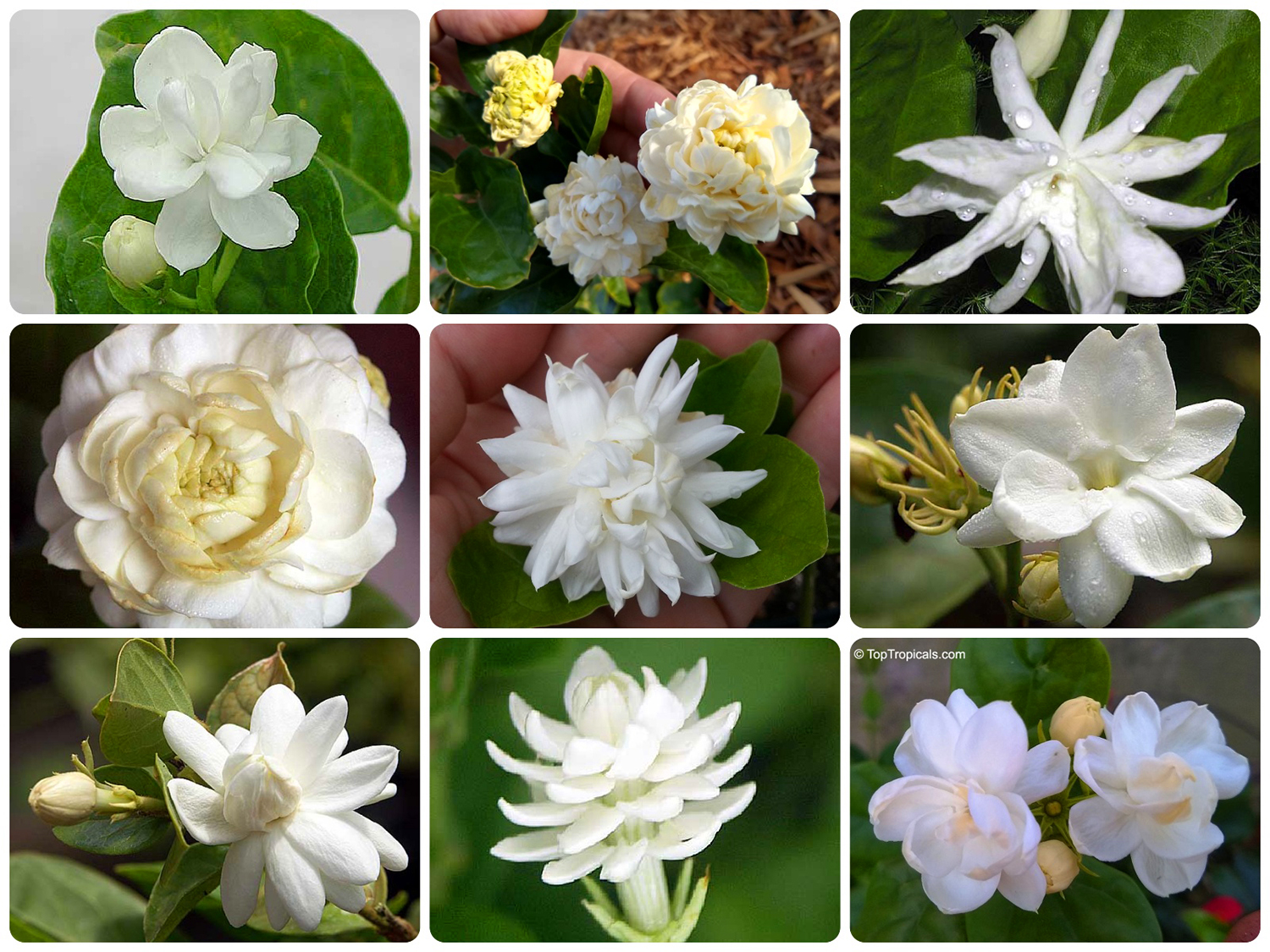
Jasmine Sambac varieties: Arabian
Nights, Little Duke, Belle of India, Grand Duke, Duke Supreme, Maid of
Orleans, Mysore Mulli, Malichat, Gundu Mallii
One of the reasons Jasmine Sambac is so fascinating is that it does not
come in just one form. Each variety has its own personality.
If you want a compact patio plant, Arabian Nights or Little
Duke are excellent choices. They stay tidy, bloom generously, and are
easy to manage in containers.
If you prefer elegant, elongated petals and a refined look, Belle of
India is a favorite. It can be grown as a small bush or trained lightly
as
a vine.
For those who love full, carnation-like double flowers, Grand Duke of
Tuscany and Grand Duke Supreme are classic
selections. They are vigorous and make impressive shrubs in warm
climates.
If you need a stronger climber for fences or hedges, Maid of
Orleans performs beautifully in full sun while Mysore Mulli
prefers semi-shade.
Collectors often enjoy rare forms like Mali Chat or newer hybrids
such as Gundu Malli, which combine traits from different lines.
How to Grow Jasmine Sambac Successfully
Sambac is not difficult, but it responds best to consistency.
Light: Full sun produces the most flowers. In very hot
climates, light
afternoon shade is acceptable. Indoors, place it in the brightest window
available.
Soil: Use a well-draining potting mix such as Sunshine
Abundance. Sambac does not
like heavy, constantly wet soil.
Water: Water thoroughly, then allow the top layer to dry
slightly before watering
again. Reduce watering during cooler months.
Pruning: Light trimming after a bloom cycle encourages
branching. More branches mean more flower buds.
Feeding: Sambac is a heavy bloomer, and fragrance takes
energy. During active growth, feed regularly with a balanced fertilizer that
supports flowering such as Green Magic (controlled release every 6 months) or liquid Sunshine
Boosters Pikake (formulated especially for fragrant flowers) - with
every watering. I prefer formulas slightly higher in potassium to encourage
stronger bud formation and richer bloom cycles. Consistent feeding during
warm months makes
a visible difference in both flower count and intensity of scent.
With proper care, Jasmine Sambac will reward you not just with flowers,
but with perfume that changes the atmosphere of your entire garden.
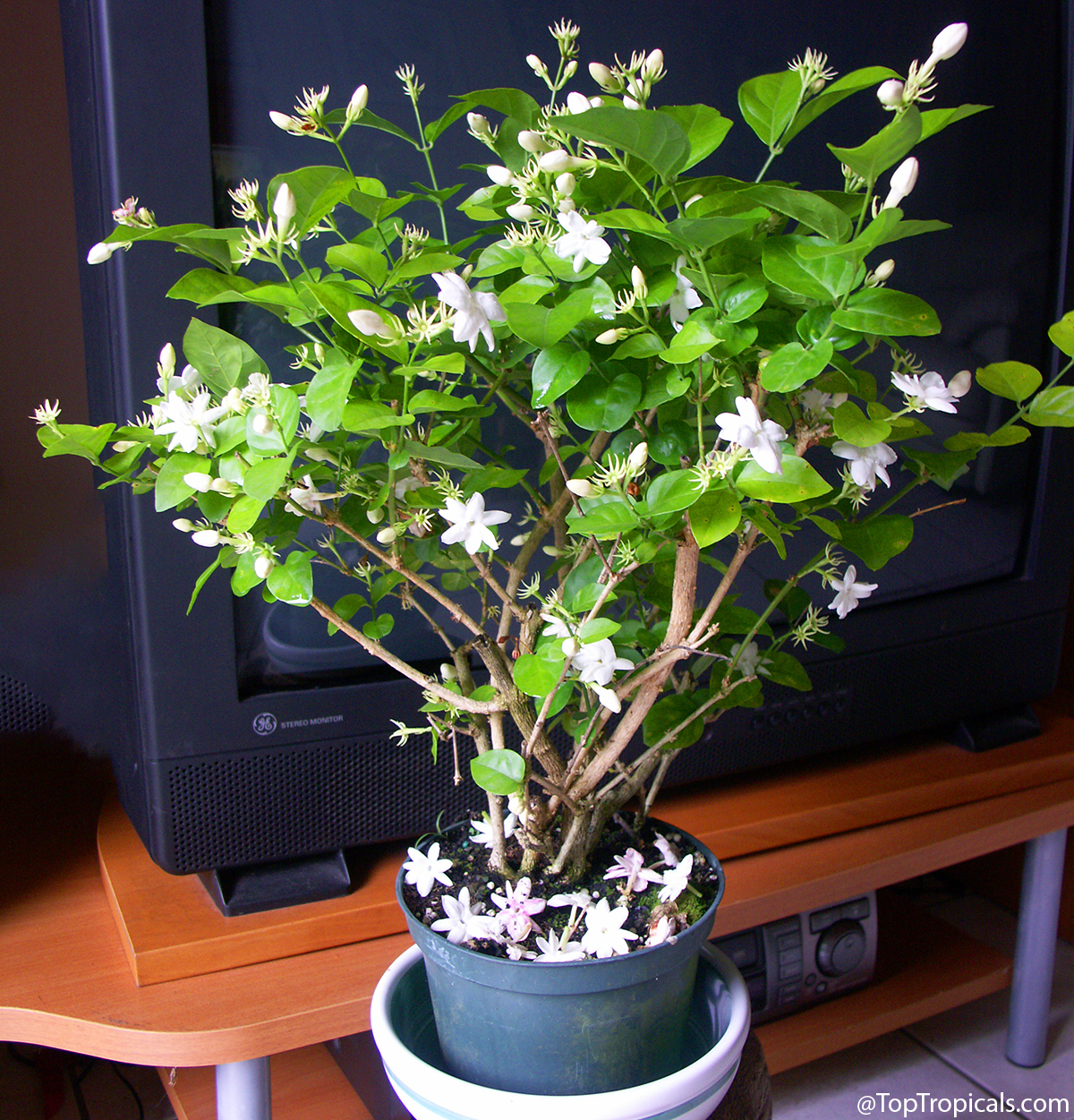
Jasmine Sambac Maid of
Orleans flowering indoors in a container under bright light.
❓Frequently Asked Questions About Jasmine Sambac
Does Jasmine Sambac need full sun?
It flowers best in full sun. In very hot climates, light afternoon shade
is acceptable. Indoors, give it the brightest window possible.
Can I grow it in a pot?
Yes. Sambac performs beautifully in containers. Many gardeners prefer pots
because it is easier to control size and move during cold weather.
How often does it bloom?
With proper light and feeding, it blooms in cycles throughout the warm
season. Consistency in care makes flowering more reliable.
Why is my plant not blooming?
The most common reasons are insufficient light or irregular feeding.
Increase light first, then review your fertilizing routine.
Is it difficult to grow indoors?
Not if you provide strong light and good air circulation. Compact varieties
adapt especially well.
Is it frost tolerant?
No. Jasmine Sambac is tropical. Protect it from temperatures below 40F and
bring it indoors before frost.
🌸 Year of
the Horse Special – Jasmine Bonus
Celebrate 2026 with the fragrance of Jasmine plants. For a limited time,
enjoy special savings when you grow one of
the most wanted perfume plants in cultivation.
Jasmine Sale - 15% Off
Save 15% on all Jasmine plants.
Discount is already applied in the online store - no code needed.
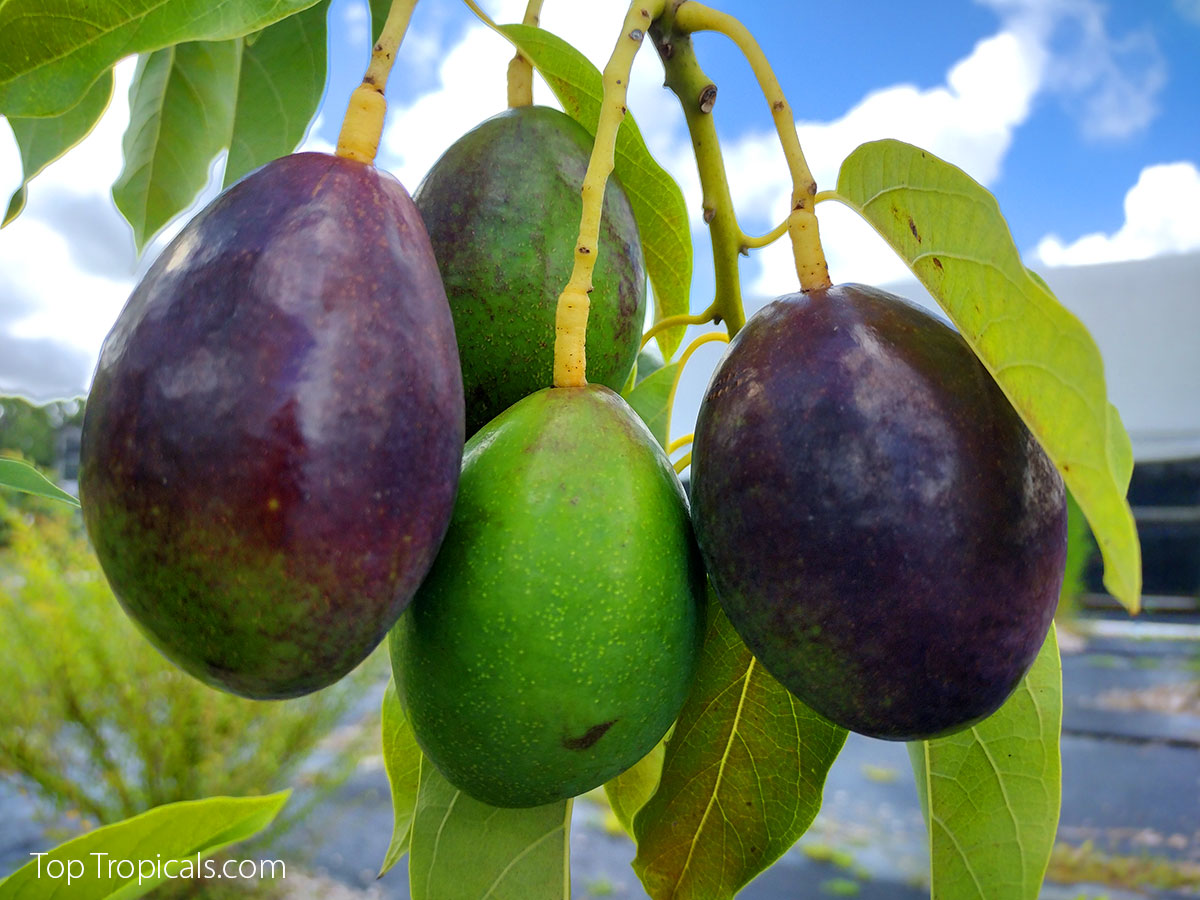
Q: I bought an anise leaf-scented avocado from
you, and it is finally quite large and doing great. I live in California, the
coldest temperatures we seem to get in some winters is around 25 to 28F, and
it never lasts long. The tree might get a bit of frost nipping on the new
growth, but it has done very well. It has flowered profusely for the last two
years but hasn't set any fruit. What variety you might recommend to help with
pollinating?
A: We are glad your avocado is doing great. Anise is
one of our favorite varieties, with the wonderful smell of leaves and tasty
fruit.
Cold hardiness and flower quality
It is true that cold damage may affect avocado production, especially in
setting fruit. To improve the tree's cold hardiness, make sure to provide
balanced plant food, especially during the season of active growth. For our
avocado trees, we use Sunshine C-Cibus year-round.
If you prefer to use dry (granulated, slow-release) fertilizers, make
sure they contain micronutrients, or apply Sunshine Superfood microelement complex once a month.
To improve flower quality (including the ability to set fruit), we
recommend a special micronutrient supplement called Sunshine Honey. It contains Boron and Molybdenum - elements that are
responsible for setting fruit and for developing fruit (meaning not dropping at
the early stage of development).
Cross-pollination and crop
In general, every avocado tree is self-fertile, meaning it can produce
some fruit with its own pollen and doesn't necessarily require a second tree
for pollination. So even if you don't do anything, sooner or later your tree
will set fruit. However, it is also true that the amount of fruit and crop
reliability depends on pollination factors. One type of avocado classification
is by flowering and pollination behavior - type A or B.
When both types of trees are grown in proximity to each other, their
overlapping flowering patterns significantly enhance the chances of
cross-pollination. This can lead to improved fruit set and higher yield, making it
especially important for commercial production and, to a lesser extent, for home
growers.
Therefore, it's advisable to plant different varieties of avocado in
your garden - the more, the merrier! The greater the diversity of avocado trees
with overlapping flowering periods, the better your crop is likely to be. If
you're growing an avocado tree without other avocados nearby, it becomes
helpful to have more than one tree with different flowering patterns (A and B) to
increase yield in your garden.
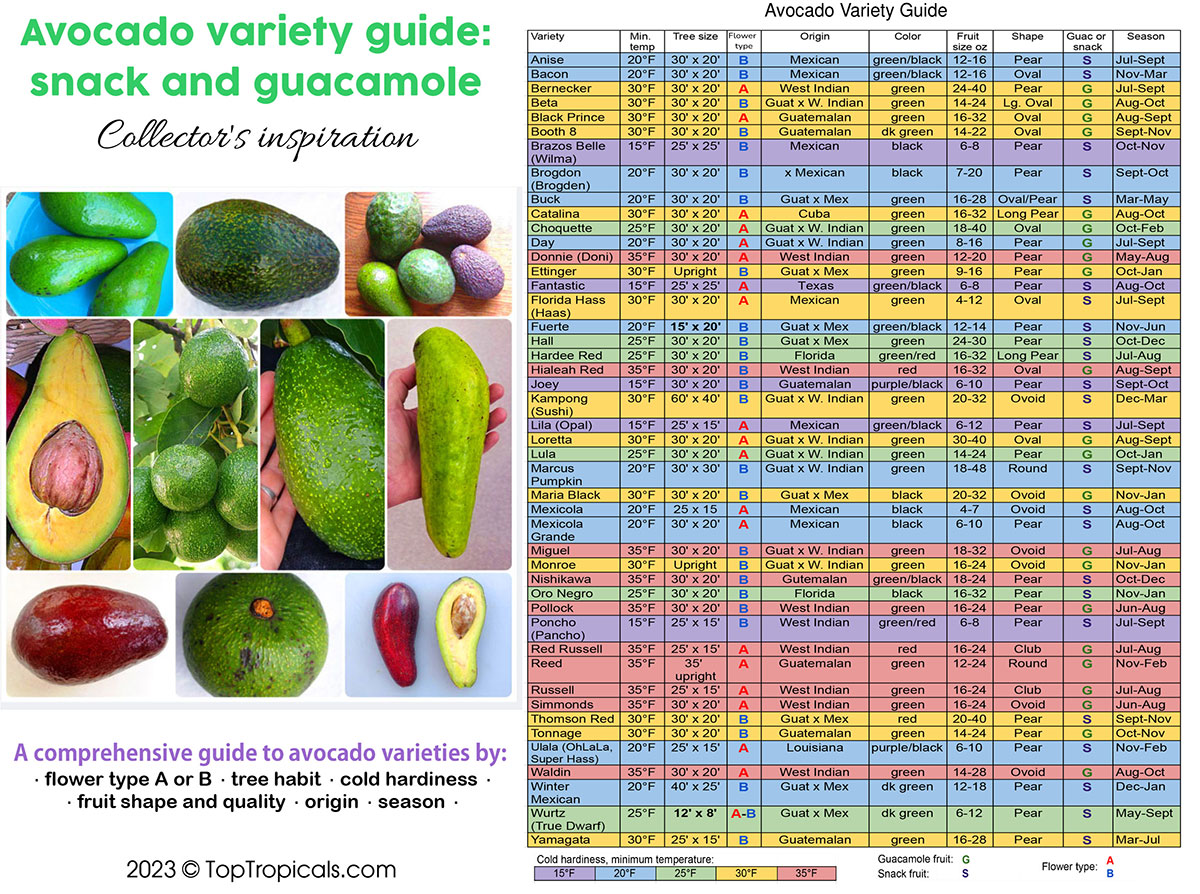
To learn more about avocado types, fruit characteristics, cold hardiness
and much more, refer to our Avocado Variety Guide - a page with very convenient interactive chart
allowing you to quickly sort types of avocado by requirements of your choice
(just click on column header to sort data). You may also buy a Book or download a PDF.

 Mulberry Care and Growing Tips