Date: 15 Jun 2021

Healthy Plants: Q&A from Mr Booster
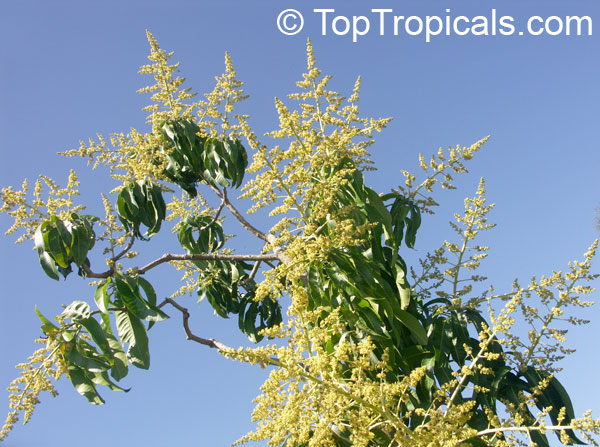
How to prevent mango flowers drop
Q:The mango blossoms my tree had in February have blown off due to weather conditions. Do you know what I can do to prevent this from happening again in the future?
A: The only "guarantee" to protect mango flowers from cold
weather damage here in Florida is to plant a LATE flowering variety. Generally,
mango trees are winter bloomers. Those varieties called "early season" start
flowering in January (for example, Nam Doc Mai), and of course very often they
get affected by cold, so they drop. Some varieties are so called "late season"
- for example Venus. They start flowering in spring when the weather conditions are
more favorable.
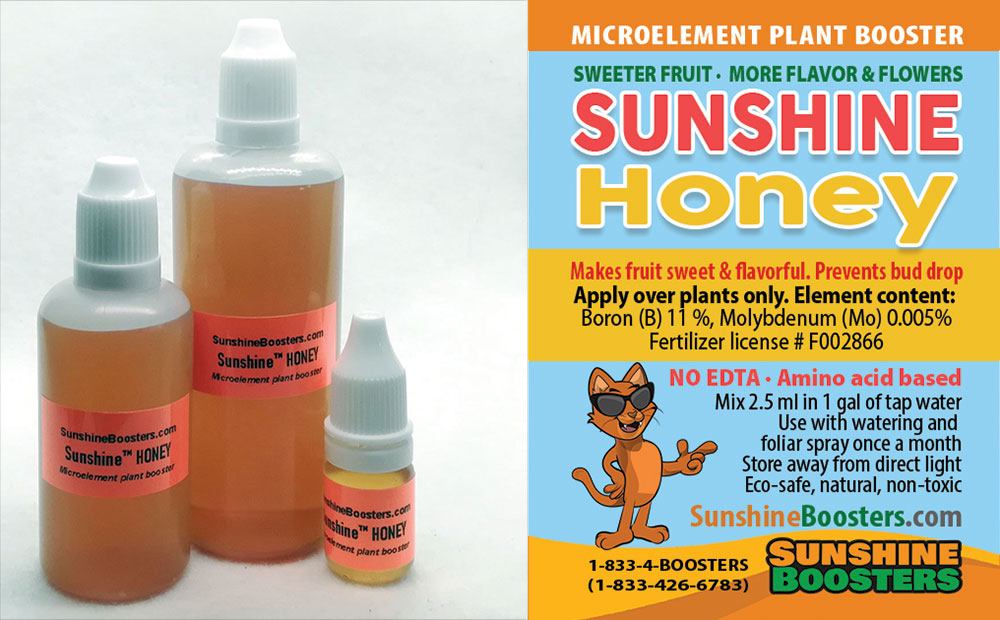
Another thing that may help you with mango flower drop is applying plant
micro-element supplement Sunshine-Honey - it contains Molybdenum and Boron, which help flower
and fruit development/strength and prevent their drop.
Read more: Boosting Mango Flowers and Fruit.

Date: 15 Oct 2020
Healthy Plants. Q&A from Mr Booster: Fertilizing Mango trees in Winter

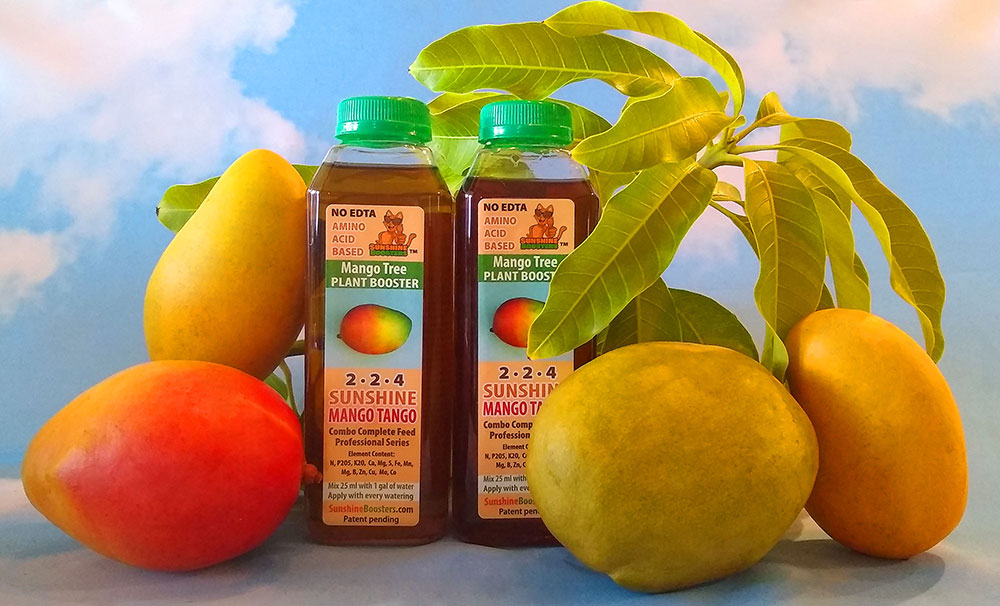
Q: I'm living in Maryland growing zone 7A and would like some info on when to fertilize my potted mango trees. I ordered your Sunshine Mango Tango 2-2-4. All your mango trees are in pots.
A: You can start using this fertilizer right away, any time of
the year, and every time you water your plants.
Sunshine Mango Tango, as well as other Sunshine boosters, is an amino-acid
based liquid fertilizer that is scientifically developed for daily plant
needs in all necessary nutrients. This means, you may use this fertilizer with
every watering, including winter period.
Traditional fertilizers (both granulated and soluble, EDTA-chelated) can
only be used during hot months while plants grow actively, and must be limited
or not used at all during cooler months, to avoid nutrient lock up in soil
(which basically means "building up unused elements"). With Liquid Sunshine Boosters, it is safe to add them every time you water
your tree.
During cooler weather and when plant metabolism slows down, a tree will
consume less water (as well as food), and you will automatically reduce
watering, to keep over-wintering plants on a dry side. This means, less fertilizer
too. This allows you to control elements intake naturally, like you control
water amount just as much as the plant needs.
Date: 4 Oct 2020
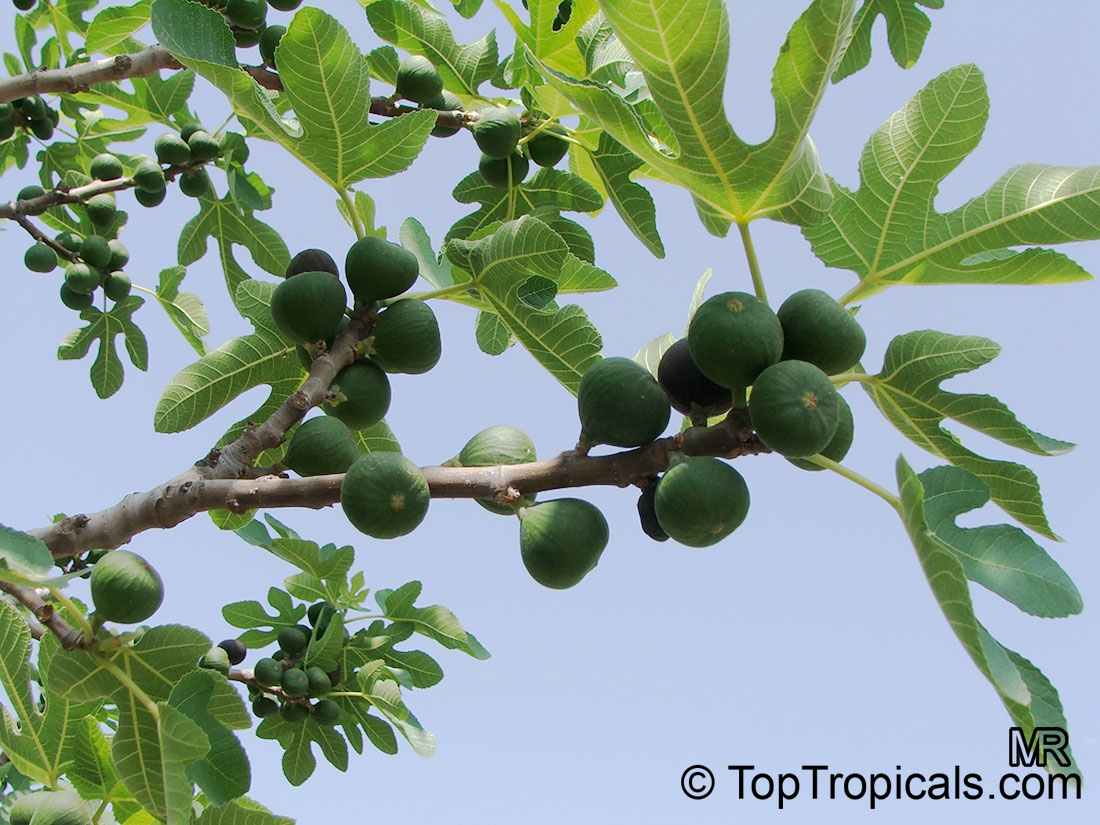
What fig trees are good for Florida?
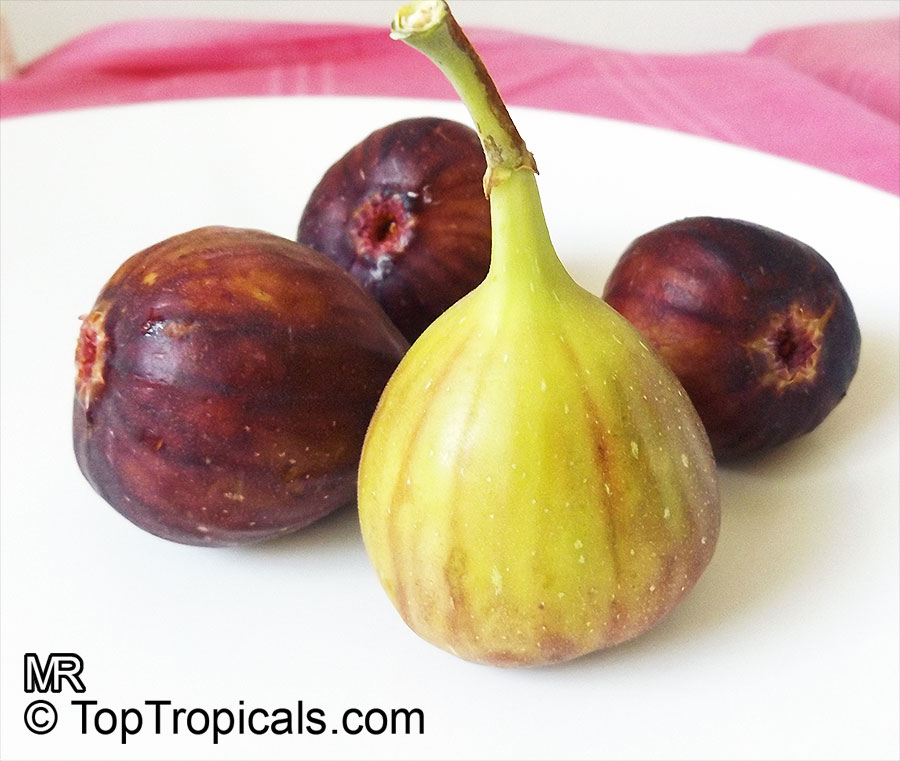
Q: My baby fig tree was sprayed by the lawn people with weed killer :( Any ideas? Also what figs do you have available to grow here in Florida?
A: Unfortunately once a plant is affected by a herbicide, there
is not much you can do about it.
If you don't rinse the chemical within a few seconds, it gets into the
plant internal system and nothing can be done to save the plant. The tree may
remain green for a few days up to a week, but then gradually dies back. If your
fig tree wasn't rinsed immediately after herbicide spray, it is probably too
late.
If you want to replace it with a new one, here is a few suggestions of our
favorite fig varieties which are great producers and grow well in Florida
heat:
Brown Turkey Fig - our favorite!
Black Mission Fig
Beers Black Fig
Texas Everbearing Fig
Magnolia Fig
LSU Purple Fig
Olympian Fig
Texas Blue Giant Fig
See full list of Fig Trees.
Make sure to get appropriate plant food for your fig tree so it develops faster for you and gets well-established before winter: SUNSHINE C-Cibus - Crop Nutrition Booster from Garden Series, or Combo Total Feed Collection - all nutrients in just one bottle, for fruit trees and edibles.
Date: 18 Apr 2020
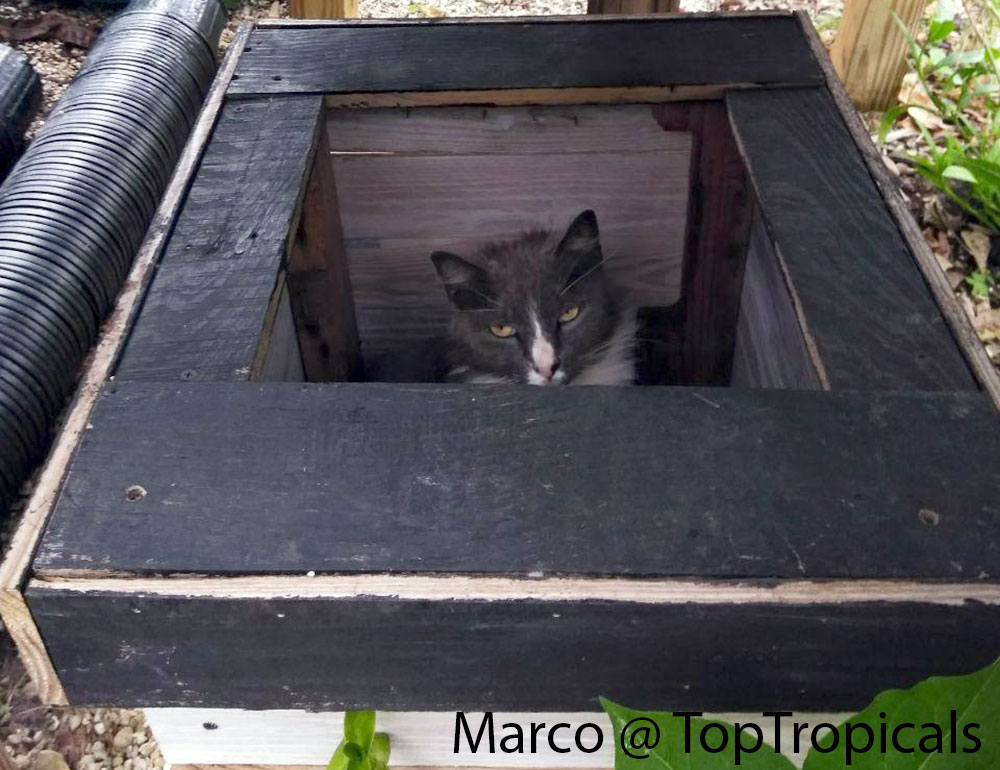
PeopleCats amid COVID-Cat-20

- Mark Twain -
While the whole world is suffering the virus attack, cats are no
exception. They do not get COVID-19, but they have their own coronavirus - a
respiratory condition that may become very dangerous for them. And although cat
coronavirus does not affect humans, we can transfer it to other cats
through our hands/petting, shared bowls and bedding, etc.
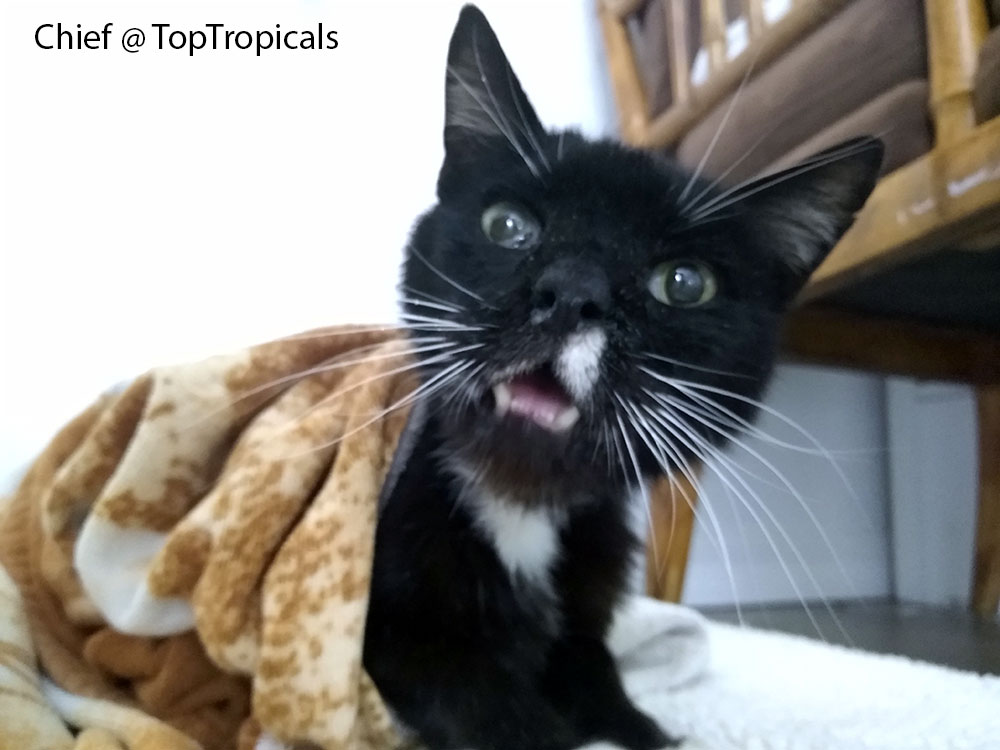
At TopTropicals, we had several cats sick with the flu and it took us a
long time and long hospital bills to bring them back to health! Below we are
sharing with you a few tips from our own experience that may help you fight and
treat cat coronavirus, that we call "Covid-Cat-20".
How to treat Cat Coronavirus
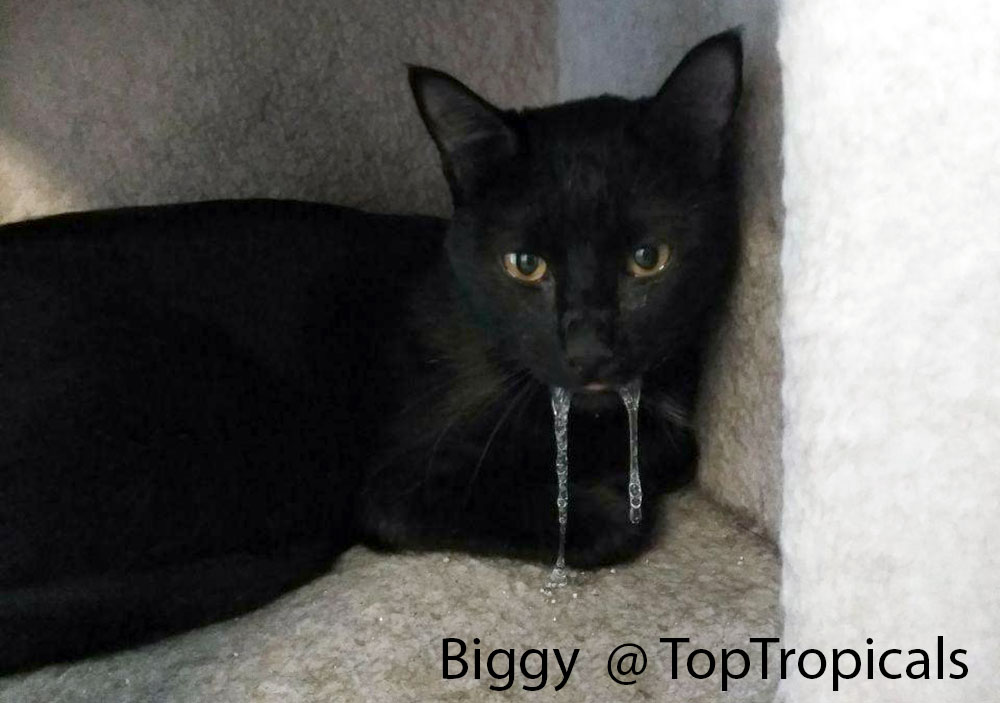
When cats get a flu/virus/cold, they suffer congestion, sneeze and cough. Just like us humans. But for cats, stuffed nose is much worse trouble, because they can't smell food = they won't eat it! In tough cases, they won't even drink any water. Due to specifics of cat metabolism, if a cat doesn't eat and/or drink for more than a couple of days, it may become life-threatening. It is not the virus that kills a cat, it is dehydration, lack of nutrition, and possible secondary infections.
- Vet. During Covid-19 lockdown, many animal hospitals are
closed, but if you are lucky to find a vet, it is wise to give the cat a
long-lasting shot of antibiotic. You can't treat a virus with antibiotic, but it will
prevent secondary infections (like pneumonia, etc.)
- Water is absolutely essential! Make sure your Cat drinks water. If
he (she) doesn't want to drink on his own, you need to give him water with a
syringe. As often as you can. Little by little. Or, ask a vet to put a
"water pouch" under cat's skin. This will save the cat from dehydration.
- Food is the main key! Your cat must eat a normal size portion per
day in order to fight the illness. Because he can't smell, it's possible he
won't eat on his own. Offer him a smelly, soft/wet food of room temperature or
slightly warmer: usually tuna works well. Get Salmon Oil and put on top of the food: it is smelly, plus a great
vitamin supplement.
- Hand-feeding. If congestion is bad, even a smelly tuna may not
help. Mix a spoonful of pate with some water and try to hand-feed this "soup" to
the cat either using syringe, or a small spoon. Little by little. Remember,
his nose is stuffed and he can't swallow and breath at the same time, so it
must be tiny bites. (Wrap the entire cat tightly in a large thick towel to
save yourself lots of scratching damage, leaving out just the face. Guaranteed,
he won't like the procedure and you will be surprised how strong he is for a
sick cat.)
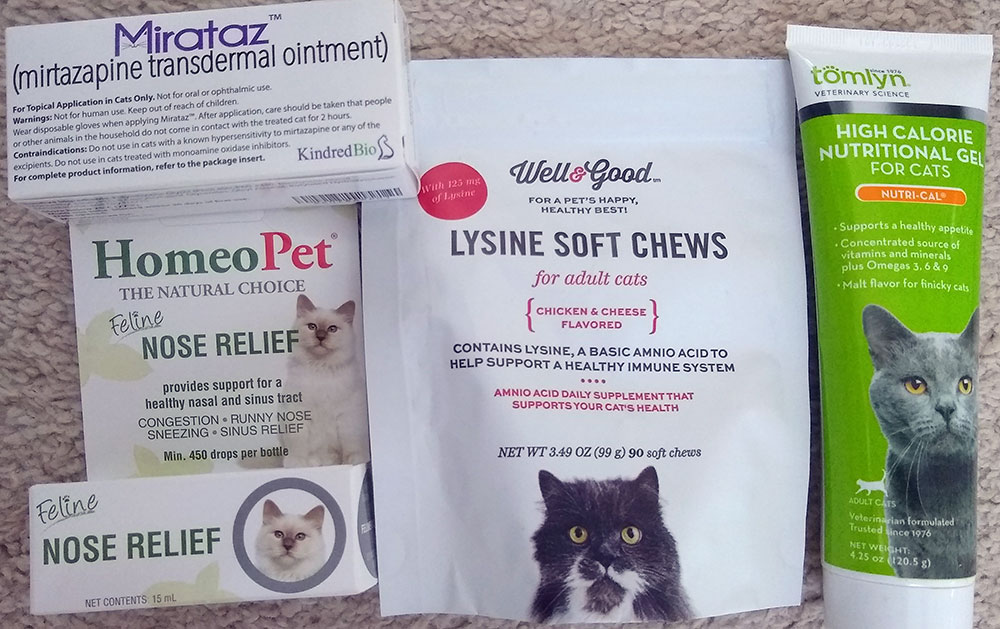
- Supplements. For an extra nutrition support, you may use Critical nutrition food and other protein supplements. Consult your vet
and you may want to try the following aids: High Calorie Liquid or Gel
(easier to administer), HomeoPet Nose Relief (for de-congestion), Lysine
Soft Chews, and Mirataz ointment (to promote appetite).
- Rest. Keep the cat indoors, in a warm place, away from drafts.
Cover with a towel to make comfy. Keep lights dimmed. Change bedding, towels,
blankets at least daily to keep clean, get rid of germs and drooling
accidents.
- Quarantine from other cats, the cat coronavirus is super
catchy! Find that spare room. Bleach, soap, alcohol and Hand Sanitizer - are your friends now to maintain germ- and virus-free
environment.
- Mild cases. Some cats have mild symptoms (we've noticed that black
cats and tuxedo cats are more susceptible regardless of age). In this case,
do not panic - just give them time to recover. Lots of rest, privacy, and be
sure to monitor water/food intake!
- Tough cases. Most cats look lethargic when sick. At some point, if
within 3-4 days you don't see improvement and the coughing continues, you
need x-ray to rule out pneumonia.
Stay well and healthy, PeopleCats!
TopTropicals PeopleCat Club
Thank you everybody for supporting us in helping PeopleCat Community!
Make
your kind donation today and receive a surprise gift from us. Every little
bit helps! Thank you and God bless you and your pets!
Date: 4 Jun 2019
Pretty in Pink... and Purple Prince for her!

By Onika Amell, tropical plant specialist
Q: I have a bare spot in my front garden, behind a low wall, in part-sun. I'm hoping to find an evergreen, flowering ground cover that will cover it quickly. Any ideas on finding something with the ability to eventually also cascade over that wall? I live on Marco Island, Florida.
A: Barleria Repens - Small Bush Violet, is a tough, fast-growing evergreen
that blooms from late spring to autumn. Of the many Barleria we see in the
tropics, Pretty in Pink is one of the most striking! The name tells the whole
story: pretty and pink. A lot of gardeners enjoy using them as a ground
cover. They will quickly cover a large area - their stems root readily as the
plant crawls along. They are easily propagated by lifting the rooted runners or
using cuttings. They also reseed easily. Flowers are followed by seed pots
that explode open when dry, dispersing 4 seeds at a time! But perhaps best liked
by many gardeners, is their habit to cascade. It will be well suited for
covering the bare area in your garden and spilling over that wall beautifully.
When used as a ground cover, remember to pinch out young shoots to
encourage bushiness and prune the plant back hard after flowering to keep it
neat.
Barleria repens will also adapt to different situations in a garden if
you need them to. Although they usually form a rounded to spreading bushy
shrub, 2 ft high by 3 ft wide, they will climb when you give them support. They
are often allowed to lean into nearby trees and shrubs.
Hardy to 28F, Barleria repens is pest-free and fairly frost-tolerant.
They love sun and part shade, as well as well-drained soil and plenty of
organic material. Avoid planting it in deep shade as it will get leggy and
reluctant to flower.
They will thrive when fed with a slow release fertilizer at intervals
of 6-8 weeks, throughout the growing season.
There is another cultivar of this exact variety that has blue-purple flowers, it is called Purple Prince! It couples perfectly with Pretty in Pink! :)
See all Barlerias from our store
Recommended fertilizers:
Pink N Good Daily Plant Food Flower Booster
Tropical Allure Smart-Release Booster
