Date: 26 Jul 2020
The best grafted Loquat varieties
at 15% OFF for 3 days!
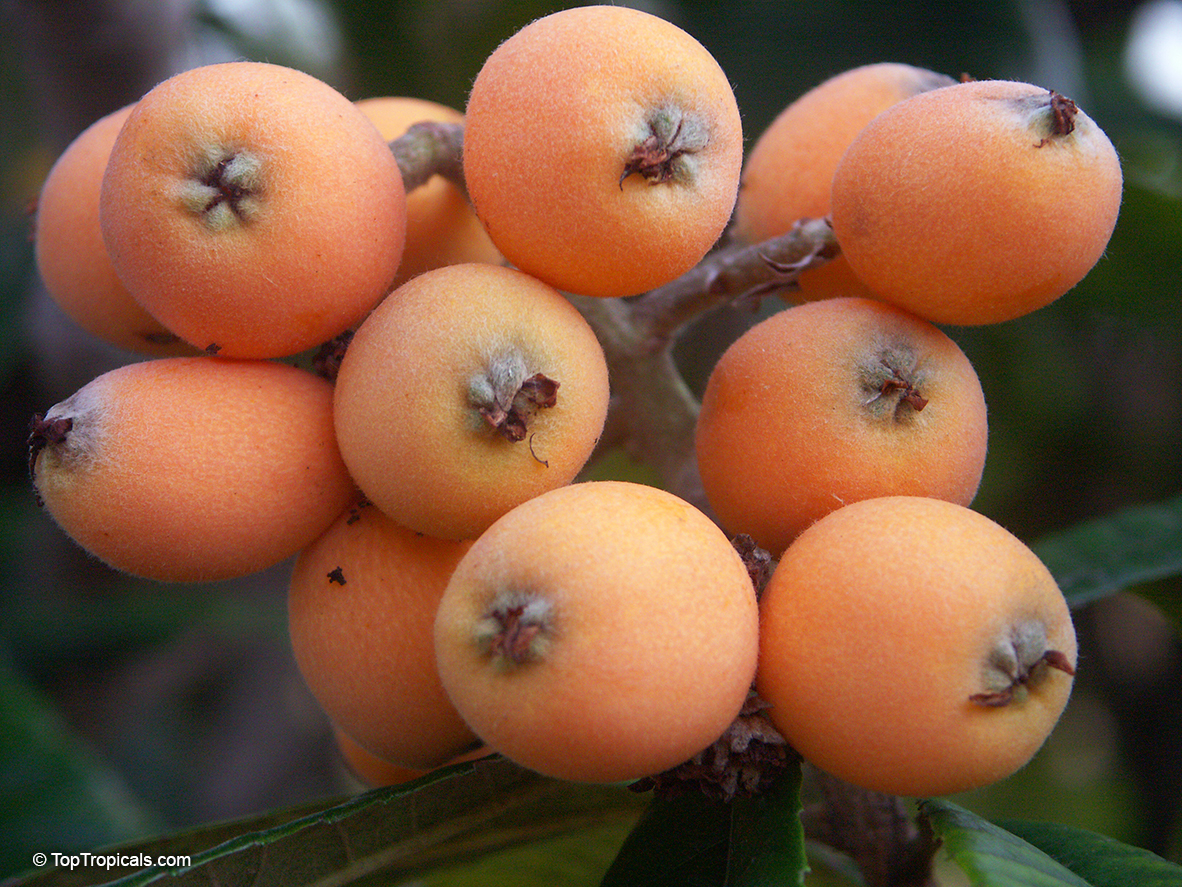
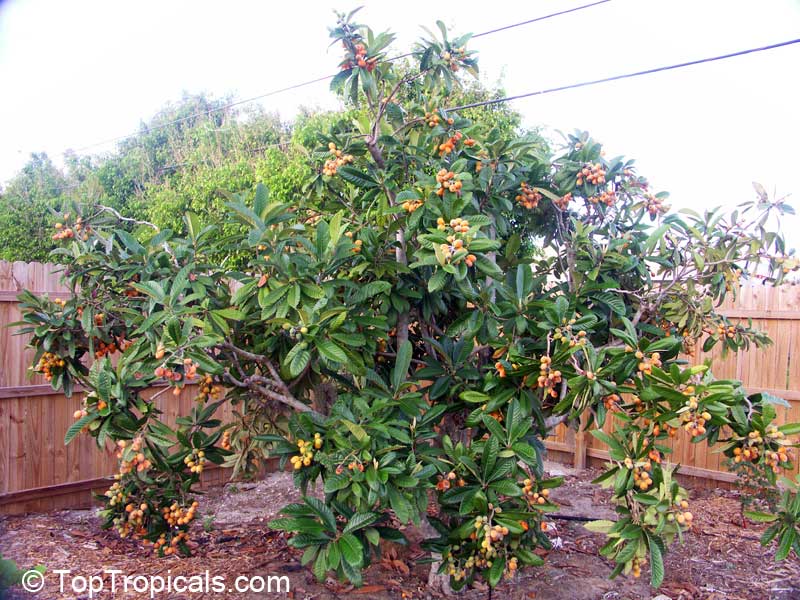
Q: I have a nice Loquat tree started from seed. I understand it will not bear fruit unless grafted. Can you graft the tree in your nursery? If this is not possible let me know the cost of Loquat tree and I buy it from your nursery.
A: From our experience, Loquat trees grown from seed bear fruit
much sooner (within 5-6 years) than seedlings of such trees as Mango and
Avocado (8-15 years). Also, unlike Mango and Avocado, the fruit quality of a
Loquat seedling is usually not too bad. However, in order to have a tree with a
superior fruit, it is recommended to plant grafted variety for a guaranteed
tasty crop. If your seedling is already a large plant (with a trunk diameter
over 5 mm), it may be too late to graft it, because quality graft requires fresh
wood.
If you have plenty of room in your yard with enough space for both grafted
tree and a seedling, you may still plant the seedling in the ground and give
it a chance to produce in a few years. If your garden space is limited, we
recommend you to plant a grafted variety and enjoy fruit as soon as the next
year.
The most popular grafted Loquat varieties, heavy
producers:
Champagne
Christmas
Gold
Nugget
Yehuda
SALE: 15% OFF now, no min. order!
- $20% OFF discount code PARENTS2020 for orders over
$200
- 5% automatically off all orders over $100
= make it a steal!
Offer expires 7-28-20
If you are local, stop by our Garden Center and we will pick the biggest
and the best tree for you. Or just order online and get it in just a few
days to your doorstep!
See full list of Loquat varieties available at the moment.

Date: 24 Jun 2018

Fruitful Fruit and SuperFood...
Q: I have a large fruit garden here in Florida with many mango trees, avocadoes, guavas, and other tropical fruit. Last year hurricane Irma and flooding killed a few avocado trees, but mangos and guavas survived OK, but the sad part is, very few flowers this year and almost no fruit setting. I noticed on your website your Superfood and Sunshine-Honey boosters that supposedly help fruiting? But I am afraid it is too late now as your instructions say first application must be in early Spring? I wish I discovered earlier that my trees wouldn't want to fruit this year...
A:
First of all, it is never late to give the food! You may
start applications of SUNSHINE products at any time
of the year. The best results will be achieved once you
treat your plants on regular basis throughout the whole
year cycle of metabolism.
Couple weeks ago we started harvesting our 2 guava trees.
These two are the same variety (Variegated Honeymoon),
planted within 20 ft from each other and growing in the
same conditions. The only difference was, one was treated
with SUNSHINE-Honey and SUNSHINE-SuperFood, and another
one didn't get any treats in order to have a control
plant.
Results are very interesting, see the picture. Both trees
were heavily covered with fruit. However the one with
treatments developed fruit that is much larger, much
sweeter and juicier, and the most interestingly - with
less seeds, almost no seeds!
To answer your question: yes, you can start feeding your
fruit trees right now. It is still a Springtime. Many
mango varieties have late season; even early varieties may
delay their fruiting if flowering triggered by
miscro-elements. Guavas have very long season and most
varieties can have multiple crops throughout Summer-Fall.
Here is a simple and affordable feeding schedule to
help your fruit garden recover from last year hurricane
stress, and establish reliable production:
1) SUNSHINE-E - for boosting
metabolism - once a month
2) SUNSHINE-Honey - for bringing
sugars to the heart of the tree and boosting fruit
sweetness and quality - now and in 2 weeks
3) SUNSHINE-SuperFood - for
overall health, recovering from hurricane and fixing root
damage from flood - now and every 2 weeks throughout warm
season.
4) You may apply regular balanced fertilizer NPK as
usual (we apply once a month, a handful per in-ground
tree)
It's that simple. Just try and watch your trees produce
again!
Check out all SUNSHINE boosters... We offer FREE shipping on them, so you can make your plants happy!

Date: 15 Jan 2021

Healthy Plants: Q&A from Mr Booster
New Boosters for the New Year!
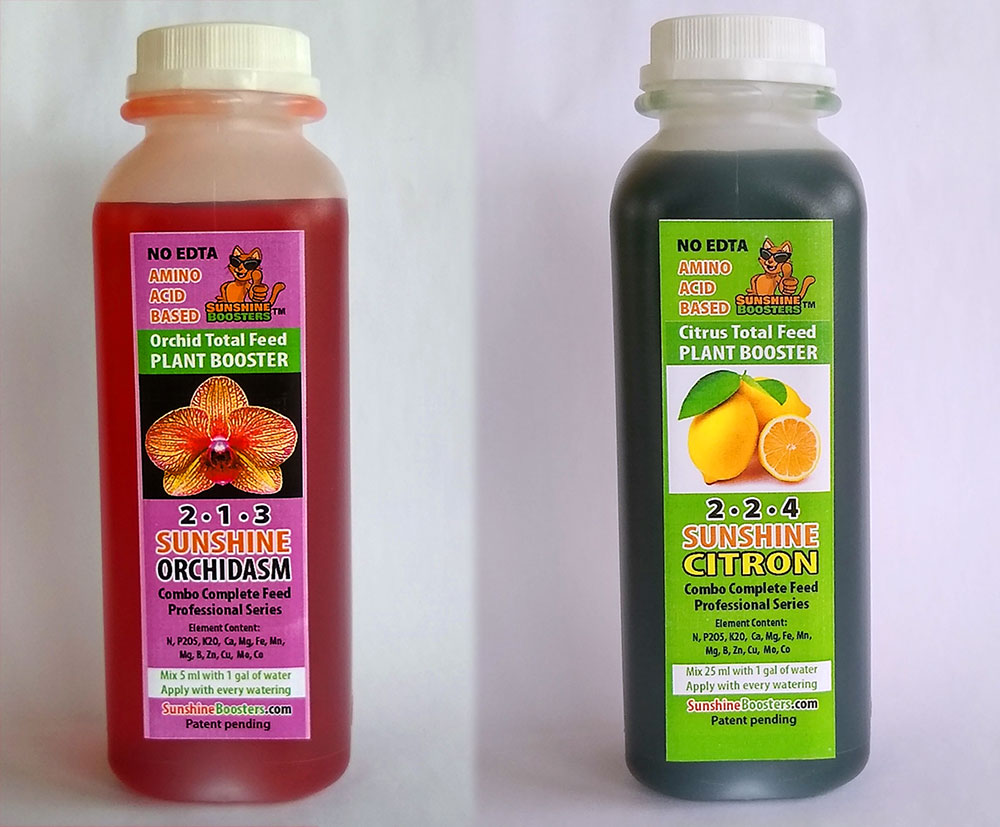
Sunshine Total Feed: Orchidasm and Citron
How to grow everblooming orchids?
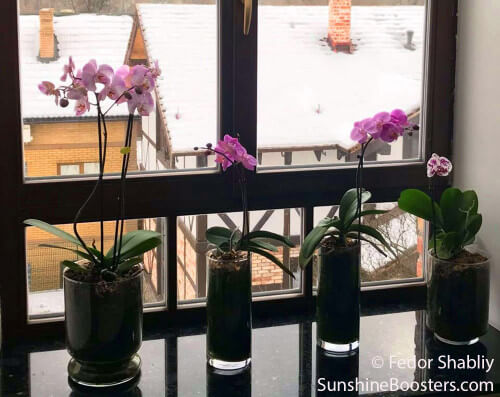
Q: I ended up with a large collection of orchids that I was given as presents... They grow well but unfortunately after the showy blooms were gone, I don't see any more flowers, just green leaves. What do I need to do to make them bloom again? Should I fertilize them with Azalea bloom booster?
A: Orchids culture is different from garden ornamental plants. First big difference, they are epiphytes, growing in a loose bark medium rather than soil, and
benefit from daily mist. Second difference is a type of fertilizer. You can not use a regular garden fertilizer on orchids,
because they are very sensitive to salts. Orchids need special, acidic type of fertilizer, very mild in action.
Luckily, Sunshine Boosters formulas are exactly what orchids need! They are amino-acid based, have very mild formulas, and do not create nutrient lock up (building up salts is one of the biggest
enemies of tender orchids).
A new Sunshine Boosters Orchidasm TotalFeed is scientifically balanced orchid food that contains all
necessary nutrients, including micro-elements, for healthy, happy, vigorous orchids. It can be used as often as daily with every foliage spray. From our testing experience, after using Orchidasm Booster, orchids not only got happy and thriving -
they also bloom more often - up to several times a year, shooting new flower spikes one after another! (while normal blooming cycle for most
orchids is once a year). It gets even better - the flower display lasts twice longer!
To enjoy these beautiful flowers year around - treat them with Love, give them some
Orchidasm!
See more information with pictures in Sunshine Boosters Orchid Blog

Secrets of a healthy Citrus tree
Q: We planted several citrus trees in our yard - Meyer Lemon, Grapefruit and Blood Orange. The trees came from the store full of flowers and even had a few fruit, but a year after planting - no more flowers! The old leaves are green, but new growth doesn't look healthy, leaves are yellowish and have spots, maybe eaten by bugs (?), and how do we get them to fruit?
A: Citrus plants are not the easiest trees to grow; they are susceptible to various diseases, pests, and deficiencies, especially in areas with high humidity/rainfall like Florida.
Fungi, viruses, leaf minors, chlorosis - this is not a complete list of citrus common problems. In commercial groves, these conditions are kept under
control by using harsh chemicals on solid schedule.
For home gardeners, growing citrus trees may become a challenge. Many people don't want to use harsh
chemicals on their edibles; and those who do, may not always have time to apply treatments on a professional schedule. So as much as we all love a fresh juicy orange,
growing your own may become quite a pain!
Sunshine
Citron TotalFeed is your simple, eco-safe solution to a healthy looking, productive citrus tree with organic fruit! Amino-acid based formula provides all
necessary elements to strengthen the tree and make it resistant to possible problems.
Did you know that treatment of leaf chlorosis (yellow leaves with dark
green veins), commonly treated with iron supplements, in fact requires a complex combination of nutrients - both balanced NPK and micro-elements?
Use Sunshine Citron in combination with Sunshine GreenLeaf and
Sunshine SuperFood and never see yellow chlorotic leaves again!
Apply Sunshine Epi on regular basis (every 2 weeks) and help your tree boost its immune system and stay virus-free.
Add Sunshine Honey, and you will have large, juicy fruit that
are much sweeter and more flavorful than those from the store! All these boosters are compatible with each other, and perfectly natural. Eat your fruit safely and enjoy...
Read more about treating citrus tree defficiencies in Sunshine Boosters Citrus Blog.
Date: 20 Feb 2017
Flowering plant for a front yard

Q: I need your expertise. I had a plant in the front of my house that when I moved in (two years ago) wasn't doing well. It was infested with grasshoppers and snails. I treated it with a pesticide and fertilizer and it flourished. Had beautiful flowerings and was almost the size of the mulch area. Then the property management company hired some terrible grass cutters that I believed destroyed it. I would come home and find the red mulch and leaves from the plant all over the front lawn. And since then it has gone down hill. I am attaching a picture. As of now the larger of the remaining two trunks (out of six that were there) is falling over and it doesn't seem to be doing well. So I was wondering if you can recommend a nice plant that I can replace this one with. Nothing extravagant but nice enough to fill in that area. Also since I only lease here don't want to get to pricey either. Thanks for any advice and plants you have.
A: The plant you have is called Spider Lily. It is one of the easiest landscape plants that doesn't require much care and is great for low maintenance yards. In your case, besides possible damage from the grass cutter, looks like the plant is very old judging by the thick woody stem. It is not a bad idea to replace it with something more pretty rather than trying to baby it. Other suggestions for this location would be something easy and low maintenance, especially if you don't have reliable sprinkler system in that area of your yard and don't want to spend time hand-watering with a house:
Sweet mimosa - grows into very large bush, Pony tail, Dwarf poinciana, Powderpuff, Clusia, Devils backbone (smaller bush 3 ft tall), Cordyline, Ti leaf - these are very colorful.
There are more low maintenance plants you can chose from.
And always remember that traditional "landscapers" that only mow grass, may not be experts on plants. You may always call TopTropicals Garden Doctor
Date: 4 Feb 2017
Groundhog Day Feb 2

On Groundhog Day Feb 2: Groundhog Punxsutawney Phil saw his shadow on Thursday morning, predicting six more weeks of winter during Groundhog Day festivities at Gobbler's Knob, a small hill just outside Phil's hometown.
According to folklore, if it is cloudy when a groundhog emerges from its burrow on this day, then the spring season will come soon; if it is sunny, the groundhog will supposedly see its shadow and retreat back into its den, and winter weather will persist for six more weeks.
Phil promised long winter, however, we should not cry in despair but starting to get ready for Spring!
Spring Check List:
- Make sure min temperatures are above 45F before you start bringing potted plants outside.
- When active new growth appears from buds, after-winter pruning can be done.
- You may start weekly fertilizing as soon as night temperatures raise above 55F.
- Start planting in the ground as soon as there are no more chances of frost, until then keep newly arrived plants in pots so they get better established.
- Low chill cold hardy fruit trees including Peaches, Nectarines, Plums, Apples, Mulberry, Loquats go in the ground first, so you can enjoy their blooms and early fruit set. Plant Pomegranates, blueberries and cranberries, raspberries and blackberries, grapes.
- Water as needed, still keeping on dry side until afternoons get hot and plants start using more water.
- Start seeds indoors. The sooner the better, to give seedlings more time to establish before planting out in the ground.
Overwintering Magnolia (Michelia)
Michelia alba Question: I have a question about Michelia alba. My Michelia alba leaves turning yellow and losing leaves. When I brought it inside for the winter, after the leaves falling off new one grow back not all of them grow back and now the new the branches start to die. I water once a week.
A: Whenever moving a plant in or out of the home it is always best to do it gradually. Moving a plant all in one day will cause stress to the plant due to environmental changes such as, new humidity levels, new light levels and new watering requirements. Michelias