Date: 24 Jun 2018
Plant Horoscope. Sagittarius Zodiac lucky plants: Fig and Baobab
Sagittarius
- 11/22 - 12/21. Sagittarius is a FIRE sign
that is ruled by the large and optimistic planet Jupiter.
Archer's plants tend to be large in size and fairly
conspicuous, with a pleasant odor. They may have large, or
elongated leathery leaves and showy flowers.
The best plants for Sagittarius will support the body's
largest glandular organ, the liver. The planet Jupiter
also rules the hips, thighs, lower spine, and the
autonomic nervous system, as well as the process of growth
and preservation. Herbs related to Jupiter have
traditionally been used to treat lower back problems
(including sciatica and lumbago), arthritis, and
rheumatism. Herbs with a high silica content are related
to Sagittarius (they promote a positive frame of mind), as
are plants with large taproots and trees that produce
fruit and nuts. Illnesses of Jupiter are said to arise
from immoderate consumption. Basil is an herb that's both
expansive and cheerful - just like Sagittarius - and its
reputation as a money attractor resonates with this sign's
generous nature as well. Use this happy herb when you want
to infuse your life with fun and prosperity!
Sagittarius Zodiac lucky plants: Mulberry, Ceiba, Chonemorpha, Beaumontia, Baobab, Grapefruit, Anise, Sage, Cinnamon, Blueberry, Thistles, Nut trees, Lemon, all Ficus trees, Peepal, Fig, Coleus, Basil, Banana, Mango, Ironwood Mesua ferrea, Clematis, Peony, Jasmine, Nutmeg, Mint, Tea, Date palm, Guava, Jambul, Maple, Magnolia, Teak, Bird of Paradise, Heliconia, Showy Gingers.
For other signs information, see full Plant Horoscope
Date: 24 Jun 2018
Asian New Year started! Year of Down to Earth Dog...
Chinese New Year, also known as the Spring Festival, started on February 16, 2018. It is the Year of the Yellow Dog, or the Earth Dog.
According to Chinese horoscope, in 2018, the
corresponding element is Earth. Earth is also associated
with the color yellow. The Year of the Earth Dog is
therefore also known as the Year of the Yellow Dog. So
what happens when you mix the Dog with the Earth Element?
The Dog is sincere, independent, and clever. Like man's
best friend, they are extremely loyal and devoted and you
can always count on them to stick by your side.
The Earth element, by its very nature, denotes origins and
growth and is associated with practicality, harmony and
hard work. The Earth seeks to nurture and be nurtured, it
anchors you and provides stability.
A loyal and hard working Dog combined with the steady and
sensible characteristics of Earth, heralds a secure,
rewarding and profitable year. A year of blossoming, to
achieve things, and to thrive. An Earth Dog combines the
integrity and diligence of the dog with a very
"down-to-earth" climate, perfect for longstanding projects
requiring persistence and grit. Real estate is high in the
agenda in the year of the Yellow Dog, whether you are
contemplating any investments or purchasing a home,
everything should align well for you this year.
The Year of the Dog follows an energetic and chaotic Year
of the Rooster... An Earth Dog Year will welcome some much
needed sense of harmony, peace and goodwill, a year of
unity and understanding that will reward all of us for our
hard work and diligence!
Lucky colors for 2018 are colors that symbolize the
element Wood (green) and the element Water (blue). Just
keep your plants green, and get some blue flowers!
For more information on Plant Astrology, see Plant Horoscope
Date: 24 Jun 2018
Growing tropicals from seeds.
From Kristi the Wizard of Rose: I grow many plants from seeds, both for my personal collection, and for TopTropicals. I receive many questions from customers who want to grow tropical plants from seeds. Some of them live in colder climates and try to extend growing season of their tropical collections by starting new varieties early in the year from seeds. These are a few tips that may be helpful.
Q: What do I need to do to speed up germination process?
A:
Many factors affect germination. Considering you get fresh
seeds (for example from TopTropicals) and Mother Nature
gives them a good kick start, there are a few things that
may speed up germination:
1) Scarification. Large seeds with a hard outer
shell can be slightly sanded down just enough for moisture
to get inside to wake up the seed during the pre-soaking.
Be careful not to damage the seed. See example of Lotus seed
scarification.
2) Pre-soaking. We recommend pre-soaking most of
the seeds for only a few hours (3-8 depending on species.
Some seeds are very sensitive to moisture and may start
rotting if stay wet without air circulation. Small seeds,
especially tiny ones like dust, should not be soaked.
3) SUNSHINE-S treatment. Adding a few drops of SUNSHINE-S booster when
pre-soaking seeds increases their germination rate 3-5
times.
4) Temperature. Warm temperatures help germination.
If grown indoors, put seeds containers or trays in the
warmest spot of your house; you may use heat pads.
Outdoors, putting them in full sun helps a lot, just don't
let soil to dry out.
Use only special porous seed germination mix
Date: 24 Jun 2018
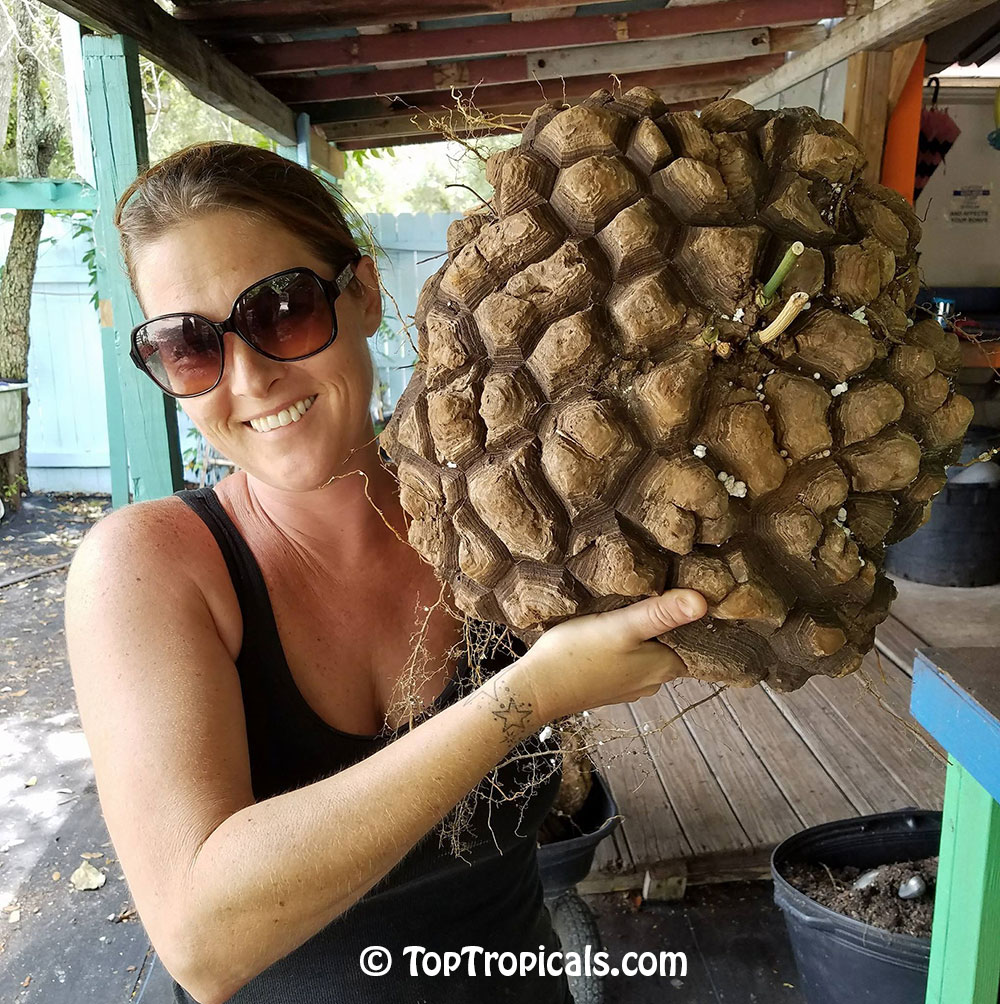
Elephant Foot, Turtle Shell - back in stock!
Dioscorea
elephantipes.
Dioscorea is a curious plant
with tuber above ground level covered with layers of corky
bark, resembling a caudex. It is a slow growing, very
unusual succulent. Tuber contains saponins, originally
cooked and eaten as a famine food by the Hottentots.
Caudex that grows up to 6' in nature, resembling an
elephant's foot and looks as if it is segmented into
geometric patterns (smaller plants look like tortoises)
and looks dead but is actually a living tuber. A plant
with 18"caudex can be almost 100 years old! The plant
grows into a vine with attractive heart-shaped leaves and
small yellow flowers. Culture is relatively easy. The
vines may die back and regrow several times a year,
depending on the particular plant and your region. The
plant doesn't send down deep roots, so plant in a shallow
pot about 1" larger than the diameter than the caudex. Potting soil should be very
porous/loose so that there is easy drainage. Water
well around the edges. Keep in a warm area and wait for
the first shoots of the vine to appear. Water regularly
from that point on. The plant should not be kept damp as
with other tropical plants. Allow it to dry before
watering again. Many books will say that they are winter
growers, because they are native to the southern
hemisphere. In fact, they grow in all seasons! Let the
plant be your guide. You cannot force them to grow, and
over watering will simply cause them to rot.
Elephant Foot is a collectors item, but remarkably easy to
grow. It will be with you for years with no effort. It is
a wonderful conversation piece! See more info about Dioscorea
elephantipes.
We have limited stock, while supply lasts, hurry up!
*** 4-6"caudex *** 6-8" caudex *** 10-12"caudex *** Seeds. Don't forget special TopTropicals Adenium Soilless Mix
Date: 24 Jun 2018
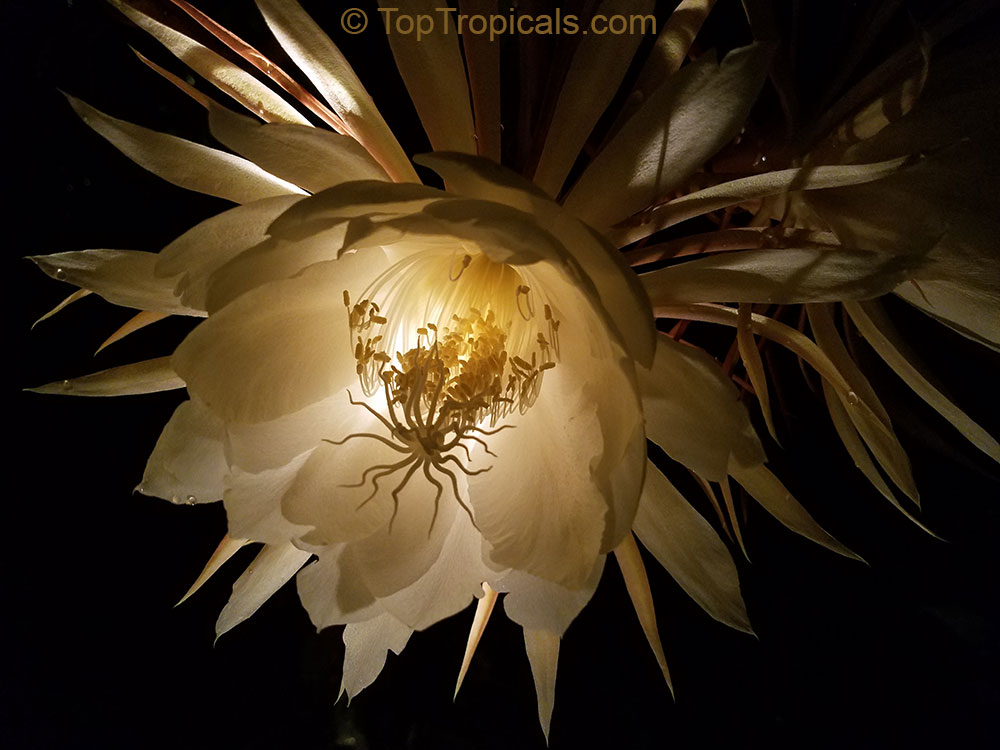
Mysterious Night Blooming Cactus - Epiphyllum. How to grow it?
Q: My friend has a huge Queen of the Night Cactus, and the blooms are so gorgeeous! She gave me a cutting but I am not sure how do I plant it? How long will it take till it starts blooming? Is it true that it has only one flower once a year and only at night?
A:
Queen of the Night is a very popular and yet mysterious
plant. The flowers open once a year after sunset for one
night. However the flowering period can last a month or
two during the warm season. So each flower lasts only one
night, but there will be more flowers to come! In the
Nature, Epiphyllum oxypetalum - Queen of
the Night - grows on trees in the jungles of Central
and South America. It is actually very easy to grow as an
indoor plant in colder climates. Here is South Florida we
grow them outside in hanging baskets. This is how to start
Queen of the Night from a cutting:
1) Put the cutting in a dim, dry place for three days,
with no soil and its base exposed to the air, so it will
form a callus.
2) Fill a 4-6-inch pot with slightly damp potting soil or succulent mix. Insert the
cutting 1 or 2 inches into the soil and tamp the soil
around its base.
3) Place the pot where the cutting will get bright light,
but no direct sun. Spritz it occasionally with a spray
bottle of water to keep the soil only slightly moist. It
should root in couple weeks.
4) Keep the plant on an east- or west-facing windowsill
where it will receive direct sunlight only in early
morning or late afternoon. Water the cactus until water
runs out of the pot's drainage holes. Dump the excess out
of the pot's saucer immediately, and wait until the
surface of the soil is dry to the touch before watering
your cactus again.
5) Fertilize once a month from March through October with
a balanced plant food, and
apply micro-elements once a month
for a healthy vigorous growth. Refrain from feeding the
plant in December and January.
6) Position the cactus in partial shade under a porch roof
or tree, if you decide to move it outdoors during the
summer. This plant likes summer humidity!
7) Repot the cactus only once every two years or so, to
keep it slightly root bound. Wait until after it flowers
in summer, and repot it after it blooms. Prune off any
damaged growth at that time as well.
8) Move the plant to a cooler room over the winter months,
one that remains dark during the evening hours with
temperatures above 45 degrees. Reduce the frequency of
watering, waiting until its soil is dry. Resume regular
watering in March.
If grown from cutting, it may take 2-3 years until the plant starts blooming, so if you don't want to wait that long - just get a blooming size plant from our store!
We only have a few plants... if sold out, add to wish list and we will have more soon!