Garden Blog - Top Tropicals

Date: 17 Oct 2018

Dobi Duck @ Top Tropicals
TopTropicals.com

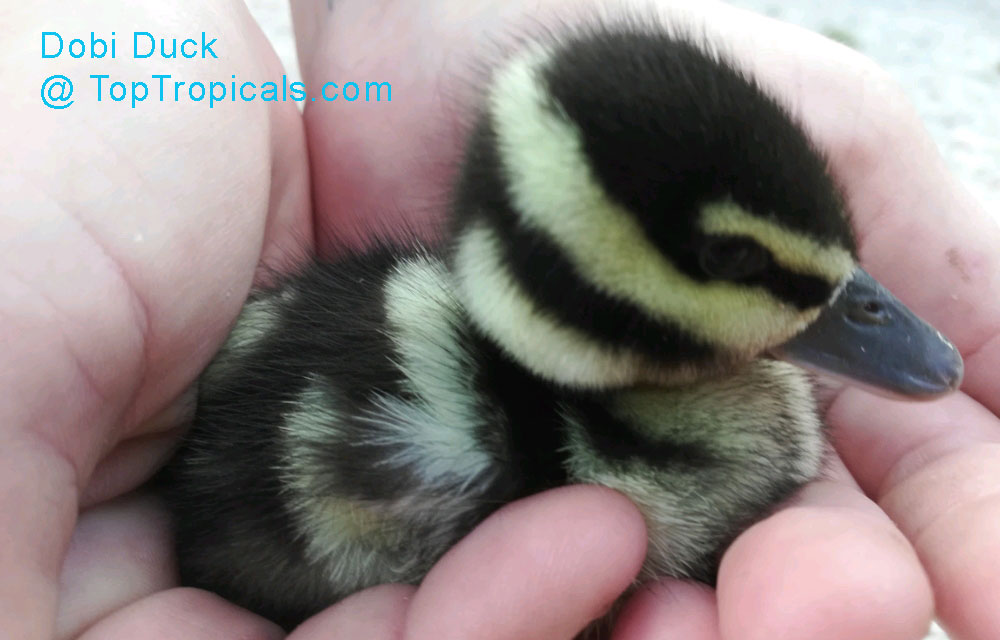
Introducing a new member of Top Tropicals Team: Duck Dobi. Full name is Adobe (Acrobat or Photoshop - he is both active and colorful perrrson).

A customer brought us this little guy who was lost on the street, probably left behind when his Mama took her babies across the road. (Why did the Duck have to cross the road after all?)
So Kristi adopted Dobi. He has been doing great for the last couple of days, decided that Kristi is his Mom so he is following her everywhere. TopTropicals cats are excited but staying away knowing better: don't mess with Mama Kristi!
Those of you who know little secrets how to raise little ducklings please drop us a line! Dobi is our first experience in raising something different than plants or cats!
Date: 12 Oct 2018

Portlandia - rich hot chocolate with vanilla

TopTropicals.com

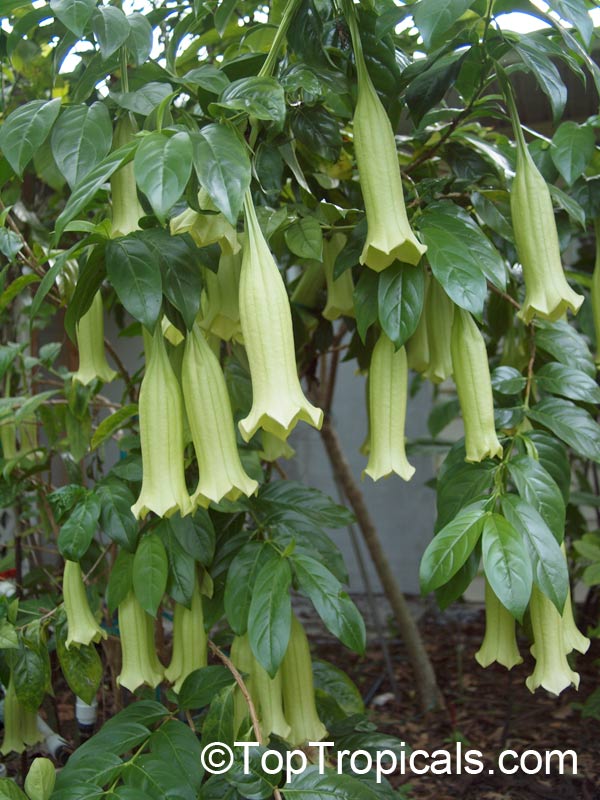
From Mark, the Garden Whiz. Since working in the horticultural field for nearly 50 years, at either nurseries or botanical gardens both in Florida and southern California, I have come into contact with a LOT of very cool plants. So many of them in-fact, that it's becoming increasingly difficult to run across new ones that really make me take special notice. Since being at Top Tropicals for a while now, there are a few species I had not met before which really stand out. Among them are a couple of kinds of Portlandia. Continue reading...

See our selection of Portlandias...

Date: 7 Oct 2018

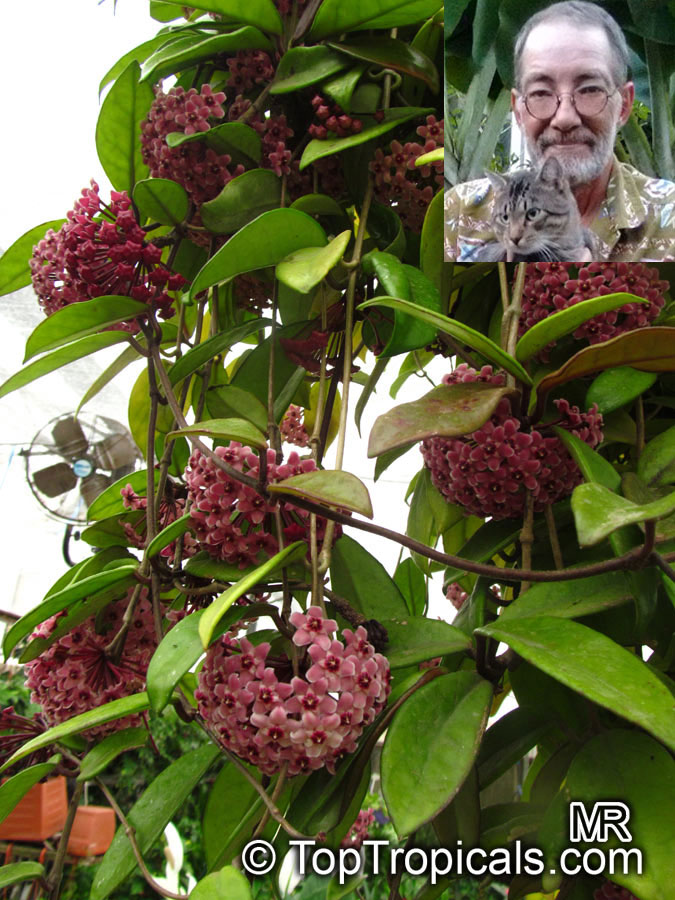
Multi-flowering Hoyas:
from Mark, the Garden Whiz

TopTropicals.com

Q: A few months ago, i was given a Hoya vine. At the time, I was told to not cut-off the flowers but was never told why. However now that it IS flowering, they are so wonderful I would like to. Is there really a reason to not clip them off?

A: Actually, that was very good advise. Unlike most plants we encounter, hoyas develop perennial flower spikes. This means that each spike flowers more than just once! In other words, after the flowers on such a spike have gotten old and fall off, the knobby ended spike remains. Then, after a period of time, that same spike will develop another ring of flower buds. Depending on what kind of hoya it is, these perennial flower spikes may continue to periodically make more flowers for several years! And while the plant will continue to make more of these perennial spikes its whole life, the flowering display becomes better all the time as more and more spikes grow. (By the way, these are technically called "flowering spurs"). So every time a spur might be cut for ornamental purposes, it'll be one less place the vine can flower from in future years.

See our selection of Hoyas...

Date: 24 Aug 2018

When and How Much to Water?

TopTropicals

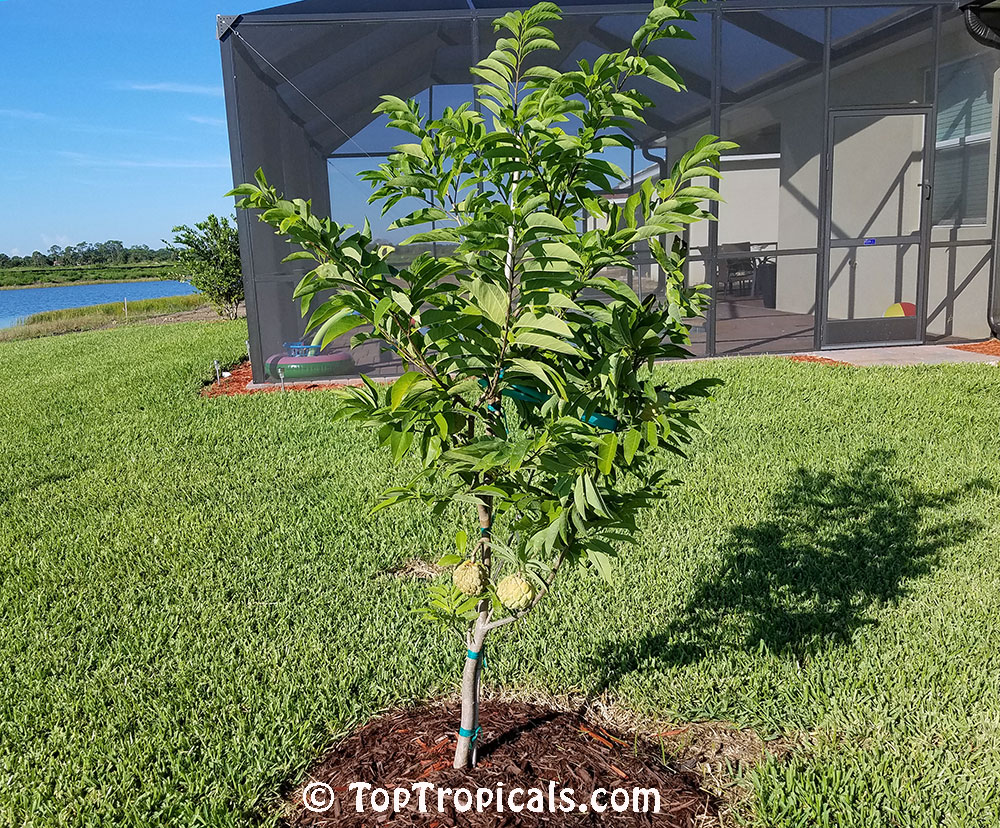
Q: I have an automatic sprinkler system that waters my lawn. I purchased a tree from you and want to plant it in the middle of the back yard where sprinklers cover that area very well. Will it be enough water? Is there any specific time of the day I should set up the sprinklers and for how long?

A: Do not rely on sprinkler system until the tree is established and starts growing. Right after planting, saturate the soil around the root ball really well. If the weather is hot, water with a garden house daily for at least a week. Once the tree starts new growth, you may rely on sprinkler system.
Twice a day usually is enough, with 10-15 min of zone duration. As far as start times of your irrigation system, water first time in early morning (as early as 4-5 am in Summer time), and second time in late afternoon, when it cools down a little bit. It is important to give leaves a chance to dry before plants go to bed. This will help to eliminate fungus problems as fungus develops in dark moist environment. Usually 4-5 p.m. is a good time for second watering in Summer. As days get shorter, reschedule second watering time to earlier hours.

Date: 27 Jun 2018

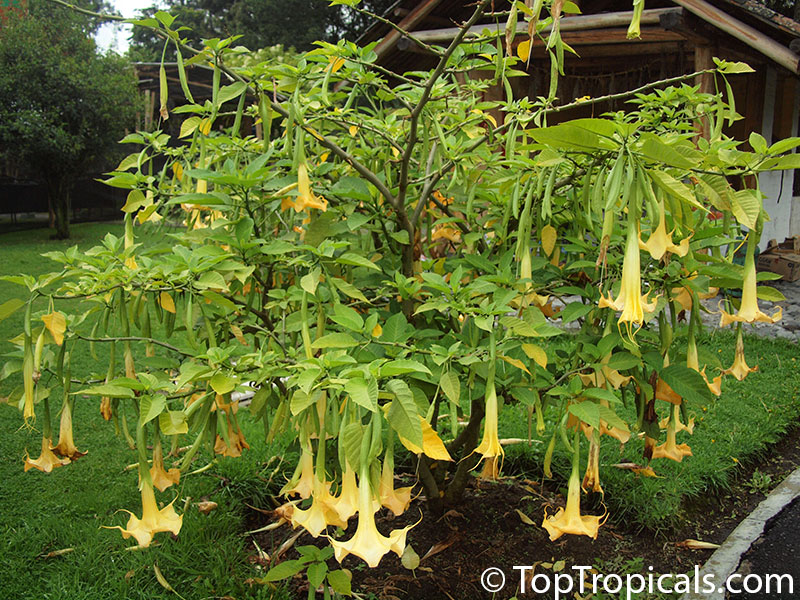
TROPICAL GARDENING: How to grow Brugmansia (Angel Trumpet) in the ground outside.

TopTropicals

Q: I recently moved from New Jersey to Florida and I brought with me my Brugmansia that I used to have as a house plant. Can I plant it in the ground now?

A: Angel Trumpet - Brugmansia - is a very popular container plant valued for its large, stunning fragrant flowers. Originated from South America, it will be happy to grow in tropical to subtropical climate outdoors. These are a few useful tips to get the most out of this beautiful plant:
1) Light. Plant it in full sun - the more sun, the more flowers you get, although Brugmansias tolerate shade. If the plant was previously grown in container indoors, to avoid leaf burn, keep it protected with a shade cloth or simply white sheet for a while and gradually open to adjust to full sun.
2) Soil and fertilizer. Use fertile soil with lots of organic matter (add compost to existing soil). It must be very well drained, Angel Trumpet won't tolerate waterlogged conditions. Plant it on a little "hill" elevated 3-4"above the surrounding area. Brugmansias are very heavy feeders. Once the plant is established, fertilize on regular basis with Slow Release Fertilizer - a handful once a month.
3) Water. Water daily until established. Once the root system is well developed, the plant is drought tolerant and won't require too much care. But at the beginning, watch the leaves - the lush foliage droops quickly if the plant is thirsty.
4) Plan space. Brugmansia is a short tree, but it needs a lot of room to spread branches with its heavy hanging flowers. Think 12" wide and maybe almost as much tall.
5) Support. Being widespread plant, Brugmansia can be blown with strong winds. Stake with strong support until established.
6) Propagation. Brugmansia is one of the few plants that propagates with semi-woody cuttings; soft green cuttings usually have little success. Other than that, it is pretty easy!

Check out our Brugmansia collection and... collect them all!