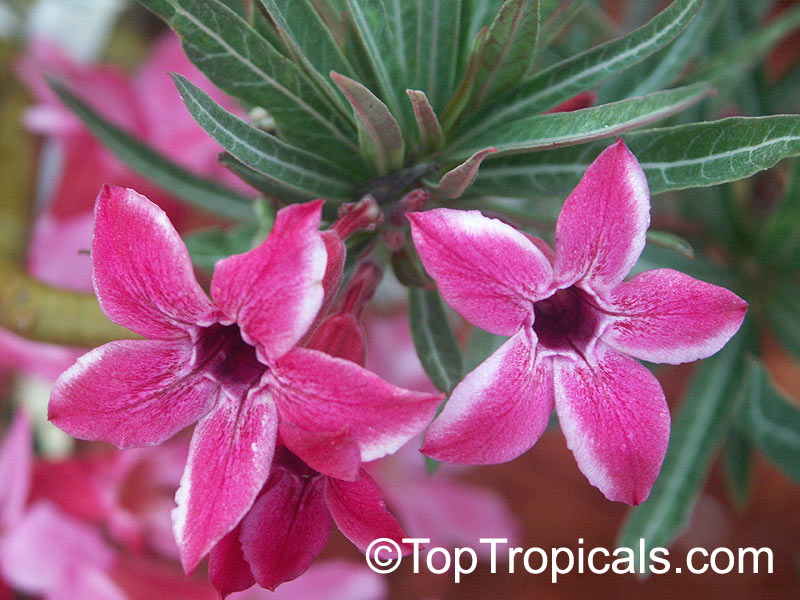
Q: I am looking forward to my three desert roses I just ordered from you and I am wondering how to take
care of them, especially during winter time. Should I put the pots in full sun
or shade? What kind of soil do they like? How often should I water them? When
it gets cooler, should I bring them inside? We do have occasional frost here
during winter.
A: Here are a few tips for your desert roses:
1. When received Adenium from mail-order, unpack carefully; branches are
fragile. Plant in well-drained potting mix. Cactus mix will do, but we
recommend special Adenium mix. If using regular acidic peat-based potting mix, you may
add sea-shells on top of soil to neutralize acidity: adeniums prefer alkaline
soils. Using clay pots is beneficial. Water once and do not water again until
soil gets dry. Place in bright shade until new leaves sprout, then the plant
can be moved to full sun.
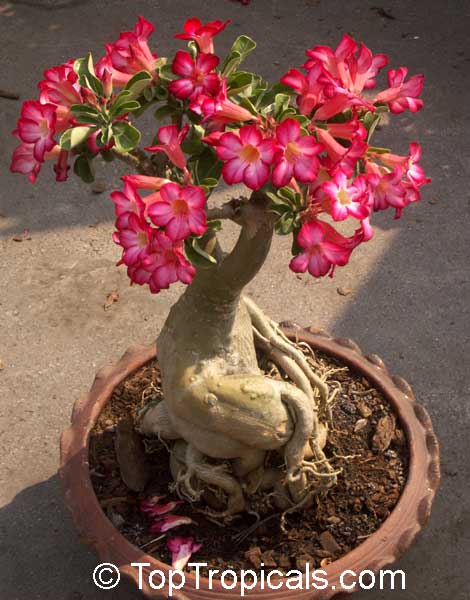
2. Adenium is a succulent, but not a cactus. It needs watering, however
let soil dry before waterings. Reduce watering during cool season and
discontinue when plant gets dormant (drops all leaves in winter).
3. Bright light is the best for profuse flowering. However, adeniums
look much healthier in slightly filtered light rather than in all-day full
sun.
4. Fertilize and spray leaves with liquid fertilizer SUNSHINE Megaflor - Nutrition Bloom Booster. Phosphorous is responsible
both for flowering and caudex development. Avoid caudex, spray over foliage
only. Dry fertilizer can be used only during hot months.
5. Watch for spider mites during hot and dry season.
6. Give plants a break during winter dormant season. Keep in bright
shade and reduce watering to 1-2 per month or stop watering if temperature is
below 65F.
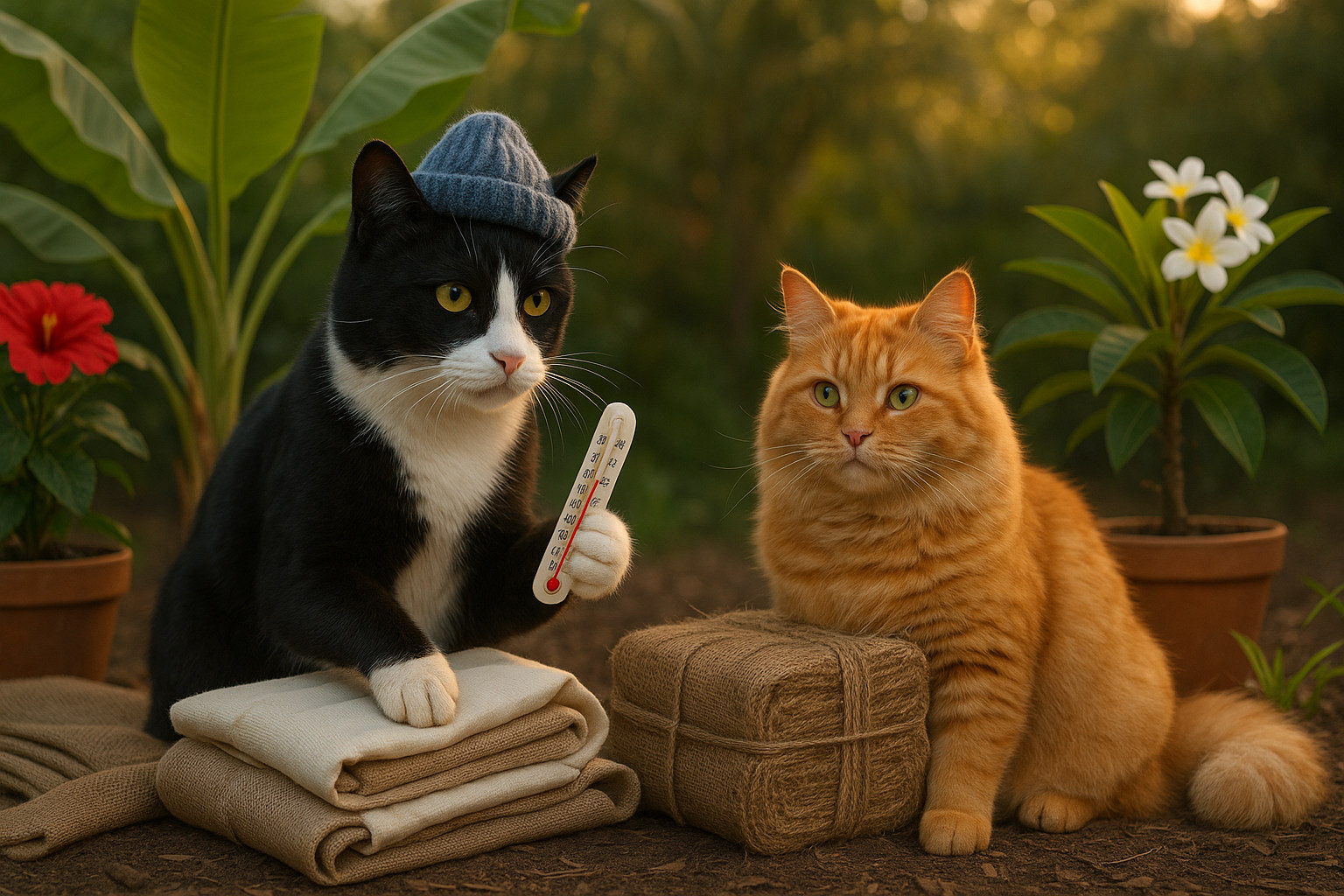
Smokey and Sunshine Wrap Up the Garden with Frost Cloth Before the
Chill.
Smokey: "Thermometer says 45. Time to wrap the bananas!"
Sunshine: "You wrap the bananas. I’ll guard the mulch… from this
sunny spot."
Smokey: "Teamwork, Sunshine. Teamwork."
🌡️ Cold nights are coming - but your
tropicals do not need to shiver!
Even in sunny Florida and other warm zones, one cold snap
can undo months of growth. Preparation is everything. Tropical plants can
handle a lot, but they dislike surprises. Let’s make sure
your garden stays safe, strong, and happy all winter long.
Tips from Tatiana Anderson, Top Tropicals Plant
Expert
👉 Group and Check Your Plants
You already know which plants are in pots and which are in the ground.
What matters now is prioritizing by cold sensitivity.
Identify the tender tropicals – papaya, banana, plumeria, adenium,
heliconia – and decide which ones get covered first when temperatures
drop.
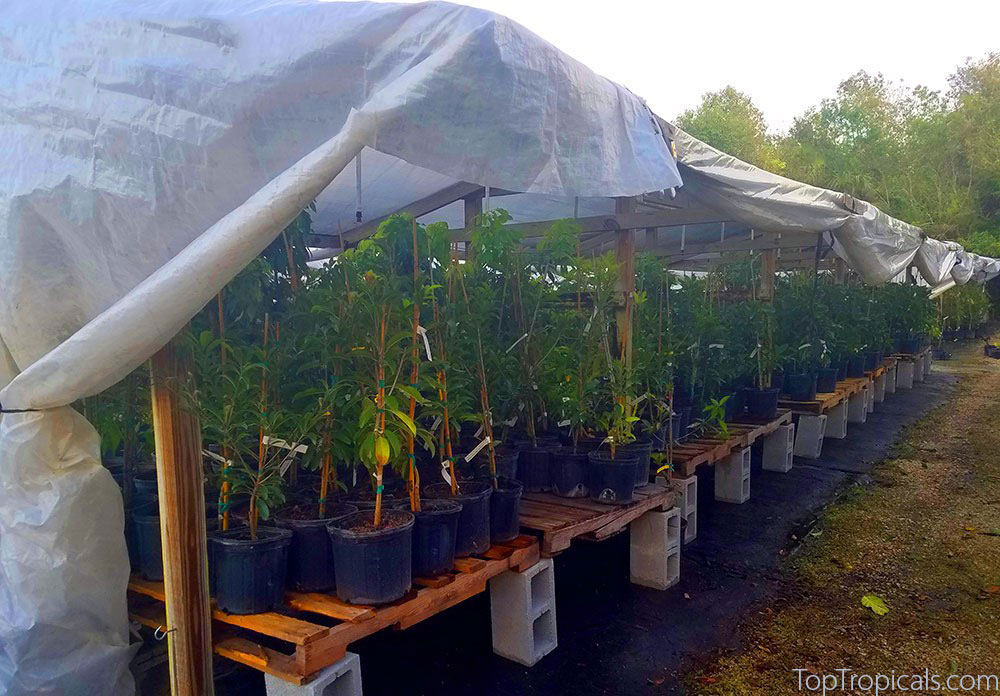
Keep frost cloths or old sheets near those areas, ready to grab fast. If
your garden is large,
label protection zones or mark plants that always need extra care. The goal
is to have a plan, not a panic, when the cold alert hits.
Once you know your priorities, you can plan the rest of your protection
strategy.
👉 Feed and Mulch
Stop using high-nitrogen fertilizers by late fall. They push soft new growth
that freezes easily.
Add compost around the base of your plants and top with 3 to 4 inches of
mulch. Mulch acts like a blanket: it keeps warmth in, protects the roots,
and keeps soil moisture steady. Just make sure the soil drains well; cold
and soggy soil leads to root rot. In raised beds, check that water flows
away easily.
After you feed and mulch, it is time to look at how your local zone changes
the game.
👉 Zone-by-Zone Tips
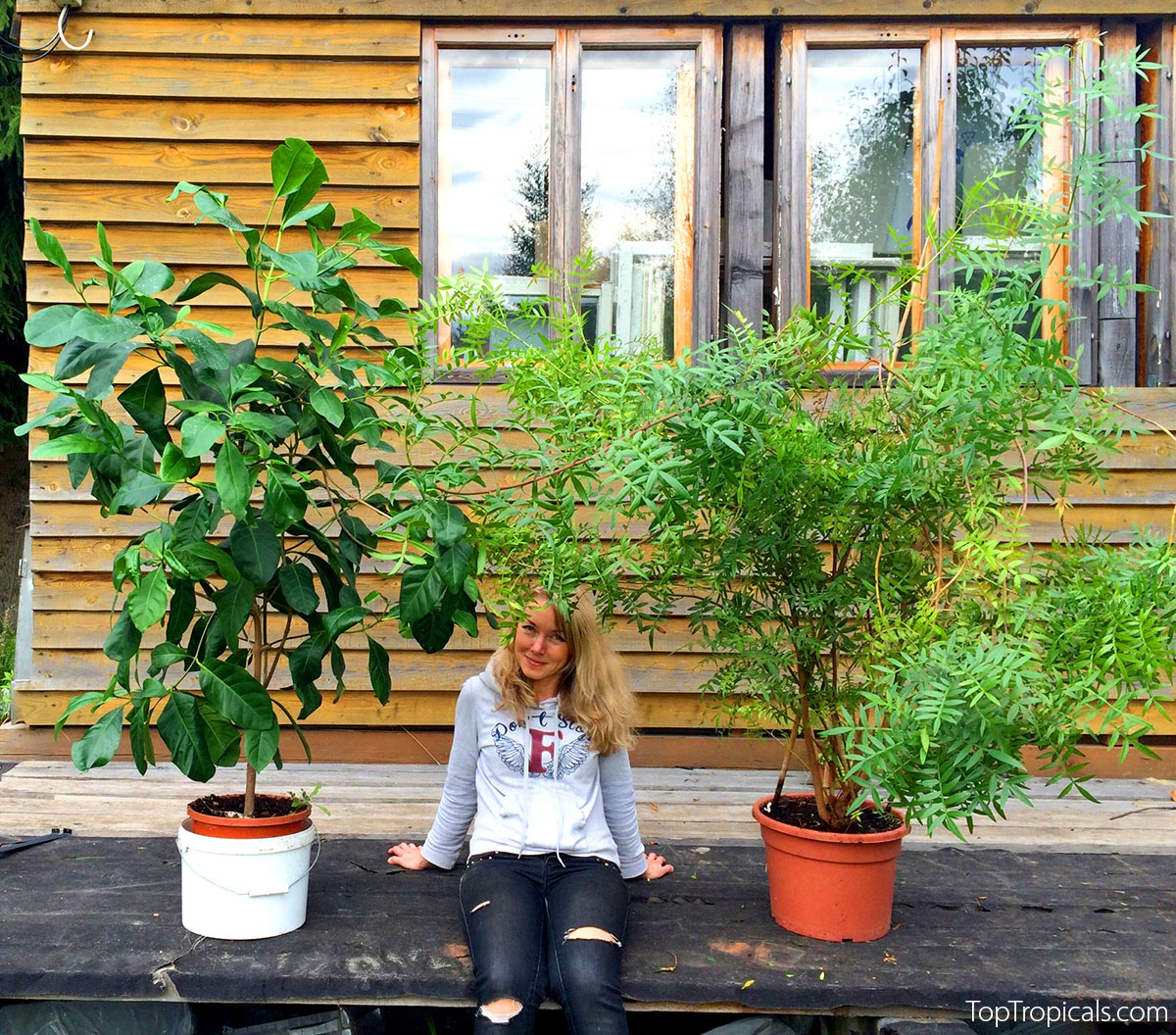
Moving Tropical Plants Indoors for Winter Protection
Zone 10: You are lucky! This is mostly a maintenance season.
Watch for root rot after heavy rain, trim lightly if needed, and protect
tender young trees during surprise chills. Keep some frost cloth ready just
in case.
Zone 9: This is the main action zone. Nights can dip into the
30s. Deep-water your trees once before cold nights to insulate the roots.
Apply heavy mulch, and have frost protection ready to go. If you grow
tropical fruit like mango or guava, consider wrapping young trunks in burlap
or foam pipe insulation.
Zone 8: This is where tropical gardening becomes creative. Stick
to cold-hardy tropicals such as loquat, guava, or cold-hardy avocado
varieties. Use portable greenhouses, wrap trunks, and move smaller plants
indoors or to a heated porch when frost threatens.
Now that the garden beds are set, let’s look at your pots and
containers – your most mobile plants.
👉 Container and Patio Plants
Potted plants are the easiest to protect but also the quickest to freeze.
Start reducing watering now so roots do not stay too wet in cooler weather.
Before moving them, check for insects hiding under leaves or in the soil.
Group your pots close to a wall for reflected heat and wind protection.
If you plan to bring them indoors, do it gradually. Move them closer to the
house for a few days before bringing them all the way inside to help them
adjust to lower light and humidity.
When the chill starts, many gardeners rush to move everything inside at once
– but a smooth transition works much better.
👉 Indoor Plants
When bringing plants inside, give them a good rinse to remove dust and bugs,
and flush the soil to wash out salts from summer fertilizing. Keep
them separate from your houseplants for a week to make sure no pests come
along. Expect some leaf drop – it is normal as they adjust to lower
light. Give them bright light near a window, and cut watering by about half
until spring. Avoid misting too much; good airflow matters more than
humidity during winter.
Many tropicals, like hibiscus, brugmansia, and crotons, may look tired for a
while, but they will bounce back quickly once days get longer.
👉 Timing Is Everything
The key is to prepare before the first cold warning. Check your weather app
regularly once nights start dropping into the 50s. Keep covers, mulch, and
supplies ready so you are not running outside at midnight with a flashlight
and a frozen hose. Have your frost cloths labeled by plant group and stored
in an easy spot. A little organization now saves a lot of stress later.
Many tropicals, like hibiscus, brugmansia, and crotons, may look tired for a
while, but they will bounce back quickly once days get longer.
Remember: the goal is to help your plants rest safely. Many gardeners prune
or fertilize too late in the season – we will talk about why that can
be risky next week." — says Tatiana Anderson, Top Tropicals Plant
Expert
Coming next mail-list: The best gadgets for cold protection (lights,
heaters, frost covers) and what NOT to do in winter.
Protecting Tropical Plants with Frost Covers at Top Tropicals
Nursery
Date: 6 Dec 2025
🌿 Bring the Jungle Inside: Winter Survival
Guide Part 2.Temperature.
❄️
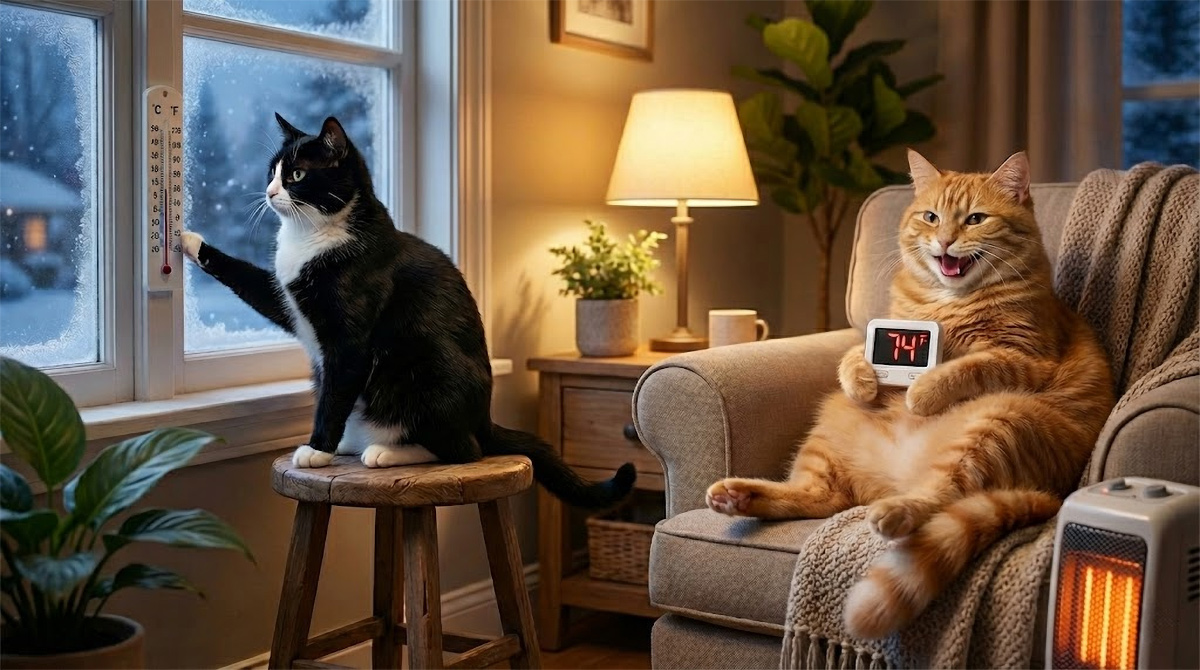
Smokey: Too cold. We need more heaters so the plants feel comfortable. Sunshine: I feel comfortable. Smokey: You are not part of my plant collection, but I am glad you are comfortable.
Most tropicals stop growing below 70 to 75 F. They stay green, but their engine shuts down.
Below 70F:
Water intake drops.
Roots slow down.
Fertilizing becomes risky.
Root root becomes easy.
If you WANT your plants to grow in winter, you must take care of everything:
Warmth, light, humidity, water. It all works together.
Aim for 75 F with bright light. Water lightly. No fertilizer.
Watch out for drafts. Cold windows. Door blasts. Garage entryways.
Even one gust can trigger leaf drop.
Vents are the opposite problem: hot, dry, dusty air. That gives you crispy edges and mites.
Root zone temperature matters just as much as room air.
Your thermostat may say 72 F, but your pot on a tile floor may be sitting at 55 F.
Fix this by elevating pots on boards or stands. Use Styrofoam.
Never keep pots directly on cold tile o windowsill
Extra winter heat: Space heaters are fine if used smartly. Do not blow hot air directly on plants.
Keep heaters away from cords, trays, and water. Oil filled radiators are the safest option for plant rooms.
Use a humidifier if you want growth or want to prevent spider mites.
But do not blow mist directly onto leaves.
Always place the unit lower than the plant canopy.
Grouping helps. Put tropical plants close together to share humidity.
Do not mix succulents with humidity lovers.
Cats and dogs love to knock over lights and stands. Secure your fixtures. Trust us.
Airflow: Light airflow is healthy. Direct fan blast is not. Still, dry corners invite mites.
A mild night drop is OK. A big one below 55 F will stop growth completely.
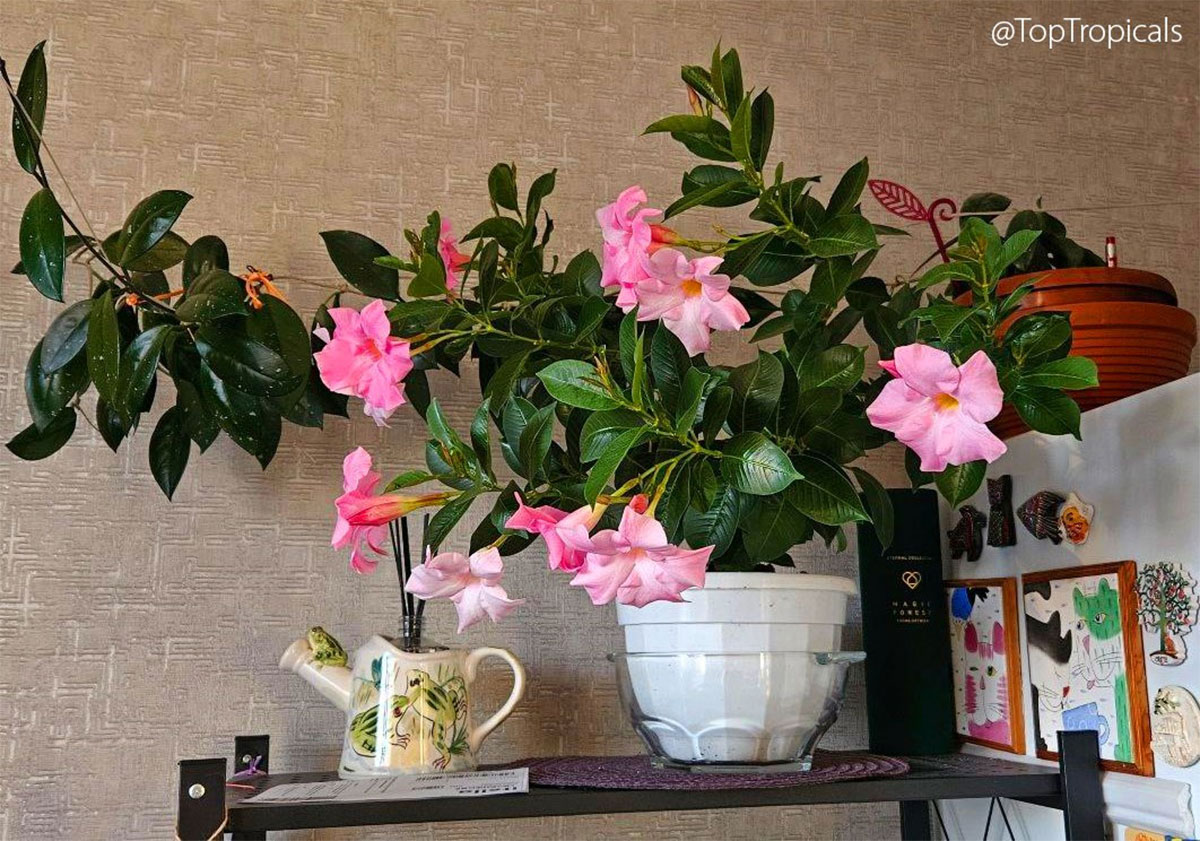
A mandevilla thriving indoors with bright pink blooms and glossy green leaves.
☂️ PLACEMENT: MICROCLIMATES RULE EVERYTHING
Indoors is one big tradeoff: light but cold near windows, warm but dim away from them.
The winning combo is a warm room with supplemental light.
Best zones to keep plants in winter:
South or east windows with additional light
Warm living spaces
Bright bathrooms for natural humidity
Worst zones to keep plants in winter:
Behind curtains
Directly on windowsills
Near heaters or vents
Against cold exterior walls
Dark corners without supplemental lighting
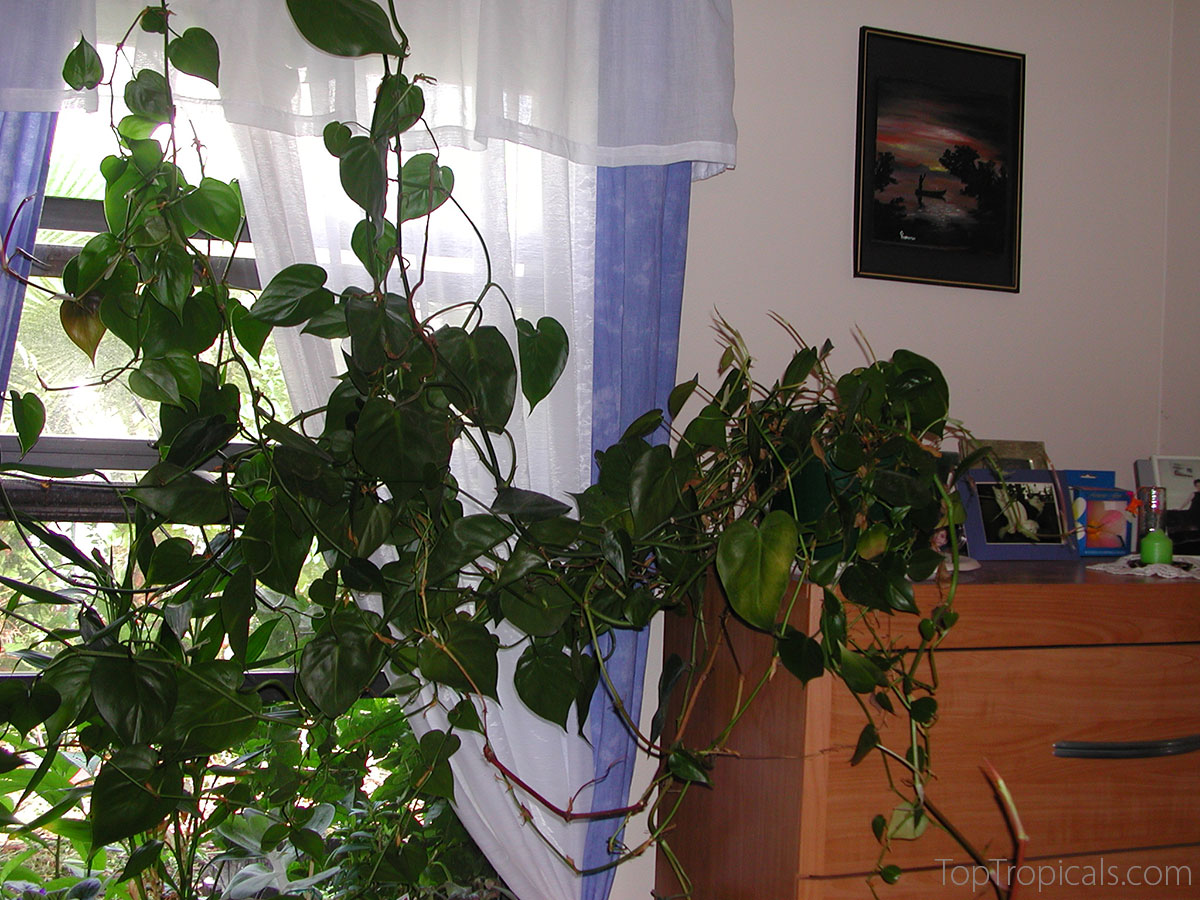
A vigorous indoor philodendron stretching across the window.
💨 ACCLIMATION
Moving a plant from outdoors to indoors is a shock. Light drops. Humidity drops. Airflow stops. Soil cools. Even healthy plants may drop some leaves for a few weeks. That is normal.
Before you bring them inside:
Rinse foliage to remove dust and pests. We recommend Sunshine NoBug - and organic, safe solution.
Check for ants.
Trim weak branches.
Treat soil if fungus gnats are present.
Try to bring plants inside before the first cold front, not after.
If you are reading this too late, do the prep now and expect a little leaf drop.
If you nail light and temperature, winter becomes simple. In the next mail-list we will cover watering, fertilizer timing, humidity, and other indoor tricks that keep tropicals happy till spring. Stay tuned.
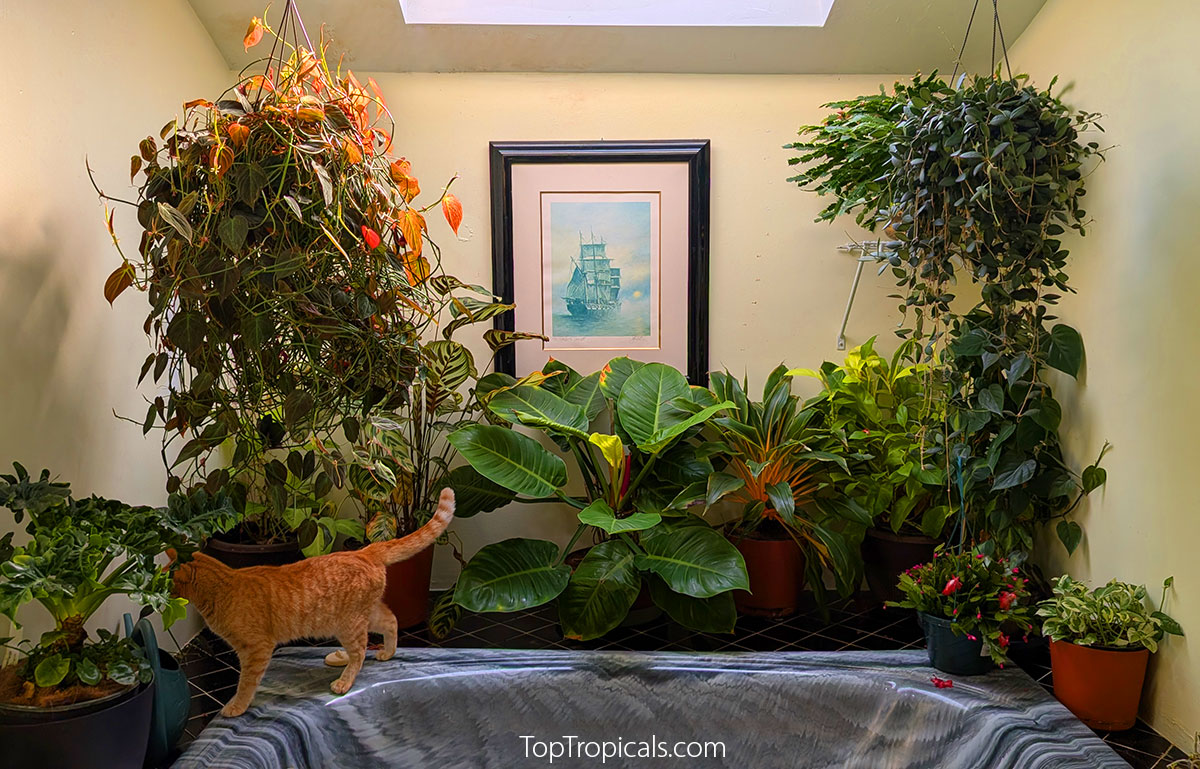
Cat Bob is inspecting his indoor garden around the tub
with a bright skylight
✔️ WINTER INDOOR FAQ: TEMPERATURE AND PLACEMENT
Q: Why are leaves dropping only on the window side?
A: Cold glass. The room may be warm, but the glass surface can be much colder.
Q: Is a cold room OK for tropicals?
A: They may survive, but they will not grow below about 65F to 75F. When nights stay below 65F for a week, many plants enter dormancy.
Q: My room feels warm. Why is my plant still not growing?
A: Check the soil temperature. Pots on cold tile can be 10 to 20F colder than the air.
Q: Can plants sit directly on the floor?
A: Not on cold tile. Always elevate them on boards, stands, or trays.
Q: Is it OK to keep plants near a heater or vent?
A: No. Vents and heaters blast hot, dry air and cause crispy leaves and mites.
Q: My plant is dropping leaves after coming indoors. Why?
A: Normal acclimation to reduced light and humidity right after the move.
Q: Can I keep plants in a bright bathroom?
A: Yes. Bathrooms can have good humidity. Just keep pots off cold tile.
Q: Do I need a humidifier?
A: Not for survival. Yes if you want better growth and fewer pests like spider mites.
Q: Do I need a grow tent?
A: No. A bright LED plus a warm room is enough for winter holding.
Q: Should I fertilize in winter?
A: Not now. Winter fertilizer rules will be covered in the next mail-list.
Q: Should I water the same as in summer?
A: No. Indoor plants need much less water in winter. Watering rules also coming soon.
🌿 Bring the Jungle Inside: Winter Survival
Guide Part 1: Lighting
❄️
Smokey: "Winter lighting must be precise. I need this light exactly at 14
inches."
Sunshine: "Sure. I am holding this… little number thing."
Smokey: "It reads humidity. Your main job is to look cute."
🌞
LIGHT, TEMPERATURE, PLACEMENT
Winter indoors is a different kind of battlefield.
Dark rooms. Dry air. Cold windows. Random drafts. Weak light. Sad plants.
We've been talking about keeping your tropicals alive outdoors previously.
But some of you have no choice this time of year. You have to bring the jungle inside.
If that is you, then this is your plant survival guide.
☀️ LIGHT: THE WINTER LIFELINE
Light advice here comes straight from our in-house expert, Michael Dubinovsky, a high-tech lighting engineer with over 30 years of hands-on experience. If he says brightness beats hours, trust him.
Here is the truth: Indoor light in winter is 10 to 50 times weaker than outdoors.
Short days. Low-angle sun. Windows filtering half the useful light. It all adds up.
Tropicals need 10 to 12 hours of real brightness. Winter sun cannot do that on its own. Not even in a big window. So we help them.
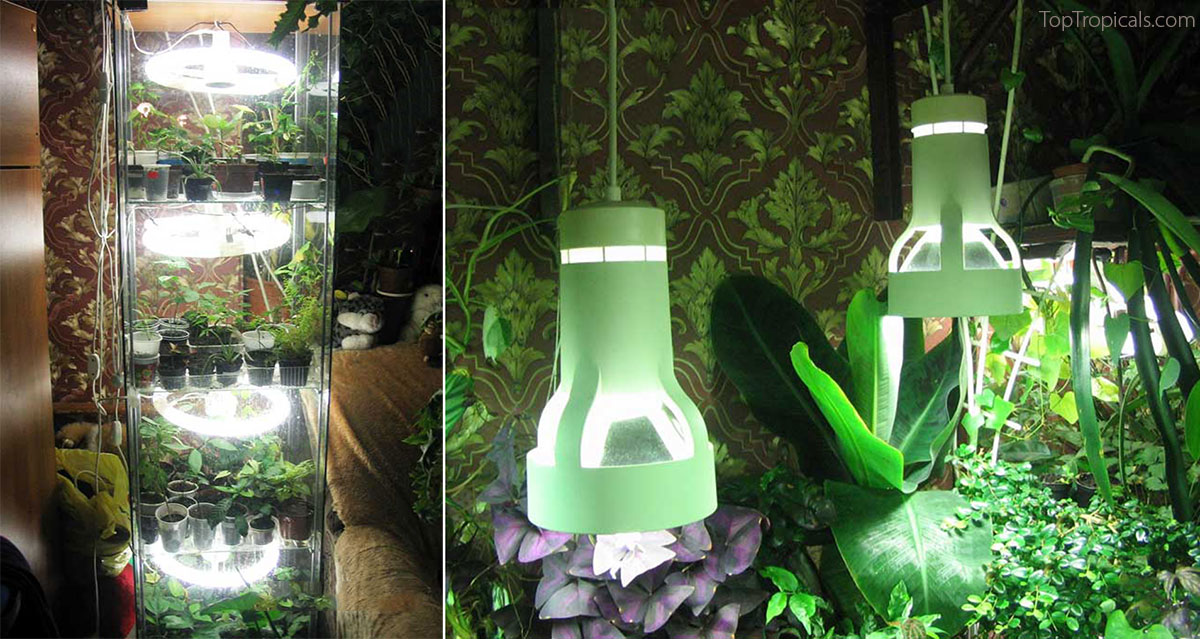
Use bright LED shop lights or utility lights. 5000K to 6500K CCT. High lumen output. Skip decorative bulbs. Skip purple grow fancy toy lights. If you want a single plant light, even a clamp lamp is fine if you screw in a bright daylight LED bulb.
Panels work best for plant clusters. Bars for shelves. Bulbs for single plants.
And grouping plants under one bright panel always beats spreading them out.
Distance matters: keep LEDs about 12 to 18 inches above the leaves.
Too close: leaf burn.
Too far: stretching, weak stems.
Leaves reaching up? Light is too high or too weak.
Leaves curling down? Light is too close.
If you want a reality check, download any smartphone lux meter app.
Most indoor corners are 50 to 200 lux without supplemental light.
Tropicals want much more
And a quick tip about windows: winter sun comes in sideways.
A spot that looks bright at noon can go dull by 2 PM. Don't count of window light
Bright light or long hours
People try to fix weak light by running it for 16 or 18 hours. That does not work.
Plants care more about light intensity.
A few hours of strong light beats all-day dim light.
If the light is weak, adding more hours will not change anything except your electric bill.
Simple rule: Short duration but bright is always better than long duration but weak. - by Michael, Top Tropicals lighting expert
No need for fancy horticultural panels
You do not need purple grow lights. You do not need special horticultural fixtures. You do not need expensive panels unless you want real winter growth.
For winter plant holding till spring, the inexpensive solution works great:
Bright LED daylight bulbs (5000K to 6500K) from hardware store
High lumen output
Inexpensive clamp lamps
Aim directly at the plant from 12 to 18 inches
This setup keeps tropicals happy until spring without buying anything fancy.
Save the money for soil, pots, or your next plant.
Indoor plant lighting safety note:
Use timers. Keep cords dry. Do not overload outlets.
Do not hang lights over humidifiers.
And do not put fixtures on piles of books to raise them. People do this.
✔️ WINTER INDOOR FAQ: TEMPERATURE AND PLACEMENT
Q: I am in Home Depot. Which light do I buy?
A: LED shop light, daylight color (5000K to 6500K), high lumens. Skip fancy plant bulbs.
Q: Can I use clamp lamps or floor lamps for plants?
A: Yes. Clamp lamps with a bright daylight LED bulb work great for winter holding.
Q: Do I need special horticultural grow lights?
A: No. A bright LED daylight bulb works fine for winter. Save the fancy lights for real growth projects.
Q: How far should the light be from the plant?
A: About 12 to 18 inches above the leaves. Too close burns. Too far stretches.
Q: Can I run weak lights for 18 hours to compensate?
A: No. Weak light plus long hours still equals a weak plant. Brightness matters more than hours.
Q: How do I know if a spot is bright enough?
A: Use a free phone lux app. Most indoor corners are much too dim for tropicals.
Q: I have a huge window. Why do I still need LEDs?
A: Indoor winter light is weak, short, and filtered by glass. Plants want intensity, not just a big window.
Q: My window faces north. Now what?
A: North windows are decorative only. Use supplemental lighting or move the plant.
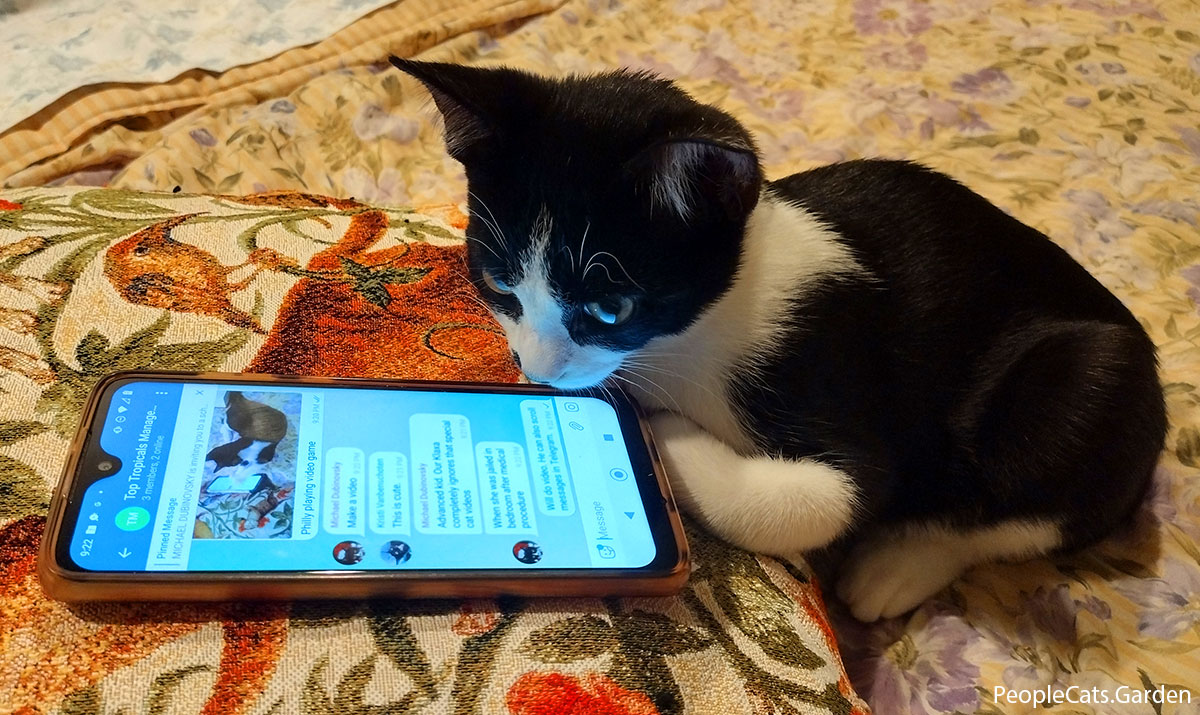
Welcome to our new Telegram
Channel!
We finally did it, and excited to connect with all of you on this amazing
platform. After using Telegram for a few years for both business and personal
communications, we realized it is a winner of the modern Social Media!
In Top Tropicals Telegram Channel
you will find much more than on our website or Newsletter: Fun Plant Facts,
Nature Wonders, Amazing Plant Videos, Gardening How-to Tips, Exotic Recipes,
Contests, Sweepstakes, Give-aways and so much more. Plus, of course, your
favorite PeopleCats!
Telegram is a messaging app with
a focus on speed and security, it's super-fast, simple and free. You can
use Telegram on all your devices at the same time - your messages sync
seamlessly across any number of your phones, tablets or computers. It's perfect for
sharing your comments, photos, videos, even making calls.
You can watch news, browse your interest, message to friends and
colleagues, save your files, create groups, make phone calls, and the most amazing
thing - Telegram works where nothing else works, no WiFi or cell service! It
proved to be more reliable than any other apps and (surprise!) even works in
airplane without wifi connection - proved!
The platform has its own cloud and offers limitless storage. And the
last and not least - it's ad-free! Telegram is free and will stay free - no ads,
no subscription fees, forever. It's a clean, clear and easy to use for all
ages and applications. Try it yourself and discover how easy and pain-free it
is!
Telegram is for everyone who wants fast and reliable
messaging and calls.
See you in Telegram!