Garden Blog - Top Tropicals

Date: 8 Nov 2024

Six colorful plants for your indoor garden
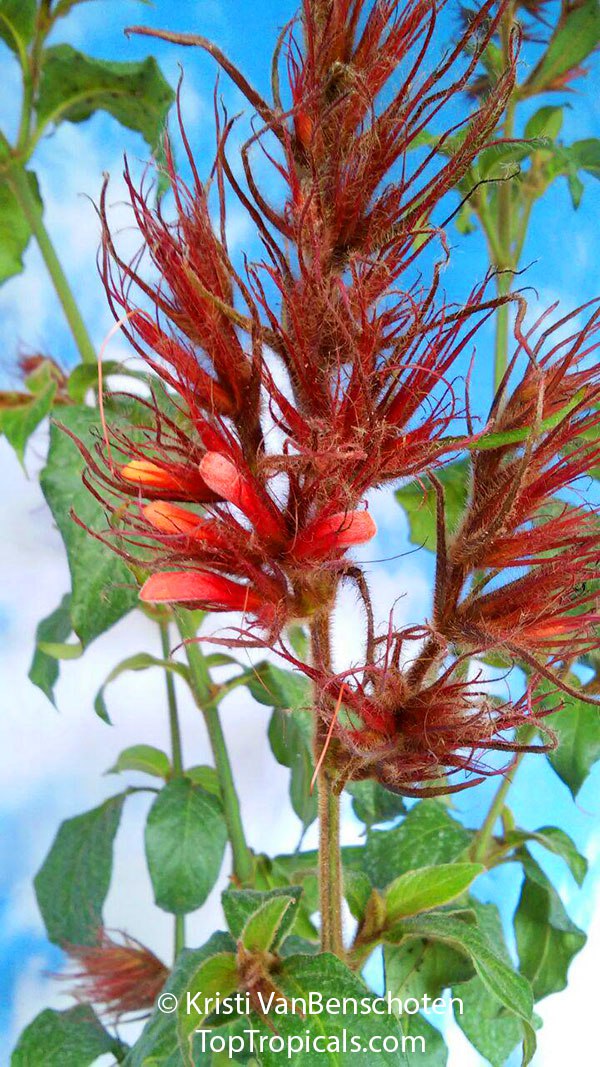
Sanchezia stenomacra - Blood Red Feather
Sanchezia stenomacra - Blood Red Feather

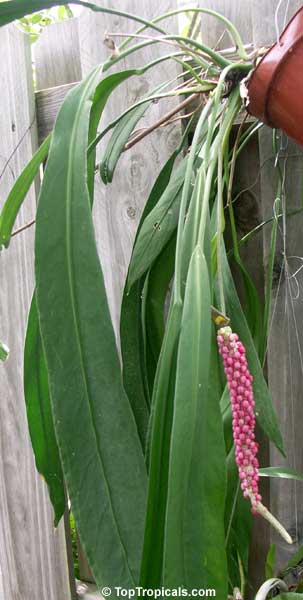
Anthurium vittariifolium- Long Leaf Anthurium
Anthurium vittariifolium- Long Leaf Anthurium

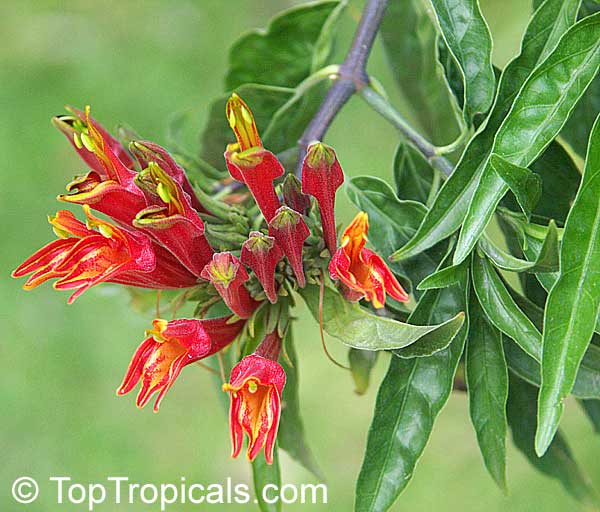
Clinacanthus nutans - Snake plant, Phaya-Yor
Clinacanthus nutans - Snake plant, Phaya-Yor

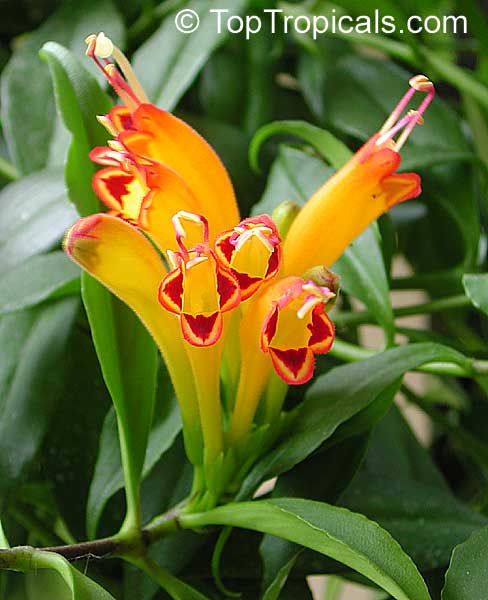
Aeschynanthus speciosus - Lipstick Plant
Aeschynanthus speciosus - Lipstick Plant

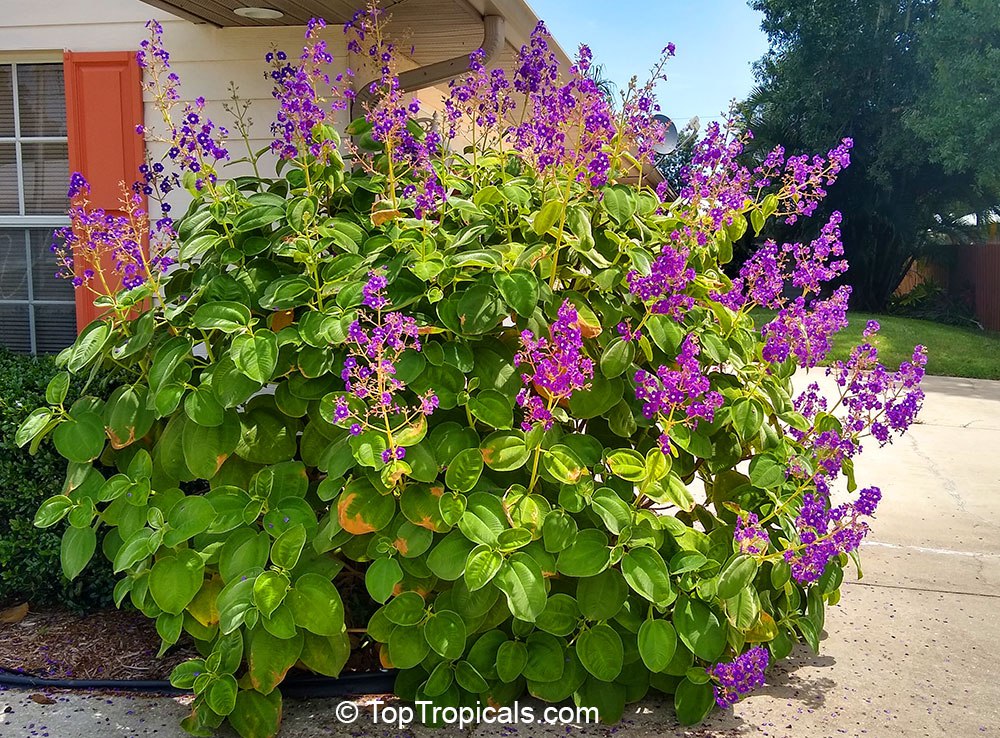
Tibouchina multiflora (grandifolia) - Glory bush, Quaresmeira
Tibouchina multiflora (grandifolia) - Glory bush, Quaresmeira

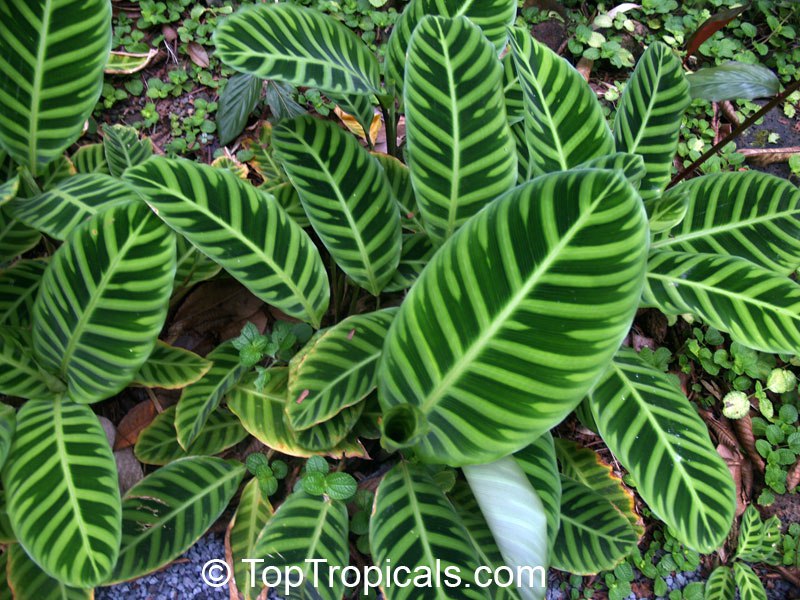
Calathea zebrina - Zebra Plant

Calathea zebrina - Zebra Plant

🌈 Six colorful plants for your indoor garden


🎶 Q: I've read your post about growing tropicals indoors and you got me inspired! Can you recommend something unusual, colorful and bright, preferably with flowers, that I can grow as house plants?

🌸 A: House plants don't have to be boring and just green! Below are a few excellent choices for your indoor garden that will brighten your sunroom. Just make sure to follow the 10 key tips for growing tropical plants indoors.

1 Sanchezia stenomacra - Blood Red Feather - spectacular red feathery blooms and and soft, fussy leaves.

2 Anthurium vittariifolium - Long Leaf Anthurium - super rare, an eye stopper, with long leaves up to 2 ft long, and bright pink fruit.

3 Clinacanthus nutans - Snake plant, Phaya-Yor - exotic flower from Thailand resembling snake's open mouth.

4 Aeschynanthus speciosus - Lipstick Plant - popular house plant with bright showy orange blooms.

5 Tibouchina multiflora (grandifolia) - Glory bush, Quaresmeira - can be grown outside in Southern gardens, as well as in a pot indoors. Showy purple flowers, velvet leaves are wonderfully soft 6-8"in diameter!

6 Calathea zebrina - Zebra Plant - the brightest zebra-striped large leaves up to 1 ft long.

👍 What flowering plants do you grow in shade? Share in comments⬇️

🛒 Shop indoor garden

#Container_Garden

🔴 Join 👉 TopTropicals
Date: 31 Jul 2025

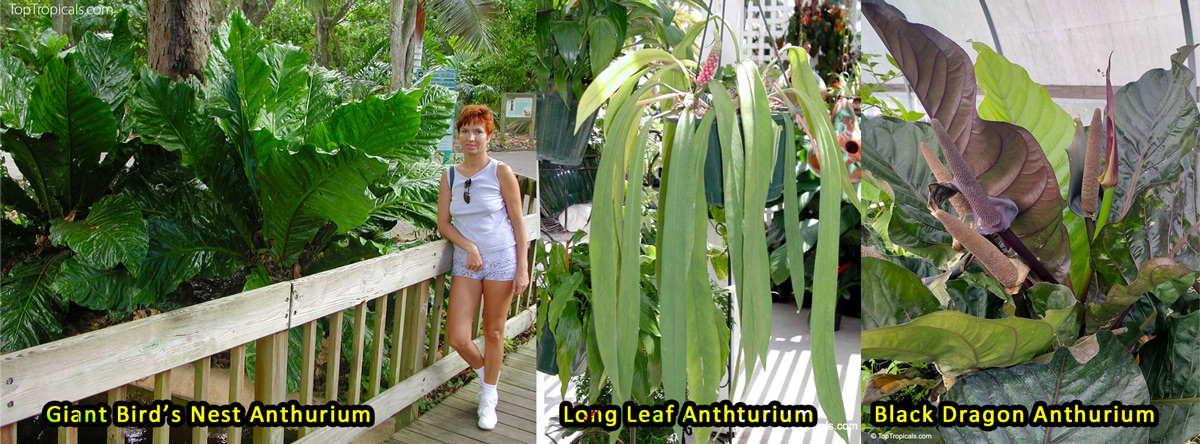
Anthurium Collector Set

Giant  Bird's  Nest,  Long  Leaf,  and  Black  Dragon  Anthuriums  side  by 
 side,  showcasing  their  dramatic  foliage  and  size

These aren't your typical tropicals - they're collector-grade Anthuriums grown for foliage and texture. Each one brings something different, but they all thrive in the same kind of setting: shade or filtered light, warmth, and humidity. Perfect for growing in containers indoors or out.

Anthurium Black Dragon

This is the most dramatic of the trio. Upright, leathery leaves shift from dark green to nearly black depending on light. Instead of bright flowers, it produces a dark brown spadix and glowing red berries. A hybrid not found in the wild, it's grown from seed - no two are exactly alike.

  • Best for: Indoor focal plant, shaded patio, black ceramic pot
  • Height: 2–4 ft in container
  • Texture: Thick, architectural leaves
  • Highlight: Color shifts with light intensity

Grow Your Own Black Dragon

Read more about Black Dragon Anthurium

Anthurium hookeri – Giant Bird's Nest

This one's about scale. Broad, crinkled leaves with a cardboard-like texture form a bold rosette. It can get huge with time - up to 6 feet across. Perfect for gardeners who want the "instant jungle" look.

  • Best for: Shaded garden, large pots on porches
  • Height: Up to 5 ft; width even more
  • Texture: Wrinkled and leathery
  • Highlight: Bright red berries in maturity

Buy Giant Bird's Nest Anthurium

Read more about Giant Bird's Nest Anthurium

Anthurium vittariifolium – Long Leaf Anthurium
Graceful and rare, this species sends out narrow strap-like leaves that can reach 5–6 ft long. Ideal for hanging baskets or mounting. Bonus: it produces small pink fruit against deep green foliage.

  • Best for: Hanging displays, vertical planters, bright bathrooms
  • Height: Leaf length, not upright height - up to 6 ft
  • Texture: Smooth, ribbon-like
  • Highlight: Cascading growth and color contrast

Buy Long Leaf Anthurium

Read more about Long Leaf Anthurium

✅ How to Care for Anthuriums

  • Light: Bright, indirect light is best. Avoid direct sun, especially mid-day. These plants evolved in rainforest understory - think "dappled light under trees."
  • Water: Keep the soil lightly moist but not soggy. Let the top inch dry before watering. They hate wet feet.
  • Humidity: These are tropicals - they'll do fine in 50-60% humidity, but thrive at 70%+. Use pebble trays or place near other plants. Bathrooms with windows work great.
  • Soil: Use an airy mix: orchid bark + perlite + peat or coco coir. Drainage is key. Never use plain potting soil.
  • Fertilizer: Feed with SUNSHINE Robusta every 2–4 weeks during warm seasons. It's formulated for aroids and won't burn roots.
  • Potting: Use shallow, wide containers. Repot only every 2–3 years, or when roots crowd the pot. They don't like frequent disruption.
  • Temperature: Ideal: 65–85 F. Short dips to the 30s F are tolerated by mature plants, but avoid cold drafts.

Shop All Anthuriums

Date: 2 Dec 2025

Lemon Candy Tree

🍋 Lemon Candy Tree


🟡 Garcinia edulis - Lemon Drop Mangosteen, Madrono. Tiny yellow-orange globes, golf-ball size, with clear, juicy pulp, and when you taste it, you understand the name instantly. Sweet and tart at the same time, like someone turned a lemon drop candy into a tropical fruit. Today Chiane and Ashley are going to taste the fruit and share with your their experience!

📱

#Food_Forest #Container_Garden

🟢 Join 👉 TopTropicals

Date: 2 Dec 2025

Little tree that makes lemon candy

Garcinia edulis - Lemon Drop Mangosteen, Madrono

🍋 Little tree that makes lemon candy


🟡 Garcinia edulis - Lemon Drop Mangosteen, Madrono - is one of those plants that doesn’t shout for attention, but when you stop and really look at it, you realize how special it is. And today Chiane and Ashley are going to taste the fruit and share their experience!

🟡This tree stays compact and neat, with glossy evergreen leaves that always look freshly polished. Perfect size for a patio pot or a small garden corner. Ours here is slow and steady, but it always looks like it got groomed this morning.

🟡And the fruit… that’s where the fun begins. Tiny yellow-orange globes, golf-ball size, glowing against the green leaves. Inside is that clear, juicy pulp, and when you taste it, you understand the name instantly. Sweet and tart at the same time, like someone turned a lemon drop candy into a tropical fruit.

🟡People snack on them right off the tree, but they’re also great in juices and little dessert experiments. It’s one of those fruits that makes you feel like you grew something exotic without needing a jungle-sized space or complicated care. Give it sun, give it water, keep it in a nice pot, and it’s perfectly happy.

🟡A cute, flavorful, collector-worthy tree that fits right into small spaces.

🛒 Plant Lemon Candy Tree - Lemon Drop Mangosteen

📚 Learn more:


Does it really taste like Lemon drops?

#Food_Forest #Container_Garden #Fun_facts

🟢 Join 👉 TopTropicals

Date: 2 Dec 2025

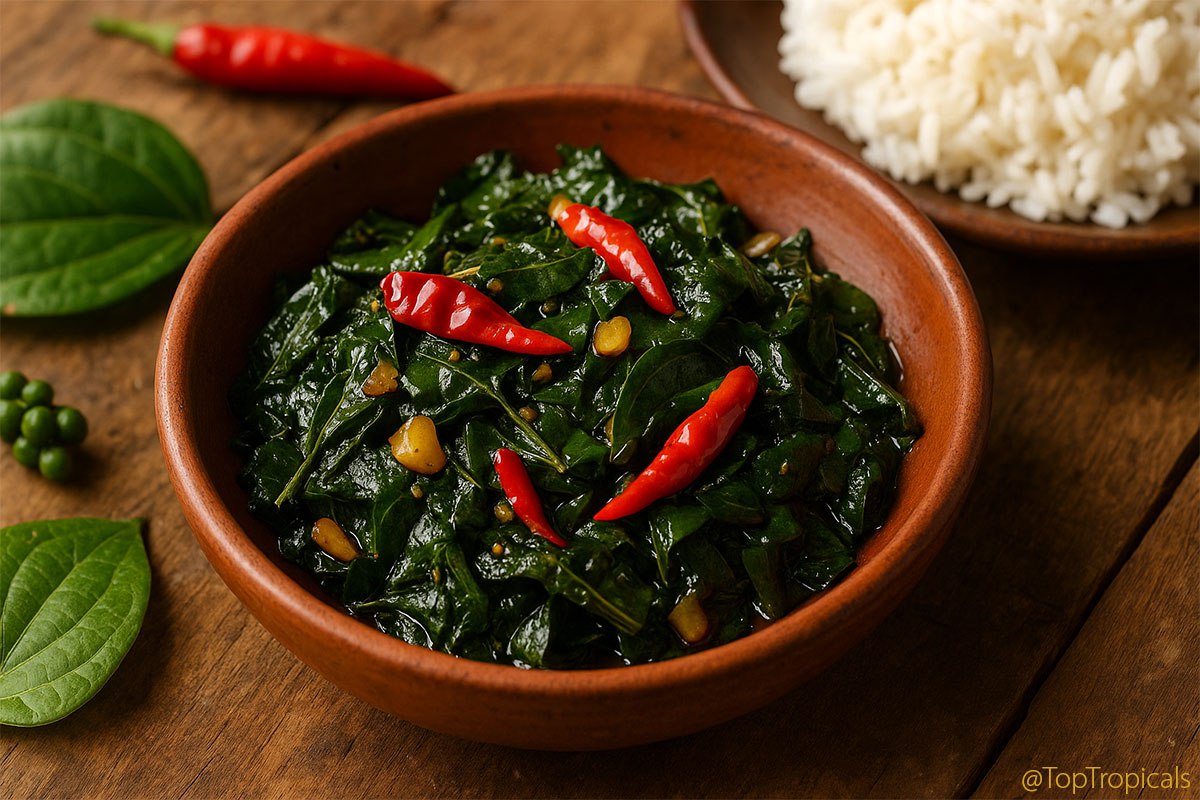
Black pepper leaf stir-fry: quick-n-fun exotic recipes

Black pepper leaf stir-fry

Black pepper leaf stir-fry

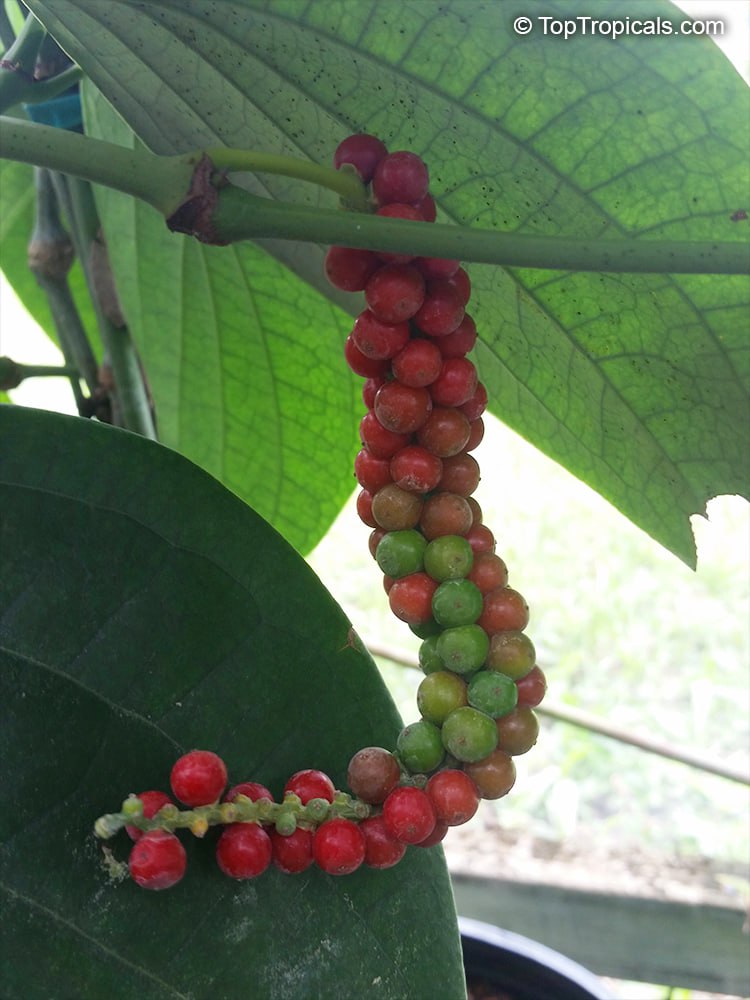
Black Pepper (Piper nigrum)

Black Pepper (Piper nigrum)

🍴 Black pepper leaf stir-fry: quick-n-fun exotic recipes


🔴Saute chopped Black Pepper (Piper nigrum) leaves with garlic, chili, and soy sauce.
🔴Bold, peppery, and perfect with rice.

Black pepper leaf stir-fry: quick-n-fun exotic recipes

Ingredients

  • 2 cups fresh Black Pepper (Piper nigrum) leaves, sliced
  • 4 garlic cloves, chopped
  • 3 to 5 small red chilies
  • 1 tbsp soy sauce
  • 1 tbsp oil
  • Salt to taste

Instructions

  1. Heat oil in a skillet.
  2. Add garlic and chilies and saute until fragrant.
  3. Add sliced Black Pepper leaves and stir-fry on medium heat.
  4. Pour in soy sauce and cook until leaves soften.
  5. Serve hot with rice.

🛒 Plant your own Black Pepper vine for all your kitchen needs

📚 Learn more:

Pepper Plant Facts

Botanical name: Piper nigrum
Also known as: Pepper
USDA Zone: 9 - 11
Highligths Large shrub 5-10 ft tallVine or creeper plantSemi-shadeShadeWatering: Regular. Let topsoil dry slightlySpice or herb plantEthnomedical plant.
Plants marked as ethnomedical and/or described as medicinal, are not offered as medicine but rather as ornamentals or plant collectibles.
Ethnomedical statements / products have not been evaluated by the FDA and are not intended to diagnose, treat, cure, or prevent any disease. We urge all customers to consult a physician before using any supplements, herbals or medicines advertised here or elsewhere.Fragrant plantSubtropical plant. Mature plant cold hardy at least to 30s F for a short time
Get personalized tips for your region

Piper nigrum in Plant Encyclopedia
Cooking with Black Pepper leaves
What is Pepper madefFrom? Black, white, green, and red
How to grow your own Pepper plants. Five most valuable 'Pipers'

📱 Watch this before cooking with black pepper

#Food_Forest #Recipes

🟢 Join 👉 TopTropicals