Garden Blog - Top Tropicals

Date: 10 Nov 2025

❄️ How to Prepare Your Tropical Garden for Winter
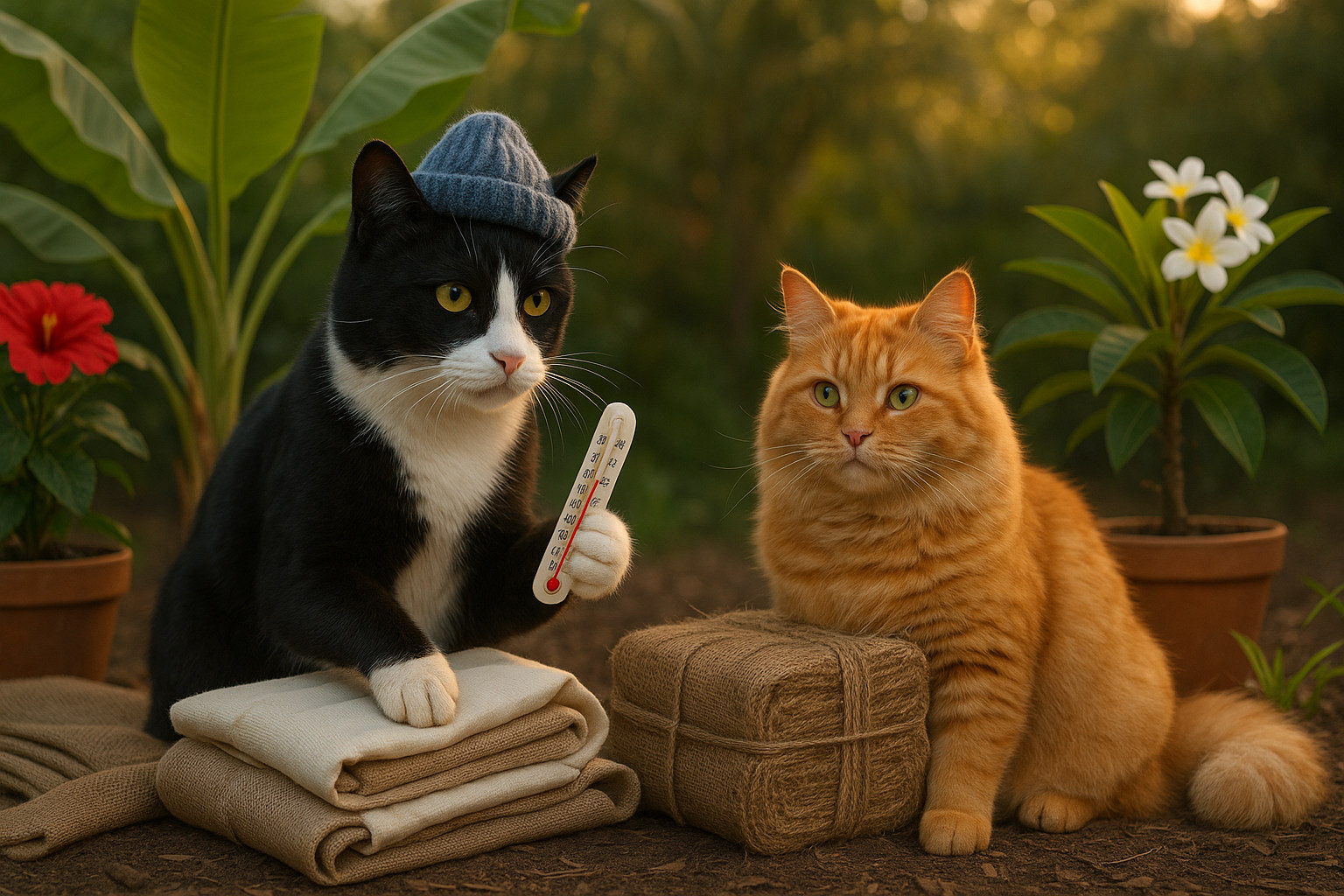
Two  cats  in  a  tropical  garden  at  sunset.  Smokey,  a  black-and-white 
 tuxedo  cat  wearing  a  wool  cap,  holds  a  thermometer  while  Sunshine,  a  fluffy 
 orange  tabby,  sits  beside  mulch  and  folded  frost  cloths  surrounded  by  banana
    and  hibiscus  plants.

Smokey and Sunshine Wrap Up the Garden with Frost Cloth Before the Chill.

Smokey: "Thermometer says 45. Time to wrap the bananas!"
Sunshine: "You wrap the bananas. I’ll guard the mulch… from this sunny spot."
Smokey: "Teamwork, Sunshine. Teamwork."

🌡️ Cold nights are coming - but your tropicals do not need to shiver!

Even in sunny Florida and other warm zones, one cold snap can undo months of growth. Preparation is everything. Tropical plants can handle a lot, but they dislike surprises. Let’s make sure your garden stays safe, strong, and happy all winter long.

Tips from Tatiana Anderson, Top Tropicals Plant Expert

👉 Group and Check Your Plants

You already know which plants are in pots and which are in the ground. What matters now is prioritizing by cold sensitivity. Identify the tender tropicals – papaya, banana, plumeria, adenium, heliconia – and decide which ones get covered first when temperatures drop. Keep frost cloths or old sheets near those areas, ready to grab fast. If your garden is large, label protection zones or mark plants that always need extra care. The goal is to have a plan, not a panic, when the cold alert hits.

Once you know your priorities, you can plan the rest of your protection strategy.

👉 Feed and Mulch

Stop using high-nitrogen fertilizers by late fall. They push soft new growth that freezes easily. Add compost around the base of your plants and top with 3 to 4 inches of mulch. Mulch acts like a blanket: it keeps warmth in, protects the roots, and keeps soil moisture steady. Just make sure the soil drains well; cold and soggy soil leads to root rot. In raised beds, check that water flows away easily.

After you feed and mulch, it is time to look at how your local zone changes the game.

👉 Zone-by-Zone Tips
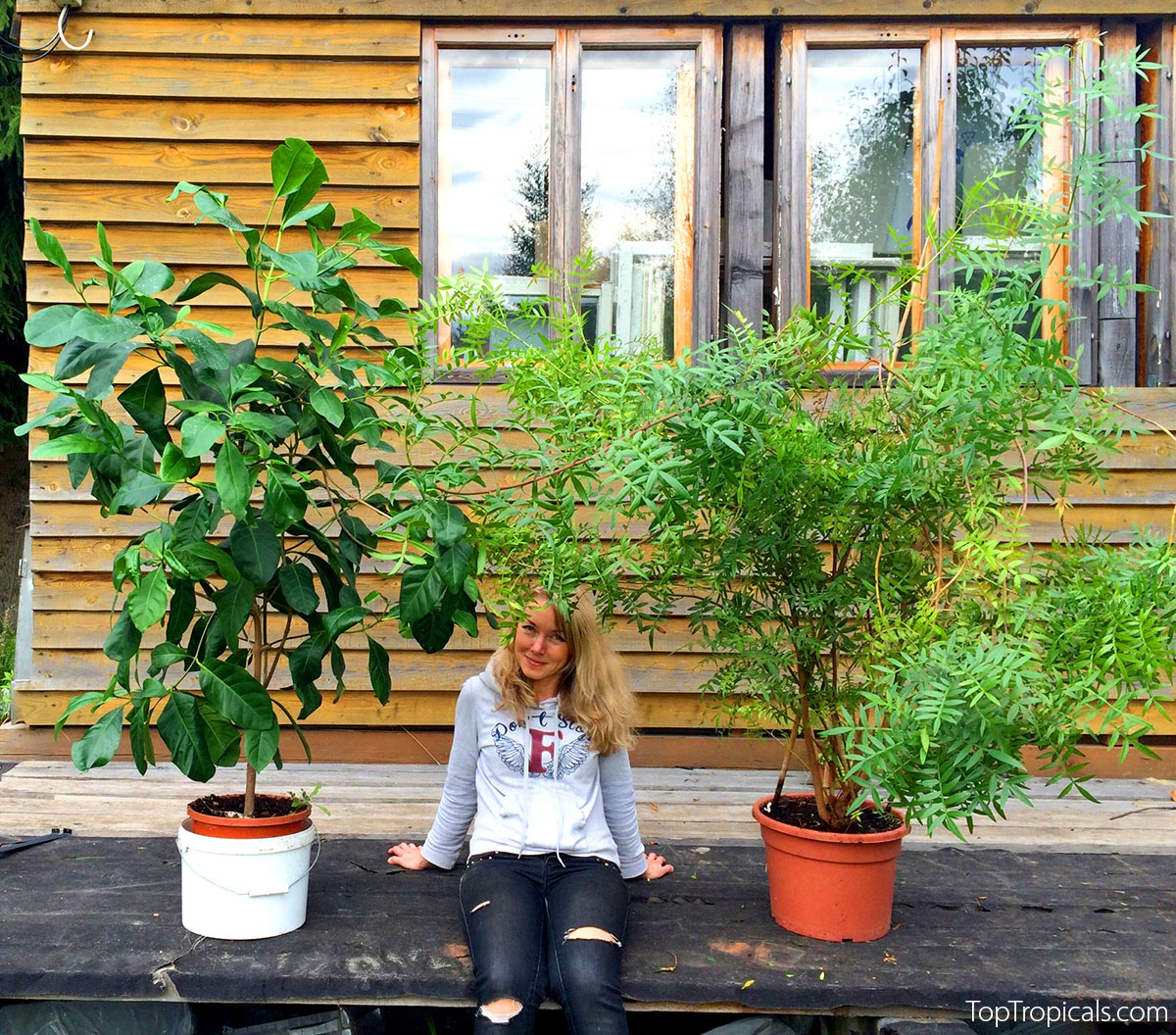
Woman  sitting  between  two  large  potted  tropical  plants  on  a  wooden  deck
    in  front  of  a  house,  preparing  to  move  them  indoors  for  the  winter.

Moving Tropical Plants Indoors for Winter Protection

  • Zone 10: You are lucky! This is mostly a maintenance season. Watch for root rot after heavy rain, trim lightly if needed, and protect tender young trees during surprise chills. Keep some frost cloth ready just in case.
  • Zone 9: This is the main action zone. Nights can dip into the 30s. Deep-water your trees once before cold nights to insulate the roots. Apply heavy mulch, and have frost protection ready to go. If you grow tropical fruit like mango or guava, consider wrapping young trunks in burlap or foam pipe insulation.
  • Zone 8: This is where tropical gardening becomes creative. Stick to cold-hardy tropicals such as loquat, guava, or cold-hardy avocado varieties. Use portable greenhouses, wrap trunks, and move smaller plants indoors or to a heated porch when frost threatens.

Now that the garden beds are set, let’s look at your pots and containers – your most mobile plants.

👉 Container and Patio Plants

Potted plants are the easiest to protect but also the quickest to freeze. Start reducing watering now so roots do not stay too wet in cooler weather. Before moving them, check for insects hiding under leaves or in the soil. Group your pots close to a wall for reflected heat and wind protection. If you plan to bring them indoors, do it gradually. Move them closer to the house for a few days before bringing them all the way inside to help them adjust to lower light and humidity.

When the chill starts, many gardeners rush to move everything inside at once – but a smooth transition works much better.

👉 Indoor Plants

When bringing plants inside, give them a good rinse to remove dust and bugs, and flush the soil to wash out salts from summer fertilizing. Keep them separate from your houseplants for a week to make sure no pests come along. Expect some leaf drop – it is normal as they adjust to lower light. Give them bright light near a window, and cut watering by about half until spring. Avoid misting too much; good airflow matters more than humidity during winter.

Many tropicals, like hibiscus, brugmansia, and crotons, may look tired for a while, but they will bounce back quickly once days get longer.

👉 Timing Is Everything

The key is to prepare before the first cold warning. Check your weather app regularly once nights start dropping into the 50s. Keep covers, mulch, and supplies ready so you are not running outside at midnight with a flashlight and a frozen hose. Have your frost cloths labeled by plant group and stored in an easy spot. A little organization now saves a lot of stress later.

Many tropicals, like hibiscus, brugmansia, and crotons, may look tired for a while, but they will bounce back quickly once days get longer.

Remember: the goal is to help your plants rest safely. Many gardeners prune or fertilize too late in the season – we will talk about why that can be risky next week."— says Tatiana Anderson, Top Tropicals Plant Expert

Coming next mail-list: The best gadgets for cold protection (lights, heaters, frost covers) and what NOT to do in winter.

📚 Learn more from Top Tropicals Blog:

Cold protection - winter action for your plant collection

What plants are good to order in Winter?

How to take care of house plants in Winter

How to protect tropical plants in Winter

How to take care of a mango tree in winter

How to protect Avocado from cold

Overwintering Adeniums outside of tropics
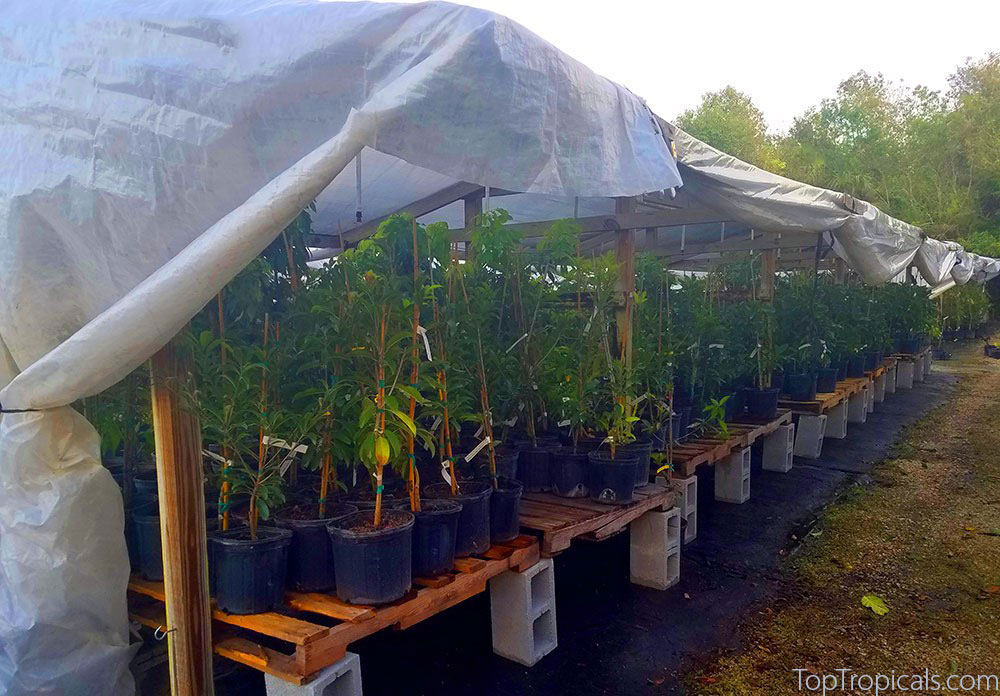
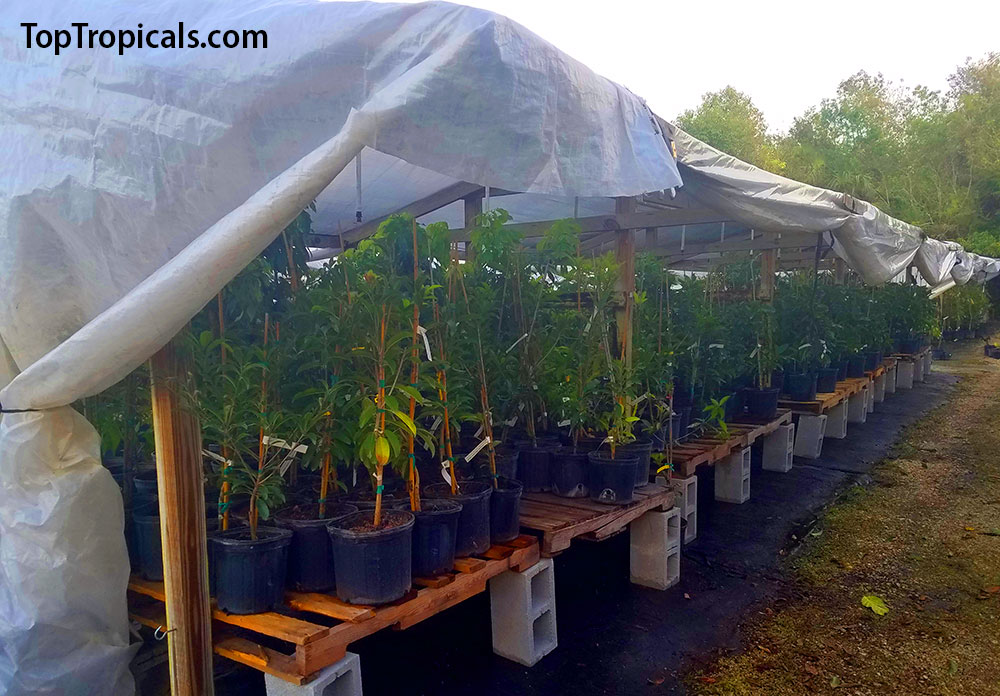
Rows  of  tropical  plants  in  black  pots  covered  with  frost  cloth  and 
 plastic  sheeting  for  winter  protection  at  Top  Tropicals  nursery.

Protecting Tropical Plants with Frost Covers at Top Tropicals Nursery
Date: 2 Jul 2023

Three colors of flowers
for 4th of July

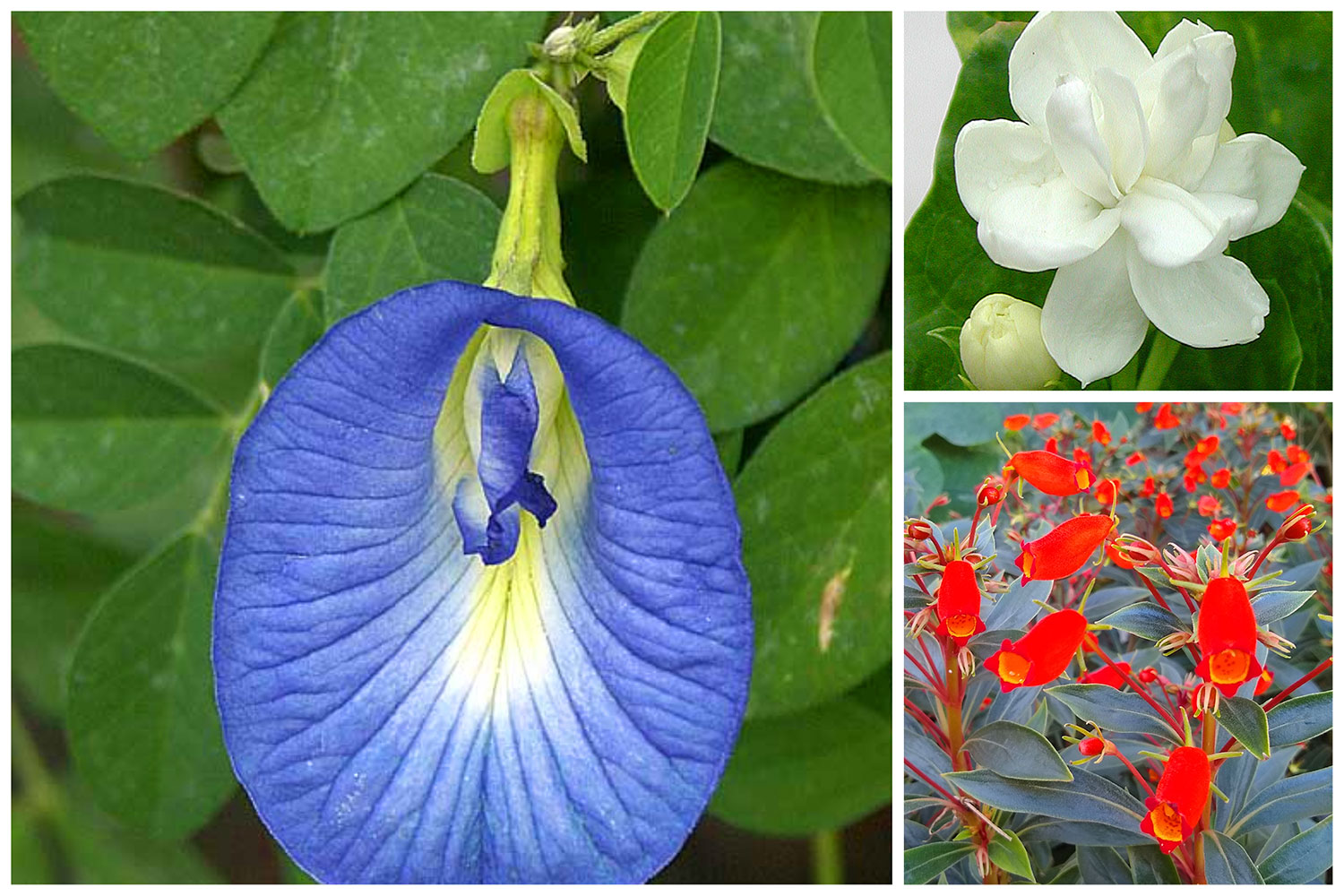
Blue,  Red  and  White  flowers  for  4th  of  July

Q: Our anniversary is on the 4th of July. Do you have anything that might be a good gift? Maybe something flowering that has red, white and blue flowers... I know that is a lot to ask but maybe you have an idea?

A: We appreciate your intriguing question and extend our heartfelt congratulations on your approaching anniversary. Numerous tropical plants lend themselves beautifully to a captivating blend of red, blue, and white hues. Here are our top recommendations for the most delightful combination:

White: Jasmine sambac fragrant bush (var. Arabian Nights is our favorite, it's a free-bloomer and easy to grow)

Blue: Clitoria Vine, it is fast growing controllable vine, everbloomer. There is also a White variety of Clitoria, you can plant them together!

Red: Gloxinia, a smaller perennial that perfectly fits into this combination of three.

More flowers for white-blue-red colors:

White: Gardenias, Jasmines, Almond Bush, Brunfelsia, Clerodendrum Bridal Veil, fragrant Cashmere Bouquet, White Brazilian Plume Flower, Montanoa - Tree Chrysanthemum

Blue: Blue Sage Lead Flower, Blue Butterfly Clerodendrum, Weeping Blue Ginger, Duranta, Thunbergia erecta - Kings Mantle, and its white variety Alba, Blue Sky vine

Red: Cat Tail Acalypha, Dwarf Poinciana, Red Bottlebrush, Pavonia multiflora - Brazilian Candles (it's actually red-and-blue), Red Button Ginger - French Kiss, Brazilian plume, Firespike , Scarlet Flame Passion Flower, Quisqualis (has white and red flowers on the same plant).

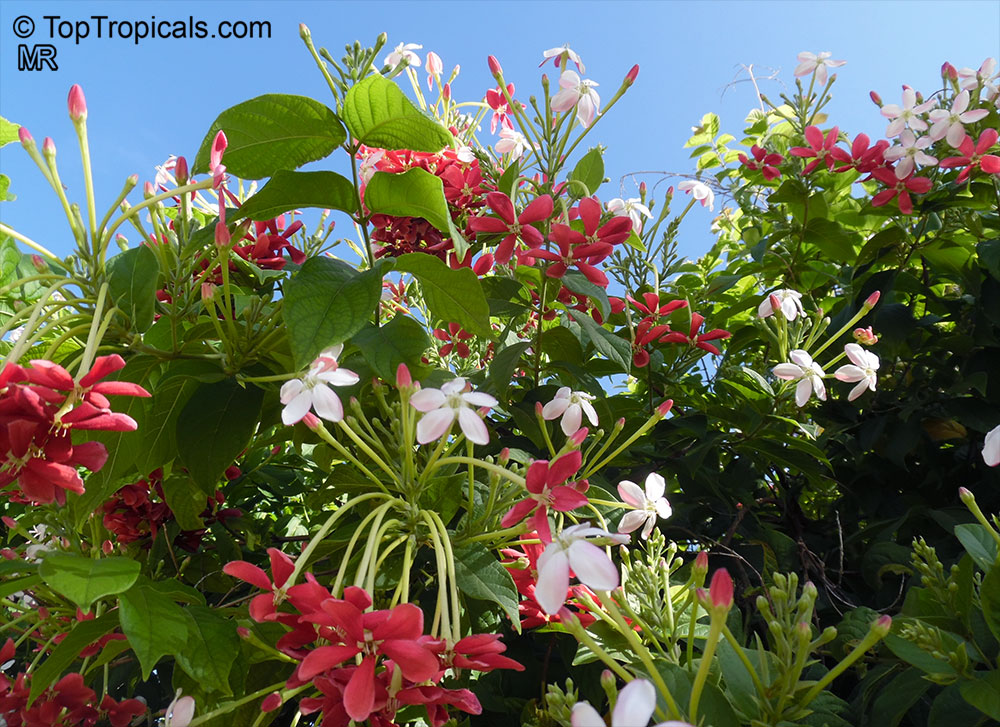
Quisqualis  Indica  -  Rangoon  Creeper

Quisqualis Indica - Rangoon Creeper. Spectacular bloom, flowers change color from white to pink to red. Sweet fragrance. Very fast growing, perfect for covering a fence or pagoda.

Date: 12 Jan 2025

How to protect tropical plants in Winter

Winter tips and podcast

Photo above: wrapping plants with frost cloth

Winter can be tough on plants, especially on tropical varieties. But with a little preparation, you can protect your garden and keep your plants safe from the cold. Here's how:

Winter Care Tips for Tropical Plants

Cut watering: Reduce watering to prevent root rot. Cold + wet = dead roots.
Water before frost: Thirsty plants are more vulnerable. Water them before a cold night to prevent damage.
Wind protection: Wind is more harmful than temperature drops. Plant near structures like houses or trees for shelter.
Prepare for long cold periods: If cold weather lasts for hours, use all available protection, including Christmas lights and propane heaters.
Don't use dry fertilizer in winter: Heavy fertilizing encourages tender growth, which is more susceptible to cold damage. Sunshine Boosters liquid fertilizers are safe to use year around as their intake is controlled by reduced watering.
Use fabric covers, not plastic: Plastic can cook plants in the sun, while fabric allows better ventilation.

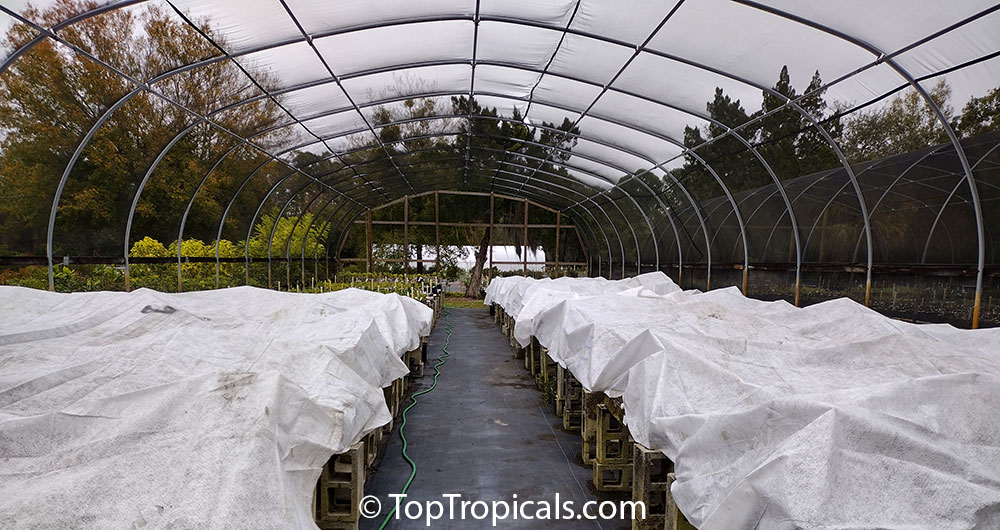
Protecting  tropical  plants  in  winter  with  covers

Photo above: we cover our plants in the nursery with a thin synthetic fabric (sintepon) called "frost cloth" or "strawberry cloth". It is light, breathable and allows light and water to go through unlike plastic that creates heavy water pockets.

Prepare for Cold Nights

Wrap plants: On cold nights, cover individual plants or trees with sheets or blankets to shield them from wind chill.
Use Christmas lights: A simple string of lights can add extra warmth, protecting your plants during frosty nights.
Use propane heaters: For added warmth in a larger area, place a propane heater near your plants. Make sure to follow safety guidelines and keep the heater at a safe distance from flammable materials. This can help maintain a few extra degrees of warmth, especially in more open garden spaces or temporary greenhouses. Always ensure proper ventilation to avoid harmful gas buildup.

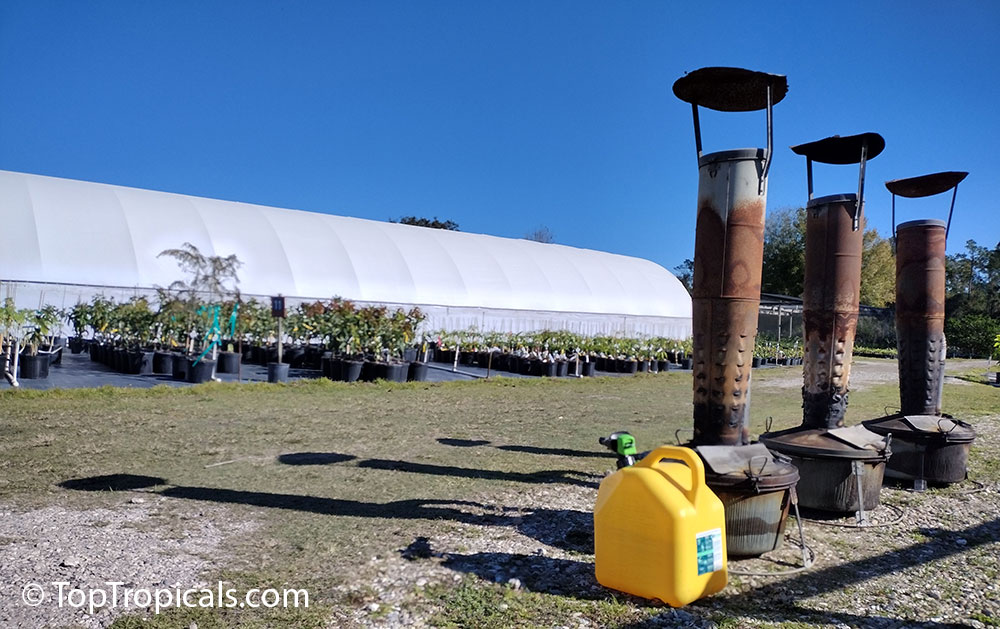
Protecting  tropical  plants  in  winter  with  heaters

Photo above: we use both propane and kerosene heaters at the nursery

Large Collections? Build a Temporary Greenhouse

Affordable winter greenhouse: For large plant collections, you don't need an expensive greenhouse. A mobile carport with plastic or fabric covering, costing around $200, can house up to 100 plants!

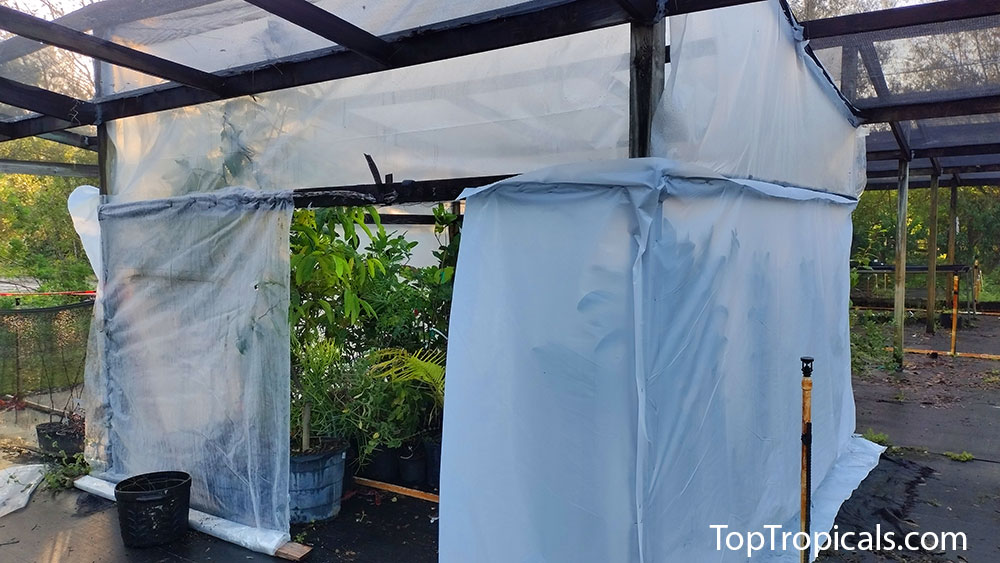
Protecting  tropical  plants  with  temporary  greenhouse

Photo above: Temporary wrapping around plant collection with a plastic or frost cloth protects from a windchill. It may also win you a few degrees even without a heater. In this particular case, according to our temp sensors, with 30F outside, it was 41F inside this "dome", no heaters used.

Southern Exposure and Garage Storage

Southern windowsills: Compact tropicals can thrive on southern-facing windowsills, getting plenty of sunlight during the day.
Move plants inside: If you have larger collections, move them into a well-lit garage for the colder nights or longer periods.

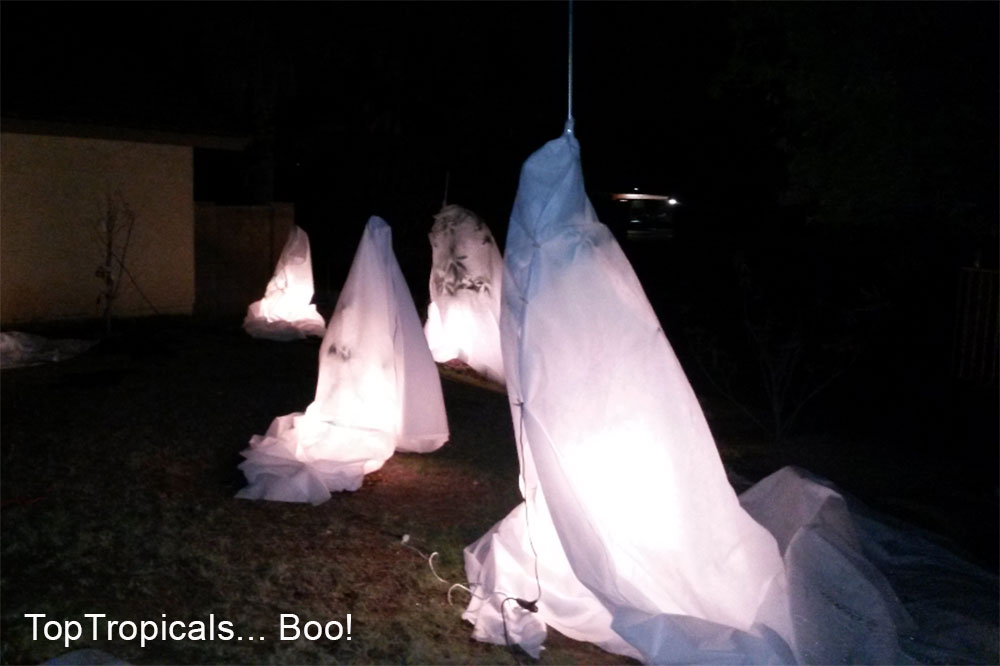
Protecting  tropical  plants  in  winter  with  Christmas  lights

Photo above: using Christmas lights around plants while wrapping with frost cloth.

Key Factors for Survival

Cold duration: Tropical plants can survive brief cold spells but long durations, even above freezing, can be deadly.
Wind-chill: Wind chill can be harsher than the temperature itself.
Exposure: Southern-facing slopes hold heat longer, making them ideal for your plants.
Humidity: Proximity to lakes or oceans can create a milder micro-climate.
Gradual temperature Drops are safer. Plants adjust better to slow temperature changes than sudden cold blasts. Gradual cooling allows plants to prepare, reducing the risk of damage.

Protecting  tropical  plants  in  winter  with  plastic  greenhouse

Strengthen Plant Hardiness

Health and maturity: Well-established, healthy plants are more cold-hardy.
Boost plant immunity: Use products like SUNSHINE-Epi to improve cold resistance. Apply it before and during cold snaps to protect your plants.
Healthy plant is hardy. Make sure to fertilize your plants on regular basis - healthier and stronger plants are more cold hardy.

With these steps, you can protect your plants and help them survive the winter months. Stay warm and keep your garden thriving!

Podcast with Horticulturist Mark Hooten:
How to Protect Tropical Plants in Winter

Protect  plants  in  winter  podcast

Date: 19 Jul 2024

What is the best flowering shrub for a shady spot?

Aphelandra hartwegiana - Yellow Aphelandra

Aphelandra hartwegiana - Yellow Aphelandra

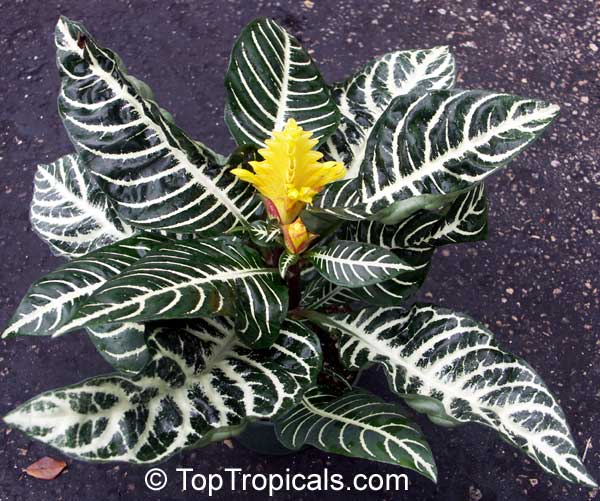
Aphelandra squarrosa - White Zebra Plant

Aphelandra squarrosa - White Zebra Plant

Aphelandra sinclairiana - Panama Queen

Aphelandra sinclairiana - Panama Queen

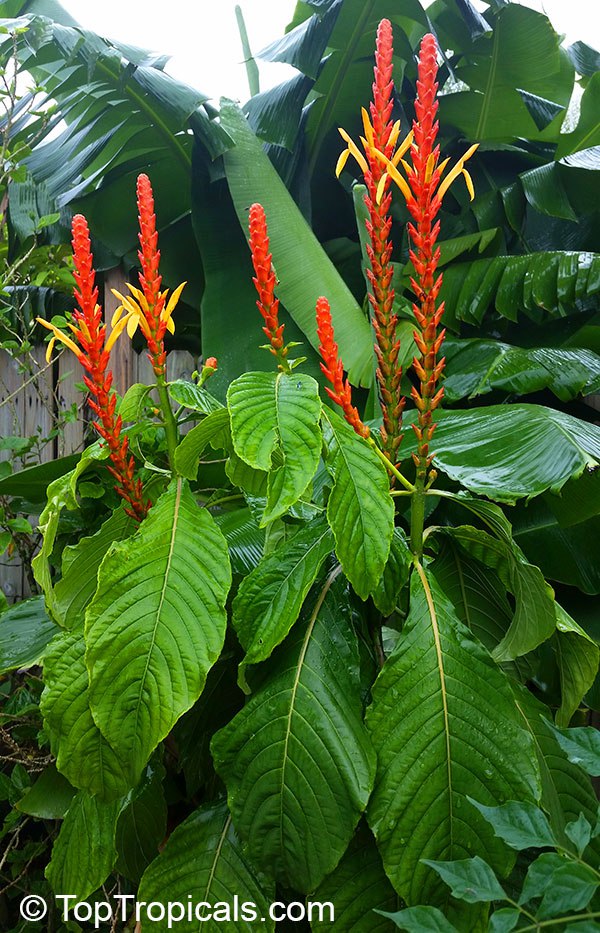
Aphelandra x panamensis - Scarlet Candle

Aphelandra x panamensis - Scarlet Candle

💐 What is the best flowering shrub for a shady spot?


🚩 Aphelandra is hands down one of the best solutions for a shade garden where you want to see more colors. It is a great addition to a collectible tropical butterfly garden, can grow into 4-5"tall bushy specimen. Tolerates both sun and shade.

🚩Aphelandras have beautiful lush foliage and showy, long terminal inflorescences throughout the warm season.

🚩These flowers are loved by hummingbirds.

🚩Aphelandra hartwegiana - Yellow Aphelandra. Yellow flowers emerge out of long orange stalks in the fall time. Pretty and unusual!

🚩Aphelandra squarrosa Dania (Snow White) - White Zebra Plant. It is also one of the best house plants, not only pretty because of its white-veined"Zebra"foliage, but also for the apical inflorescence with its beautiful yellow bracts.

🚩Aphelandra sinclairiana - Panama Queen, has extremely tropical look and fragrant flowers of unusual color combination: orange and pink.

🚩Aphelandra x panamensis - Scarlet Candle - a rare hybrid with bright red flowers

📚 Learn more from previous posts:
Panama Queen
How to grow Zebra in container?

🛒 Shop Aphelandras

#Butterfly_Plants #Hedges_with_benefits #Shade_Garden

🏵 TopTropicals

Date: 17 Mar 2025

What is the difference between Clerodendrum schmitii and Clerodendrum wallichii?

What is the difference between Clerodendrum schmitii and Clerodendrum wallichii?


⭐️ The main difference between Clerodendrum schmitii and Clerodendrum wallichii lies in the color of their flower stalk and a slight variation in their growth habits, though both share similar overall characteristics.

⭐️ Clerodendrum schmitii - also known as Chains of Glory or Light Bulb Flower, is a rare species that features elegant white, fragrant flowers held in loose, pendulous panicles. These blooms are showy against the plant's dark green foliage and typically hang down a foot and a half or more. This winter bloomer often has two flowering periods during the season and is distinguished by its striking red stems, adding a touch of drama to its graceful form.

⭐️ Clerodendrum wallichiii, also known as Bridal Veil, has a similar cascading growth habit with fragrant white flowers in loose panicles, which appear around Thanksgiving. The flowers are beautiful, but the key difference is in its green stems. This plant grows up to 7 feet tall and has narrow, pointed leaves. It blooms from fall to spring, preferring to be protected from wind and hot afternoon sun.

⭐️ While both plants feature fountain-like shapes and are covered in flowers during the winter to spring season, the red flower stalks of Clerodendrum schmitii and the green ones of Clerodendrum wallichii set them apart.

🎥 Clerodendrum schmitii - Chains of Glory, Light Bulb Flower.
More pictures in next post ⬇️

📚 More about Clerodendrums in previous posts:
💋What is the most spectacular Clerodendrum
💋How to grow Clerodendrums
💋Fireworks of Winter
💋Fragrant Cashmere Bouquet
💋Fountain Clerodendrum
💋What is better - Blue or Pink
💋Why is it called Blue Butterfly
💋Clerodendrum paniculatum
💋Seaside Clerodendrum
💋Pink Bleeding Heart
💋Why is it called Musical Notes
💋Bleeding Heart Vine
💋Cashmere Bouquet

🛍 Shop Clerodendrums

#Butterfly_Plants #Shade_Garden #Fun_Facts #Hedges_with_benefits #Container_Garden

🔴 Join 👉 TopTropicals