Date: 31 Aug 2025
🌿 The Jungle Cactus with a secret life
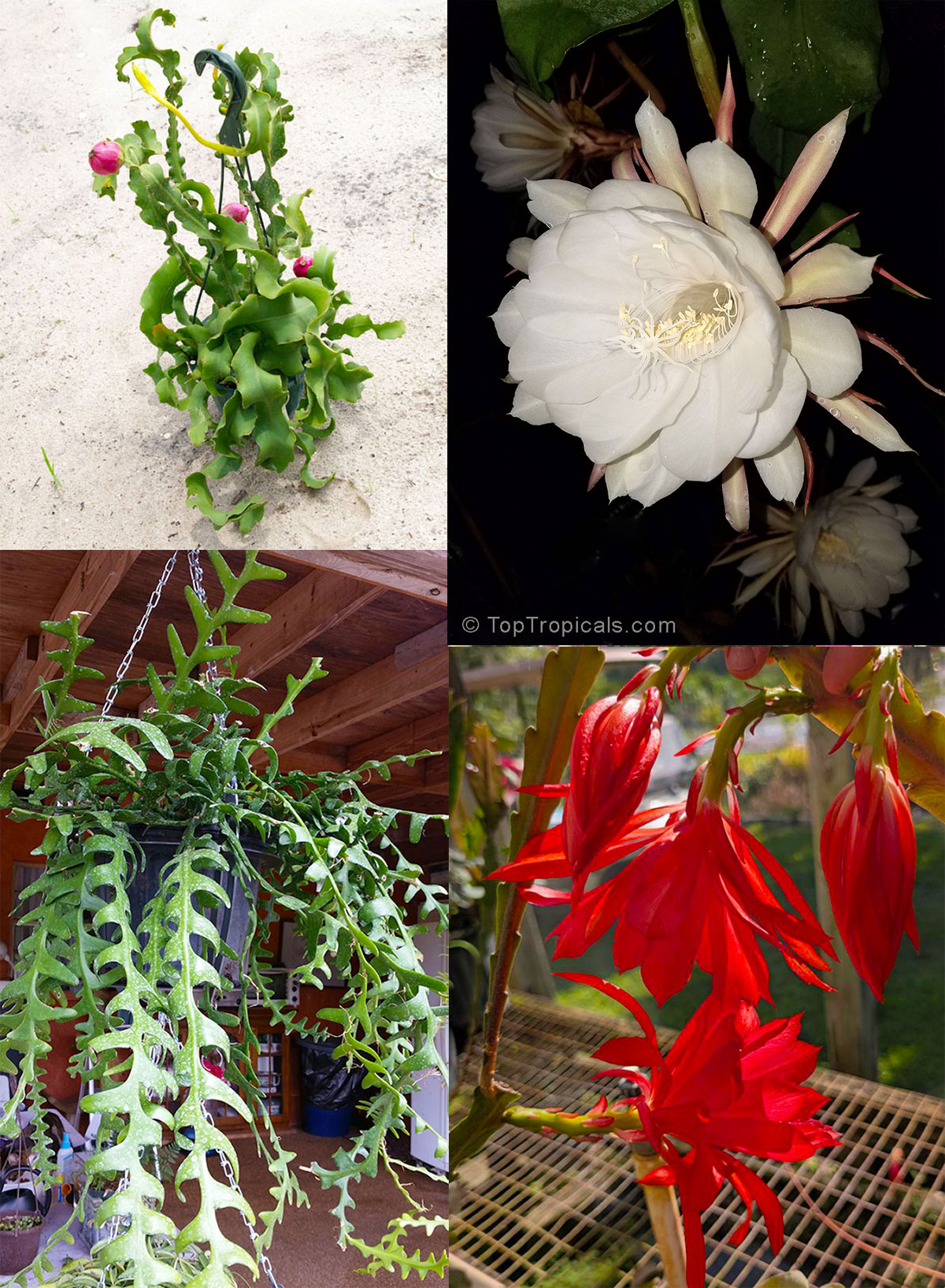
Jungle cactus collage: top left Epiphyllum guatemalense Monstrosa (Curly Locks Orchid Cactus), top right Epiphyllum oxypetalum (Queen of the Night), bottom left Cryptocereus anthonyanus (Zig-Zag Cactus), and bottom right Disocactus ackermanni (Red Orchid Cactus)
Most people picture cactus as desert plants: hot sun, sharp spines, dry sand. But that’s only half the story. There’s another branch of the family that lives in the shade of rainforests. These are the jungle cacti — epiphyte plants that climb trees, trail from branches, and throw out flowers so big and showy they look closer to orchids than to cactus blooms.
See one up close and it’s a surprise. The stems can be flat, zig-zagged, or even curly. Some trail like ferns, others pile into a shaggy basket. And when the flowers open — often at night — they’re wide, fragrant, and gone by morning. It’s no wonder gardeners like them from a first sight.
✔️ Jungle Cactus Q&A
Aren’t all cacti desert plants?
Not these. Jungle cacti are epiphytes and grow in rainforests, clinging to trees and catching rain. They never touch desert sand.
What kind of light do they need?
Outdoors, filtered sun under a tree works best. Indoors, give them bright but indirect light — east or north windows are usually safe. Direct summer sun can scorch the stems, whether inside or out.
How much water is safe?
They take more water than desert cactus but still hate wet feet. Outdoors, a rain shower is fine if the pot drains fast. Indoors, water when the top inch of soil feels dry. Always use a loose mix like Adenium mix so roots get some air.
Do they bloom indoors?
Yes. In fact, many bloom better inside where conditions are steady. They set buds when a little root-bound, and cooler nights help. Outdoors in frost-free zones, flowers come with seasonal shifts. Indoors, expect surprise buds after a cool spell by the window.
Best way to display them?
Hanging baskets show off trailing stems both inside and out. Shallow pots work well on shelves or ledges indoors. In warm climates, they can even be tied to a tree branch outside — exactly how they grow in the wild.
Extra note on indoor vs. outdoor care?
Indoors, watch for dry heated air in winter — they like a bit of humidity. A tray of pebbles and water under the pot helps. Outdoors, protect from heavy midday sun and bring them in if nights dip below the mid 30s F.
Jungle cacti are easy to keep and full of surprises. Whether trailing from a basket or blooming after dark, they prove that not every cactus belongs in the desert.
Date: 22 Mar 2017
Condo Mango
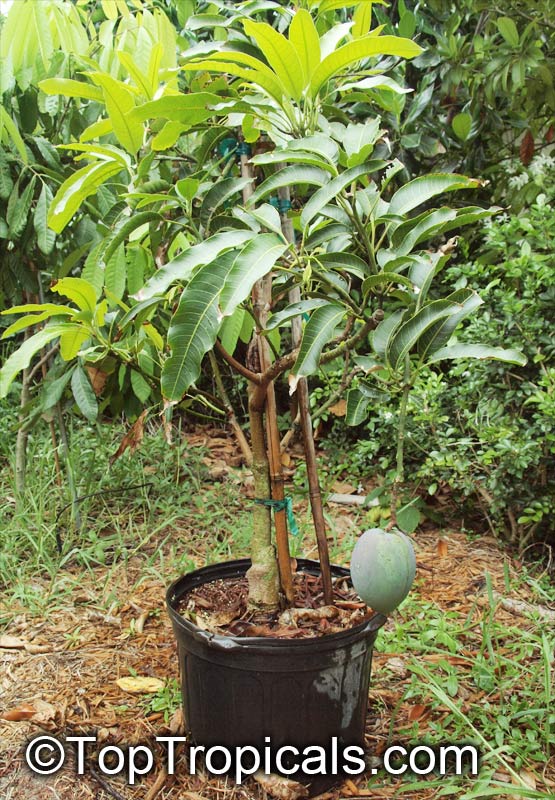
Q: I was curious about indoor fruiting mango trees. I live in upstate New York and was thinking about trying to grow an indoor tree for fruit. I have a small heated greenhouse. Is there a variety that can be grown from seed that would suit my purposes and if not what is the most economical way I could obtain a cutting or small grafted plant? I keep my greenhouse around 60F in the winter and have no supplemental lighting. Are there any varieties that may work in a sunroom or other well lit indoor location?
A:
There are many dwarf varieties of mango suitable for container culture. They
are called "condo mangoes".
The most popular condo varieties are: Carrie, Cogshall, Cushman, Fairchild,
Graham, Ice Cream, Julie
, Mallika, Nam Doc Mai,
Pickering. You may read more about them in our online
catalog. You may also look into variety
Lancetilla which is also a compact tree, and produces one of the biggest size
fruit, up to 5 pounds. If you want some rare variety that hardly anyone else has -
try Baptiste, an exotic Haitian dessert
mango.
Your greenhouse should work for the winter time. Mango trees can take
as low as mid 40s during winter and even lower as long as that cold is
occasional. If you keep the temperature around 60, this should work well for over
wintering. Just make sure to reduce watering to a minimum, because cool
temperatures, low light and wet soil - is a bad combination for tropical plants,
especially for mango trees which prefer to be kept on a dry side.
Many indoor gardeners have fruiting mango trees in their collection. However,
keep in mind that the most important requirement for a mango is full sun.
While you may over winter the plant for a few months in a low light conditions,
in order for it to flower and produce fruit it needs lots of light. If moving
the tree into full sun your yard during the summer is possible, this would
be the best solution.
We always recommend
SUNSHINE boosters for both over wintering tropical plants in colder
climates, and for indoor gardening. SUNSHINE applications will help your tree to
cope with cool temperatures and low light conditions. This will also
dramatically increase flowering and fruiting performance. Another important factor for
keeping your container plant healthy is quality of your potting soil. We
offer a special
professional mix that contains lots of good stuff: coconut fiber, peat moss, pine
bark, and perlite. Fertilizing potted plants
is also very important during the warm season, because this is the only way
for them to get nutrients (which in the ground can be reached by spreading
root system).
As far as seedlings vs. grafting - the only way to
have a nicely fruiting mango tree is to plant a grafted variety. Seedlings start
producing only after 8-15 years, and the quality of such fruit may be
questionable. Only grafted plants can guarantee the desired taste of a variety.
Besides, grafted mangoes start producing immediately - you may see fruit forming
on plants as small as 3 ft, in 3 gal containers. However, during the first
1-2 years you will need to remove extra fruit and leave only 1-2 fruit so the
plant doesn't get exhausted and has enough energy to establish strong root
system.
For fun stories about growing mango, check out our Radio
Show recording YO Tango Mango!
Date: 8 Oct 2024
Is this Adenium?
caudiciform Morning Glory - Ipomoea platensis
🌸 Is this Adenium? No, its a Morning Glory!
🌸 This remarkable caudiciform Morning Glory - Ipomoea platensis - is growing from a large caudex! The caudex can be of some weird shapes and forms. Similar to Desert roses (Adeniums), it grows caudex for water storage to survive extended drought periods. This is one of our favorite plants, easy to grow, makes a great conversation piece. It is a perfect for bonsai
📚Learn more from previous post:
A beauty from Argentina
🛒 Order Caudiciform Morning Glory
#Nature_Wonders
🔴 Join 👉 TopTropicals
Date: 9 Apr 2023
How Gardening improves your health
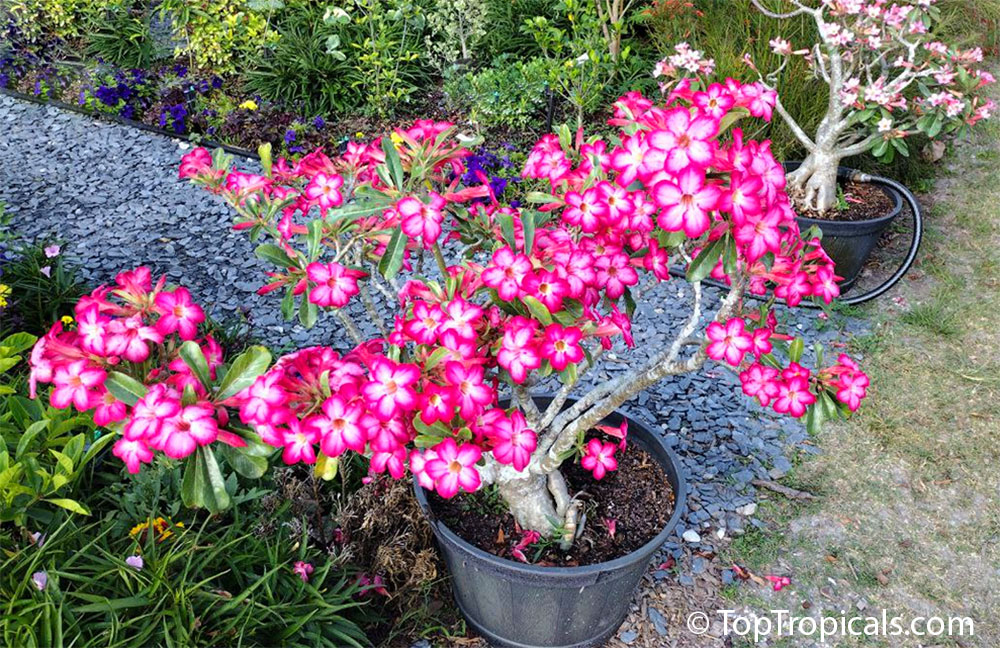
Q: Can gardening improve my health?
A: Gardening is not only a fun way to spend time but also an opportunity to bond with family and friends. Get everyone involved in planting flowers, starting a vegetable patch, or even organizing a whimsical Easter egg hunt amidst the blooming garden.
The joy of gardening offers mood-boosting benefits, leaving you feeling invigorated and cheerful during the festive holiday. Plus, the sense of accomplishment when your garden begins to flourish perfectly aligns with Easter's spirit of personal growth and transformation.
Head out to your garden with a spring in your step and a smile on your face. Revel in the beauty of nature, spend time with loved ones, and watch as your garden transforms into a lively, colorful haven.
Date: 24 Jun 2018
Adenium: a Rose by any Other Name
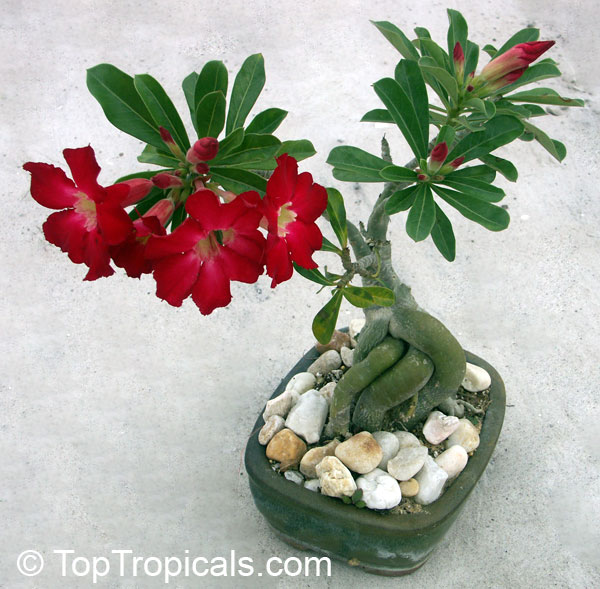
New
article by Jane Jordan.
"...The famous quote is often used to imply that the names
of things do not affect what they really are, in the case
of The Desert Rose (Adenium obesum) it is not a rose at
all, rather a succulent that thrives in hot, dry and sunny
conditions. These spectacular plants have no relation to
the rose family, they are a species of flowering plant
from the dogbane family, Apocynaceae. The naming of this
plant is partly correct as they originate in sub-Saharan
Africa and the Arabian Peninsula, where they can grow into
large trees with huge swollen trunks..."
Continue reading...