Garden Blog - Top Tropicals

Date: 24 Jun 2018

TopTropicals

Florida winters and gardening

From Anna Banana, our Garden Center customer advisor.
Cool weather - no sweat. Here in Florida we are blessed to have warm winters. We just went to the beach for Christmas! Winter time is not only a good beach time, but also the best planting time here. Why? I always refer my customers to Murray Corman's article Tropical Planting Breaks the Rules. "...Wintertime does not just mean hard work for tropical gardeners. It is also a time to enjoy the fruits of our labor. Winter-blooming plants and the visitors they attract - birds, bats and butterflies - make the garden as enjoyable in winter as any other time of year. Tasks performed during the spring and summer up north have to be done during the fall and winter here. Why? The answer is elementary: It's too hot! Taking advantage of the coolest months of the subtropical year for heavy chores like planting trees has a twofold benefit: The gardener can make hay while the sun shines without getting heat stroke and the plants appreciate the moderate temperatures, enjoying a break from the stress of 93 degrees in the shade..."
Continue reading...

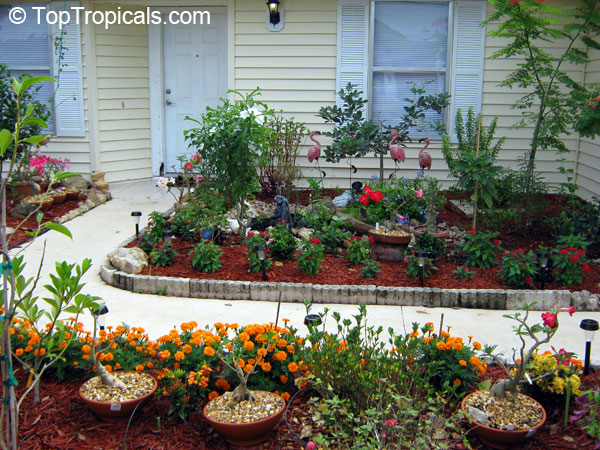
Winter flowering plants - are a blessing for a tropical gardener. See below what's blooming now! See our recommendations for winter flowering and fruiting plants (PDF).

Date: 24 Jun 2018

TopTropicals

New 2018 release: SUNSHINE SuperFood

"Two out of every five people on Earth today owe their lives to the higher crop outputs that fertilizer has made possible." (Bill Gates)

Micronutrient Supplement and Plant Health Booster
Misshapen, small fruit or no fruit?
Poor root growth?
Pale or yellow leaves?
Die backs?
Curled leaves?
Slow growth?
Don't let your plants starve... SUNSHINE SuperFood is your answer to all these problems!
Read more why your plants need SUNSHINE-SuperFood - Essential Element Complex that has them all: N-NH2, Mg, Fe, Mn, Zn, Cu, B, Mo, S...
SUNSHINEâ„¢ SuperFood is a revolutionary new product released in 2018. It is a super micro-element supplement (Amino Acid Chelated Micronutrient) containing microelements, ultra-microelements, glycinates, as well as SUNSHINE-Honey ingredients. It shows amazing results in plant development, treating different element deficiencies, and improving fruit trees production.

GREEN-EARTH-ECOLOGY FRIENDLY! And it is GREEN color!

Buy SUNSHINE Superfood... item # 6000!

Date: 24 Jun 2018

TopTropicals

Secrets of perfect mulch

Poor man's mulch... or natural solution? With warmer weather weeds started spreading around the garden... pulling, spraying, mulching them... that helps. Here are a few tips about natural mulch based on our own experience.

1) Do not rake dry leaves and pine needles, use them as natural mulch. A leaf is a part of a plant with the highest nitrogen content which is a major plant nutrient. After breaking down, leaves will work as a fertilizer. If you prefer to have a fancy mulch, put it on top of those leaves.

2) Do not dispose cut grass. Spread it around trees and shrubs. Hay is one of the best mulching materials. It has at least 2 exceptional benefits: a) after couple rains it becomes dense, creating perfect protection from sprouting weeds, and b) grass is actually also a leaf - so it had built up lots of nitrogen too, and works as a fertilizer.

3) Be careful with "bulk mulch" that sometimes offered by local tree service companies (usually for free). It often contains bugs, plant parts that are infested with bad insects, or simply fleas. Natural mulch from your own garden is always the best choice, proven organic and safe solution.

4) A few layers of newspaper (or even better - cardboard from your endless Amazon deliveries) placed underneath the mulch work as a great weed barrier and will make your mulching work results last 4-5 times longer. Water drains through them, and paper products are ecologically safe and biodegradable.

Date: 24 Jun 2018

TopTropicals

How to make a Mango tree bloom and fruit

Mango trees are especially beautiful during spring time when they flush out multi-color new leaves! But you want your mango be not only beautiful but fruitful as well. Here are some tips:

1) Fertilize Mango tree with a balanced slow release fertilizer starting March. Use 1 tsp of granulated fertilizer per 1 gal of soil, or a handful or two for an in-ground tree. You may add one application of foliar spray of a water-soluble bloom booster fertilizer (the one for Roses or Azaleas will work). This will give your tree a good macro-nutrient kick-start.

2) Spray entire tree with SUNSHINE-Superfood solution. This will provide all necessary micro-elements and keep the plant healthy and strong throughout the season. Repeat treatment once a month until harvest time.

3) For sweeter fruit, apply SUNSHINE-Honey solution several times:
- early spring before flowering
- at setting buds
- right at the beginning of setting fruit
- after harvesting, to provide the tree with all good micro-nutrients before resting season.

Date: 24 Jun 2018

TopTropicals

Cleanest fruit?

"Dirty" fruit: According to the Environmental Working Group research, Strawberries are top the list of the 12 "dirtiest" fruits and vegetables grown commercially. Spinach is the second, followed by (in order of contamination) nectarines, apples, grapes, peaches, cherries, pears, tomatoes, celery, potatoes and sweet bell peppers. Each of these foods tested positive for pesticide residues and contained higher concentrations of pesticides than other produce. This causes of course chronic health implications. Children are of special concern as younger bodies have greater susceptibility to pesticides than adult bodies, the report emphasizes. Pesticides may induce chronic health complications in children, including neuro- and behavioral problems, birth defects, allergies, asthma, and even cancer...

"Clean 15": Avocados lead 2018's clean fruits and veggies list, that also includes: mangoes, papayas, pineapples, kiwi, sweet corn, cabbage, onions, frozen sweet peas, asparagus, eggplant, honeydew melon, cantaloupe, cauliflower and broccoli.
Obviously, home grown fruit and vegetables are even better. Such fruit as Custard Apples, Sapodilla, Sapote, Jackfruit, Dragon Fruit, Passion Fruit and other rare varieties of tropical fruit, are even better for you because they are not grown commercially, and the choice from your own organic garden is the healthiest for yourself and your family!
Plant them today and get your cleanest fruit tomorrow!

Check out all tropical fruit trees and all tropical spice plants.