Garden Blog - Top Tropicals

Date: 14 Jan 2026

Did you know that Tacca is a cat?

Tacca plants and Cats

Tacca plants and Cats

🐈 Did you know that Tacca is a cat?


That’s probably the real evolutionary secret no botanist will admit! Those whiskers? Pure marketing genius from nature.
Cats had it figured out first — look mysterious, add long elegant whiskers, and everyone falls in love.
Tacca just took notes and said, “Alright, I can work with that!
Continue reading: Tacca wants to be a cat! - and everyone loves cats!

Tacca colors: Black, White, Green:


Tacca nivea - White Tacca
Tacca chantrieri - Black Tacca
Tacca leontopetaloides - Green Tacca

🛒 Add Get your own Bat Head Lily Tacca

📚 Learn more:

Bat Head Lily Plant Facts

Botanical name: Tacca chantrieri
Also known as: Bat Head Lily, Bat Flower, Devil Flower, Black Tacca
USDA Zone: 9 - 11
Highligths Small plant 2-5 ftShadeWatering: Regular. Let topsoil dry slightlyOrnamental foliageUnusual color
Get personalized tips for your region

Tacca Lily in Plant Encyclopedia
Perfect Halloween plant: Black Bat Lily (Tacca)
When plants cross into the Gothic: the Darker Bat Lily
What is the rarest Tacca?
The mystery of the White Bat Lily - the plant with wings and whiskers
A flying bat with whiskers
The rarest Green Tacca - Tacca leontopetaloides
When Bat Head Devil Flower is in bloom
Bat Head - Devil Flower

#Container_Garden #Shade_Garden #Nature_Wonders

🟢 Join 👉 TopTropicals

Date: 22 Feb 2026

How to grow Papaya from seed, step-by step - FAQ

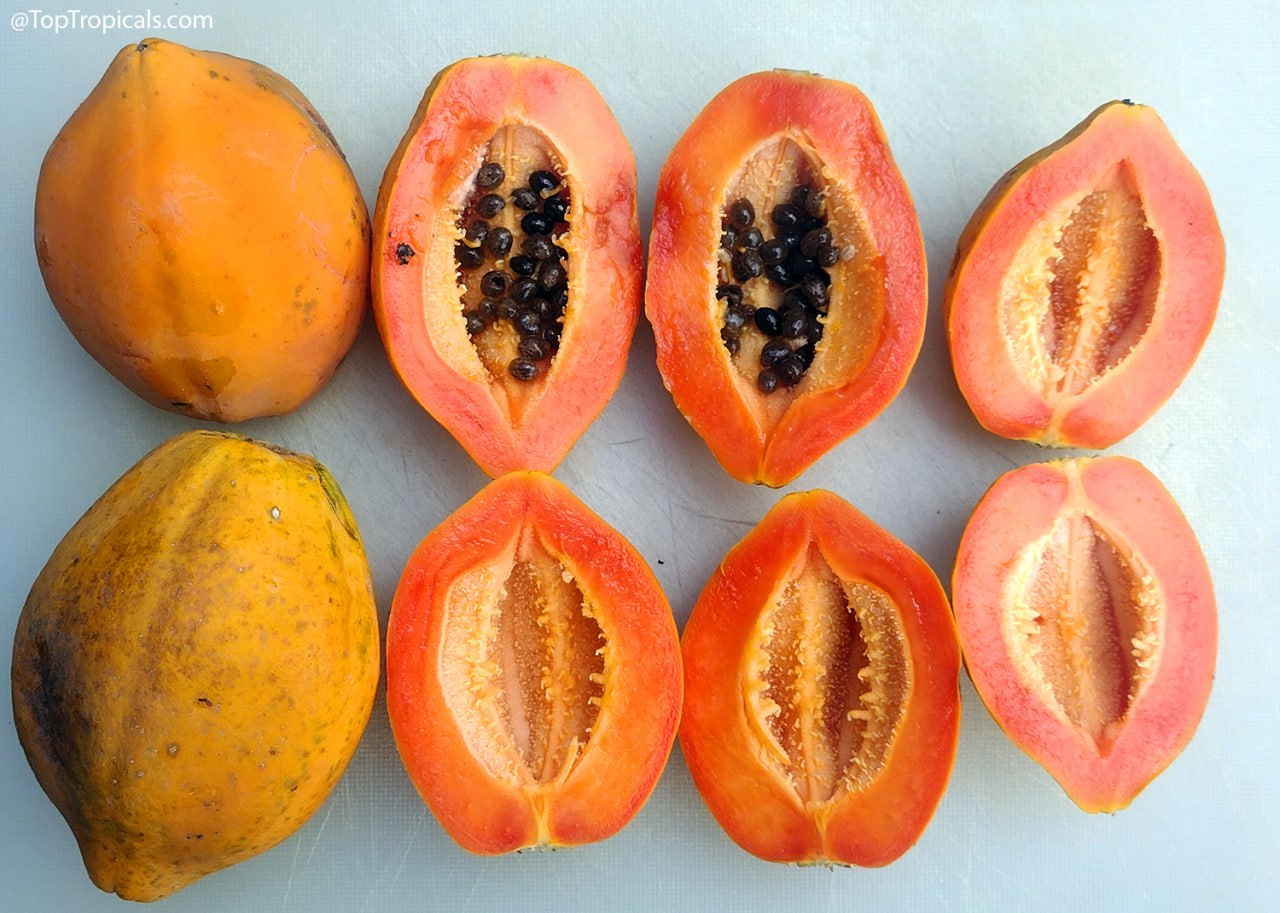
Carica papaya - Papaya fruit

Carica papaya - Papaya fruit

🍊 How to grow Papaya from seed, step-by step - FAQ


💚 Is papaya a tree?


No. Papaya is a herbaceous plant with a hollow trunk. Treating it like a tree is one of the most common mistakes growers make.

💚 How fast does papaya grow from seed?


Very fast. Papaya can start producing fruit in 10–15 months when grown in warm conditions.

💚 Can papaya be grown in containers?


Yes. Dwarf papaya varieties stay under 4–5 ft tall in containers and still produce full-size fruit.

💚 Will seeds from grocery store papaya work?


They will germinate, but the variety is unknown and usually not dwarf. If you want a compact plant, use seeds from a known dwarf variety.

💚 Do papaya plants come true from seed?


Yes. When the seed source is known, papaya grows true to type.

💚 How long do papaya seeds take to germinate?


Fresh seeds usually germinate in 2–3 weeks with warmth. Stored dry seeds can take 8–10 weeks.

💚 What temperature do papaya seeds need?


Above 70F, ideally 85–90F. Bottom heat greatly improves success.

💚 Do papaya seeds need to be cleaned before planting?


Yes. The slimy coating must be removed or seeds may rot instead of sprouting.

💚 What soil is best for papaya seedlings?


A well-draining mix or coconut fiber. Soil should be moist, never soggy.

💚 Why do papaya seedlings rot so easily?


Overwatering and poor drainage are the main causes. Young papaya roots are very sensitive to excess moisture.

💚 Do papayas like transplanting?


No. Papayas hate root disturbance. Reduce transplanting and move into larger containers sooner rather than stepping up gradually.

💚 How big should the container be?


After a 4-inch pot, move directly into a 1-gallon or even 3-gallon container to minimize root disturbance.

💚 Does papaya need staking?


Yes. Papaya grows fast, and the stem can outpace root development. Even light wind can knock it over.

💚 How much sun does papaya need?


Full sun. Shade causes leggy growth, poor flowering, and little to no fruit.

💚 Should papaya be watered heavily?


No. Once established, papaya prefers drier conditions. Large plants tolerate rain better than young ones.

💚 Can papaya be planted in the ground?


Yes, but only in well-drained soil and elevated spots. Low areas with standing water will kill it.

💚 Is fertilizer important for papaya?


Yes. Papaya is a heavy feeder. Poor soil means poor growth and little or no fruit. Use Green Magic once every 6 months or Sunshine Boosters C-Cibus with every watering.

💚 Should papaya be pruned to control height?


No. Pruning ruins its natural form. If height is an issue, grow a dwarf variety instead.

🛒 Explore Papaya varieties

📚 Learn more:

Papaya Plant Facts

Botanical name: Carica papaya
Also known as: Papaya
USDA Zone: 9 - 11
Highligths Small tree 10-20 ftFull sunWater Requirement: Low. Allow soil to dry out between wateringsWatering: Moderate. Water when top soil feels dryYellow, orange flowersWhite, off-white flowersEdible plantEthnomedical plant.
Plants marked as ethnomedical and/or described as medicinal, are not offered as medicine but rather as ornamentals or plant collectibles.
Ethnomedical statements / products have not been evaluated by the FDA and are not intended to diagnose, treat, cure, or prevent any disease. We urge all customers to consult a physician before using any supplements, herbals or medicines advertised here or elsewhere.Subtropical plant. Mature plant cold hardy at least to 30s F for a short time
Get personalized tips for your region

· Carica papaya in Plant Encyclopedia
· How to grow papaya from seed without killing it:
Part 1: Papaya basics
Part 2: Seeds germination
Part 3: Containers, sunlight, and common mistakes
· Carefree Garden: How Easy Is It to Grow a Papaya Tree?
· Male papaya produces fruit!
· Top 10 fast-fruiting trees: #6. Papaya
· How to have fresh Papaya fruit year around
· The truth about Papaya
· Papayas contain a secret enzyme

🎥 Nobel Prize goes to this pregnant male papaya

#Food_Forest #How_to #Papaya #Discover

🟢 Join 👉 TopTropicals

Date: 21 Aug 2025

🍒 Tropical Cherries – Eugenias

Two  cats  enjoy  Grumichama  fruit  indoors  —  a  tuxedo  cat  picks  berries  from  a  potted  tree  while  an  orange  fluffy  cat  smiles,  sitting  by  tea  cups  and  plates  of 
 fruit.

Tropical Tea Time with Grumichama

Eugenias have earned a spot in many Southern gardens because they’re easy, dependable, and surprisingly versatile. These small trees and shrubs grow well in the ground or in containers, and they don’t waste time before setting fruit.

15% Off Eugenias – Limited Time

Use code EUGENIA15 at checkout.
Excluding S/H. Offer expires 08/28/2025

👍 Popular Choices:

What Makes Eugenia Cherries Stand Out

  • Start producing fruit in just a couple of years
  • Compact size — easy to keep 6–12 ft tall, smaller in pots
  • Low-care — tolerant of most soils and resistant to common pests
  • Strong in hot weather, yet can handle a light frost down to the mid-20s °F
  • Plenty of fruit for people and birds alike

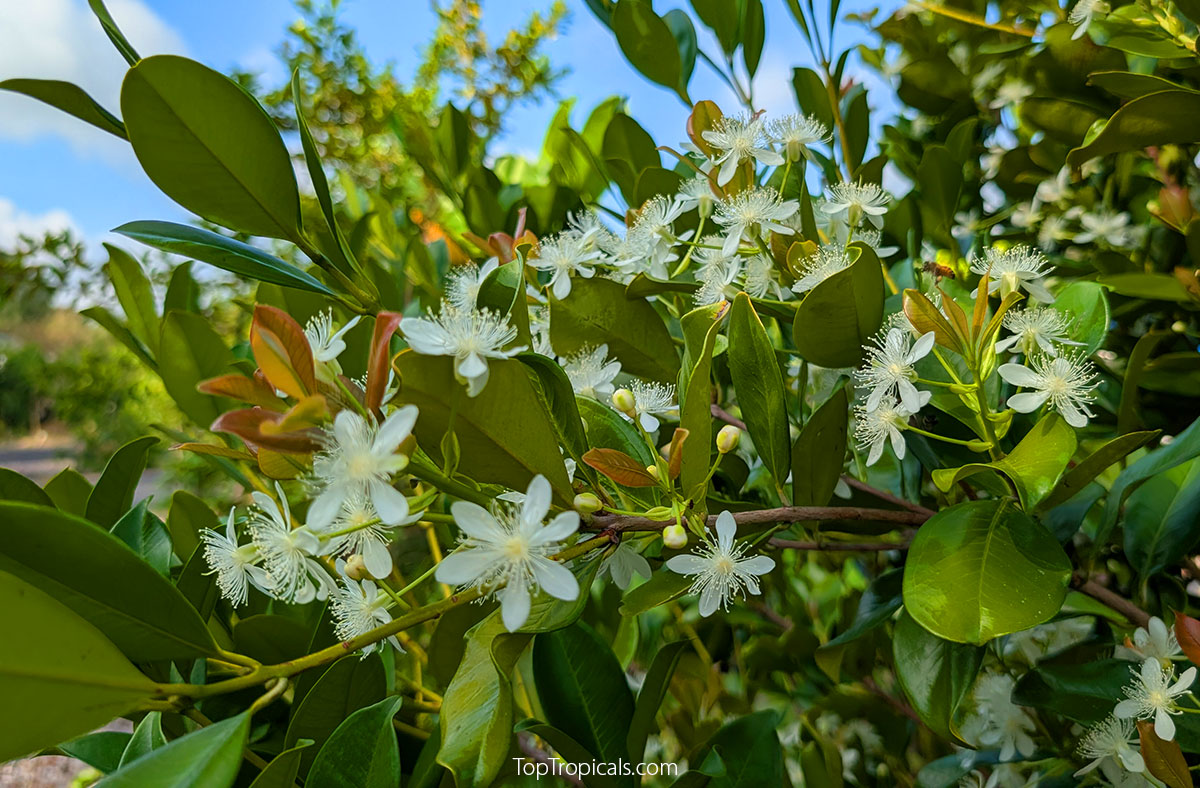
Close-up  of  Grumichama  tree  branches  with  clusters  of  small  white  flowers  among  glossy  green 
 leaves. Grumichama Tree in Bloom – Eugenia brasiliensis

Growing & Care

Outdoors

  • Best in USDA Zones 9–11
  • Sun or partial shade; more sun usually means sweeter fruit
  • Plant in well-drained soil; avoid heavy, wet spots
  • Withstands summer heat and humidity, and can take a light freeze

Container / Indoor

  • Do well in 5–10 gallon pots on patios or balconies
  • Need bright light indoors — a sunny window or grow lights
  • Can flower and fruit in containers if kept warm and well lit
  • In cooler zones, bring plants indoors for winter and back out in spring

General Care

  • Water: Keep soil evenly moist; drought-tolerant once established but best yields with regular watering
  • Soil: Use good potting mix - LINK TO SOIL
  • Fertilizer: Balanced slow-release LINKL TO FERTILIZER Sunshine Boosters
  • Pruning: Light trimming keeps plants bushy and productive
  • Pollination: Self-fertile; one plant will fruit on its own

Read Garden Blog about Tropical Cherries

Shop Tropical Cherries

Date: 24 Jun 2018

Cold hardy tropical fruit trees for Luisiana

Q: I've just moved to Louisiana and have been wondering whether it would make sense to plant some tropical fruit trees in our garden. Average lows in New Orleans are 41 deg F in January and February, although we did hit 25 once with the Arctic vortex. I'm interested in litchi, longan, rambutans, and persimmons. Do you have varieties that can tolerate Louisiana's temperature range? I'd love mangosteen but I don't suppose they will survive. Do you have any suggestions on tropical fruit trees that I could try?

A: Average temperatures are for statistics only; it is actual temperatures that may hurt your cold sensitive plant. This is what you should keep in mind when starting your tropical fruit collection:
1) Ultra-tropical plants like Rambutan can not survive winters below 45-50F. However, they can be successfully grown in containers in a greenhouse or moved indoors into a sun room during cold periods.
2) Tropical plants like Litchi and Longan may take some light frost once established. Still, for areas with freeze our advice is - keep them in pots and move inside in case of cold.
3) There is a number of subtropical fruit trees that are hardy enough to take some freeze. Persimmon, Feijoa, Fig, Cattley Guava, Jujube, Kiwi, some Eugenias and others. Please refer to our Tropical Fruit Sensitivity Chart.
4) Remember that plant's ability to survive winter depends on several factors, not only temperature itself. Important factors are: wind protection (chill wind kills rather than low temperature itself), exposure, how close the tree is planted to the house, plant maturity and its overall strength and health. If a plant had received good nutrients during summer, has well established root system, planted in enclosed area protected from winds and has plenty of bright sunlight - it has better chances to survive than a weak plant in warmer conditions.
5) Use SUNSHINE plant boosters for improving cold tolerance of your tropical plant. It only takes a few drops, and only costs $5!

Date: 24 Jun 2018

NEW SLIDESHOW: Top Tropicals - We Grow Happiness!

Look at these most spectacular flowers of the Tropical World.

You can have them... We can ship!
Whether you live in Tropical Florida or Downtown New York, you can grow tropical plants and enjoy the beauty of fragrant flowers and exotic fruit. Bring some happiness into your life and let us do the rest - grow these plants for you and give you some advice how to keep them happy.

Stay updated with TopTropicals Videos by subscribing to our channel at YouTube.com/TopTropicals and get our latest video news of what is fruiting and blooming!