Garden Blog - Top Tropicals

Date: 16 Jun 2026

💜 The Tree Everyone Stops to Take Pictures Of

Sunshine,  an  orange  tabby  cat,  takes  a  selfie  beneath  a  blooming  purple
    jacaranda  tree  while  Smokey,  a  tuxedo  cat  wearing  glasses,  watches  nearby 
 at  Top 
 Tropicals.
Sunshine: Every angle looks good.
Smokey: That's because you're photographing a Jacaranda at peak bloom.
Sunshine: I think the purple brings out my orange.
Smokey:The Jacaranda makes everything look better.

There's a moment, if you've never seen a mature Jacaranda in full bloom, that stops you completely.

You're driving down a street, or walking through a neighborhood you've passed through a hundred times, and suddenly there it is — a tree that looks like someone painted it from memory rather than from life. The canopy spreads wide and low, covered so thoroughly in lavender-blue flower clusters that you can barely see the branches beneath. People are already stopped on the sidewalk. Someone has their phone out. A couple is standing beneath it, looking up.

You understand immediately why they stopped. You stop too.

That first encounter with a Jacaranda mimosifolia in bloom is the kind of thing gardeners remember for years. It's also, for many of them, the moment they decided they needed one.

👉Plant Your Purple Jacaranda

💜 The Tree That Turns Cities Purple

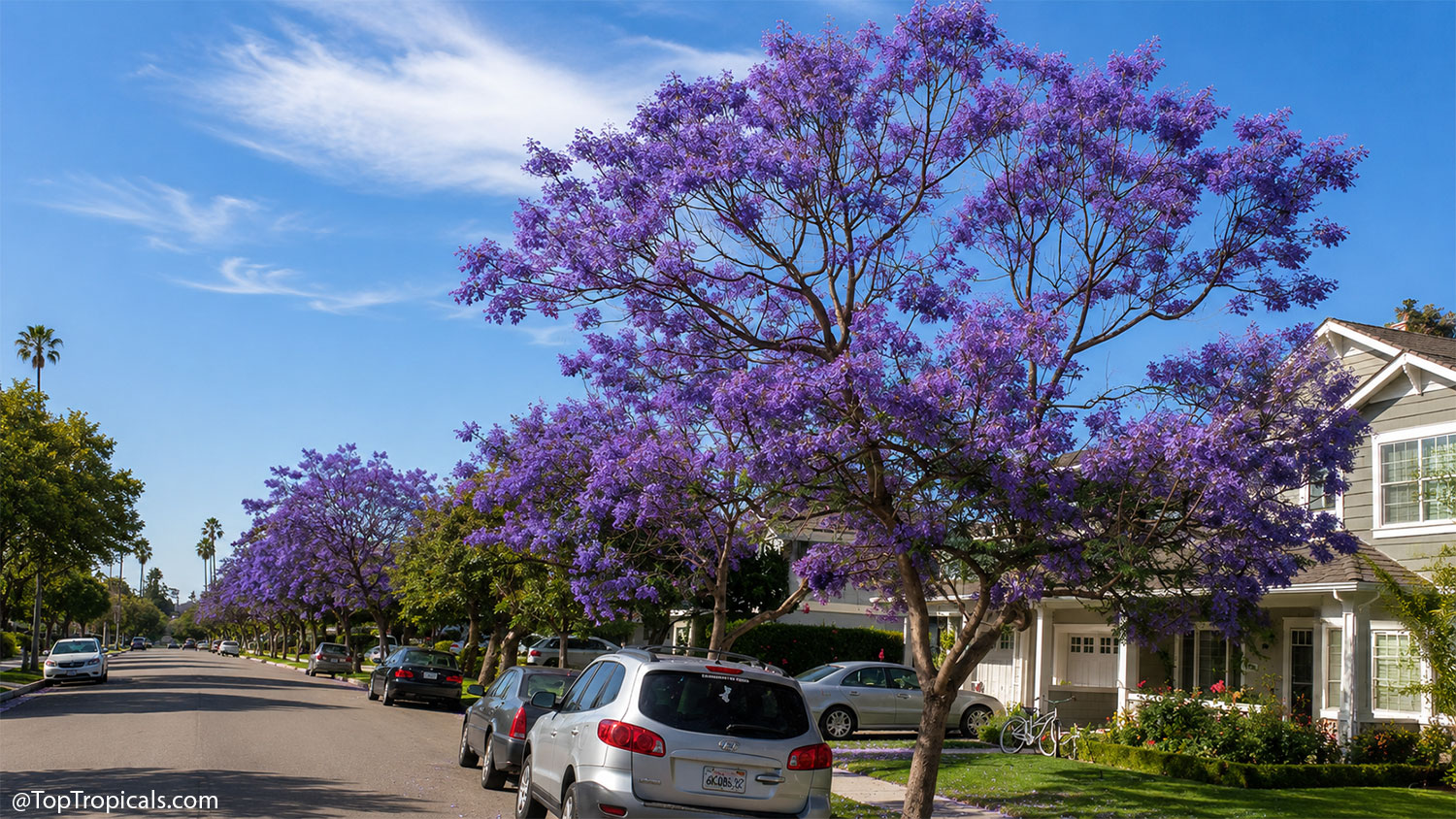
Residential  street  lined  with  blooming  jacaranda  trees  covered  in 
 vibrant  purple  flowers.  A  large  jacaranda  shades  parked  cars  and  front 
 yards,  while  additional  flowering  trees  create  a  stunning  purple  avenue 
 beneath  a  bright  blue 
 sky.

When jacarandas bloom, entire neighborhoods are transformed into rivers of purple. Their spectacular floral display turns ordinary streets into some of the most photographed landscapes of spring and early summer.

Most flowering trees get admired. Jacarandas become events.

Pretoria, South Africa is known worldwide as "Jacaranda City." During bloom season, entire neighborhoods seem to disappear beneath a haze of lavender-blue flowers.

Buenos Aires, Sydney and Brisbane have their own Jacaranda traditions. In Southern California, mature Jacarandas are so anticipated that bloom season regularly fills social media with photos of purple-lined streets and neighborhoods.

People don't merely grow Jacarandas. They wait for Jacaranda season. There's something unusual about a tree that generates that kind of anticipation. Most ornamental trees are appreciated in passing. Jacaranda creates a ritual.

💜 A Tree Surrounded by Legends


Mitu  mitu  bird  (Alagoas  Curassow)  -  adult  male.  Illustration  from 
 Nouveau  recueil  de  planches  coloriées 
 d'oiseaux,  1838

Mitu mitu — the bird of the Tupi-Guarani legend (Wikimedia Commons)

In Tupi-Guarani tradition, Mitu, a great forest bird, carried the Daughter of the Moon from the heavens and placed her in a flowering Jacaranda tree. She descended among the people, bringing wisdom and knowledge before returning to the sky.

Few trees become part of local folklore. Fewer still become part of everyday life across multiple continents.

💜 Beautiful Beyond Bloom
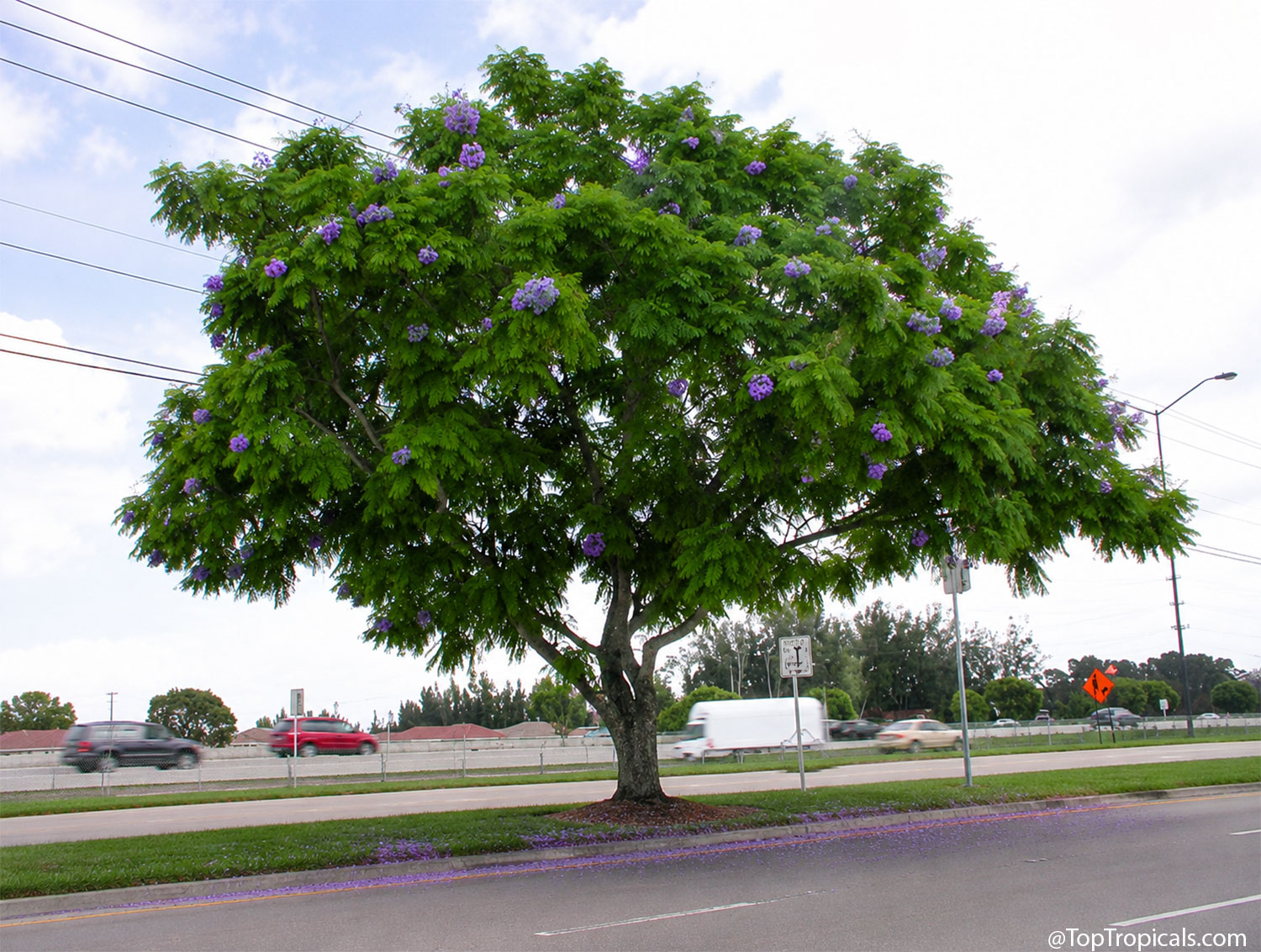
Young  jacaranda  tree  with  lush  fern-like  green  foliage  and  scattered 
 clusters  of  purple  flowers  growing  along  a  roadside.  The  broad  canopy  forms 
 a  graceful  umbrella  shape,  showing  the 
 tree's  attractive  structure  even  when  not  in  peak  bloom.

Jacaranda is beautiful even outside its main flowering season. Its finely divided, fern-like foliage creates a soft tropical canopy, while occasional clusters of purple blooms offer a preview of the spectacular display that transforms the tree into a cloud of lavender each year.

Here's what surprises people who plant their first Jacaranda: they love it even when it isn't flowering.

The foliage is finely divided and fern-like, giving the tree a delicate, airy texture that softens any landscape. The branching structure is naturally graceful, spreading wide with a canopy shape that looks considered rather than accidental. The light that comes through the leaves is gentle and dappled — the kind of shade that doesn't feel heavy, that lets enough brightness in to make the space beneath feel pleasant rather than dim.

💜 Mature Size
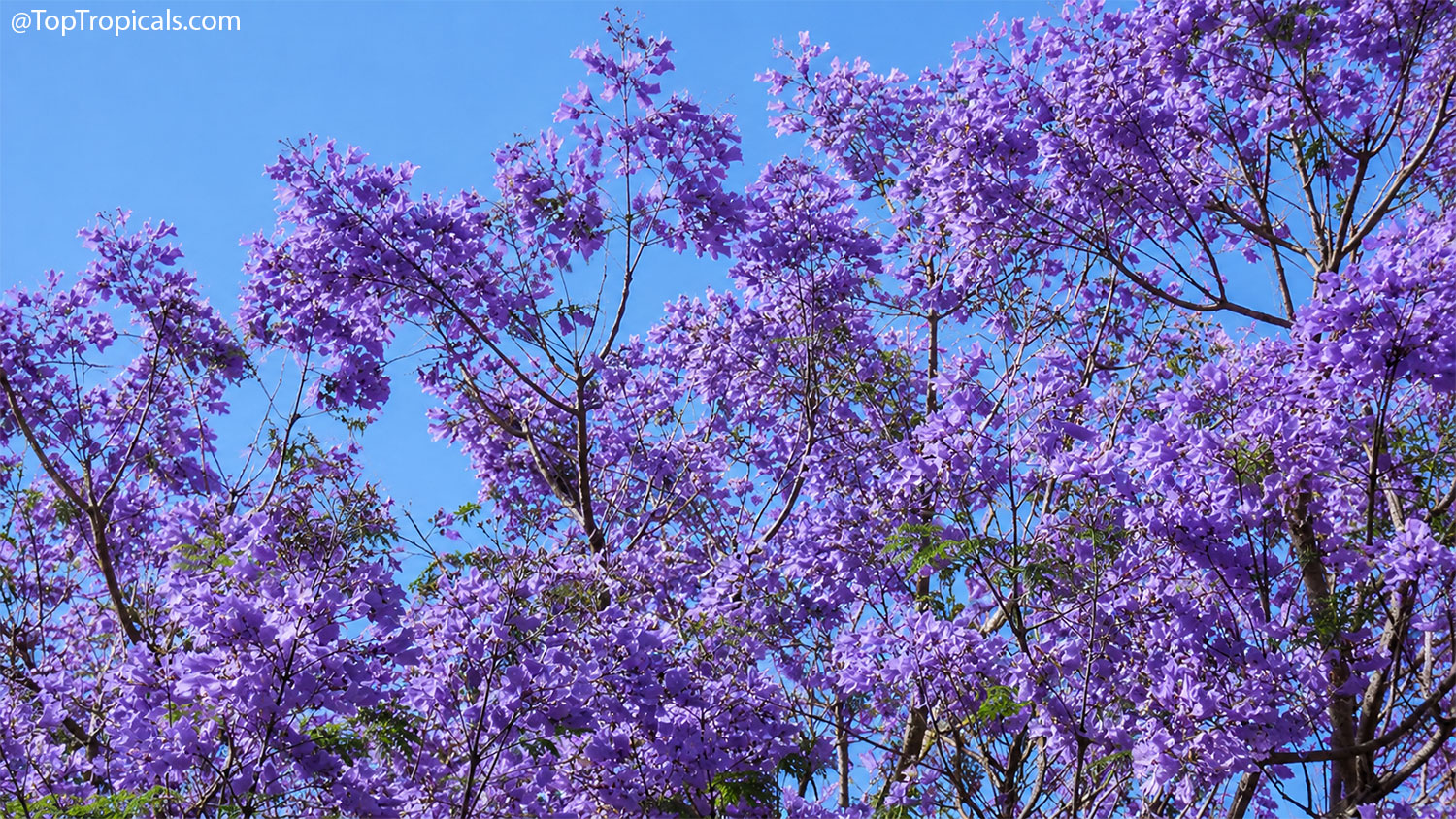
Upper  canopy  of  a  blooming  jacaranda  tree  filled  with  thousands  of 
 lavender-purple  flowers  against  a  clear  blue  sky.  The  delicate 
 trumpet-shaped  blossoms  create  a  soft,  cloud-like  effect  among  the 
 tree's  fine  branches  and  sparse  fern-like  foliage.

At peak bloom, jacaranda trees appear draped in purple clouds. The airy canopy of lavender blossoms creates a breathtaking display that has made this tree famous in gardens, parks, and city streets around the world.

A mature Jacaranda typically reaches 25 to 30 feet tall with a broad, spreading canopy of similar width. Given room to grow, it becomes a true focal point in the landscape.

That size is the point. A Jacaranda works beautifully as a specimen tree where you have room to let it express itself fully. It makes an excellent lawn tree, its canopy casting light shade over a wide area. Planted where it can be seen from a distance, it becomes a focal point in any season and a spectacle during bloom.

If you want a tree that will grow into something people notice — something that will still be there and still be blooming long after you've finished planting the rest of the garden — Jacaranda delivers.

How to Grow Jacaranda

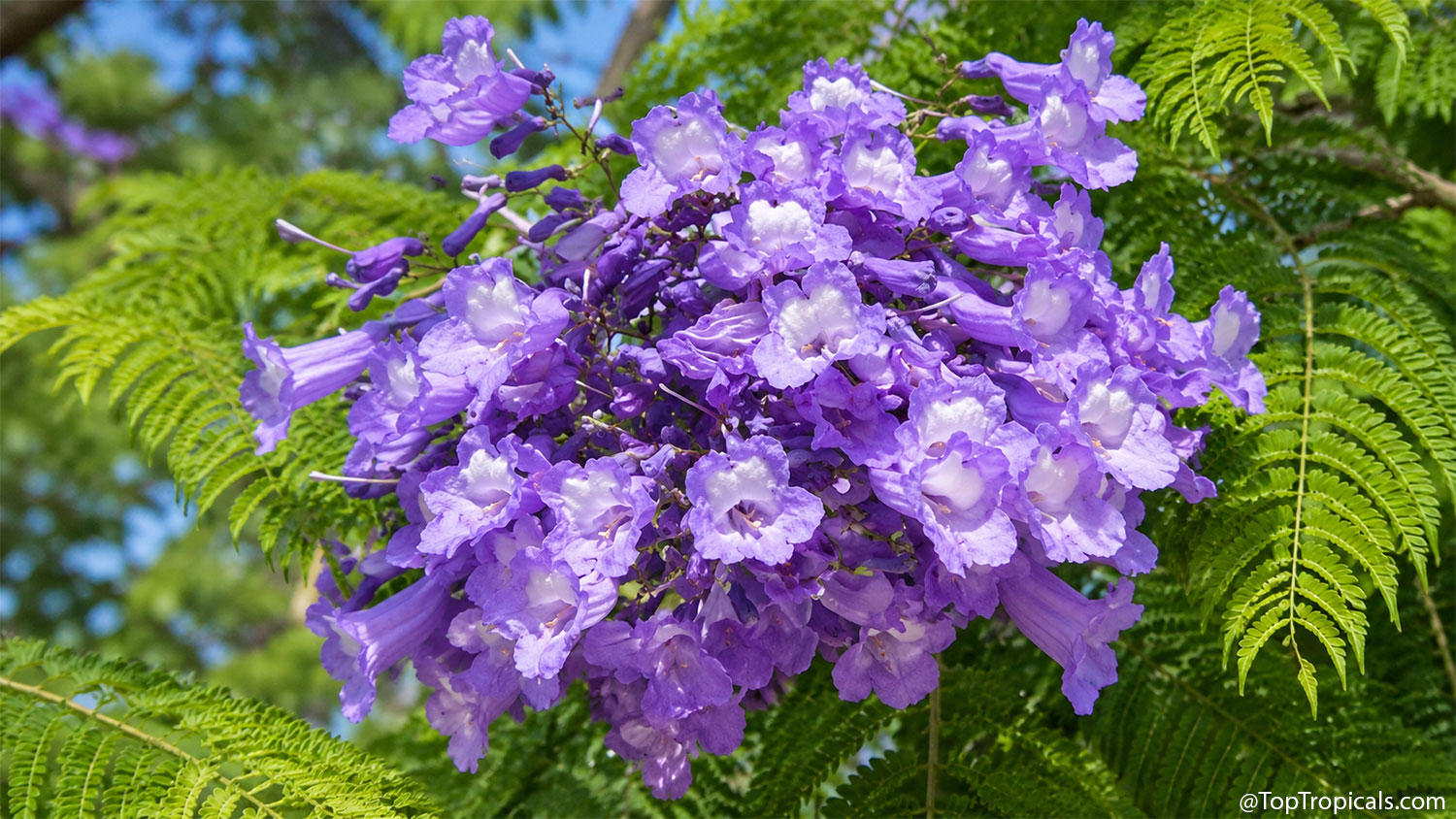
Dense  cluster  of  lavender-purple  jacaranda  flowers  surrounded  by 
 delicate  fern-like  green  foliage.  The  trumpet-shaped  blooms  are  packed 
 tightly  together,  with  pale  white  throats  creating  a  striking  contrast 
 against  the  vibrant  purple 
 petals.

The beauty of jacaranda is not only in its massive floral display but also in the individual flower clusters. Each bouquet combines dozens of delicate trumpet-shaped blooms framed by soft, fern-like foliage, creating a perfect balance of texture and color.

For best results, provide:

  • Full sun
  • Best planted away from sidewalks and driveways
  • Well-drained, sandy loam; highly sensitive to waterlogged or heavy clay soils
  • Regular watering while establishing
  • Moderate watering once mature
  • A balanced fertilizer during the growing season
  • USDA Zones: 9B – 11. Can tolerate brief, light frosts once mature. Protect from cold while young

Bloom season: Late Spring to Early Summer (Main flush), occasional light scattered bloom in Fall. As the flowers fall, they often create a colorful purple carpet beneath the canopy, extending the display from the branches to the ground below.

In warm climates such as South Florida, coastal Southern California, and Hawaii, Jacaranda can become a long-lived landscape tree that provides shade, beauty, and spectacular seasonal blooms for decades.

Top Tropicals Tip:
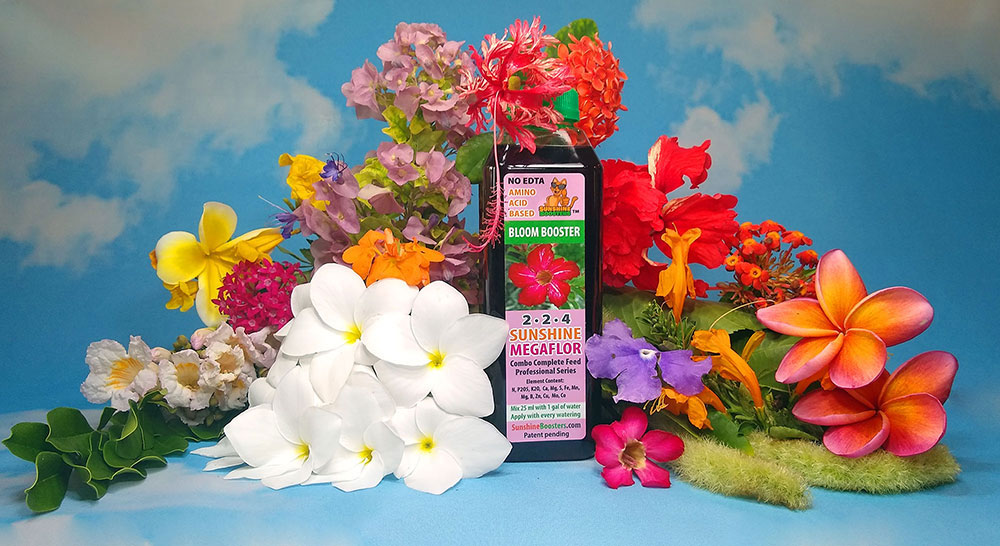
To help young trees get established quickly, consider using Sunshine Boosters Green Magic when planting or transplanting. During the growing season, regular feeding with Sunshine Boosters Megaflor can help support vigorous growth and a healthy canopy.
To maximize the bloom density for next season, ensure the tree receives consistent micronutrients during the late summer growth surge.

Read Top Tropicals Guide to Sunshine Boosters™

Jacaranda can also be grown in large containers, where its size may be managed through container culture and occasional pruning. This is a useful option for gardeners in colder climates or for those who wish to enjoy the tree on patios and terraces.

📚 More About Jacaranda on the Top Tropicals Garden Blog

💜 Why Gardeners Fall in Love With Jacaranda
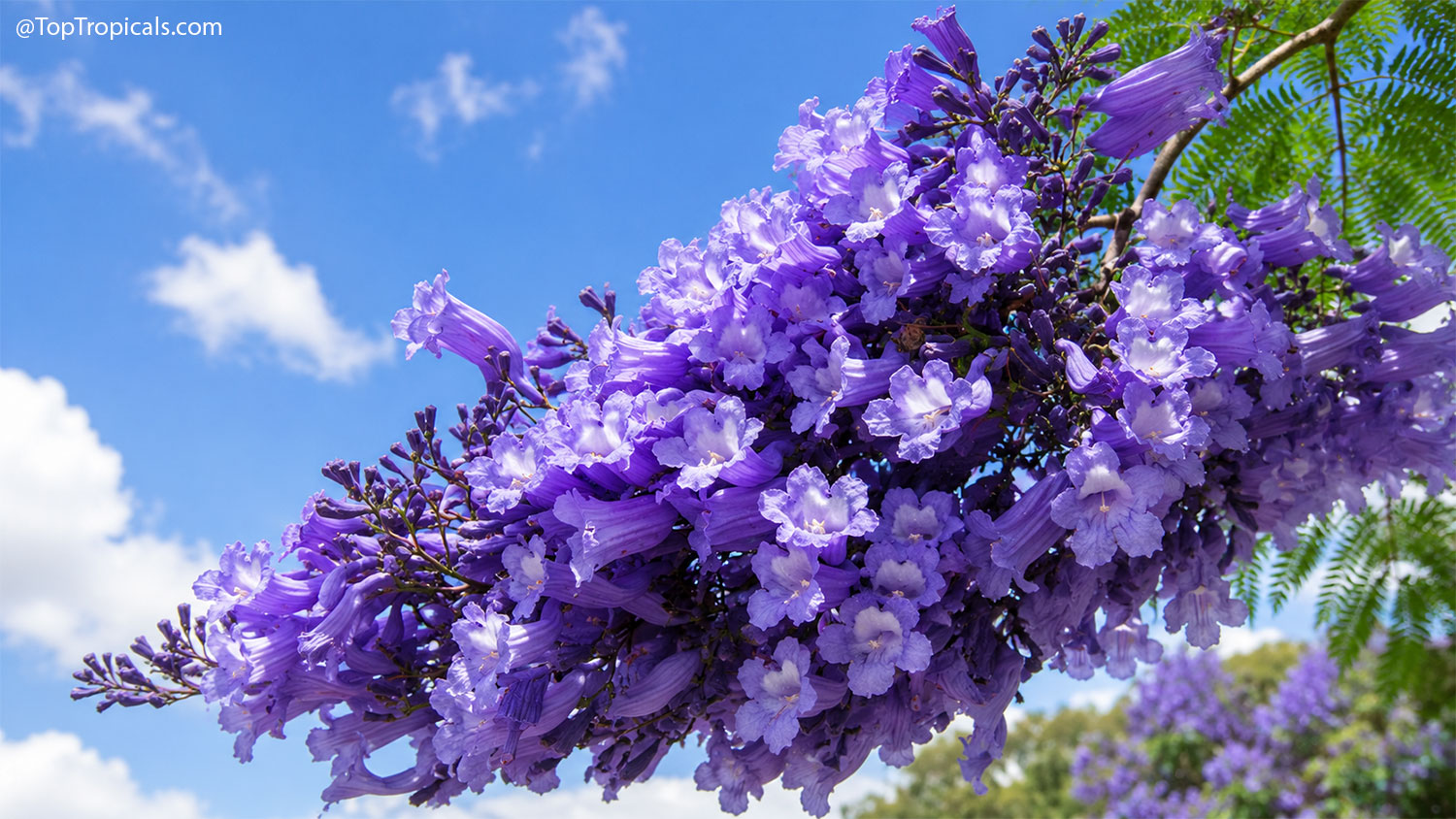
Large  cluster  of  lavender-purple  jacaranda  flowers  hanging  from  a 
 branch  against  a  bright  blue  sky  with  white  clouds.  The  trumpet-shaped 
 blooms  are  packed  tightly  together,  creating  a  spectacular  display  of  color,
    while  delicate  fern-like  foliage  frames  the 
 scene.

Jacaranda flowers bloom in dense clusters of lavender-purple trumpets, creating one of the most spectacular floral displays in the tree world. Against a clear blue sky, the blossoms seem to glow, giving the tree its famous "purple cloud" appearance.

Ask someone with a mature Jacaranda in their yard what it's like when it blooms, and they'll usually smile before they answer.

There's a particular pleasure in seasonal anticipation - in knowing that something beautiful is coming, in watching for the first flower clusters to appear, in the morning you walk outside and realize the tree has finally opened. Jacaranda delivers that pleasure reliably, year after year.

Mature trees become landmarks. "Turn left at the purple tree" is a surprisingly common way to find a house during Jacaranda season. They become the reason people slow down while driving past your house. They become the tree your kids remember.

Few landscape trees combine beauty, shade, elegance, and seasonal drama quite the way a Jacaranda does. Long after the flowers fade, the tree remains a graceful presence in the garden. And when bloom season returns, it reminds you exactly why you planted it.

Some trees provide shade. Others provide flowers. Jacaranda provides both.

That's a rare thing in a garden, and it's worth planting.

Sunshine: What happens when the flowers are gone?
Smokey: Then you enjoy the tree.
Sunshine: And when the flowers come back?
Smokey: Then you remember why you planted it.

👉Shop Jacaranda Trees

Close-up  of  pale  lavender  jacaranda  flowers  showing  the  distinctive 
 trumpet-shaped  blooms  with  soft,  velvety  petals  and  fuzzy  white  throats. 
 Sunlight  highlights  the  delicate  flower  texture  against  a  softly  blurred 
 background  of  green 
 foliage.

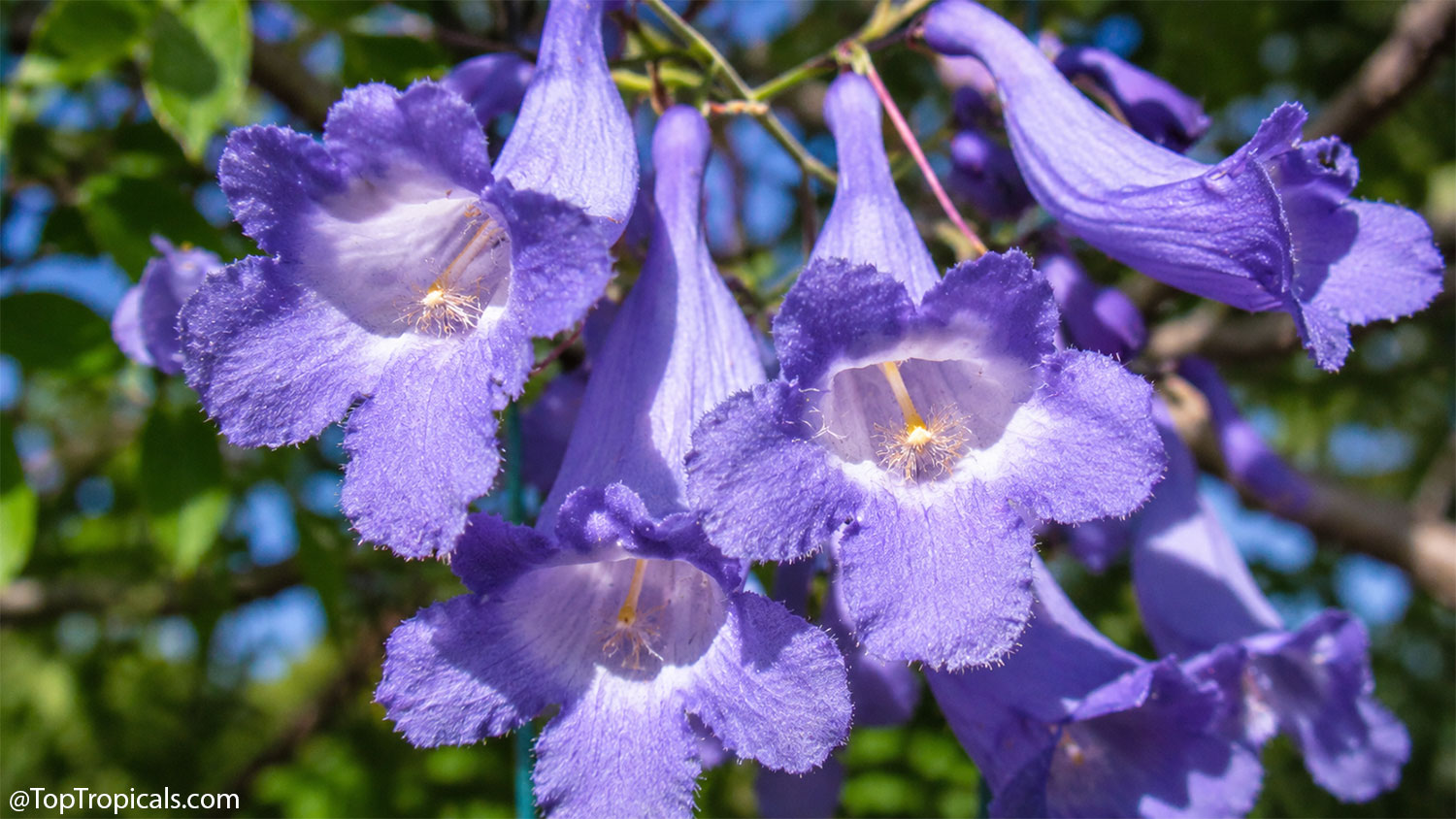
A close-up look at the intricate flowers of the Jacaranda tree (Jacaranda mimosifolia). Each velvety trumpet-shaped bloom combines soft lavender tones with delicate textures that make this tree one of the most recognizable flowering trees in the world.

Date: 28 Dec 2020

Healthy Plants: Q&A from Mr Booster

How to grow a happy Red Jade Vine?

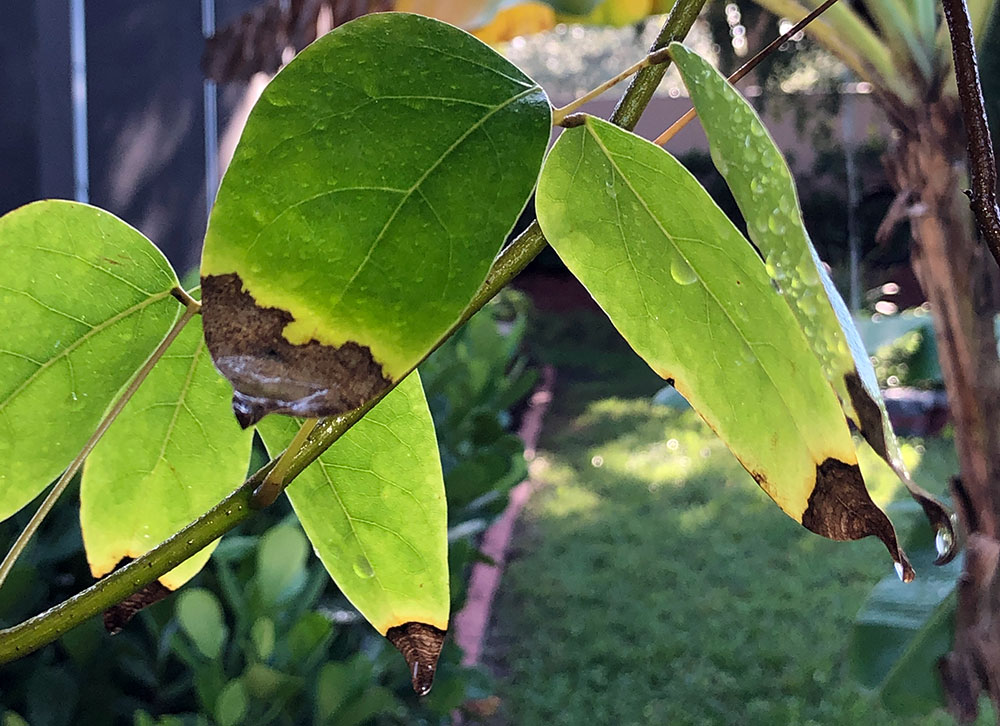
Q: My Red Jade Vine has the leaf tips turning brown. I water this plant four times a week and I am using a half a teaspoon of miracle grow bloom booster 15-30-15 per 2 gallons, every two weeks. In the beginning I had to water this plant off city water in South Fort Myers. Over the last two months I picked up a dechlorinator buggy plus threw that on my hose and I've been watering it with that but it didn't seem to make a difference. I put this plant in the ground last September. It has three shoots that run into the top of the tree, so it is growing but leaves seem to drop off down low at the base of the vine and the brown tipping running into the top of the plant. But not the newest shoot its leaves are solid green all the way at the top. Thanks for any advice.

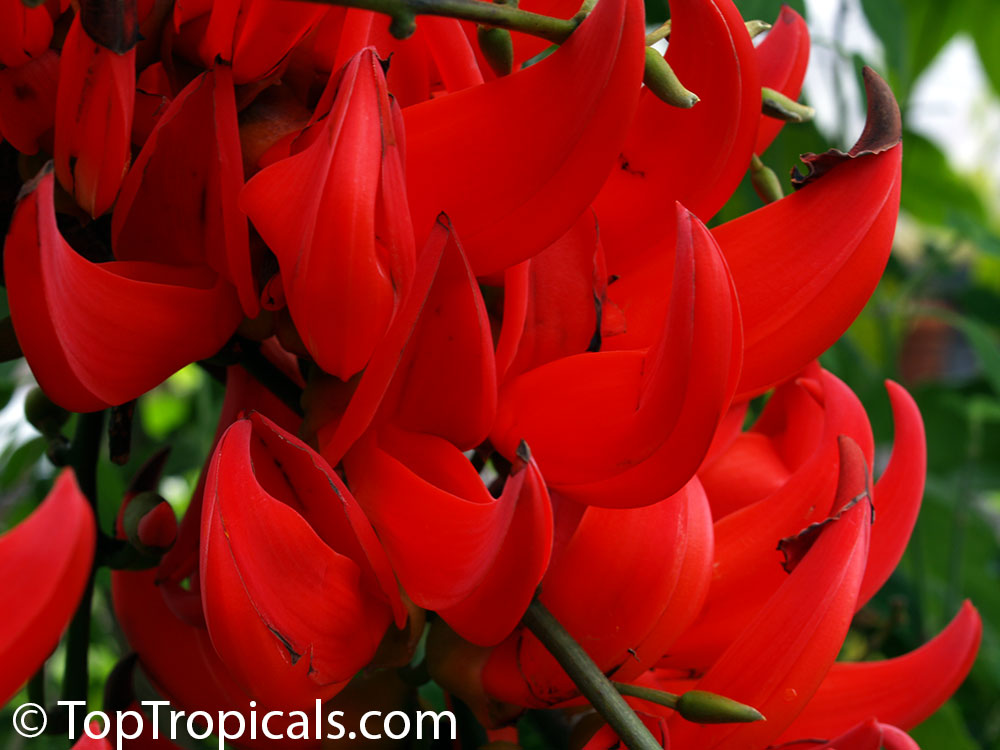
A: Mucuna benettii - Red Jade vine - is not the easiest plant to grow, and we are glad your vine is growing well. For those who love this plant but not ready to face all challenges, we recommend its cousin - Camptosema grandiflora - Dwarf Red Jade Vine, which is much hardier and easier plant.
We looked at the photos and these are our thoughts.

1) The top of the plant with green fresh leaves definitely indicates that the plant is generally healthy and vigorous.
2) Dry tips of the old leaves may indicate excess salts in soil, in combination with the summer heat that it went through. Based on your feeding program description, that fertilizer may create a problem. Water soluble traditional fertilizers are EDTA-chelated which often causes nutrients lock up in soil and leaf drop. Try to stay away from that fertilizer for a month and let the rains and/or irrigation water flush the soil for a couple of weeks.
3) Red Jade vine is a very sensitive species. Normally, during hot season it is safe to use traditional fertilizers, especially slow-release granulated. However, with this plant we recommend you to switch to more delicate formula and use only liquid fertilizer.
SUNSHINE Megaflor - Bloom Nutrition Booster will be the best. It is safe to use it as frequent as with every watering! It is amino-acid based, and will be totally consumed by the plant without nutrient lockup.
4) Another cause of dry leaf tips may be micro-element deficiency.
Megaflor booster already has all necessary micro-nutrients in it, plus you may apply some extra: SUNSHINE Superfood.
5) You may continue using regular water for watering (including city water) as long as you use amino-acid based plant food and supplements: they improve soil acidity (what tropical plants like is acidic soil, and Florida soils are alkaline). Additionally, to improve soil acidity which can be critical for this Mucuna species, you may add 1"layer of pure peat moss on top of the soil around the plant. Please keep us in loop how the plant is doing. It is pretty rare species in cultivation and we will be happy to help you to keep it thriving.

Date: 26 Mar 2026

🌸 How to Grow Adeniums Without Overthinking It

By Tatiana Anderson, Horticulture Expert at Top Tropicals with Smokey & Sunshine help

Adenium  desert  roses  blooming  in  greenhouse  during  winter  freeze,  rows 
 of  potted  plants  with  colorful 
 flowers

Adenium Plant Facts

Botanical name: Adenium sp.
Also known as: Adenium, Desert Rose, Impala Lily
USDA Zone: 9 - 10
Highligths Plant with caudexLarge shrub 5-10 ft tallSmall tree 10-20 ftFull sunWater Requirement: Low. Allow soil to dry out between wateringsWatering: Moderate. Water when top soil feels dryYellow, orange flowersRed, crimson, vinous flowersUnusual colorBlue, lavender, purple flowersWhite, off-white flowersPink flowersToxic or Poisonous
Get personalized tips for your region
Adeniums blooming inside the Top Tropicals greenhouse during the record freeze of February 2026 - protected from the cold, kept above 40F, and fed with liquid Sunshine Megaflor. They responded with a spectacular, synchronized winter bloom. Quite a surprize!

✅ Simple rules that actually make them bloom and grow well

  • Light - The more light, the better the growth and flowering. Full sun is ideal, but in very hot climates, filtered bright light keeps plants looking healthier.
  • Water - Water well, then let soil dry on the surface. Sitting in wet soil damages roots, but letting plants dry out too often can push them into early dormancy.
  • Pot and shaping - Use a shallow pot with excellent drainage. To develop a sculptural caudex, lift the plant slightly each time you repot and remove some of the top soil so upper roots become exposed. Over time, this creates a thicker, more prominent base.
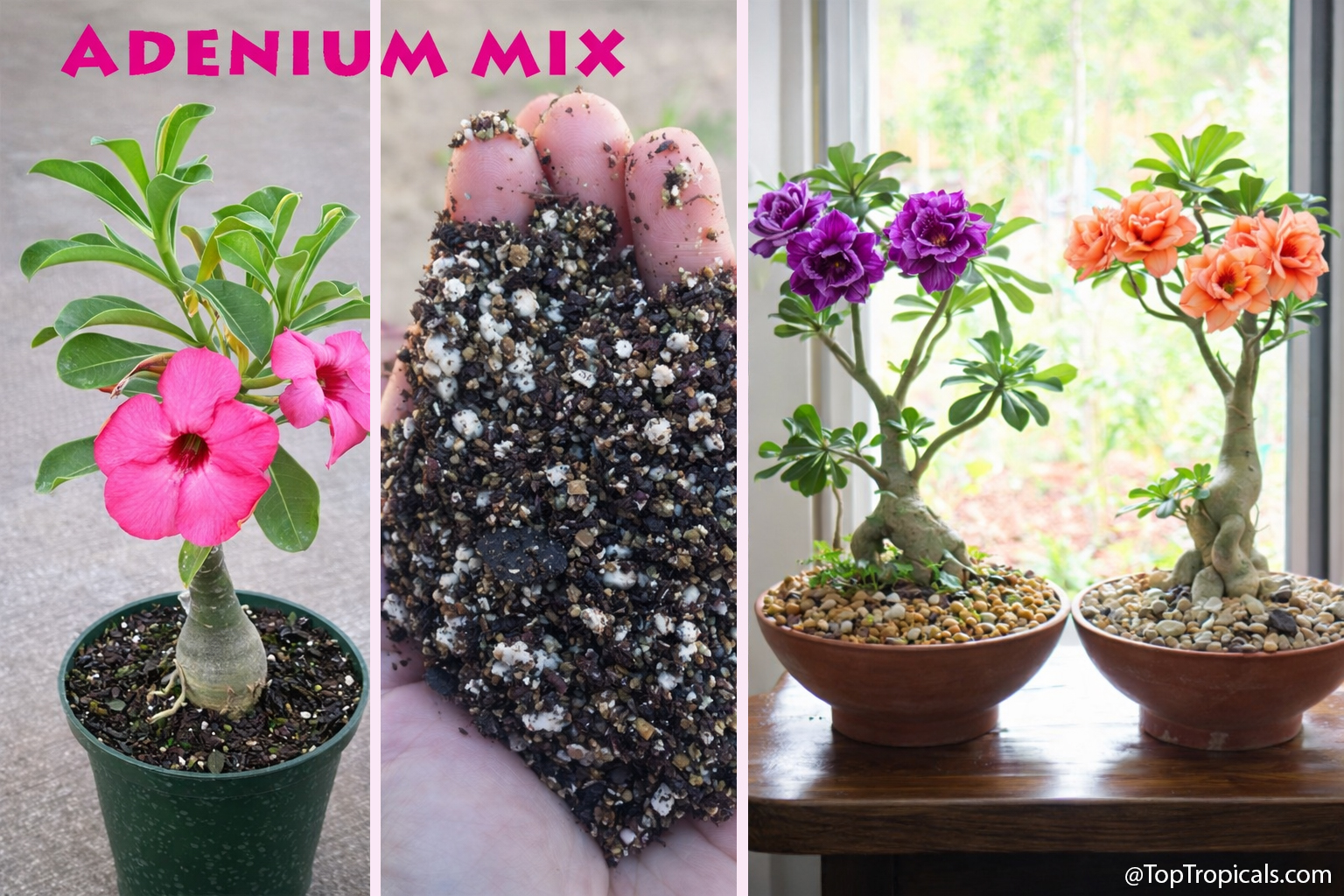
  • Soil - Use a fast-draining Adenium potting Mix.
  • Adenium desert rose plant, fast draining soil mix in hand, and bonsai 
style adeniums blooming indoors

    Healthy adeniums start with the right foundation - a fast-draining soil mix and careful watering only when dry to avoid caudex rot.

  • Cold hardiness - Adeniums are tropical and do not tolerate frost. Keep above 40 F. Brief drops to mid 30s may be tolerated if dry, but cold and wet conditions can damage or kill the plant. In cooler climates, bring indoors or protect during cold nights.
  • Indoor winter care - Move plants indoors before cold nights. Place in the brightest spot possible, ideally a south-facing window. Or use additional lighting. Water very lightly and less often, as growth slows. Do not fertilize during dormancy. Some leaf drop is normal in winter.
  • Freshly grafted Adenium desert rose plants in dormancy arranged in 
greenhouse rows with bare branches

    Freshly grafted adeniums in dormancy - a crucial resting phase. Keep watering low (once a month) and avoid overcare; this is the time to let them rest and etablish.

  • Feeding - Adeniums respond best to liquid fertilizer. We apply Sunshine Megaflor Booster with each watering throughout the year. During dormancy, watering is reduced, so fertilizer use decreases accordingly. Consistent, light feeding promotes strong roots, a thicker caudex, and improved flowering.
  • Pruning - For multiple blooms, regular pruning is essential. After flowering, cut back long or leggy growth to stimulate branching. Each new branch can produce more buds, leading to a much fuller bloom in the next cycle.

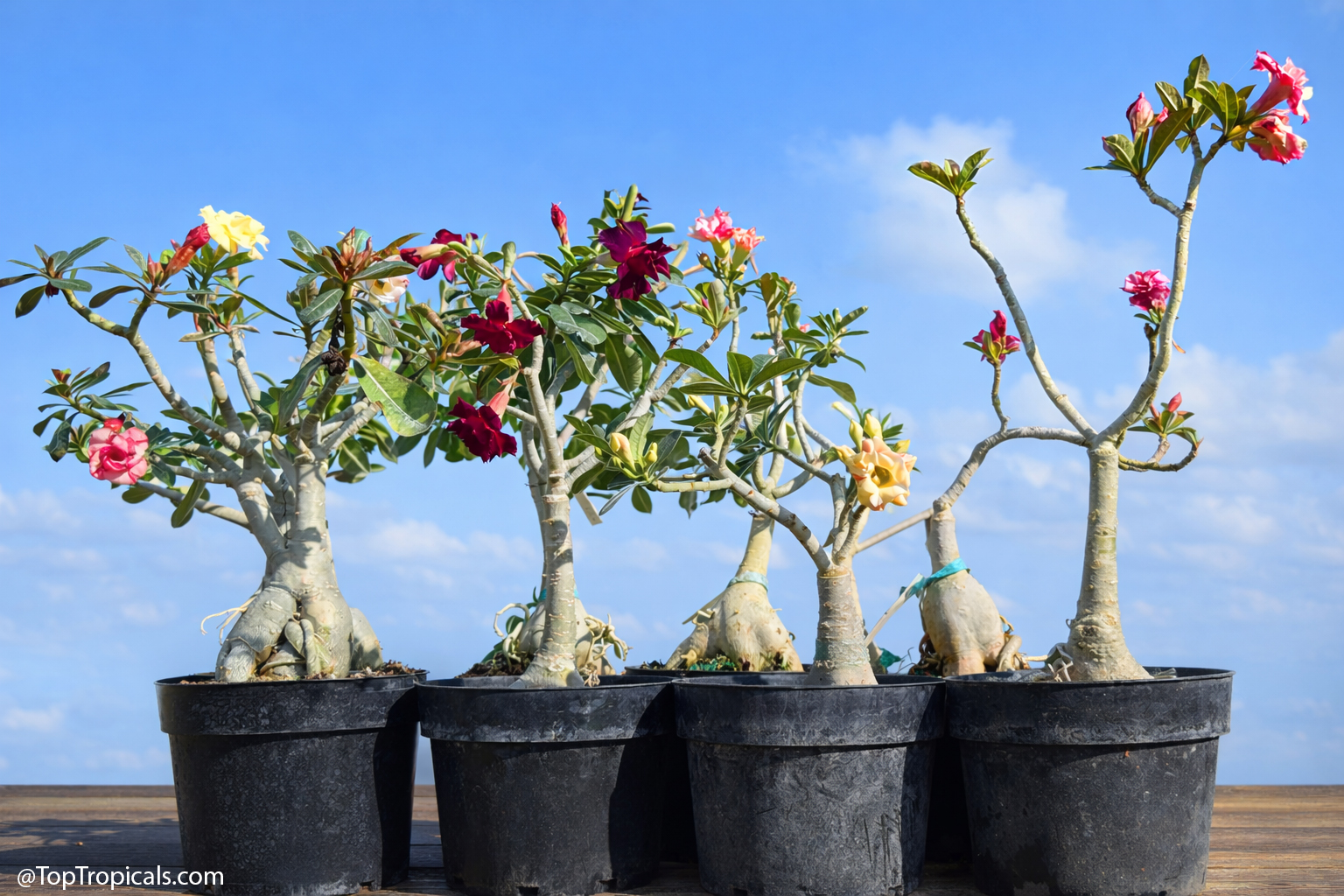
Pruned  and  unpruned  Adenium  desert  rose  plants  showing  difference  in 
 branching  and  flowering

Pruned vs. unpruned - the difference is clear. The four plants on the left were trimmed 6 months ago, while the two on the right were not. Same species, very different results.

✍️ Learn more about Adeniums from our Blog

🎥 Watch videos of Adenium Rainbow

Free Shipping on Adeniums
Add bold color and unique forms to your collection with no extra shipping cost.

🛒 Explore Exotic Adenium varieties

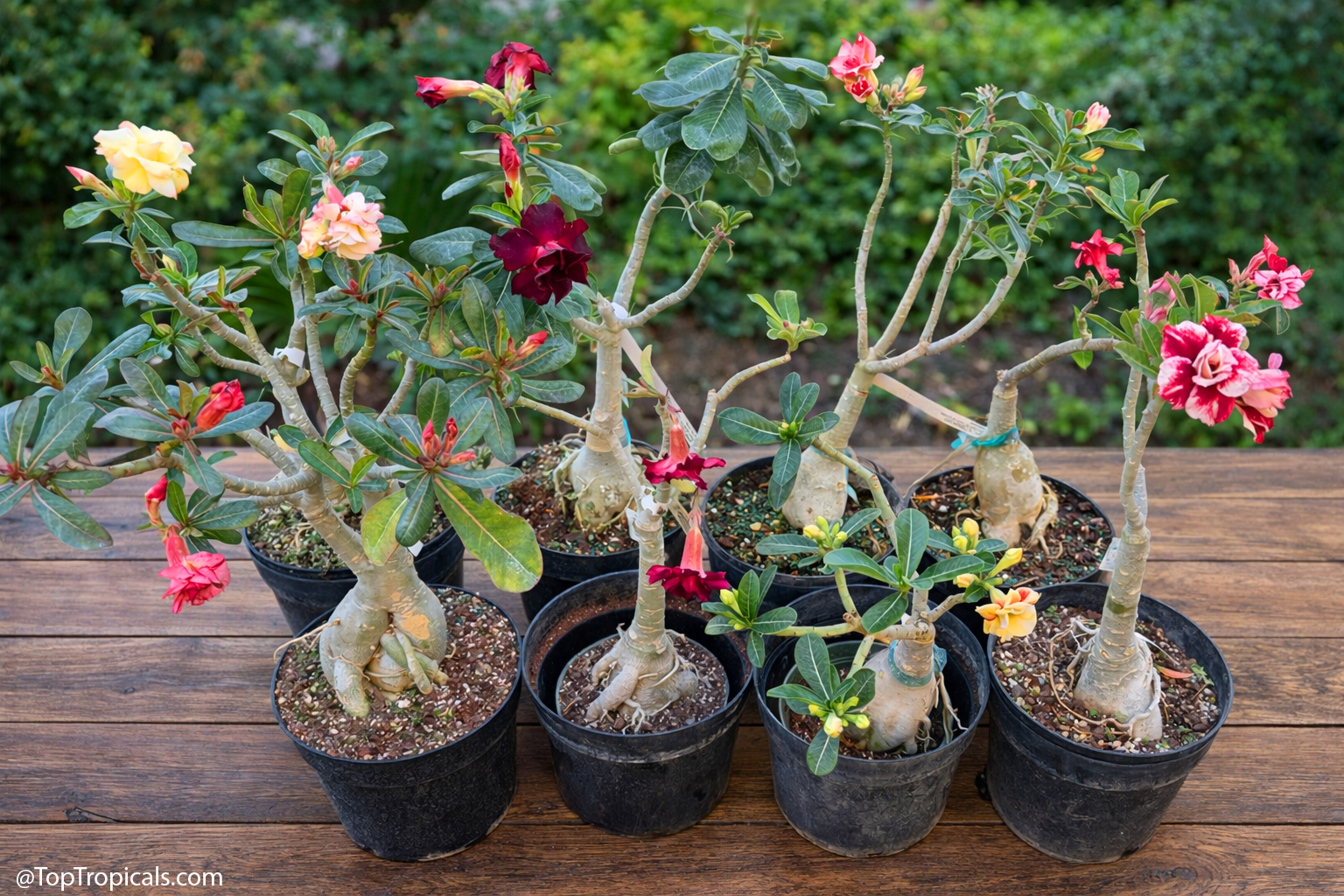
Leggy  Adenium  desert  rose  plants  with  sparse  branching  and  flowers, 
 ready  for 
 pruning

These Adeniums are screaming for pruning so they can bush out and produce more blooms

Date: 7 Aug 2020

Healthy Plant Food

Q&A from Mr Booster

Plant food for a Star Fruit

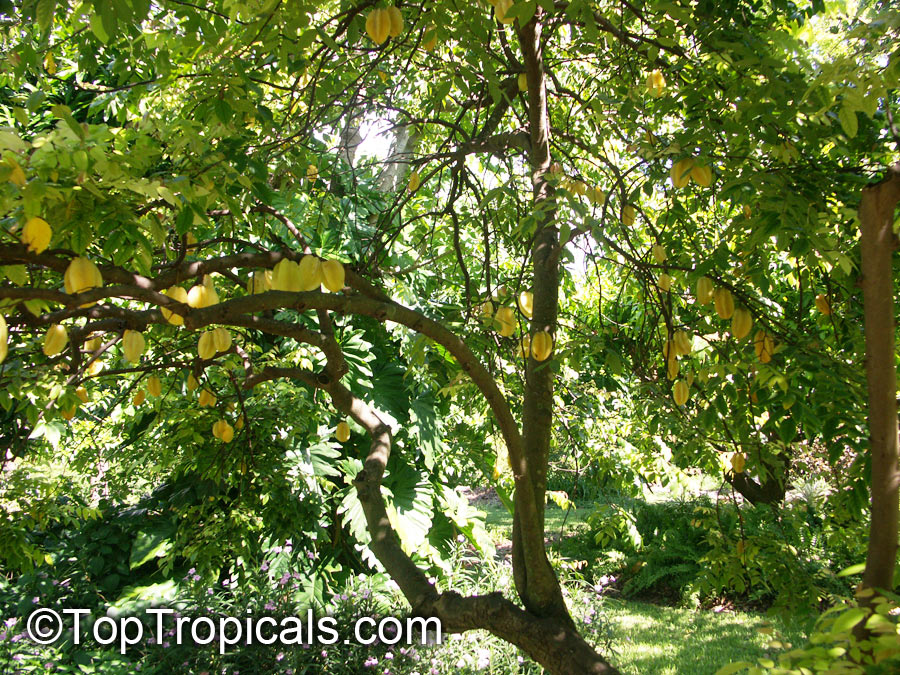
Q: I have 2 Starfruit plants from you. One on the left is B10 has a lot of flowers but no fruit is developing. On the rite is Kenjeng. This one has no flowers at all. Both plants are growing very well. Plenty of sun and water. I am located in Boynton Beach Florida. So what to do?

A: Your trees on the pictures look very healthy, congratulations with a great care!
Starfruit, as well as other grafted fruit trees (like mango, avocado, etc) usually flower/fruit easily and readily while in pots in the nursery. Sometimes, once planted in the ground, they may reduce flowering or even stop flowering. What happened?
The answer is simple. In pots, we fertilize them on regular basis. In our nursery, we have fertilizer injector inline with irrigation system that dozes plant food with EVERY watering. In other nurseries, they may also use slow-release fertilizers, but it is still a regular routine to provide plant food to potted plants.
In the ground, especially in Florida poor soils, fruit trees may stop flowering or delay fruiting due to lack of nutrients, or dis-balance of elements in the ground. Without fertilizer, a tree may take extra time to develop bigger root system to reach out for necessary elements, and eventually will start fruiting anyway.
But we want it to fruit soon! The only way to fix the problem is to provide fertilizer on regular basis for a young tree. It is especially important during hot summer months when plant metabolism is fast due to high temperatures, plus nutrients may get washed away with frequent summer rains (like we have in Florida) even if you've added some fertilizer at time of planting.

You can use smart release fertilizer once a month during hot season, this one or similar:
Mango-Food - Smart Release Fruit Tree Booster.

But the most effective way to get a tropical tree to flowering and fruiting, is frequent applications of liquid fertilizer. We use Sunshine Boosters with every watering on our plants. They work great even on hard cases and weak plants, and you see the difference in a matter of weeks, sometimes even days.
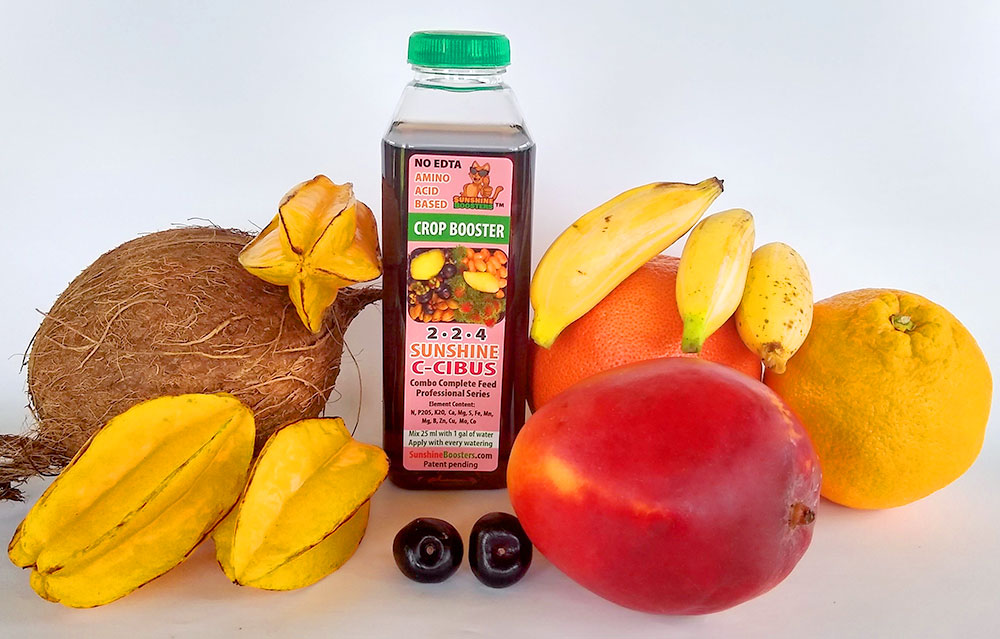
We recommend the following fertilizer that contains all necessary elements for young fruit trees: SUNSHINE C-Cibus - Crop Nutrition Booster

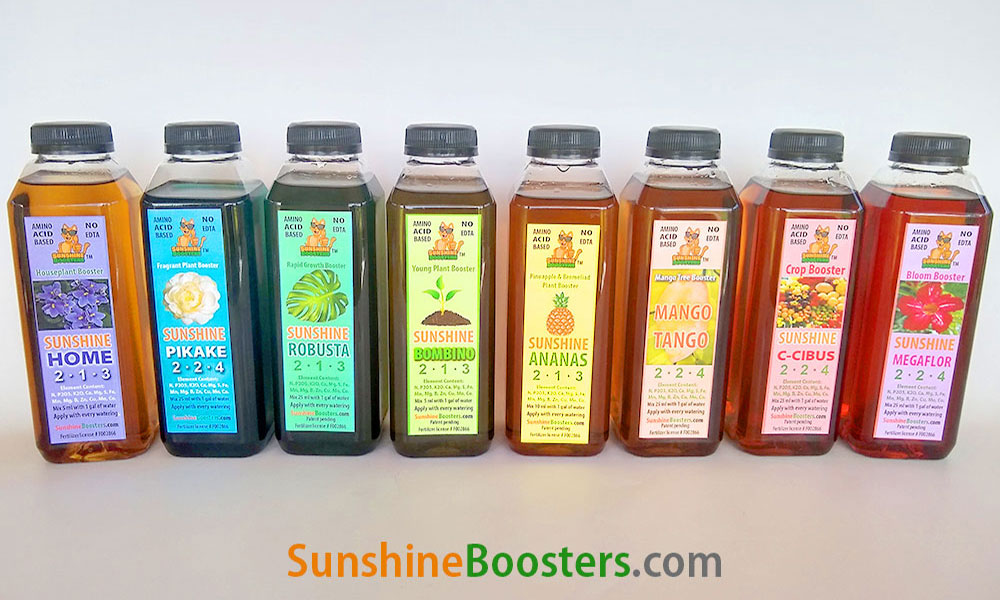
SUNSHINE C-Cibus - Crop Nutrition Booster from Garden Series, or Combo Total Feed Collection - all nutrients in just one bottle, for fruit trees and edibles.

Date: 2 May 2020

Which fertilizer is right?

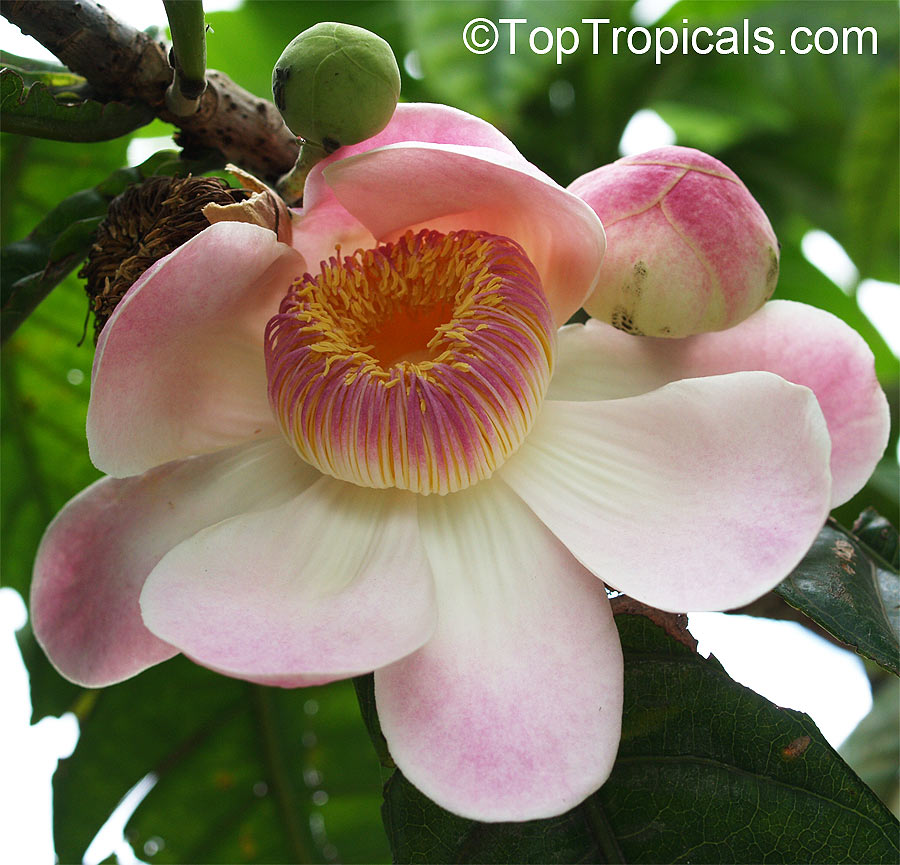
Q: I need some advice on which fertilizer(s) would be perfect for my C​annonball tree and its cousin Heaven's Lotus (Gustavia augusta). ​I also have fruit trees... soursops, mango, etc. and a collection of flowers including pua keni keni, plumeria, bougainvillea, etc. I am wondering if you can recommend a custom fertilizing regimen for my garden (especially the cannonball and the gustavia since they are young).

A: It is a perfect time now to fertilize your plants as they start active growth. We have suggestions on fertilizing programs for your trees. You will find here our recommendations for:

1. Young trees
2. Flowering trees
3. Fragrant plants
4. In-ground grown fruit trees... CONTINUE READING >>