Garden Blog - Top Tropicals

Date: 23 Nov 2016

Growing tropical fruit trees in containers in winter

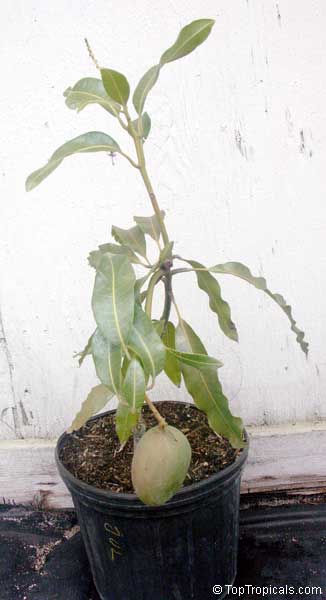
Q: Please give me your advice. The winter is here. I bought mango tree, jackfruit tree, sugar apple tree and planned them for spring. What can I do to keep them no frost bite? My home in Bonifay FL.

A: In subtropical areas with occasional hard freeze in winter, we recommend you to keep tropical plants in pots. The plants you purchase are tender to frost. For cold protection, container growing has several advantages:
1) easy to move into wind-protected and sun-exposed locations as needed: for example, on a different side of the house. In many areas, seasonal prevailing winds have opposite directions in Summer and Winter.
2) easy to cover with frost cloth, sheets, or blankets in case of immediate cold spells. Container plants' growth is easier to control and trim, and those plants naturally stay more compact.
3) easy to move indoors, inside garage, or in covered lanai/patio.
We also recommend to keep these trees in their original pots until Spring, in containers size of the rootball. Step them up in Spring, when plants start active growth of root system. This will help you to avoid root rot due to possible overwatering in Winter. Reduce watering in any case, and keep your plants in bright, wind-protected spot. Do not fertilize until Spring. Protect from cold when night temperature drops below 35-40F.

Use SUNSHINE plant boosters to provide additional cold tolerance.

Cold protection is a lengthy subject. You may also use propane heaters during cold nights. Here is some more information on cold protection.

Black Friday starts Wednesday! Use this discount code in your shopping cart from Wednesday through end of Friday. Enter THANKS2016 in your shopping cart for 20% off on all plants and seeds from our store - no minimum order! Offer is not valid for previous purchases
Date: 2 Apr 2022

Grow Your Own Food:
Costa Rican Guava - Guava for Drinking!

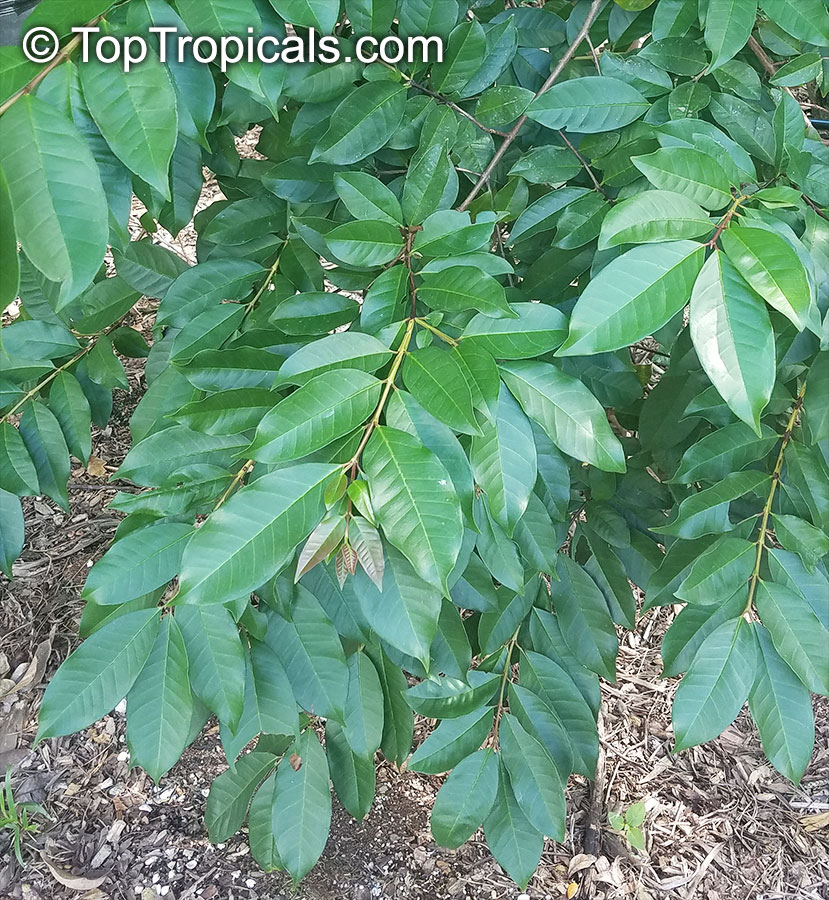
Cas  Guava  -  Psidium  friedrichsthalianum,  Fruit

by Alex Butova, the Witch of Herbs and Cats

...Looking for a handsome, unusual fruit tree for container culture with healthy and flavorful fruit? Or simply want an easy fruit tree that is hardy and undemanding? Psidium friedrichsthalianum (family Myrtaceae), the Costa Rican Guava or Cas Guava, is a perfect small guava tree that can be very rewarding. In Nicaragua it is called "Guava for Drinking" or "Fresco de Guava". Despite the tartness, the flavor is excellent with passionfruit and pineapple tones and is much more pronounced than the subtle flavor of the common Guava. These fruits are very much a part of the culture and cuisine of Costa Rica. Also it has been successfully grown in California now and can be grown in many subtropical regions or as a container plant - "condo" fruit tree...

Cas  Guava  -  Psidium  friedrichsthalianum,  Tree

Date: 23 Oct 2019

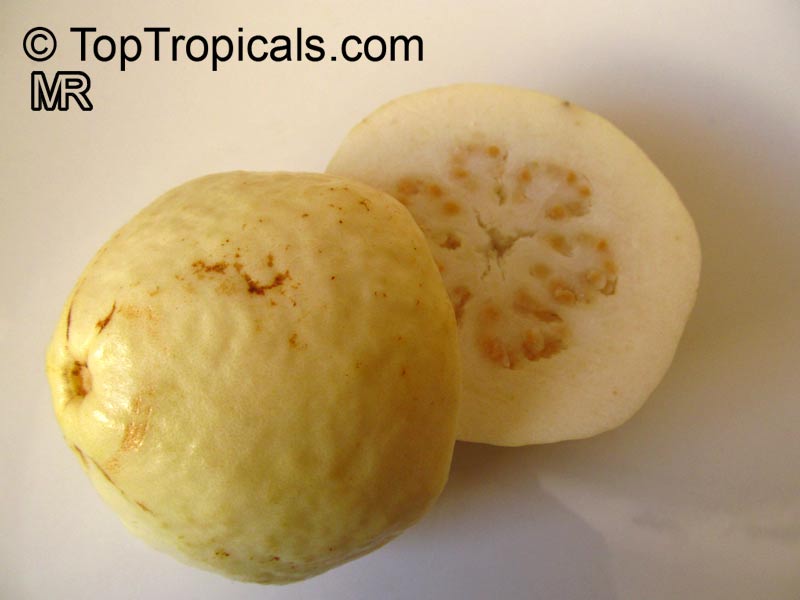
Best tasting white guava

Q: What's your best tasting white guava?

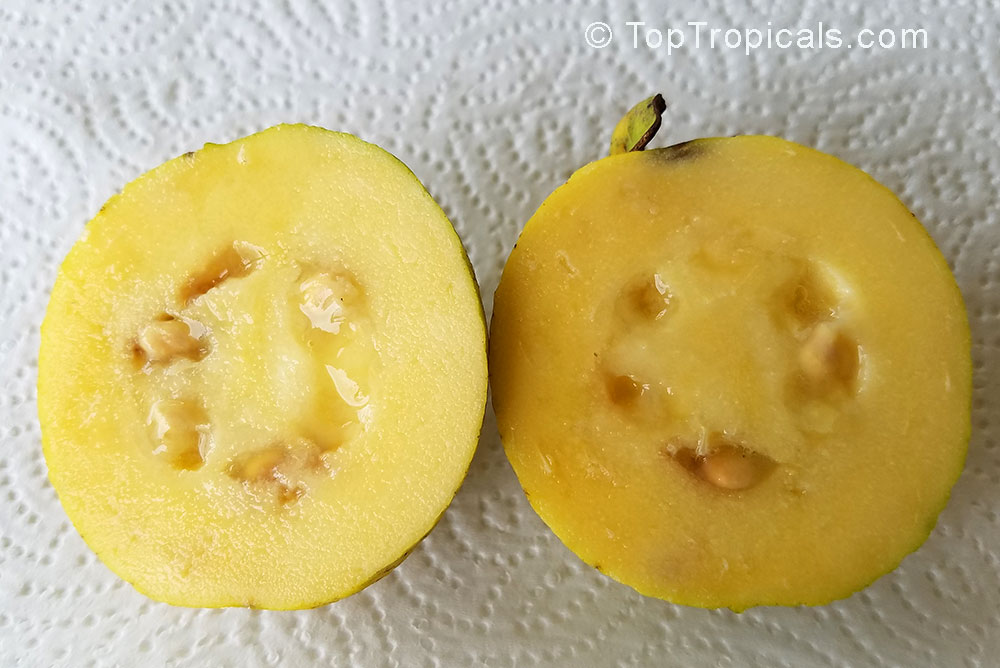
A: Our favorite white Guava is Viet Nam variety that is also very rare and hard to find. The fruit is very large, up to 6" in diameter, the pulp is very sweet and somewhat crunchy. The seeds are small which makes it more pleasurable to eat out of hand.
Another great feature of this variety, it stays compact and branches do not get leggy, unlike most guavas. It can be easily grown in a container, trimmed to the desired size and it will produce fruit under proper care.

Another cool variety is Indonesian, it also has a large round fruit and very few seeds to compare with others.

And last but not least, if you prefer soft fruit to crunchy, the Peruvian variety is a great choice. The fruit is pear-shaped.

Remember to provide plant food for good production, especially if grown in a container.

Fruit Festival Plant Food - Super Crop Booster
Mango-Food - Smart Release Fruit Tree Booster
SUNSHINE C-Cibus - Crop Nutrition Booster

Date: 28 Dec 2018

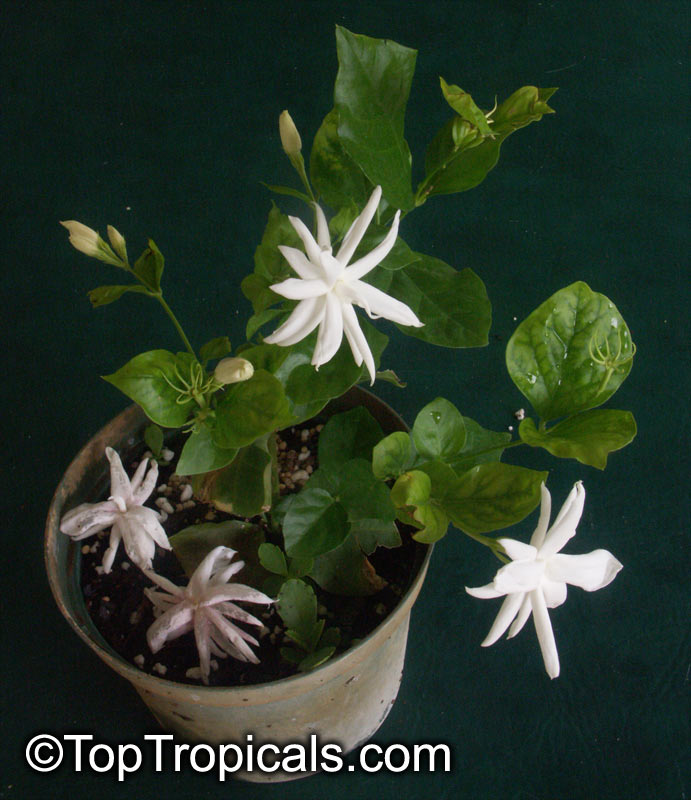
How to get a Jasmine to bloom.
Caring for jasmines as container plants during Winter

TopTropicals.com

Locate the jasmine plant where it will receive bright filtered light at least six hours every day.

Put a few pebbles in a shallow plate or tray and pour fresh water over the pebbles. Set the pot on the pebbles, but don't let the water level touch the bottom of the pot. This increases the humidity in the air around the jasmine. Keep the plant away from wood stoves, heat vents and radiators.

Water the jasmine when the top 1/2 inch of the soil feels dry. Don't let the soil get soggy, and never let the pot sit in water. Water the plant sparingly during the winter.

Feed jasmine twice a month between Spring and early Fall, using a granulated slow-release, or water-soluble houseplant fertilizer mixed at half strength. Don't fertilize during the winter months.

Prune the jasmine as needed to maintain the desired shape. Never prune in winter, as the plant will be preparing to bud.

Encourage the jasmine to bloom by putting it in a cool room at night for four to five weeks during Fall to Early Winter. The plant should get plenty of sunlight during the day, but during the night, move it to a pitch-dark room where the temperature is between 40 and 50 degrees F. After four to five weeks, leave the plant in its regular, daytime location. The plant should start blooming in mid-Winter to early Spring.

See all jasmine plants...

Date: 27 Jun 2018

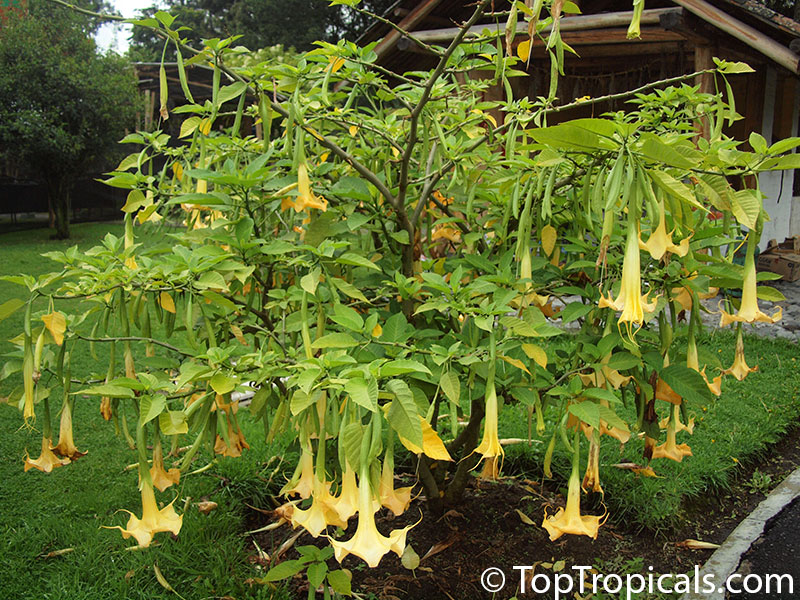
TROPICAL GARDENING: How to grow Brugmansia (Angel Trumpet) in the ground outside.

TopTropicals

Q: I recently moved from New Jersey to Florida and I brought with me my Brugmansia that I used to have as a house plant. Can I plant it in the ground now?

A: Angel Trumpet - Brugmansia - is a very popular container plant valued for its large, stunning fragrant flowers. Originated from South America, it will be happy to grow in tropical to subtropical climate outdoors. These are a few useful tips to get the most out of this beautiful plant:
1) Light. Plant it in full sun - the more sun, the more flowers you get, although Brugmansias tolerate shade. If the plant was previously grown in container indoors, to avoid leaf burn, keep it protected with a shade cloth or simply white sheet for a while and gradually open to adjust to full sun.
2) Soil and fertilizer. Use fertile soil with lots of organic matter (add compost to existing soil). It must be very well drained, Angel Trumpet won't tolerate waterlogged conditions. Plant it on a little "hill" elevated 3-4" above the surrounding area. Brugmansias are very heavy feeders. Once the plant is established, fertilize on regular basis with Slow Release Fertilizer - a handful once a month.
3) Water. Water daily until established. Once the root system is well developed, the plant is drought tolerant and won't require too much care. But at the beginning, watch the leaves - the lush foliage droops quickly if the plant is thirsty.
4) Plan space. Brugmansia is a short tree, but it needs a lot of room to spread branches with its heavy hanging flowers. Think 12" wide and maybe almost as much tall.
5) Support. Being widespread plant, Brugmansia can be blown with strong winds. Stake with strong support until established.
6) Propagation. Brugmansia is one of the few plants that propagates with semi-woody cuttings; soft green cuttings usually have little success. Other than that, it is pretty easy!

Check out our Brugmansia collection and... collect them all!