Garden Blog - Top Tropicals

Date: 10 Oct 2016

Cold protection - winter action for your plant collection
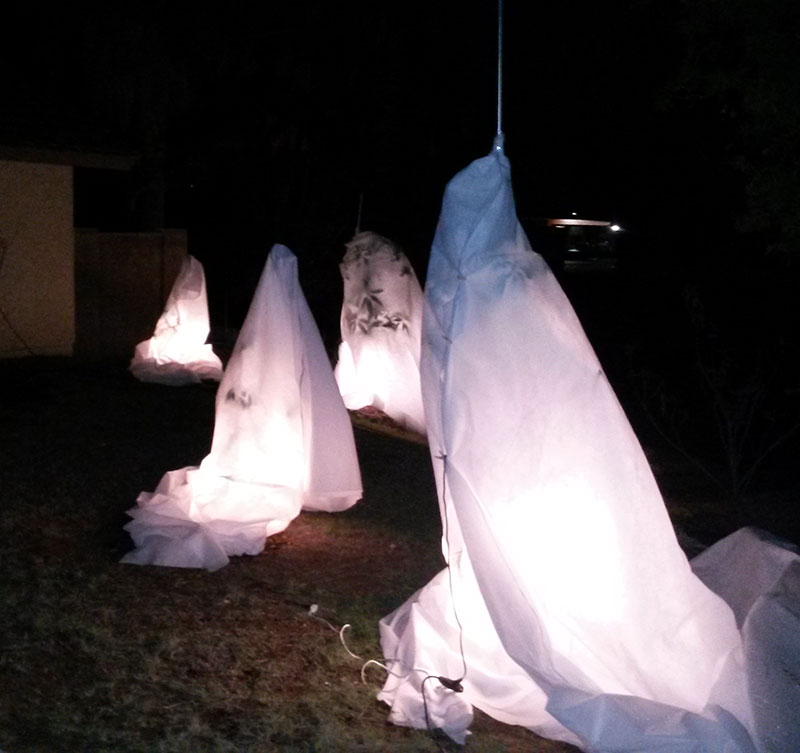
A note from our customer: Last winter was very cold here in Arizona, lower 30's. I used white synthetic sheets (called frost cloth, it is very light and yet effective) to cover my fruit trees, and kept simple light garlands on for the whole night. Sending you couple photos so you can share with others. It worked pretty well for my plants and no cold damage!

With winter approaching, it is time to take some actions to protect your rare plants from cold stress and damage.
If you live in a mild climate, you still need to get ready for the cold nights. When expecting a cold night, individual plants and trees can be wrapped with sheets, or blankets, to protect them from the wind chill. Christmas lights is a good idea for an additional warm up.

For large collections of tropical plants, temporary winter greenhouse doesn't have to be expensive. An easy-assembly mobile carport from a hardware store covered with a plastic or fabric will cost you $100-200. It can fit a hundred plants or more!

If you live in area with a hard freeze, Southern exposure windowsill will work for most of the compact tropicals providing proper care. Larger collections may also move into your garage for a few cold nights, or for longer periods if the garage has a bright light source.

Factors affecting tropical plant winter survival:

1. Duration of cold period. Tropical plants can't stand long periods of cold. A few days of even upper 30's may kill a tropical plant. A few hours of frost may cause leaf drop but the plant will recover.
2. Minimum temperature - of course, the warmer the better. But see 1) - if cold is not for too long, it may be OK.
3. Wind-chill can be more dangerous than low temperatures.
4. Exposure. Southern slopes get warm during daytime and stay warm longer.
5. Protection with a house, fence, larger trees - where a "pocket" of warm air forms and stays - is beneficial.
6. Humidity. A lake or a river nearby (especially ocean) will mild the micro-climate.
7. Individual species hardiness. Don't try to grow Orchid Tree outdoors in New York.
8. Plant maturity and health. A well-established plant with developed root system has more chances to survive cold. If a plant had a good change to develop during warm season (bright light, enough water, fertilizer), it will be more cold hardy. Healthy plant can withstand lower temperature, so proper nutrition is important, including micro-element applications. Large specimens, even ultra-tropical, may survive cooler winter than they normally do in their natural habitat. The Nature provided plants with better hardiness level than it is normally used. To boost plant immune system and improve cold tolerance even more, use SUNSHINE plant boosters. SUNSHINE-T - thermo-protection booster, is specially formulated for winter protection of tropical plants. To improve cold hardiness, spray 1-2 days prior to cold with 5 ml/1 gal solution and continue applications with 2.5 ml/1 gal solution every 10-15 days throughout winter period.
9. Gradual temperature decrease is less dangerous than a sudden drop since it gives a plant a chance to adjust. One sudden freeze in December with prior warm fall may create more damage than a gradual temperature adjustment. If it starts to get cold early in the Fall, plants slow down their metabolism, and the new tender growth won't get hurt later in winter, since the plants are "expecting" the cold.
10. Do not fertilize plants during cool months. Not only because they don't need much food beyond growing season, but also because fertilizer (especially Nitrogen) encourages rapid tender growth that will be damaged by cold and this will stress the whole plant.

Stay warm!
Date: 19 Aug 2016

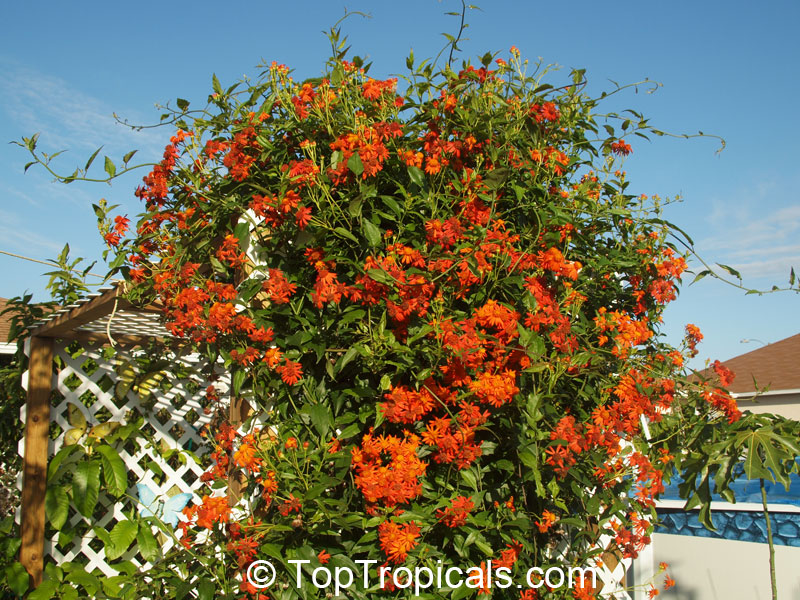
Growing Mexican Flame Vine as an annual

Q: While down in Fort Myers a few years ago, I saw this plant - Senecio confusus or Mexican Flame Vine, growing over chain-link fencing. At any rate, I fell in love with the plant then and there, only to later see it up here in Wisconsin, albeit down in Madison at The Centennial House, a noted botanical garden. This has led me to believe it may be possible to use this plant up here in the north as an annual. I could really use the orange coloration in mixed containers, etc. What I would like to try to find out is, will it grow and flower sufficiently within one of our growing seasons up here to make the choice worthwhile? Again, seeing it at Centennial House at least leads me to believe it may be possible. China where the flower was admired for its beauty and believed to have medicinal properties that promoted good health and long life. The Japanese Emperor was so smitten with the kiku flower that he adopted it as his personal crest, and it remains the insignia of the imperial family today. The art of growing and displaying Kiku for the Emperor's garden represented by amazing Imperial styles: Ozukuri, Ogiku, Kengai... Imagine growing out of one stem a single chrysanthemum trained to produce hundreds of simultaneous blossoms in a massive, dome-shaped array.

A: Mexican Flame vine is a good candidate to be grown as annual, thanks to these features:
- extremely fast growing
- it flowers in small size and young age
- long flowering period (2-3 months depending on conditions), throughout early Spring into Summer, sometimes it has a second blooming season by end of Summer.
- we keep large mature plants in stock year round, so you can have blooming size specimen as early as spring once your temperatures reach 65F so the plant will feel comfortable and develop quickly.
- easy to propagate - more plants can be made for next year season.

In winter, a potted plant can be cut back and kept in semi-dormant state indoors - garage, enclosed patio, with temperatures around 50F and above. Some gardeners from North prefer to plant a tropical specimen with a pot into the ground (make sure to add extra drainage holes), and when winter comes, it makes it easier to dig it out and save till warm season.

Date: 12 Aug 2016

Grow lights overview

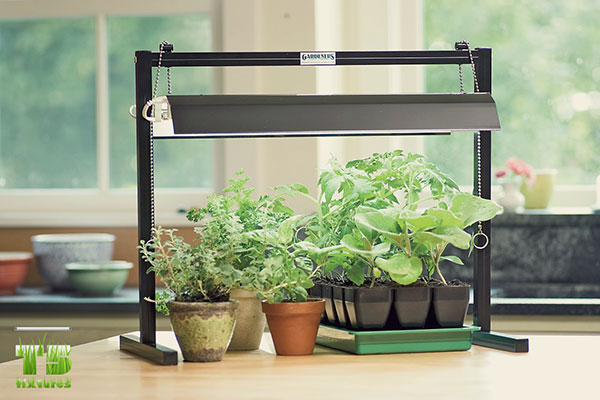
By Benjamin Thorton. If you are an avid gardener living in a place where there are distinct seasons, then you probably know the feeling of dread that sets in when summer ends, because that means that soon you will have to harvest what has grown and put gardening on hold until next spring. However, there is a way how you can continue gardening even when it is cold and snowy outside, and that is to use grow lights to create an indoors garden. So if you want to find out more about what are grow lights and how to use them, then keep on reading...

For more information on grow lights, visit T5fixtures.com, a website that provides all the latest information on indoors gardening and lighting, that you can use to facilitate plant growth. Have this information as a guide to growing healthy, big-yielding plants without having to leave your house.

This week only, 20% OFF on all plants well suitable for indoor culture. Most tropical plants can be grown in containers and many of them indoors, but this selection is the best for beginners, check them out!

Date: 18 Jun 2016

New Top Tropicals Video


Top Tropicals Video - Pesticide 101 Safe and Easy. Top Tropicals Plant Clinic with Robert Riefer (Certified Crop Adviser, ISA Certified Arborist). Many people are afraid of using harsh chemicals. We will discuss some pests you may find in your garden and what you can do about them, including using easy and safe household remedies.

Stay updated with TopTropicals Videos by subscribing to our channel at YouTube.com/TopTropicals and get our latest video news of what's fruiting and blooming!

Date: 8 Jun 2016

How to get Clerodendrum to bloom?

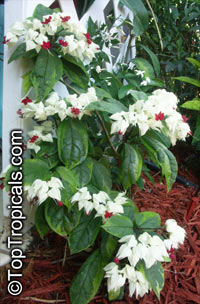
Q: My Clerodendrum thomsoniae is not blooming. Actually it is not doing much of anything except putting out weak growth and small leaves. I purchased this plant May 26. 2015. Over the winter it was in a heated sunroom, at night 60 degrees, where it received some direct sun from the skylights. I reduced the water to prevent excessive leggy growth. I don't see how this plant can take full sun or even part sun. Temps here in Raleigh NC are 80-85 degrees and 65-70 at night, at the moment. I figured I would gradually expose it to more direct sun after being in a sunroom but the leaves burn. I had this plant in San Jose many years ago where it did quite well, blooming with no special treatment. So thought I'd give it a try again. Any advice?

A: Clerodendrums are all time favorites, appreciated by both gardeners and house plant collectors, for their showy, fragrant flowers and very easy culture. When growing Bleeding Heart (Clerodendrum thomsoniae), a few things should be taken in consideration:

1) Temperature.Like most clerodendrums, this plant is semi-decidious outside of tropics and goes dormant in winter. It may lose some or all leaves if temperatures drop below 60-65F. It is not too cold sensitive, the plant can even take some light freeze. However when it is not hot and humid, it slows down metabolism. This means, water should be reduced during cooler months.

2) Light. This plant can grow in both sun and shade like most clerodendrums - this is the beauty of this genus. However like with all flowering plants, more sun promotes more bloom. In shade, it will grow beautiful dark green foliage (leaves will be bigger than in the sun) on the account of flowering; in full sun leaves turn lighter color and sometimes may even get unattractive "faded" look, but flowering will be profuse. Also remember that Arizona full sun is different than New York full sun. Here in Florida, Bleeding Heart can take some full sun, but if exposed to sun all day long, leaves often get sun burn.

3) Acclimation. Also called acclimatization - this is a process when a living organism adjusts to environment changes. Acclimation is always the case when growing plants indoors, even in a sun room. When Spring comes, and especially when we start taking outdoors those plants that have spent a few months indoors, light level increases dramatically, and this may cause leaf loss, and leaf burn. It is not necessarily a bad thing, it is just a mechanism of acclimation. Example: imagine yourself after living in a warm tropical climate, moving to a cold country. For a while your body will feel discomfort from "too much cold", while native residents may feel comfortable. We call it "My blood has thinned after living in Florida" - and this is a physiological fact. And vice versa, if you are a Northerner, moving to hot climate may be a challenge; it will take a while until you get used to hot and humid tropical summers. Same thing with plants: during cooler and darker period, their body (leaves and stems) becomes "winter type", with some serious chemical restructuring. Immediate environment change, like bright light and high temperature, causes a shock to those "winter cells", and as a defense mechanism, the plant gets rid of those useless "winter" leaves, replacing them with new "summer" leaves with completely new chemistry and metabolism.

From what you described, you know your plants, and you know what you are doing. You did everything right by reducing watering in winter and gradually moving the plant into brighter light. You still may see some stress, and this is normal. If you patiently keep changing environment slowly, eventually your plant will generate new healthy "summer" growth, it will also improve more vigorous root grown which will help the plant to establish better and to be stronger. You will see larger, thicker leaves, and definitely some flowers.