Q: Recently I started working remotely and I kinda like it, no
need to commute, it saves me so much time so I can have life now! My friend got
me involved into growing some small houseplants but I really want to take
advantage of our Florida climate and sun. I want to plant some cool fruit trees
since I have a decent size yard. But I live in Florida Panhandle and we do
have some occasional freeze in winter, although not for too long. But it gets
very hot in summer! Are there any tropical fruit trees that will be happy
here? Or should I keep everything in pots? I am excited to have my own tropical
plant collection!
A: There is a perfect plant for everyone, and a perfect tree for
every climate. Many tropical and especially subtropical plants can be much
hardier than they are believed to be, both flowering and fruiting trees among
them. You may keep the most sensitive species in pots and bring them inside
for winter, while there are so many trees that will be happy in your area.
Start with these that are perfect for climates with hot summers and cool winters:
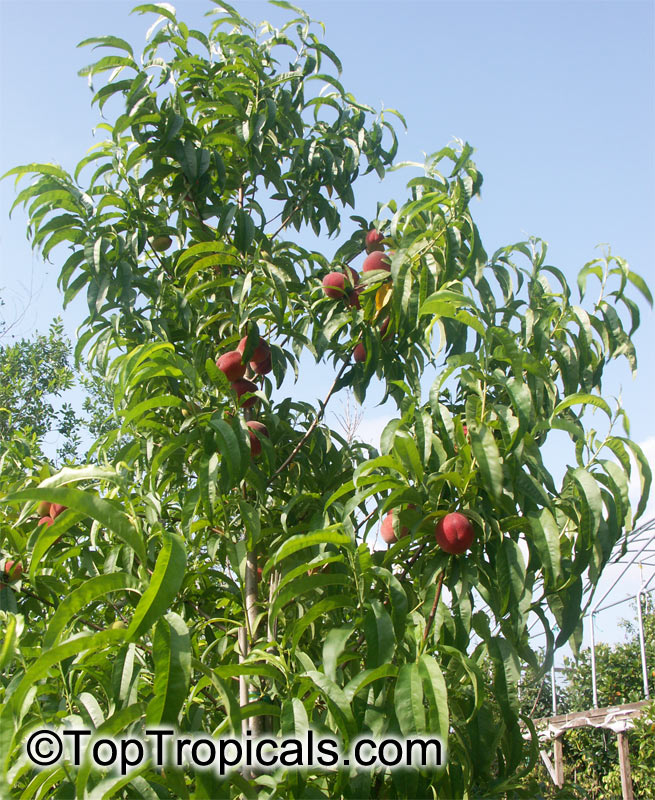
1. Peaches and Plums
Low-chill, Heat-tolerant Peaches, Nectarines, Plums are especially
selected for Florida hot summers. They produce well and do not require many
"chill" hours like temperate fruit trees. They only need 150 chill hours and grow
well in even in Arizona, so you know they are taking the heat.
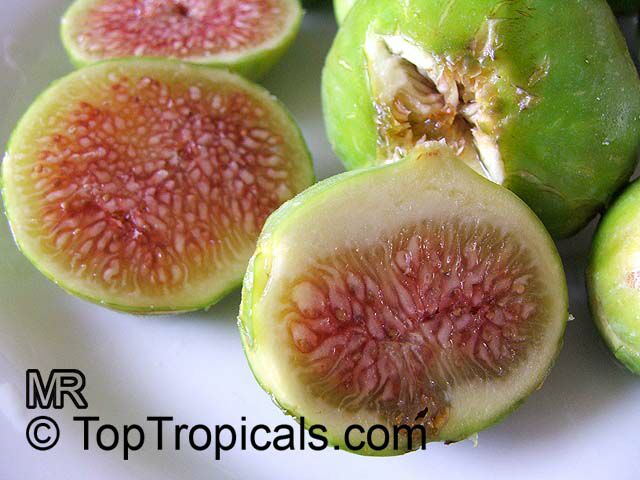
2. Figs
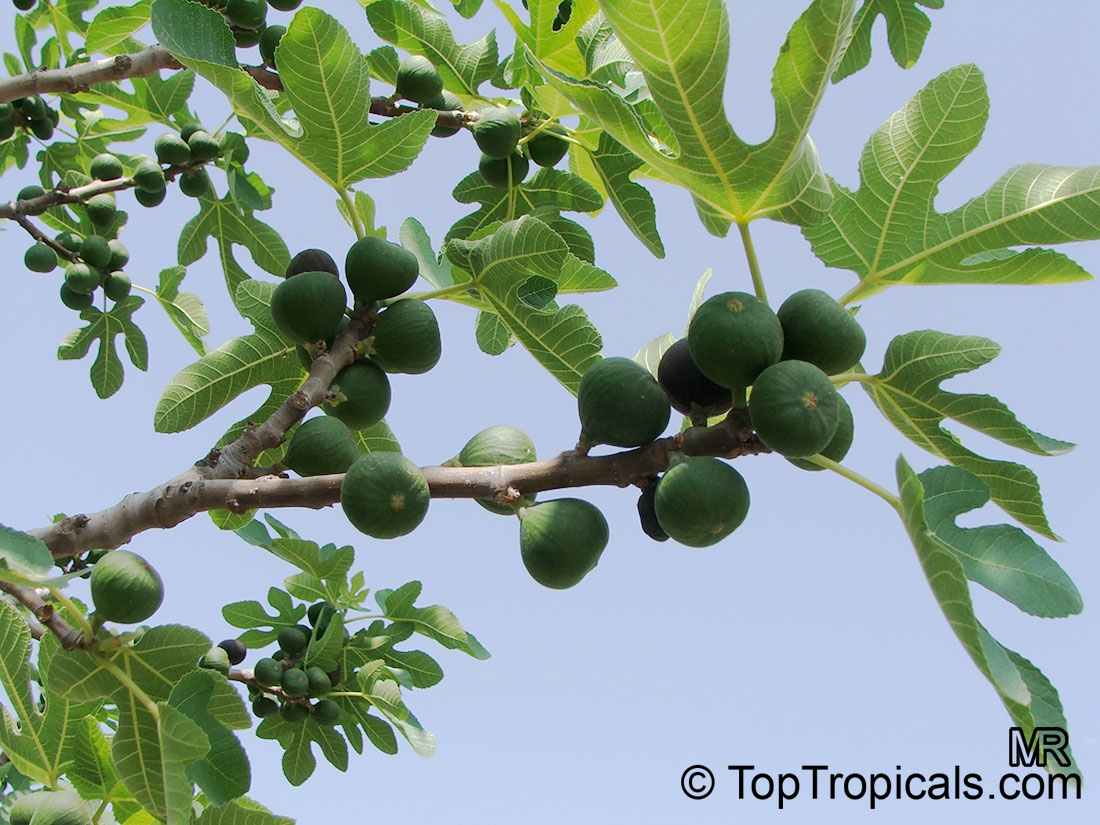
2) Fig trees - they are easy to grow, heat- and drought- resistant trees.
They are prized for their delicious fruit, which can be one to three inches
in length, violet, brown or black. There are even varieties with yellow fruit.
Most fruits are borne from early summer to late fall on new growth, and the
fruits generally mature very quickly. These trees are sensitive to frost only
when actively growing, but can withstand 10F when dormant.
Read more about Fig trees.
Date: 11 Sep 2025
September 11th remains one of the darkest days in our
nation’s memory, a tragedy that touched every life in some way. More
than
two decades later, we may come from different places, hold different views,
and
see the world through different lenses — but on this day, we stand
together in remembrance.
Like a young tree reaching toward the sky, we find strength
in renewal. Nature reminds us that healing takes root quietly and grows over
time. A branch in bloom, a sunrise after storm clouds, the steady rhythm of
the seasons — all speak of life’s resilience. As we honor the
lives lost, may we also honor the life that continues around us.
And we will keep remembering, together.
For us, trees and gardens are daily reminders of resilience. That’s
why we grow them, and share them with others who find hope in nature.
Explore our plants.
Date: 22 Oct 2025
Detailed Cassia and Bauhinia Care Guide
Outdoor Cassia and Bauhinia Care
Light: Both Cassia and Bauhinia need at least 6 hours of direct
sunlight daily. Cassias handle intense heat; Bauhinias can take light
afternoon shade.
Soil: Use loose, fast-draining soil. Mix equal parts garden
soil, coarse sand, and compost.
Watering: Keep evenly moist but never soggy. Cassias tolerate
dry spells once established; Bauhinias prefer steady moisture. Water when
the
top inch feels dry.
Feeding:
For profuse flowering, feed with liquid Sunshine
Boosters Megaflor that is safe to use with every watering,
year around. You may also apply Green
Magic controlled release fertilizer every 6 months. Bauhinias and
Cassias respond quickly to feeding.
Pruning:
After flowering, prune lightly to shape and remove dead tips. Cassias can
be trimmed to shrub form; Bauhinias stay bushy with pinching.
Mulch:
Add a 2-inch mulch layer around the base to conserve moisture and prevent
weeds, but keep mulch off the trunk.
Cold protection:
Most Cassias handle brief frost; some Bauhinias like B. acuminata
and B. monandra must be sheltered below freezing. For cold nights,
cover
with frost cloth or move containers into shelter.
Dormancy: Outside of tropics, most Bauhinias drop leaves in
winter for a short period of time, right before flowering and are called
"semi-deciduous". Cassias stay evergreen.
Indoor or Porch Care (cool-climate growers)
Container: Choose a sturdy pot with several drainage holes, one
size larger than the root ball. Unglazed clay or thick plastic pots work
best
for heat regulation. Use a light, well-drained mix such as professional
soilless mix
Abundance. Both Cassias and Bauhinias dislike soggy roots. Add a thin
layer
of coarse gravel at the bottom to improve drainage. Repot every 1–2
years in spring
Light:
Brightest spot possible - south-facing window or heated sunroom. Supplement
with a grow light if sunlight is weak.
Temperature:
Keep potted trees in warm environment for best results. The optimum
temperature for Cassias and Bauhinias is between 60–85 F, although
many
species can tolerate cooler temperatures. Avoid cold drafts and sudden
drops.
Humidity:
Average indoor humidity is fine; occasional misting keeps foliage
glossy.
Watering:
Water sparingly in winter when growth slows; allow the top inch to dry
between waterings. Do not let roots sit in water.
Fertilizing:
Feed with Sunshine
Boosters Megaflor that is safe to use with every watering,
year around, to maintain flowering indoors. You may also apply Green
Magic controlled release fertilizer every 6 months.
Pest watch:
Check undersides of leaves for aphids or whitefly. A light spray of neem
oil or insecticidal soap clears them fast.
"Whether you crave golden summer fireworks or soft orchid blooms that last
nearly all year, both Cassia and Bauhinia bring pure joy to the garden.
💖 Bring color that never quits."
Did you know: Fall is the best planting season —
roots grow faster and you’ll have flowers by spring!
When northern gardens fade into gray, our tropicals wake up. Winter is
color season here - and even if you live up north, you can still enjoy these
same flowering trees indoors or on a sunny patio.
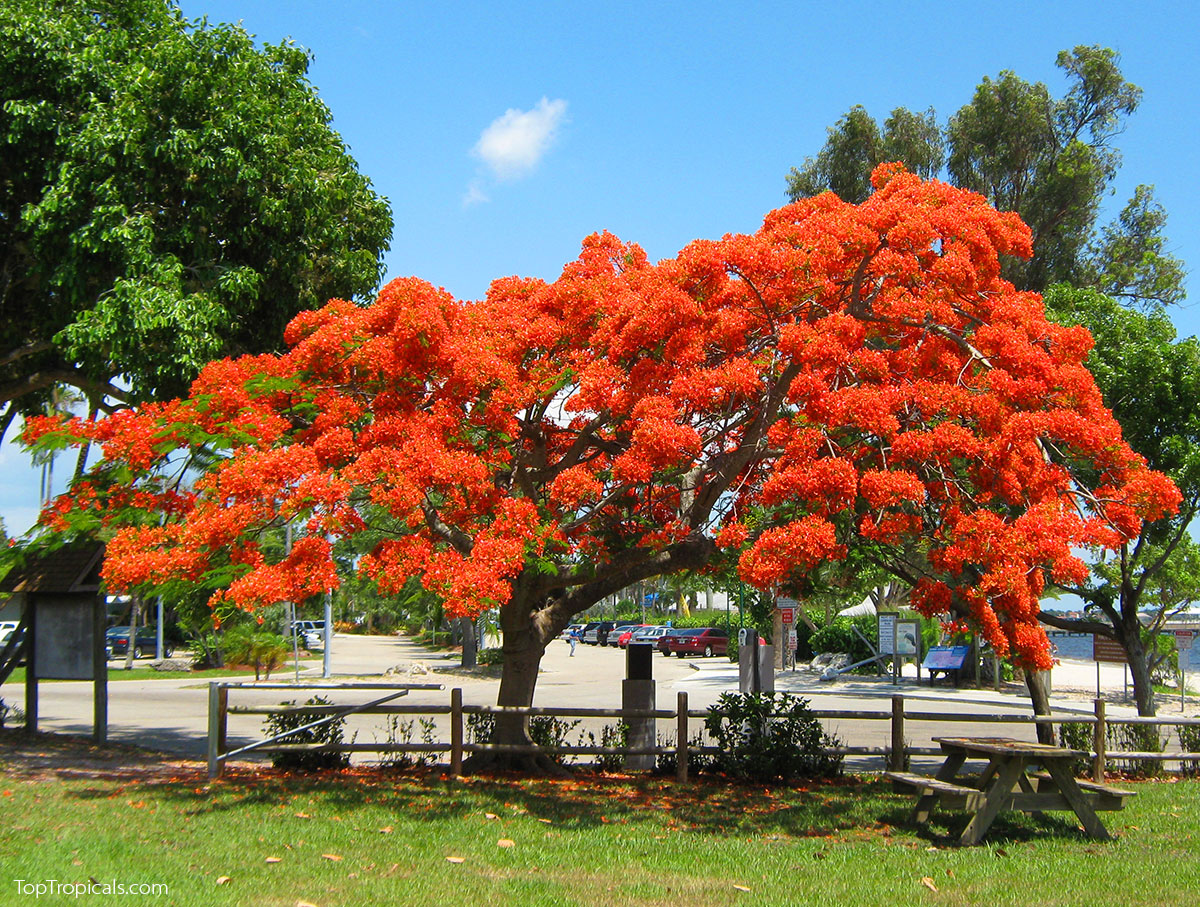
From the fiery Royal
Poinciana to the golden Tabebuia and
violet Jacaranda,
these eight trees prove that winter can bloom anywhere
How to Care for Winter-Flowering Trees
We're often asked, at Top Tropicals, “Can I really grow tropical
trees in winter?”
Yes — with the right light and care, you can.
Here’s what works best both outdoors and indoors, according to our
expert, Tatiana Anderson.
🌡️ Fall Planting Guide
Let’s talk about timing, because that’s the part most people
get nervous about.
Everyone asks: “Isn’t it too cool to plant now?” —
and the answer is no!
Fall and early winter are actually the best months for tropicals in Zones 9
to 11.
Here’s why: the air has cooled off, but the soil is still warm.
Roots love that combination. They quietly spread underground while the rest
of
the plant takes a break.
By spring, those roots are ready to feed a burst of new growth — and
that’s when you’ll see the first big flush of flowers.
Pick a sunny spot that gets plenty of light — six to eight hours
if you can.
Loosen the soil and mix in compost or pine bark so it drains well.
Dig a hole about twice as wide as the pot and just as deep.
Set the plant level with the ground, backfill, and water it deeply to
settle everything in.
Then add mulch — two or three inches is plenty — but keep it
away from the trunk so it can breathe.
Tatiana’s tip: “Fall planting builds roots while everyone
else is resting. By spring, your tree wakes up ready to grow.”
🌳 Outdoor Care (Warm Climates Zones 9–11)
Now, let’s talk about what happens after planting — because
real gardening starts once the plant is yours. Tropical trees thrive on
routine: steady sunlight, deep watering, and just a bit of attention.
Water them about once a week when the weather is mild, more often if
it’s dry or windy.
Always check the soil first — if it feels dry two inches down, go
ahead and water.
Mulch helps more than most people realize — it keeps roots cool in
summer and warm in winter, and it saves you from watering as often.
Now, for those of you in Zone 9, here’s the truth: your trees can
take a chill, but they don’t love surprises.
A quick night in the upper 20s F won’t hurt mature plants, but young
ones appreciate a little help — a frost cloth or being planted at the
south side.
And don’t underestimate the wind. Cold, dry gusts can burn leaves
faster than frost.
Use fences, hedges, or taller shrubs as windbreaks, and take advantage of
microclimates — those warm pockets next to the house, brick patios, or
corners that get extra afternoon sun.
Tatiana’s tip: “A tropical garden in Zone 9 isn’t
about fighting nature — it’s about cooperating with it. Find the
warm corners, protect from the cold wind, and your trees will thank you with
flowers all winter.”
🏚️ Indoor & Patio Care (Cooler Climates)
For our northern friends — yes, you can grow tropicals indoors!
You just need good light, warm air, and a little attention.
Pick a large pot, with drainage holes and a light tropical soil mix.
Place it in a bright window — south or southwest if you can —
or under grow lights for about 12–14 hours a day.
Keep temperatures between 65 and 85 F, and water when the top inch of soil
dries out.
Misting helps keep leaves clean and adds humidity.
Rotate the pot every couple of weeks so all sides get sun. In summer, move
your plant outdoors gradually so it can enjoy real sunlight — then
bring it back in before nights drop below 40 F.
Tatiana’s tip: “Don’t be afraid of growing trees in
pots. They adapt beautifully — just select the right trees and pay
attention to their needs.”
Looking for a small tree that blooms like fireworks but still fits on
your patio? We hear this question all the time at Top Tropicals: Cassia or
Bauhinia? Both are tropical showstoppers, but they shine in very different
ways.
🌞
Cassias: Sunshine Fireworks
Cassia trees
are some of the most rewarding tropical bloomers you can
grow. Fast-growing, free-flowering, and surprisingly cold-tolerant, they
thrive in full sun and summer heat. Their bright clusters come in shades of
yellow, orange, pink, red, and even multicolor blends. The famous Rainbow
Cassias
show swirls of coral, gold, and rose on the same tree, creating a living
fireworks display.
Cassias can also be grown in pots with pruning and
patience. Once mature, they reward you with breathtaking color that turns
any patio
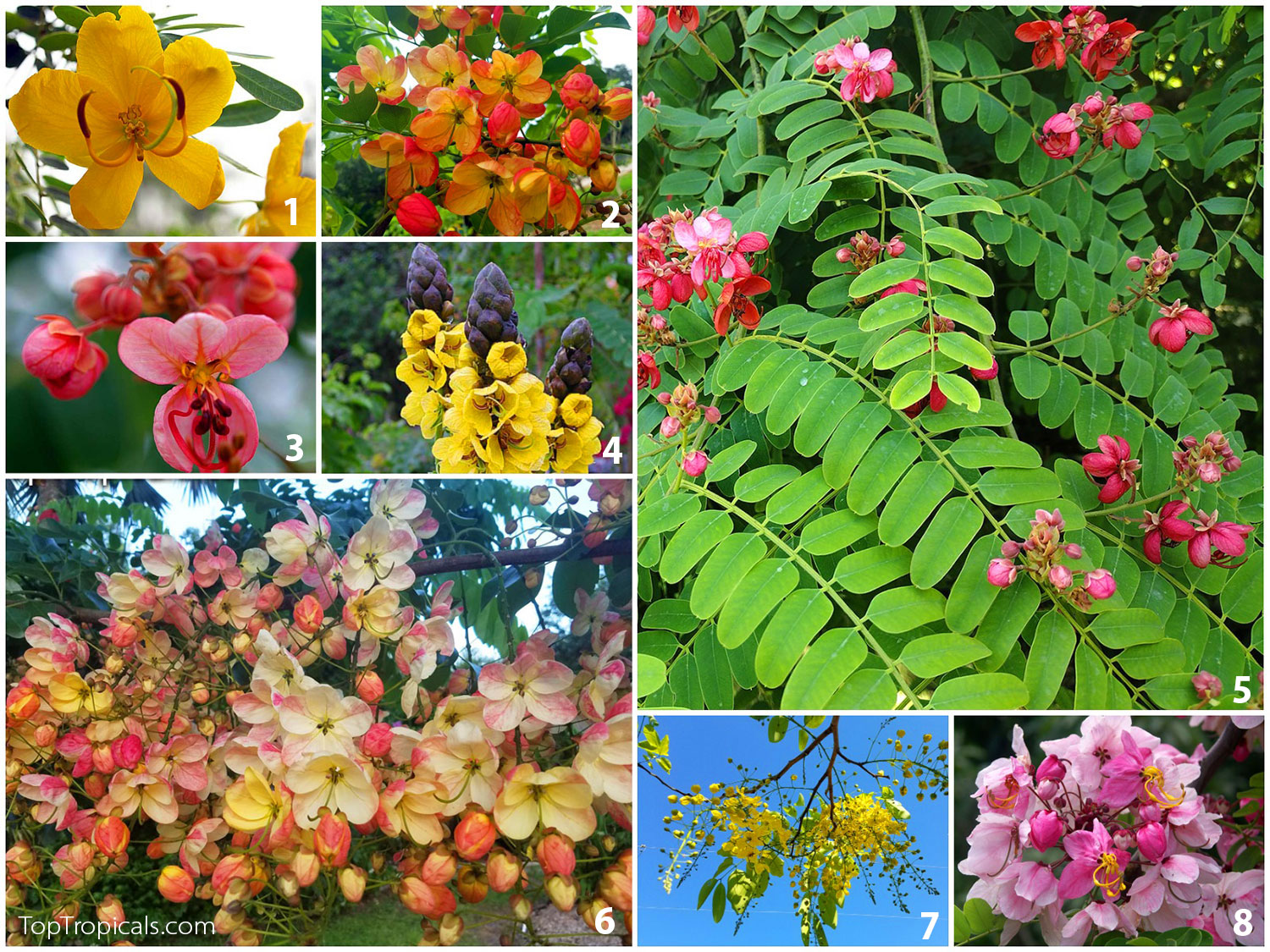
or pool deck into a tropical show. Most showy cassias (numbers correspond to
the photos in the collage above):
Cassia
bicapsularis (Butterfly Bush) - is a fast-growing,
low-maintenance shrub covered in bright yellow, butterfly-like blooms from
fall
through winter.
Cassia roxburghii (Ceylon Senna) - graceful tree with spreading,
drooping branches appearing to be overweighed by its wealth of clustering
red
blossoms.
Cassia
x nodosa (Pink Shower) - is a spectacular medium-sized, fast-growing
tree with cascading clusters of fragrant pink-and-white appleblossom blooms
in spring and summer.
Cassia fistula (Golden Shower) - to many tropical gardeners, the
most beautiful of cassias with masses of bright gold flower clusters appear
on
almost every branch.
Cassia javanica (Apple Blossom) - dazzles with dense clusters of
pink-to-white blossoms that change shades as they bloom, creating a
spectacular
display that lasts for months.
"Cassias love the heat and sunshine," says Tatiana
Anderson, Top Tropicals Plant Expert. "They are perfect for anyone
who wants big
bursts of color and doesn’t mind giving them space and light to grow."
Bauhinia Magic: Orchid-Like Blooms in a Compact Size
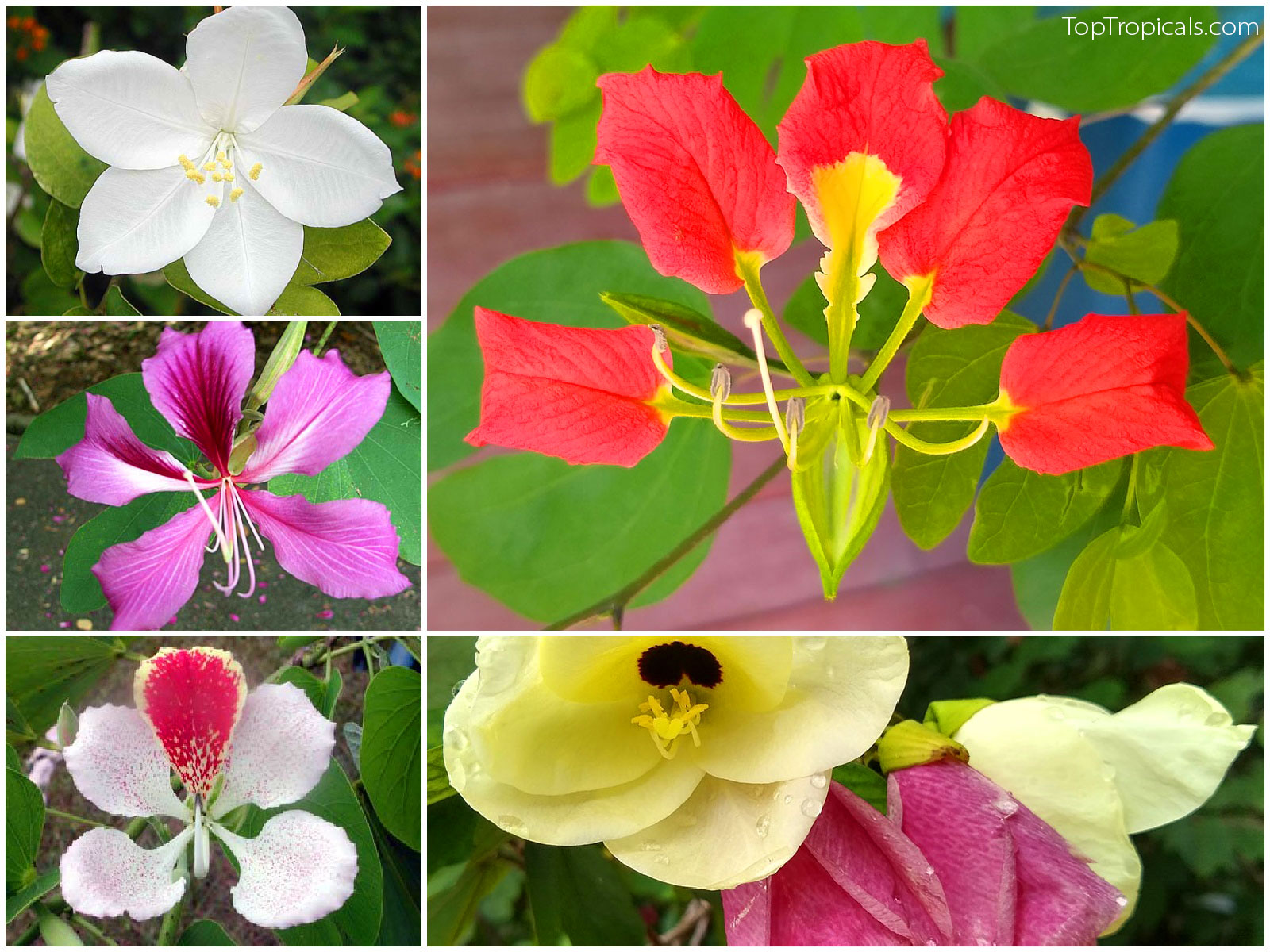
Bauhinia orchid trees: top left
– Bauhinia acuminata (Dwarf White Orchid Tree), middle left –
Bauhinia blakeana (Hong Kong Orchid Tree), bottom left – Bauhinia
monandra
(Napoleon’s Plume Orchid Tree), top right – Bauhinia
madagascariensis (Red Dwarf Orchid Tree), and bottom right – Bauhinia
tomentosa
(Yellow Orchid Tree)
Bauhinia trees
known as Orchid Trees, bring a touch of tropical luxury
to any space. Their butterfly-shaped leaves and orchid-like blossoms appear
in shades of red, pink, purple, white, and yellow, often lasting up to ten
months a year. Bauhinias are ideal for gardeners who want nonstop color in a
manageable size. Most species grow well in large pots and bloom young, often
within the first season.
The following compact varieties stay neat and flower almost
continuously in warm weather:
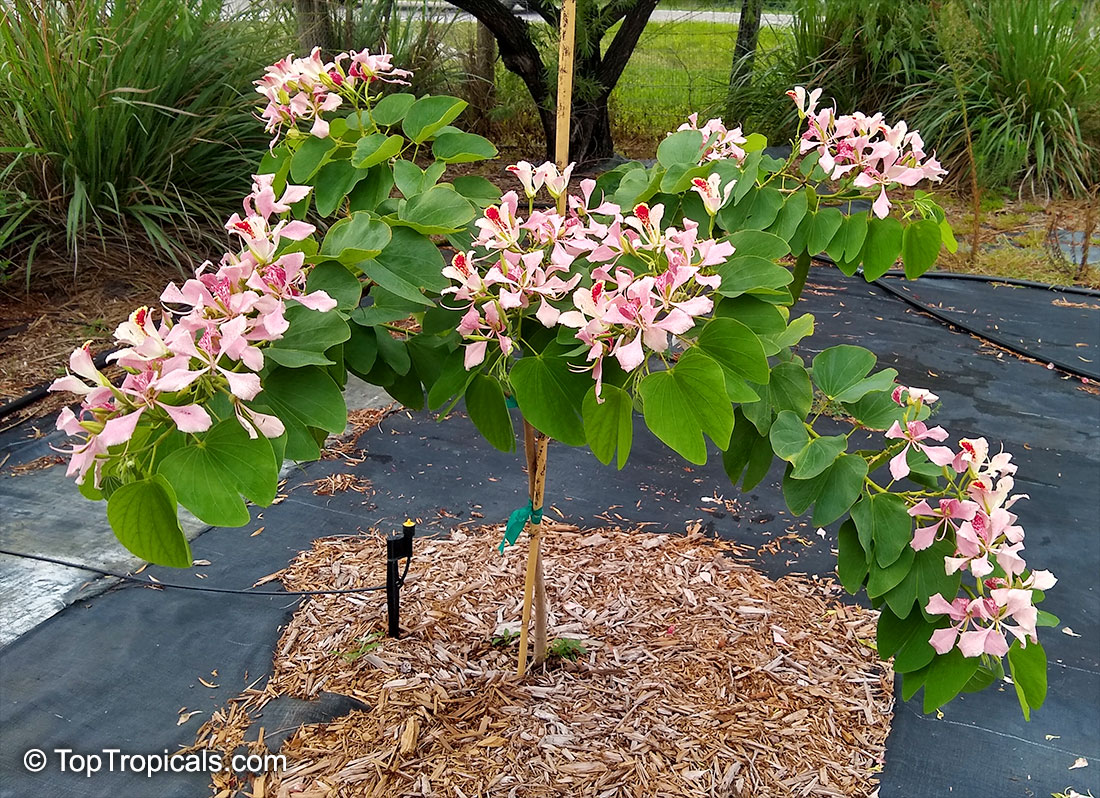
Bauhinia blakeana (Hong Kong Orchid Tree). A large tree in the
ground, but compact in pots if trimmed. Grafted trees flower right
away.
Winter bloomer, cold hardy to light frost.
The Hong Kong Orchid Tree is especially prized because it
is sterile and produces no messy seed pods, keeping patios clean. Grafted Buhinia
blakeana trees begin blooming while still small, making them perfect for
containers or tight spaces.
"Bauhinias are generous bloomers," Tatiana explains. "They respond
beautifully to regular feeding and full sun. If nights turn too cold, just
move the
pot to a sunny porch - they’ll keep their tropical charm most of the
year."
Give them full sun, regular fertilizer, and a well-drained
mix such as Sunshine
Abundance, and they will reward you with months of vivid
blooms. When nights turn too cold, simply move the pot to a sunny porch or
bright
window. Bauhinias adjust beautifully and keep their tropical grace year
after
year.
🎥
Watch Short Videos:
💲
Special Offer – 20% off Cassias and Bauhinias!
Get 20% OFF Cassias and Bauhinias with code
RAINBOW2025
Min order $100. Excluding S/H, valid online only,
cannot be combined with other offers.


 Detailed Cassia and Bauhinia Care Guide