Garden Blog - Top Tropicals

Date: 17 Mar 2026

Move Over, Paddy: Why March 17th is Actually the International Day of the Cat Lady

March 17th - International Day of the Cat Lady, Gertrude with cats

March 17th - International Day of the Cat Lady, Gertrude with cats

Move Over, Paddy: Why March 17th is Actually the "International Day of the Cat Lady" ☘️ 🐈

When you think of March 17th, you probably think of green beer, shamrocks, and parades. But while everyone else is toasted to St. Patrick, a subset of gardeners and feline enthusiasts are celebrating a different icon: St. Gertrude of Nivelles. She 's the 7th-century abbess who skipped the noble marriage proposals to become the unofficial Patron Saint of Cats, Gardeners, and anyone who really, really hates mice.
  • 🐾 From Noblewoman to Monastery Boss


    Born in 626 AD (modern-day Belgium), Gertrude wasn't your average medieval teenager. When her family tried to marry her off to a rich duke, she famously told them she’d rather be a bride of Christ than any man on Earth.
    She eventually ran the Nivelles monastery like a pro, turning it into a 5-star medieval hub for travelers, scholars, and pilgrims. But it isn't her hospitality that made her an internet icon 1,300 years later - it’s her "pest control" skills.
  • 🐾 The Mouse-Hater’s Hero


    Look at any medieval painting of Gertrude, and you’ll notice something weird: mice are literally climbing up her staff. In the Middle Ages, mice weren't "cute Disney sidekicks." They were grain-destroying, plague-spreading menaces. Gertrude became the go-to saint for:

    Protecting the harvest from rodents.
    Keeping the pantry mouse-free.
    Calming the nerves of people with a serious case of musophobia (fear of mice).
    The Logic: If you’re the saint of mice, you’re naturally the BFF of the creature that eats them.
  • 🐾 How She Became the "Cat Lady Saint"


    Interestingly, Gertrude wasn't "officially" the saint of cats for most of history. That title actually went viral in the late 20th century.

    A 1981 Metropolitan Museum of Art catalog highlighted her rodent-fighting reputation, and the world’s cat lovers basically said, "Hold my catnip". The association stuck instantly. Today, she’s the patron saint of the "Original Cat Lady" aesthetic, celebrated by anyone who knows that a home isn't a home without a feline supervisor.
  • 🐾 A Big Day for Green Thumbs


    If you’re a gardener, March 17th is your "Green Flag" day. In European folklore, St. Gertrude’s feast day is the traditional start of the planting season.

  • 👉 Pro-Tip from the Middle Ages: If the sun is out on March 17th, it’s a sign that your garden will thrive all year. If it’s raining? Well, maybe stay inside and pet the cat.


🐾 The Perfect Trio: Cats, Gardens, and Gertrude


There’s a reason plant people and cat people are often the same people. Cats love a good garden patrol - they nap in the mulch, stalk the butterflies, and ensure no chipmunk dares to touch your tomatoes.

At TopTropicals, we take this tradition seriously. Our PeopleCats are more than just pets; they are the furry CEOs of the nursery, supervising every seed we plant and every leaf we prune.
  • 🐾 Meet the PeopleCats:


    The furry supervisors of the garden world!
  • 🐾 This March 17th, Wear a Little Extra Fur


    Whether you’re Irish or not, take a moment this March 17th to raise a glass (or a bag of treats) to St. Gertrude.

    This year, let’s celebrate:
  • 🐾 The Feline Patrol: For keeping our gardens mouse-free.
  • 🐾 The Gardeners: For braving the dirt to grow something beautiful.
  • 🐾 The Abbess: For being the coolest historical figure you'd never heard of.


📚 Learn more:
St. Gertrude of Nivelles: Patron Saint of Cats, Gardeners, and Those Who Fear Mice!

#PeopleCats #Horoscope #Fun_Facts

🟢 Join 👉 TopTropicals and 🐈PeopleCats.Garden
Date: 18 Oct 2016

Checklist - preparing for winter in subtropical areas.
Watering. Start reducing the amount you water your plants in early fall, once the temperature drops below 65 °F. Avoid watering your plants during cool nights, as this may cause serious root rot.
Mulch. When a plant is protected by a thick layer of mulch, the root system stays healthy.
No Pruning. Avoid pruning, trimming, or pinching branch tips altogether during the fall and winter which encourages new shoots that are soft, tender, and very cold sensitive.
No Fertilizer. Avoid fertilizers during the winter. The main reason being the same as above for pruning: fertilizing promotes growth of the upper plant parts which should be avoided during the winter months.

Time to clean your yard!
In the South. It's getting cooler in subtropical areas, and garden work becomes even more enjoyable. Your garden now is in the most perfect shape after summer vigorous growth. It is the best time now to run the last trim before winter, as well as last fertilizer application. Clean up your yard without sweating off, add mulch to help plants to survive through possible winter chills. Don't forget to start reducing watering! Remember once temperatures drop below 65F, tropical plants slow down or stop growing and go into winter dormancy sleep.

Up North. When temperatures drop below 45 °F, start bringing sensitive plants indoors or into protected areas. Prepare/cover greenhouse, check availability of covers (sheets, plastic) and condition of heaters. Plants indoors will experience environment change, may drop leaves, and need different care than out in the sun. Reduce watering, check for insects once a week, and stop fertilizing until spring. Remember to pick the brightest spots for overwintering your tropical plants!

Enjoy cooler weather, fresh air, and thank yourself for a wonderful work you have done in your yard!

Date: 19 Aug 2016

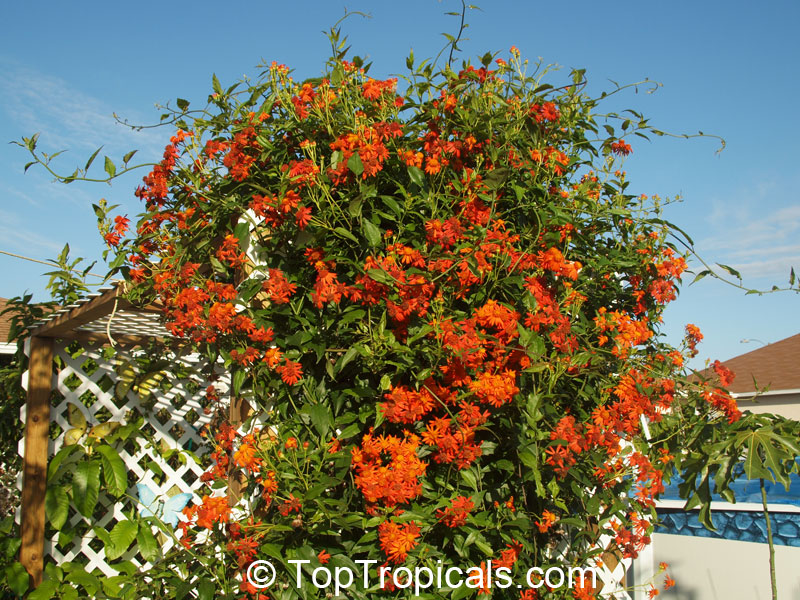
Growing Mexican Flame Vine as an annual

Q: While down in Fort Myers a few years ago, I saw this plant - Senecio confusus or Mexican Flame Vine, growing over chain-link fencing. At any rate, I fell in love with the plant then and there, only to later see it up here in Wisconsin, albeit down in Madison at The Centennial House, a noted botanical garden. This has led me to believe it may be possible to use this plant up here in the north as an annual. I could really use the orange coloration in mixed containers, etc. What I would like to try to find out is, will it grow and flower sufficiently within one of our growing seasons up here to make the choice worthwhile? Again, seeing it at Centennial House at least leads me to believe it may be possible. China where the flower was admired for its beauty and believed to have medicinal properties that promoted good health and long life. The Japanese Emperor was so smitten with the kiku flower that he adopted it as his personal crest, and it remains the insignia of the imperial family today. The art of growing and displaying Kiku for the Emperor's garden represented by amazing Imperial styles: Ozukuri, Ogiku, Kengai... Imagine growing out of one stem a single chrysanthemum trained to produce hundreds of simultaneous blossoms in a massive, dome-shaped array.

A: Mexican Flame vine is a good candidate to be grown as annual, thanks to these features:
- extremely fast growing
- it flowers in small size and young age
- long flowering period (2-3 months depending on conditions), throughout early Spring into Summer, sometimes it has a second blooming season by end of Summer.
- we keep large mature plants in stock year round, so you can have blooming size specimen as early as spring once your temperatures reach 65F so the plant will feel comfortable and develop quickly.
- easy to propagate - more plants can be made for next year season.

In winter, a potted plant can be cut back and kept in semi-dormant state indoors - garage, enclosed patio, with temperatures around 50F and above. Some gardeners from North prefer to plant a tropical specimen with a pot into the ground (make sure to add extra drainage holes), and when winter comes, it makes it easier to dig it out and save till warm season.

Date: 2 Apr 2016

Erblichia or Flor de Fuego - Apricot fragrance and sunny color

Q: I saw this wonderful flower Flor de Fuego on your website and I would like to buy this plant. I am wondering how big this tree will grow and how long will it take until I can smell the lovely flowers? I have a big garden and not much space left, but I still have a few spots available for smaller trees. Also any special care info will be appreciated.

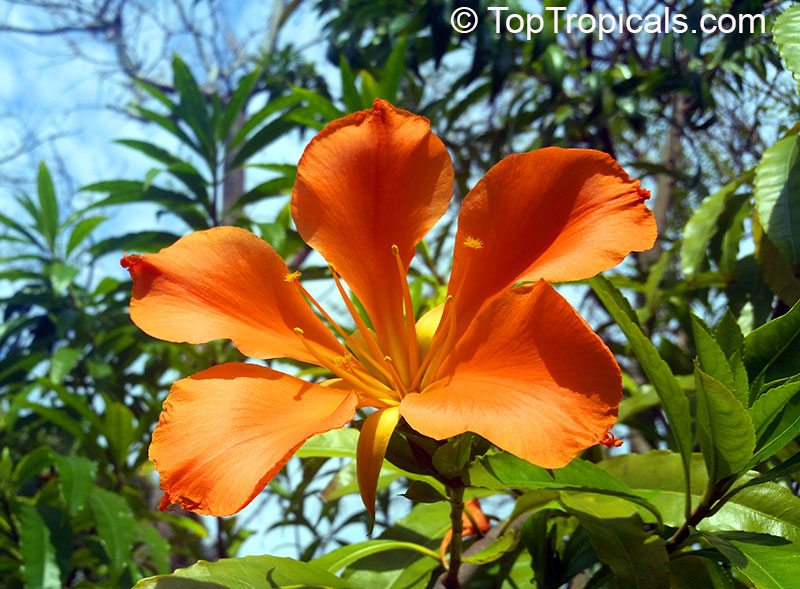
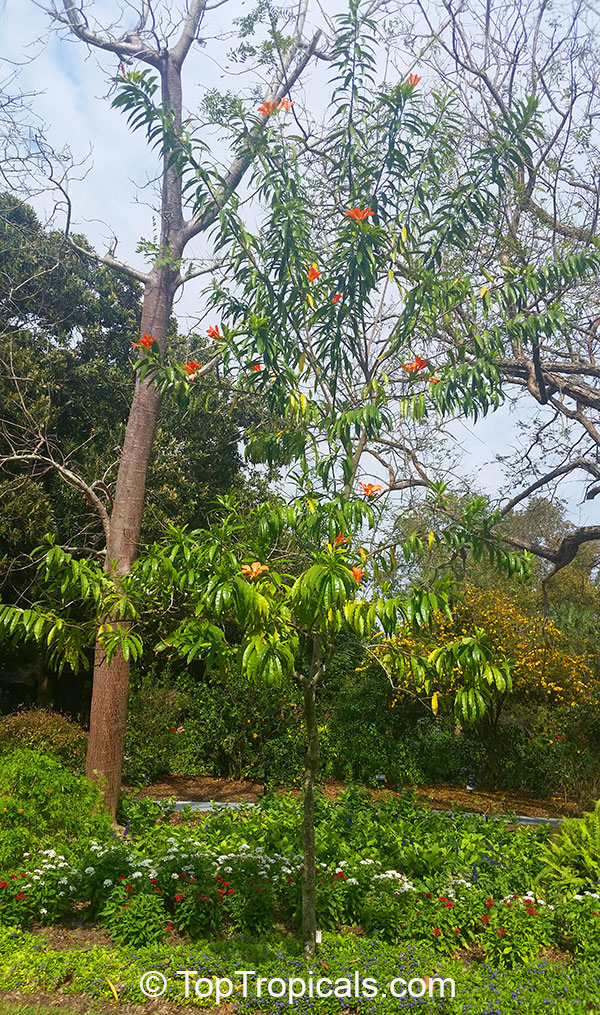
A: Flor de Fuego is a small tree and will fit in any small yard situation. It is very rare in cultivation. This is the newest, most exciting tree to be introduced in the last decade. It said to be one of the most beautiful flowering trees in Central America. It has long narrow leaves and large flowers 6-8"across that smell like apricots. It blooms from late fall through early winter and sometimes through spring. Normally it starts blooming in 2-3 years after planted in the ground. Surprisingly for such a delicate plant, it tolerates poor soils. Once established, it doesn't require any special care other than regular watering and fertilizing during hot months. It does take some effort sometimes to make the tree happy in its new habitat. After planting in the ground, keep your eye on irrigation schedule and do not let soil stay wet, young trees don't like wet feet. In natural habitat, the plant prefers to have a dry period that is beneficial for profuse blooming.

See full size picture of Erblichia tree in full bloom

Click here to buy Flor de Fuego

Date: 20 Sep 2025

How to make lots of Insulin Ginger plants quickly and get more health benefits

Costus igneus (Chamaecostus cuspidatus) - Fiery Costus or Spiral Flag

💚 How to make lots of Insulin Ginger plants quickly and get more health benefits

  • Costus igneus (Chamaecostus cuspidatus) - Fiery Costus or Spiral Flag is believed to help lower blood glucose levels naturally and managing diabetes.
  • Have you heard of Insulin Ginger? Everyone wants to have it in the garden!
  • Gardeners in India grow it not just for its pretty spiral leaves, but for what those leaves do. People with diabetes often chew them fresh or brew them into tea, saying it helps keep their blood sugar under control.
  • Researchers have found something interesting: the leaves contain an insulin-like compound, along with antioxidants and anti-inflammatory properties. In animal studies, extracts from the plant lowered blood sugar, protected the liver and kidneys, and even made the body more sensitive to insulin.
  • The way folks use it is simple. You can chew a leaf right off the plant, steep dried leaves for tea, or find it in powders and capsules. It's one of those plants that shows how tradition and science sometimes meet in the garden.
  • Its lush, turmeric-like leaves spiral around upright stems, with a glossy dark green top and a striking light purple underside. In warm months, it produces bright orange, cone-like flowers that stand out beautifully in the garden.
  • Beyond its beauty and natural insulin effects, the insulin plant is credited with aiding digestion, reducing cholesterol, boosting energy, improving skin health, supporting weight loss, relieving stress, and promoting heart wellness. A real botanical multitasker!


🎥 In this video, we’ll show you how to multiply Insulin Ginger fast, so you’ll have plenty of plants for yourself and even extras to share with friends and family.

✅ Don’t forget to use Green Magic fertilizer for the best results. Gingers absolutely love this plant food - they thrive on it and respond better than any other plant, with vigorous growth, lush foliage and loads of leaves you’ll need for all the benefits.

🛒 Grow your own sugar-fighter - the Insulin Ginger

📚 Learn more:


#Food_Forest #Remedies #Shade_Garden #Discover

🟢 Join 👉 TopTropicals