Garden Blog - Top Tropicals

Date: 19 Apr 2026

Complete Adenium Care Guide: 9 tips how to keep it simple and thriving
Complete Adenium Care Guide: 9 tips how to keep it simple and thriving

🌸 Complete Adenium Care Guide: 9 tips how to keep it simple and thriving


Adeniums don’t need intense care - just the right balance.
Most problems come from too much water, not enough light, or the wrong soil.
  • 🌸 1. Soil is everything


    Why it matters
    Adeniums are succulents with thick roots and a caudex that stores water. They must never sit in wet, heavy soil.
    Most problems come from soil that stays wet too long - leading to root rot, soft caudex, weak growth, and poor flowering.
    Good soil builds strong roots, dries faster, supports a healthy caudex, and improves blooming.

    Ideal soil formula
    Use a very fast-draining, airy mix with perlite, bark, sand, coconut fiber. Avoid heavy peat-based mixes.
    A simple formula: TopTropicals Abundance potting mix + coarse sand (50/50). Use coarse sand (for construction), not fine beach sand. Sand improves drainage, structure, and aeration.
    You can also add lava rock and charcoal.

    Soil pH
    Adeniums prefer slightly alkaline soil. Too much peat (acidic) holds moisture and increases rot risk.
    Tip: add a few sea shells on top - watering slowly raises pH.

    Golden rule
    Better too fast-draining than too heavy.
    You can water more. You can’t fix rot.
  • 🌸 2. Containers


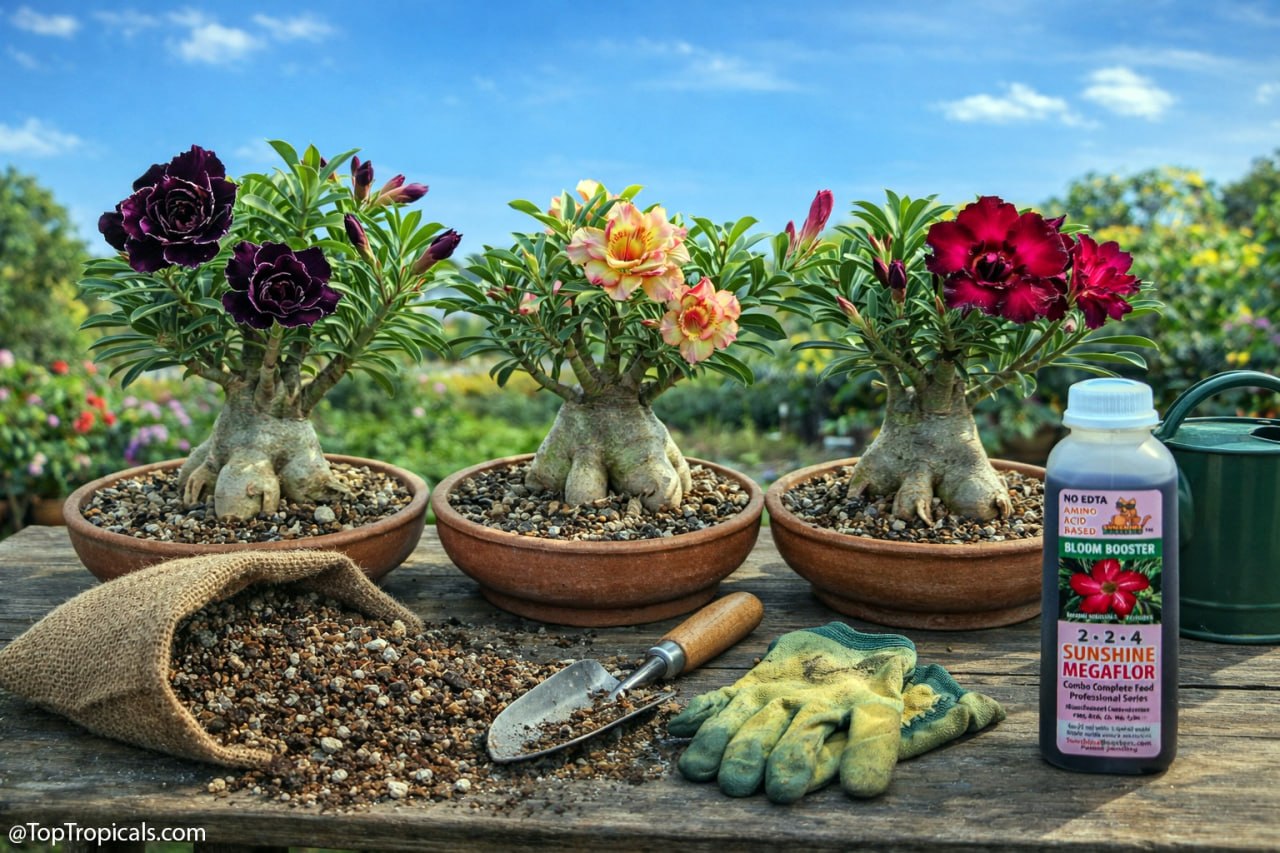
    Use shallow, unglazed clay pots. They dry faster, improve airflow, and stabilize the plant as the caudex gets heavy.
    Do not oversize - keep close to root ball.
    When repotting, raise the caudex slightly each time to develop that thick base.
  • 🌸 3. Light


    Give as much light as possible.
    Full sun is best, but in very hot climates, bright filtered light prevents leaf burn and helps flowers last longer.
    Too little light = weak growth and poor blooming.
  • 🌸 4. Watering


    Water deeply, then let soil dry out completely before watering again.
    Do not keep soil constantly wet. Adeniums prefer the dry side and hate sitting in moisture.
    In rainy climates, protect from excess water. Keep under cover - bright light, no constant soaking.
  • 🌸 5. Fertilizer


    Feed lightly and regularly during active growth.
    Use liquid fertilizer Sunshine Megafloк Bloom Booster on soil and lightly on leaves - avoid the caudex.
    Bloom boosters (high phosphorus) support flowers and caudex growth.
    Add controlled-release fertilizer (Green Magic) twice a year - spring and late summer. Do not fertilize during winter dormancy.
    Add microelements (iron, boron, molybdenum) - Sunshine Superfood supplement - for healthier leaves and longer blooms.
  • 🌸 6. Trimming (pruning)


    Trim after flowering, especially leggy branches.
    Pruning encourages branching - more branches = more flowers.
    Don’t be afraid to cut - it improves structure and blooming.
  • 🌸 7. Caudex development (secret trick)


    When repotting, raise the caudex slightly above soil level.
    Combined with regular feeding (bloom booster), this helps develop a thicker, more pronounced base.
  • 🌸 8. Seedlings vs grafted plants


    Seed-grown plants form a natural caudex but take 2-3 years to bloom and do not come true to type (often simple pink).
    Grafted plants combine a developed caudex with a known variety.
    Best choice for predictable, high-quality blooms.
  • 🌸 9. Troubleshooting


    If something goes wrong, check these first:

· Too much water
  • · Not enough light
  • · Soil too heavy
Fix these, and your plant will recover.

🛒 Explore Exotic Thai Adeniums

📚 Learn more:

Plant Facts

Adenium sp.
Adenium, Desert Rose, Impala Lily
USDA Zone: 9-11
Plant with caudexLarge shrub 5-10 ft tallSmall tree 10-20 ftFull sunDry conditionsModerate waterYellow, orange flowersRed, crimson, vinous flowersUnusual colorBlue, lavender, purple flowersWhite, off-white flowersPink flowersToxic or Poisonous

#Container_Garden #Adeniums #How_to #Discover

🟢 Join 👉 TopTropicals
Date: 21 Apr 2026

13 tropical flowers to plant in spring to attract pollinators year around

13 tropical flowers to plant in spring to attract pollinators year around

13 tropical flowers to plant in spring to attract pollinators year around


Spring is when everything wakes up - and if you plant smart now, your garden can stay alive with butterflies, bees, and hummingbirds all year long. The key is mixing tropical bloomers that flower in waves, not all at once. These plants don’t just look good - they keep pollinators coming back season after season, turning your yard into a living, moving ecosystem.

  • 1. Abutilon Fireball (Abutilon darwinii x striatum)

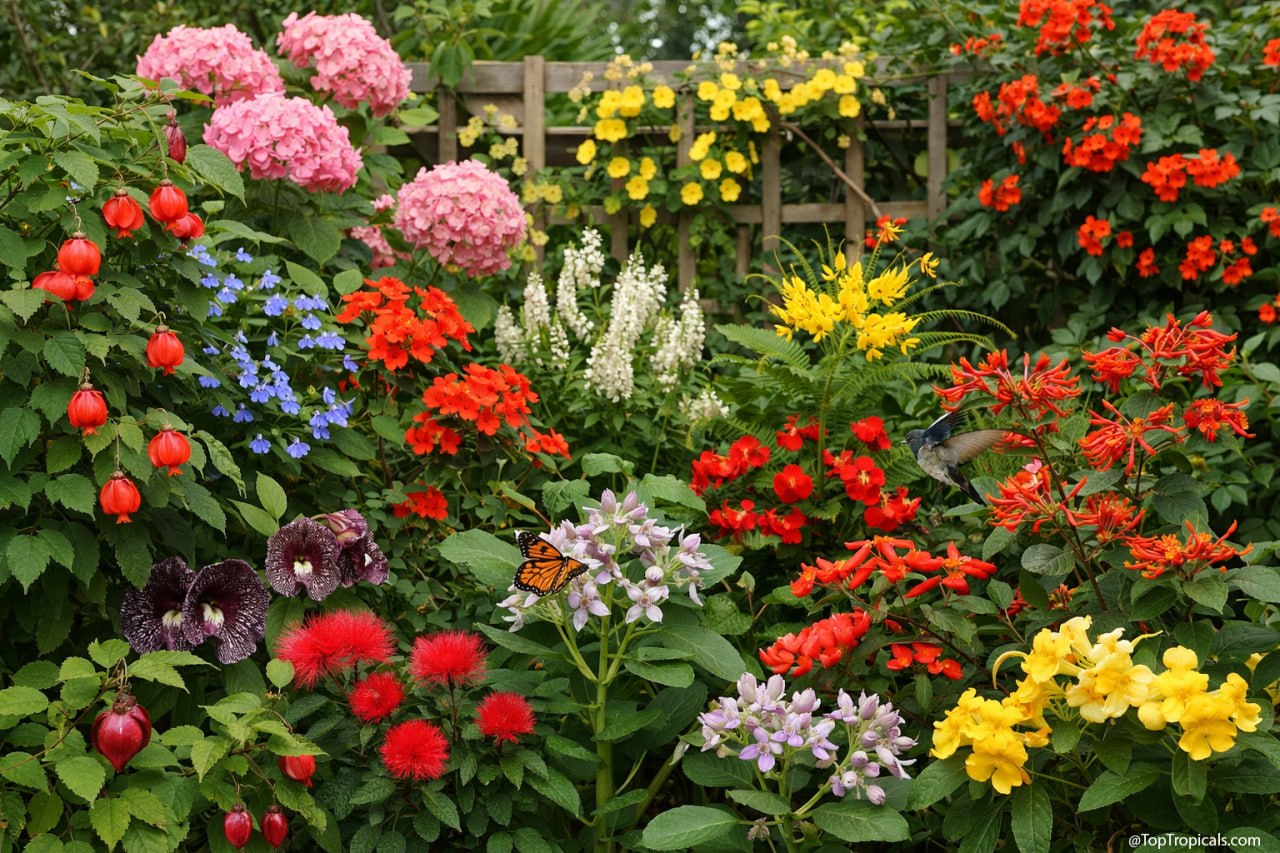
Bell-shaped flowers in warm red and orange tones hang like little lanterns. Very cold hardy, blooms on and off through the year, especially in mild climates. A steady nectar source for hummingbirds. More 👉

  • 2. Almond Bush (Aloysia virgata)

Light, airy clusters of tiny white flowers with a strong almond scent. Bees absolutely cover this plant when it’s in bloom. Flowers repeatedly through warm months. More 👉

  • 3. Calico Flower (Aristolochia littoralis)

One of the most unusual flowers you can grow - patterned like fabric. More importantly, it’s a host plant for butterflies, giving them a place to lay eggs. More 👉

  • 4. Pride of De Kaap (Bauhinia galpinii)

Bright orange-red blooms cover this shrub for months. Tough, fast-growing, and constantly visited by butterflies and bees. More 👉

  • 5. Mexican Bird of Paradise (Caesalpinia mexicana)

Sunny yellow flowers with a light fragrance. Handles heat, freeze, and poor soil easily. A reliable nectar plant for bees and butterflies. More 👉

  • 6. Red Tassel Flower (Calliandra tweedii With Love)

Very showy red-flowered powderpuff, fast-growing and spacey shrub. Cold tolerant to hard freeze, making it a strong choice for subtropical gardens. Forms a dense, many-stemmed plant with fine, feathery foliage that folds at night or by touch. Large scarlet tassel flowers bloom from spring to autumn and attract pollinators nonstop. More 👉

  • 7. Giant Milkweed (Calotropis gigantea)

A bold plant with thick leaves and waxy flowers. Important host plant for butterflies, especially monarchs. Handles heat and drought well. More 👉

  • 8. Blue Butterfly (Clerodendrum ugandense)

Flowers really do look like little blue butterflies. Blooms frequently and attracts actual butterflies along with bees. More 👉

  • 9. Tropical Hydrangea (Dombeya wallichii)

Large clusters of soft pink flowers appear in cooler months when little else is blooming. A major nectar source in winter. More 👉

  • 10. Fire Bush (Hamelia patens)

One of the best all-around pollinator plants and a tough bush - takes both cold and heat. Tubular orange-red flowers attract hummingbirds nonstop, plus butterflies and bees. More 👉

  • 11. Butterfly Orchid Vine (Mascagnia macroptera)

A climbing, cold hardy vine covered in bright yellow flowers and butterfly-like seeds. Great for fences or trellises, adding vertical color and feeding pollinators. More 👉

  • 12. Mexican Flame Vine (Senecio confusus)

Fast-growing, hardy vine with intense red blooms. Flowers heavily and brings in butterflies quickly. More 👉

13. Yellow Elder (Tecoma stans)


Bright yellow trumpet flowers that bloom over a long season. A dependable plant for both bees and hummingbirds. More 👉

✔️ Planting a mix of these gives you something in bloom almost every month.
That’s the real trick - not just planting for spring, but building a rotation of flowers that keeps pollinators fed all year long.

🛒 Transform your yard into a Butterfly Haven with exotic plants

📚 Learn more:


#Butterfly_Plants
Butterfly Haven or a Heaven on Earth?
Top 20 plants for a Butterfly Haven
Five best butterfly attractors for a Southern garden
Top Eight irresistible vines for a hummingbird haven: Part 1 - Part 2

#Hedges_with_benefits #Butterfly_Plants #How_to #Discover

🟢 Join 👉 TopTropicals

Date: 25 Apr 2026

♥️ Mother’s Day: More Than a Gift

Smokey  cat  with  glasses  showing  mango  tree  to  mother  cat  in  garden
Mom: You grew this… for me? You remembered my favorite…
Smokey: I did.
Mom: You never forget what matters. It’s beautiful.
Smokey: Not as much as you. Happy Mother’s Day.
Sunshine: You raised him right. It shows.

Some things stay with you from your mom.

A favorite fruit. A smell from the garden. The way she showed you how to care for something and stick with it.

At the time, it felt small. Later, you realize it wasn’t. It turns into something real - a tree, a habit, a way of doing things you still follow.

Mother’s Day is simply a reason to tell your mom you remember. To say thank you for what she taught you, and to show your love.

It does not have to be complicated. Just something that makes it clear you were paying attention.

If you are thinking what to give, start simple.

A fruit she loves. A plant she will enjoy watching grow. Something alive, not just something that sits on a shelf.

It does not have to be big. What matters is that it means something to her.

And maybe, years from now, it becomes one of those things that stays.

We put together a few plants that make good Mother’s Day gifts.

Fragrant flowers. Fruit trees she can enjoy year after year. Easy growers that do not require much effort.

If she has a favorite, start there. If not, pick something simple and reliable.

🛒 Shop Gift plants