Garden Blog - Top Tropicals

Date: 9 Nov 2019

Saving Fallen Papaya Tree
Q: Hope there is help for my beautiful amazing papaya tree! There where a loooooooot of fruits on it, but it broke! First of all, it was leaning and friends tried to straight my beautiful tree. What can I do? Will it get fruits again?

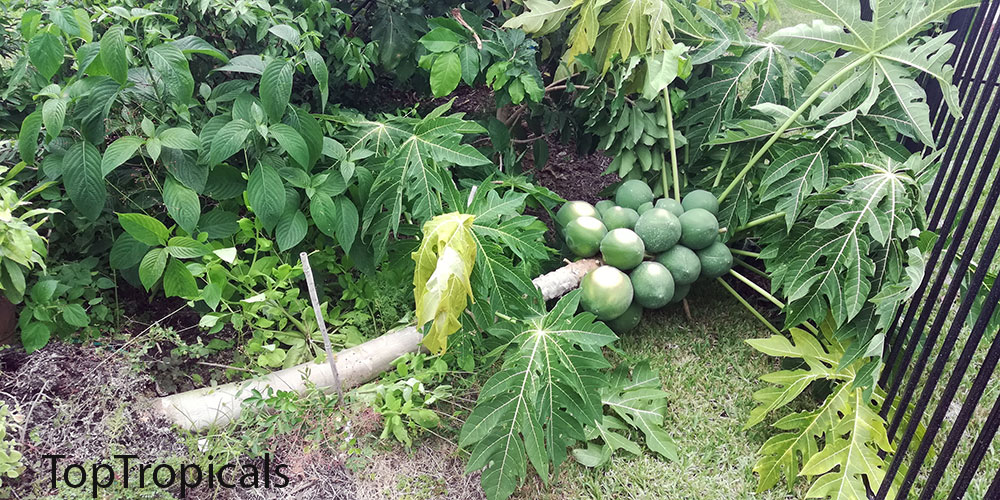
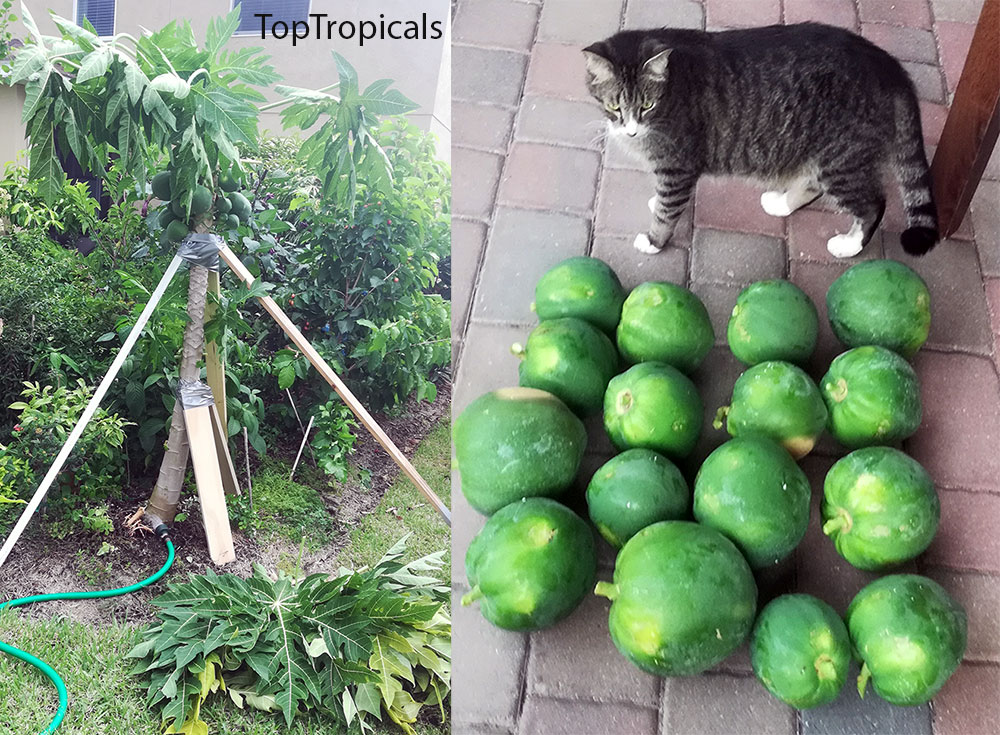
A: A couple months ago we also had a Papaya tree loaded with fruit that fell down (see photos). It was heart-breaking. We secured it and it continued growing for a couple of weeks but unfortunately, at the end the tree still died, leaving us a million fruit. The Papaya tree has a very sensitive root system and is hard to re-establish once the roots are damaged.
However, if it just has a broken top, it has a good chance to grow back from the side shoots.
Of course, remove all the fruit so they don't take energy from the recovering tree.
When a tree is loaded with fruit, it is important to provide support for heavy branches and for the trunk if needed. Always support the fruiting tree to prevent from possible falling BEFORE it starts leaning down and may become broken by even a light wind.
In the photo, you can see how we fixed boards around, but it was already after the tree fell. Unfortunately, it was too late since the roots got damaged. Always need to stake the tree up before the branches get too heavy!

RECOMMENDED FERTILIZERS:
Fruit Festival Plant Food - Super Crop Booster
Mango-Food - Smart Release Fruit Tree Booster
SUNSHINE-Honey - sugar booster

Maradol Papaya $10 Hot Sale

Only local pick up from our Garden Center
Hurry up, while supply lasts!

Date: 6 May 2020

The best Aquarium fish food ever - stikiStik

Everyone knows that Top Tropicals is good at unique, special novelties. And it is not a secret that most plant people also are pet people - cat people (with PeopleCats), dog people (with PeopleDogs) or at least fish people, right?
Today we are excited to introduce our new revolutionary Fish Food developed by our business partners at Floritin Aquarium Labs

Floritin stikiStikâ„¢ - Ultimate Aquarium fish food

StikiStik is a dry powder that you just mixed with water to create a sticky paste. The paste can be attached to any surface inside your aquarium.

Watch a cool video of fish having a stikiStik meal!

StikiStik is a patent pending fish food that does things which conventional fish food does not. It introduces picky eaters to a more natural feeding environment, does not pollute the fish tank, is easy to mix from its powder format and provides gradual feeding. It is easy to apply to any surface in the aquarium, such as interior glass wall, rocks or coral skeleton.

stikiStik advantages

- Easy to use. Just mix with a few drops of water and stik it in! Self adhesive paste can be applied to any surface. Stays intact for hours in aquarium. Does not pollute water
- Scientifically designed and proven for all types of aquarium fish, invertebrates, and corals
- Optimal and balanced nutrition. Contains vitamins and amino acids
- Natural. No hormones, no artificial colors
- Stimulates fish appetite and enhances fish color
- Promotes natural feeding habits. Helps training hard to feed fish. The perfect food to acclimate newly introduced fish, including Moorish Idol, finicky butterfly fish, such as Copperband Butterfly, Pearscale Butterfly, Mandarinfish, and many oithers
- Easy to store. Can be used immediately or frozen for future use
- Add any frozen fish food or medications to mix

See element contents / instructions and more information with videos on stikiStik website

"The stikiStik is the best Aquarium fish food ever - hands down!"
- Mr Booster -

Date: 25 Apr 2026

♥️ Mother’s Day: More Than a Gift

Smokey  cat  with  glasses  showing  mango  tree  to  mother  cat  in  garden
Mom: You grew this… for me? You remembered my favorite…
Smokey: I did.
Mom: You never forget what matters. It’s beautiful.
Smokey: Not as much as you. Happy Mother’s Day.
Sunshine: You raised him right. It shows.

Some things stay with you from your mom.

A favorite fruit. A smell from the garden. The way she showed you how to care for something and stick with it.

At the time, it felt small. Later, you realize it wasn’t. It turns into something real - a tree, a habit, a way of doing things you still follow.

Mother’s Day is simply a reason to tell your mom you remember. To say thank you for what she taught you, and to show your love.

It does not have to be complicated. Just something that makes it clear you were paying attention.

If you are thinking what to give, start simple.

A fruit she loves. A plant she will enjoy watching grow. Something alive, not just something that sits on a shelf.

It does not have to be big. What matters is that it means something to her.

And maybe, years from now, it becomes one of those things that stays.

We put together a few plants that make good Mother’s Day gifts.

Fragrant flowers. Fruit trees she can enjoy year after year. Easy growers that do not require much effort.

If she has a favorite, start there. If not, pick something simple and reliable.

🛒 Shop Gift plants

Date: 17 Sep 2025

Mulberry Care and Growing Tips

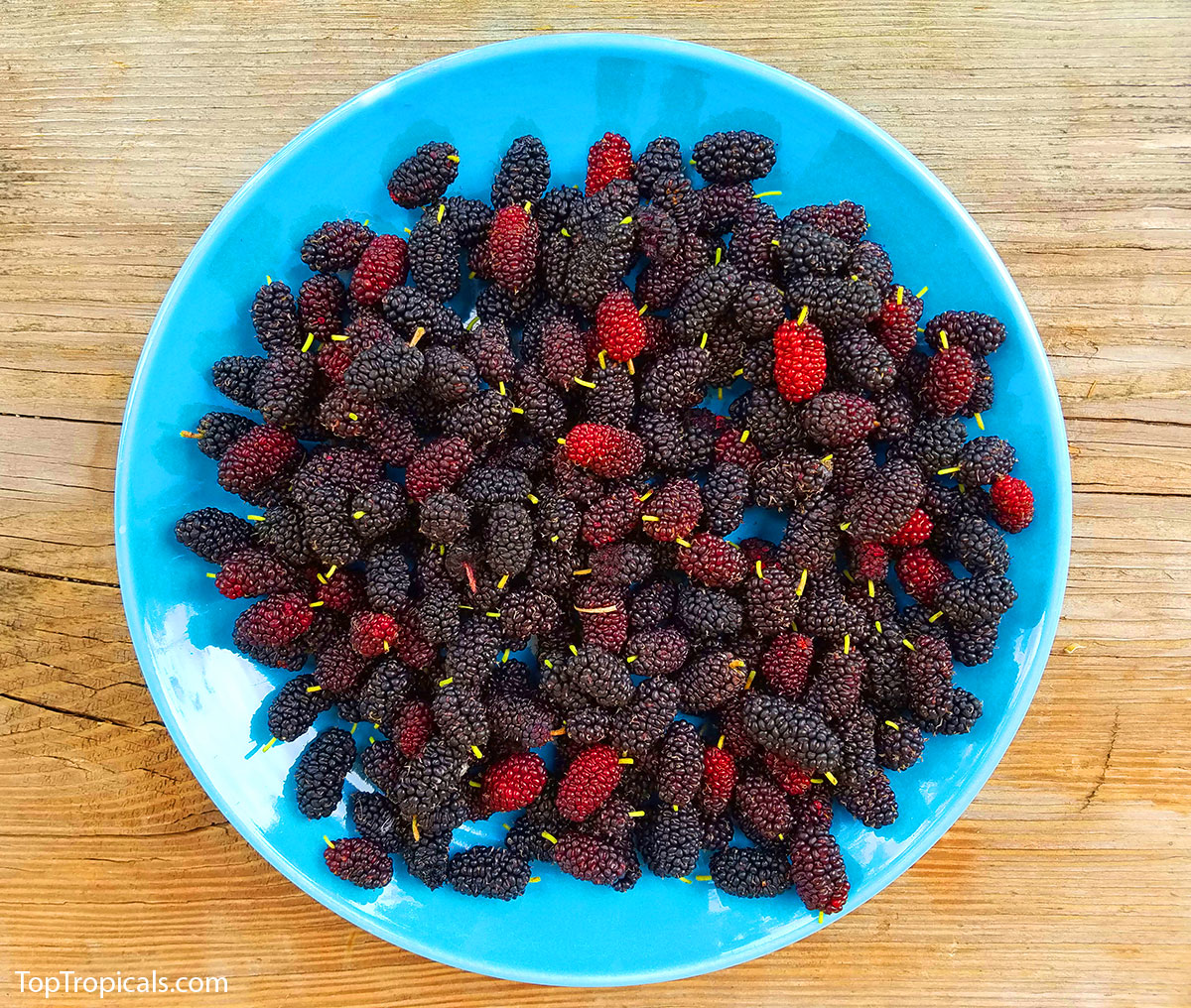
Mulberry  fruit  on  a  plate

Mulberries are tough, low-maintenance fruit trees that adapt to many conditions.

  • Climate: Hardy from USDA zone 5 to 10.
  • Soil: Grow well in almost any soil; prefer good drainage.
  • Watering: Regular watering during dry spells; drought tolerant once etablished.
  • Growth: 3–5 feet per year, producing fruit early.
  • Pruning: Annual pruning controls size and improves branching.
  • Pot culture: Dwarf types thrive in containers, staying 6–7 feet tall. Use a large pot, water consistently, and prune lightly. Use Abundance potting mix for best results.
  • Fertilizer: For reliable production, fertilizer regularly. Apply Sunshine C-Cibus liquid booster with every watering, or Green Magic controlled release fertilizer every 5-6 months.

❓ Mulberry FAQ


How soon will a mulberry fruit?

One to two years, sometimes the very first season.

What climates are suitable?

USDA zones 5–10, from -20F winters to hot summers.

How tall do they get?

Standard trees 20–30 ft; dwarfs 6–10 ft in pots.

Do I need more than one tree?

No, they are self-pollinating.

What do they taste like?

Sweet and juicy, like a blend of blackberry and raspberry.

How long is the harvest?

Everbearing types ripen gradually from summer into fall.

Do birds eat them?

Yes, but trees are so productive there’s plenty to share.

Are they messy?

Dark-fruited varieties can stain; white mulberries do not.

Can I grow them in containers?

Yes, dwarf types (Dwarf Everbearing, Issai) fruit well in pots.

How long do they live?

Many live for decades; Illinois Everbearing can endure for generations.

What are the health benefits?

Mulberries are low-glycemic, support healthy blood sugar, improve heart health, and are rich in antioxidants.

Shop Mulberries

Date: 22 Oct 2025

Detailed Cassia and Bauhinia Care Guide

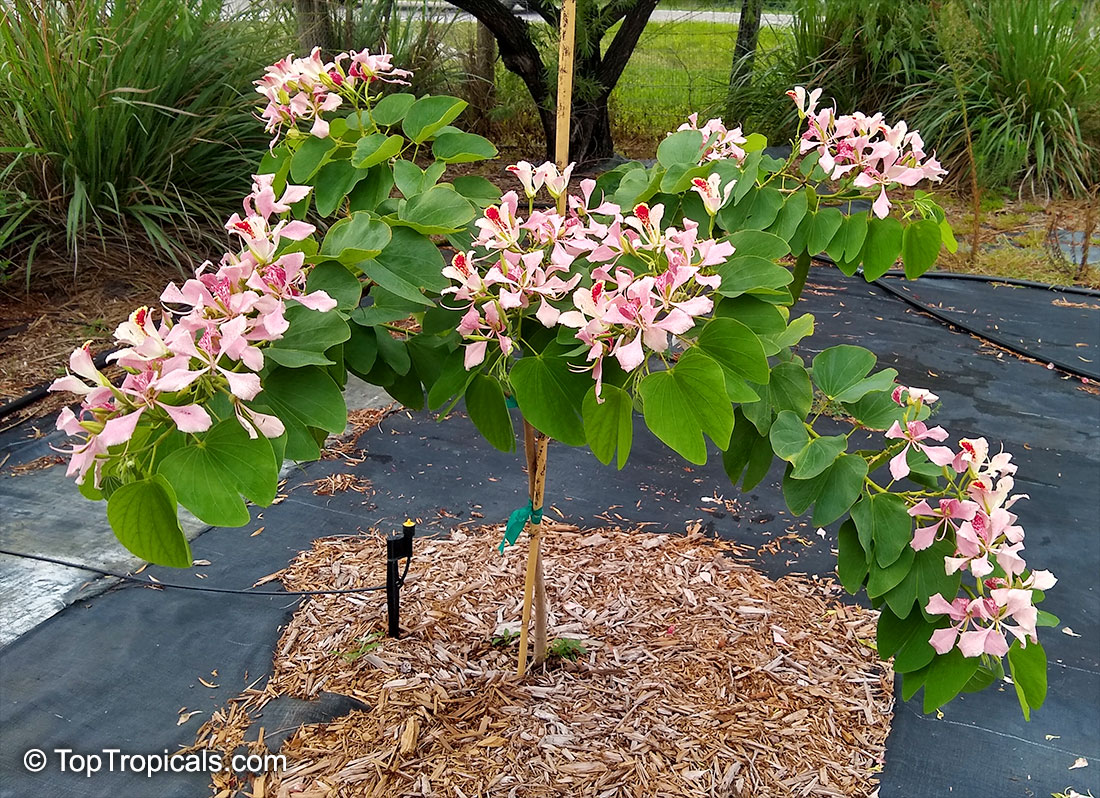
Young  Bauhinia  monandra  tree  blooming  with  clusters  of  pink  and  white 
 orchid-like  flowers,  growing  at  Top  Tropicals  nursery  with  fresh  mulch  and 
 drip  irrigation 
 setup

Outdoor Cassia and Bauhinia Care

  • Light: Both Cassia and Bauhinia need at least 6 hours of direct sunlight daily. Cassias handle intense heat; Bauhinias can take light afternoon shade.
  • Soil: Use loose, fast-draining soil. Mix equal parts garden soil, coarse sand, and compost.
  • Watering: Keep evenly moist but never soggy. Cassias tolerate dry spells once established; Bauhinias prefer steady moisture. Water when the top inch feels dry.
  • Feeding: For profuse flowering, feed with liquid Sunshine Boosters Megaflor that is safe to use with every watering, year around. You may also apply Green Magic controlled release fertilizer every 6 months. Bauhinias and Cassias respond quickly to feeding.
  • Pruning: After flowering, prune lightly to shape and remove dead tips. Cassias can be trimmed to shrub form; Bauhinias stay bushy with pinching.
  • Mulch: Add a 2-inch mulch layer around the base to conserve moisture and prevent weeds, but keep mulch off the trunk.
  • Cold protection: Most Cassias handle brief frost; some Bauhinias like B. acuminata and B. monandra must be sheltered below freezing. For cold nights, cover with frost cloth or move containers into shelter.
  • Dormancy: Outside of tropics, most Bauhinias drop leaves in winter for a short period of time, right before flowering and are called "semi-deciduous". Cassias stay evergreen.

Indoor or Porch Care (cool-climate growers)

  • Container: Choose a sturdy pot with several drainage holes, one size larger than the root ball. Unglazed clay or thick plastic pots work best for heat regulation. Use a light, well-drained mix such as professional soilless mix Abundance. Both Cassias and Bauhinias dislike soggy roots. Add a thin layer of coarse gravel at the bottom to improve drainage. Repot every 1–2 years in spring
  • Light: Brightest spot possible - south-facing window or heated sunroom. Supplement with a grow light if sunlight is weak.
  • Temperature: Keep potted trees in warm environment for best results. The optimum temperature for Cassias and Bauhinias is between 60–85 F, although many species can tolerate cooler temperatures. Avoid cold drafts and sudden drops.
  • Humidity: Average indoor humidity is fine; occasional misting keeps foliage glossy.
  • Watering: Water sparingly in winter when growth slows; allow the top inch to dry between waterings. Do not let roots sit in water.
  • Fertilizing: Feed with Sunshine Boosters Megaflor that is safe to use with every watering, year around, to maintain flowering indoors. You may also apply Green Magic controlled release fertilizer every 6 months.
  • Pest watch: Check undersides of leaves for aphids or whitefly. A light spray of neem oil or insecticidal soap clears them fast.

"Whether you crave golden summer fireworks or soft orchid blooms that last nearly all year, both Cassia and Bauhinia bring pure joy to the garden. 💖 Bring color that never quits."

Did you know: Fall is the best planting season — roots grow faster and you’ll have flowers by spring!

✔️ Fall Planting Guide

🛒 Shop Tropical Flowering trees