Date: 24 Jun 2018
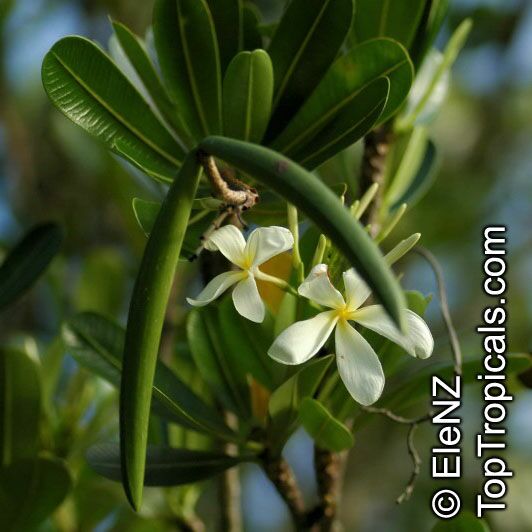
Tip of the day: Growing Plumeria from seed
Q: I purchased a Plumeria from your company. It has done quite nicely and now has produced a seed pod. Please forward me information on how to care for it and use the seeds that may be inside to propagate another plant.
A: Wait until seeds are ripe (seed pod turns brownish). Soak seeds overnight. Use only well drained soil, or cactus mix. Insert heavy end of seed 1/4"into soil, leaving feathered end exposed. Place the pot in direct sunlight. Don't allow soil to completely dry out, but don't let it be soggy. Germination occurs usually within 3 weeks. Do not overwater. For more information on growing Plumerias, see our slideshow guide:
Date: 24 Jun 2018
Cold hardy tropical fruit trees for Luisiana
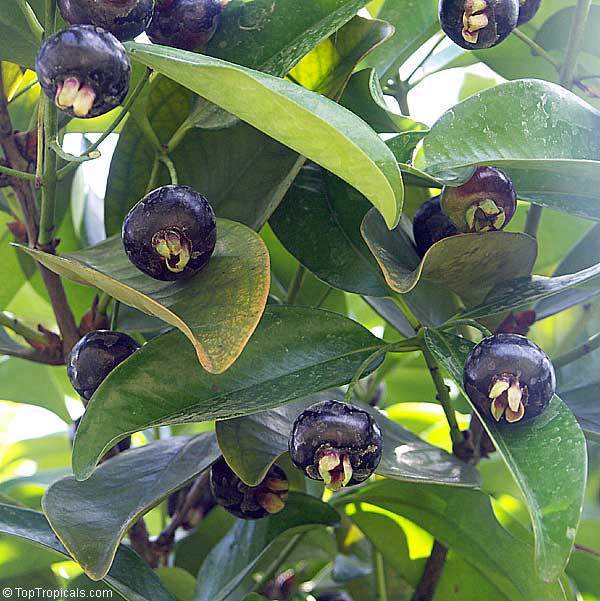
Q: I've just moved to Louisiana and have been wondering whether it would make sense to plant some tropical fruit trees in our garden. Average lows in New Orleans are 41 deg F in January and February, although we did hit 25 once with the Arctic vortex. I'm interested in litchi, longan, rambutans, and persimmons. Do you have varieties that can tolerate Louisiana's temperature range? I'd love mangosteen but I don't suppose they will survive. Do you have any suggestions on tropical fruit trees that I could try?
A:
Average temperatures are for statistics only; it is actual
temperatures that may hurt your cold sensitive plant. This
is what you should keep in mind when starting your
tropical fruit collection:
1) Ultra-tropical plants like Rambutan can not survive
winters below 45-50F. However, they can be successfully
grown in containers in a greenhouse or moved indoors into
a sun room during cold periods.
2) Tropical plants like Litchi and Longan may take some light
frost once established. Still, for areas with freeze our
advice is - keep them in pots and move inside in case of
cold.
3) There is a number of subtropical fruit trees that are
hardy enough to take some freeze. Persimmon, Feijoa, Fig, Cattley Guava, Jujube, Kiwi, some Eugenias and others. Please
refer to our Tropical Fruit Sensitivity Chart.
4) Remember that plant's ability to survive winter depends
on several factors, not only temperature itself. Important
factors are: wind protection (chill wind kills rather than
low temperature itself), exposure, how close the tree is
planted to the house, plant maturity and its overall
strength and health. If a plant had received good
nutrients during summer, has well established root system,
planted in enclosed area protected from winds and has
plenty of bright sunlight - it has better chances to
survive than a weak plant in warmer conditions.
5) Use SUNSHINE plant boosters
Date: 24 Jun 2018
Plant Horoscope. Virgo Zodiac lucky plants: Crape Myrtle and Laurus nobilis

Virgo - 8/23-9/22. Virgo is an EARTH sign ruled by the planet Mercury, which also rules Gemini. Virgo is traditionally the Goddess of the Grain, and is associated with autumn. Her plants often have finely divided leaves or stems, subtle odors, or small, brightly-colored flowers. The most beneficial plants for Virgo are high in potassium and help to calm the nerves. In its rulership of Virgo, Mercury governs the abdomen and the lower intestinal tract and the entire digestive process. Herbs associated with Virgo assist in digestion (as do Cancer herbs) and help to reduce flatulence. The relaxing, calming scents help Virgo release stress and worries.
Virgo
Zodiac lucky plants: Amorphophallus, Dill,
Barringtonia, Bolusanthus, Dioscorea, Grewia asiatica
(Falsa), Hibiscus Karkade, Iboza riparia, Lagerstroemia
Queens Crape Myrtle, Laurus nobilis (Bay Leaf), Lippia,
Melissa, Catnip, Mint, Arugula, Piper betle, Piper
sarmentosum, Psychotria, Clove, Banisteriopsis, Papaya,
Mesua ferrea (Ironwood), Assai Palm, Jacaranda, Pimenta
dioica (Allspice), Petrea, Plumbago, Clitoria, Eranthemum,
Litchi, Cashew, Pecan, Nut trees, Cherries, Lavender,
Sansiveria, Aloe vera, Blackberry, Honey suckle, Satureja,
Vitex, Mulberry, Elaeocarpus, Feronia elephantum (Bel
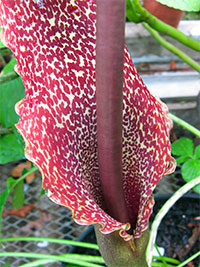
Fruit). On the photo: Sauromatum venosum - Voodoo Lily.
For links to these plants and other signs information, see
full Plant Horoscope
Date: 24 Jun 2018

Date: 24 Jun 2018
4
steps how to check and save a tree:
1. Checking. To make sure a fallen tree can be
restored, check:
a) Roots: If less than a half of root ball is out and has
been exposed less than a week, the tree has more chances
to recover.
b) Trunk: scratch-test the bark, if it is green
underneath, then the tree is alive and worth saving.
2. Trimming. Before lifting, trim the tree. Bush
the crown approximately half-way, keeping round shape. If
the tree has only an upright trunk left, cut off the
broken top. It may bush out from the top.
3. Lifting and securing. Using towing strips or
strong thick rope, pull the tree up. For larger trees, you
may use a power of a pick up truck (we use our golf
carts). Hammer 48"metal stakes ($5 from Home Depot) 3-4
ways around the tree, at 45 degrees, 5 ft away or more
depending on tree size, and secure the tree with a strong
rope. Make sure to check rubbing points from now on and
loosen as needed to avoid bark damage and creating braking
points.
4. Maintenance. Water the tree on regular basis
and give it a few weeks for new buds to appear in case it
lost all its leaves. Some trees may take a few months to
recover. Keep the stakes at least for a year.