Garden Blog - Top Tropicals
Date:
Shipping plants during hot weather. Ship plants now or wait until it gets cooler

Q: Can you ship my plants now or should I wait until it gets cooler? Daytime temperatures here are around 90F.
A: Top Tropicals ships year around. In transit, packages are usually kept in a temperature controlled environment. In hot summer time, it is still safe to order plants in mail, as long as the box is not left at your doorstep in full sun.
Keep your eye at the weather forecast and if temperatures get to extremes (over 95F daytime), we strongly advise that you be present to accept delivery. As your package may be left on your doorstep by the carrier, this prolonged exposure to heat may be harmful to the health of your plants.
If no one is available to accept delivery, we suggest that you contact our customer service to postpone shipment until a later date or coordinate an alternate delivery address, or simply use your work address for delivery - so you can get your plants without delay. You may also use the delivery address at FedEx pickup locations to avoid delays!
We monitor the weather at destination before shipping. When daytime temperatures in your area are over 90F, your shipment may be delayed to ensure plants have a safe trip and do not overheat in the delivery truck. See information on shipping process and terms.
Please contact us for more info on holding orders during hot weather.
Read more about hot weather shipping...

Date:
Meet PeopleCats of TopTropicals. Charlie, the Indoor Hunter
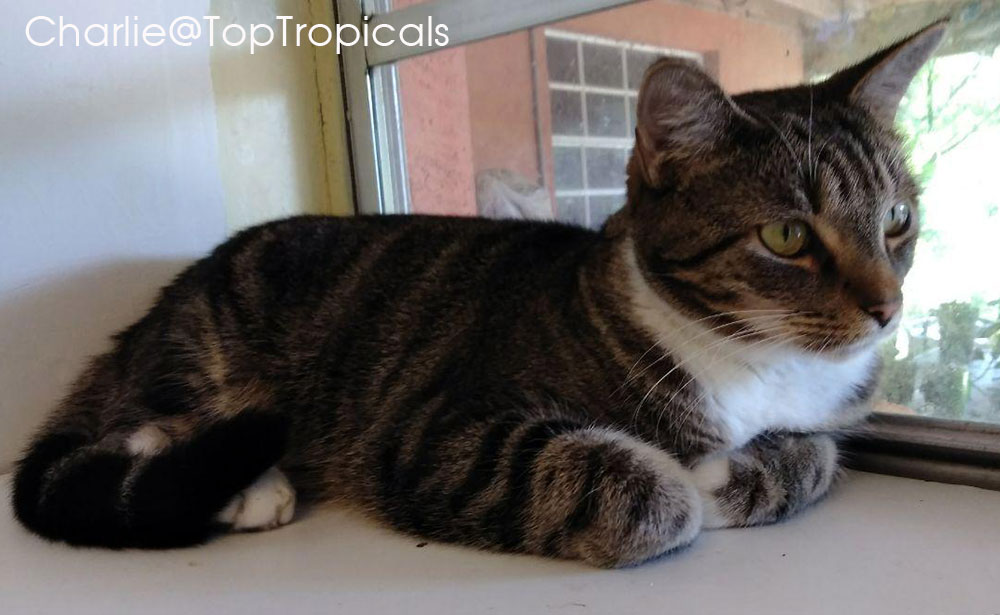
Carlie was a kitty drop off with LadyBug, Rickie, and Purry.
Charlie is Jamie's baby. She has an attitude of a teenager, one minute she
loves you and the next - wants nothing to do with you. Carlie stays with the
inside PeopleCats, she says it's too big in the outside world for her and she
gets scared. Carlie has a fun game (fun to her): she plays around 2:00 am in
the morning, she loves to drag random items down the hall (socks, toys,
shirts, even blankets) in her mouth MEOOOWWWING as loud as she can. She then sets
the items down on her human's bedroom rug and waits for her human to say
thank you. We're pretty sure her hunting instinct is off...
Check out and more Cat of the Day stories.
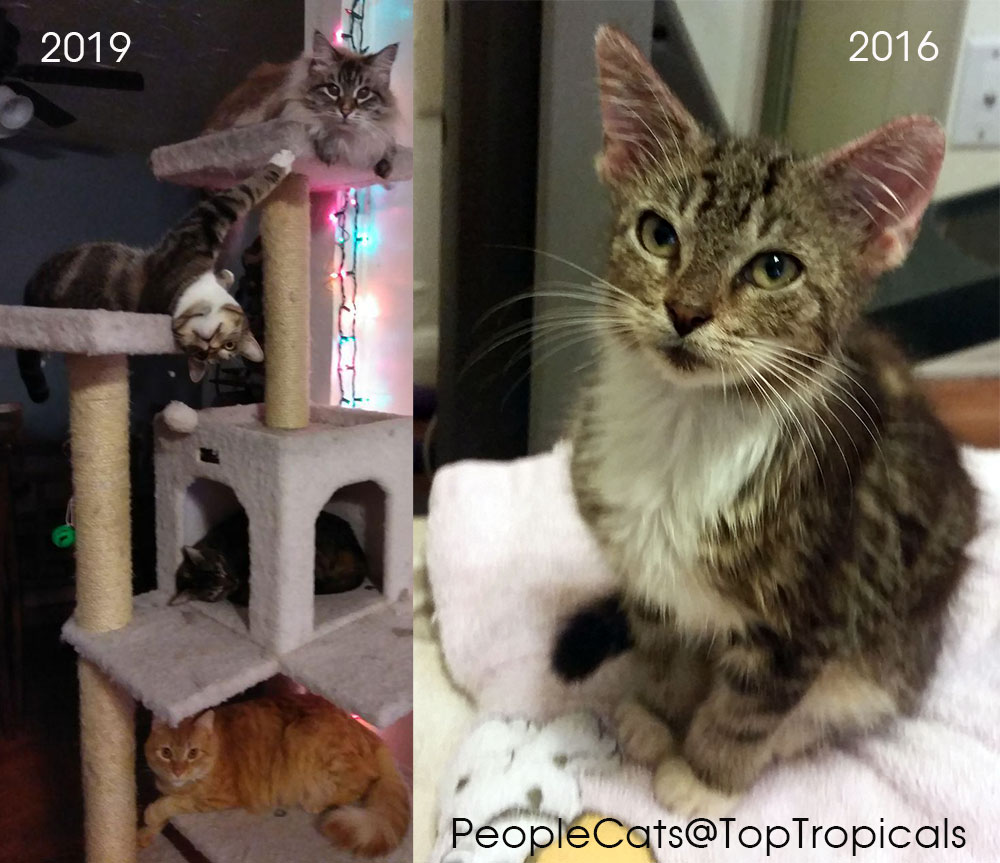
2019, from Top to Bottom: Moe, Charlie, Bagheera, and Snitch. 2016: Charlie
Date:
Seven rules of cold protection for tropicals
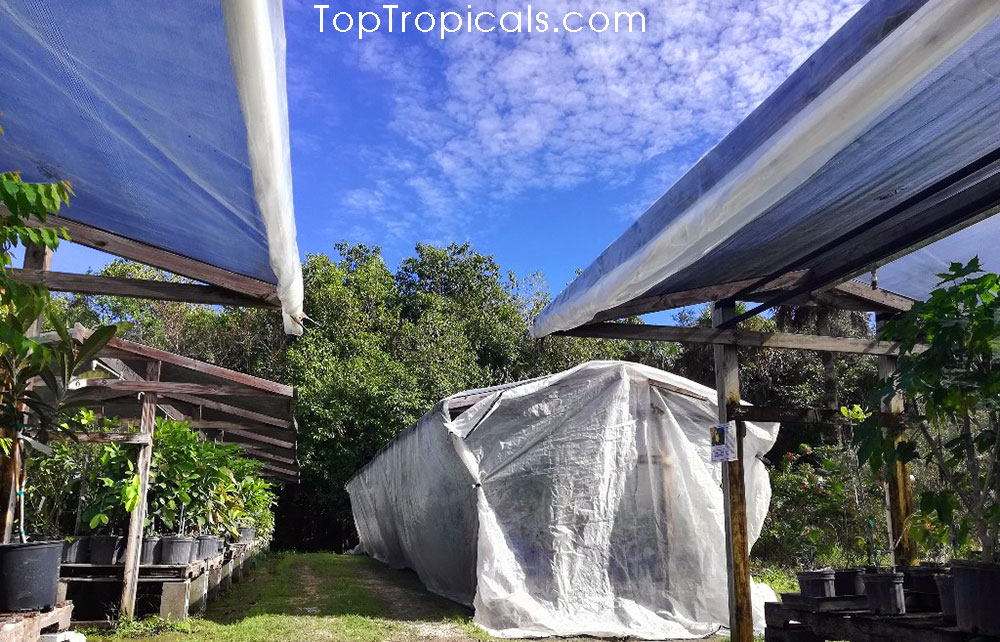
Q: I was always wondering how you guys manage to grow true tropical trees in Florida? I live in Puerto Rico and we have Breadfruit trees growing here in a wild... but my sister lives not far away from you, in Orlando, which is much colder, and I wonder if I can get her a Breadfruit tree for Christmas?
A: Your
sister can grow a Breadfruit tree in Orlando either in a pot (and bring it indoors during
cold periods) or in the ground inside a structure (an elclosed conservatory
with heating system). See our customer's Greenhouse in Virginia. Cold protection of tropical plants is a lengthy
subject and we have many interesting publications about it in our managine
Tropical
Treasures and on the website. In a nutshell, when growing tropicals outside of
tropical climate, you need to follow these 7 rules:
1. Cut watering to a minimum. Cold+wet kills tropical roots.
2. Water thirsty plants before a cold night. Jucy leaves have fewer
chances to be cold-zapped.
3. Wind protection is more important than a temperature drop. Plant
tropicals close to a house or surrounded by other trees.
4. Duration of a cold period is more critical than the cold itself. If
expecting long cold hours, bring up all available protection resources.
Christmas lights or propane heaters - as long as there is a heat source,
everything helps!
5. Remove plastic covers during the daytime so plants don't get
"cooked" in the sun. Fabric covers are better than plastic.
6. Grow ultra-tropicals in containers and bring them inside the garage
or even indoors during the cold.
7. Use SUNSHINE plant boosters and feed your plants well during Summer to improve cold hardiness.
Related topics:
About Cold Protection
Cold protection - winter action for your plant collection
Improving cold hardiness before winter: fertilizer and micro-elements
Cold hardy tropical fruit trees
Date:
Meet PeopleCats of TopTropicals. Cindy's Purry - Jackson's Nanny

Purry came in the same litter with LadyBug, Ricki, and Charlie.
She now lives in Cindy's house as an indoor cat. She is the most lovable and purring purrrrson.
Purry (or Pursey) has a little ward she faithfully looks after... Her soft purrs put Baby Jackson Michael every time to sleep!
Check out and more Cat of the Day stories.
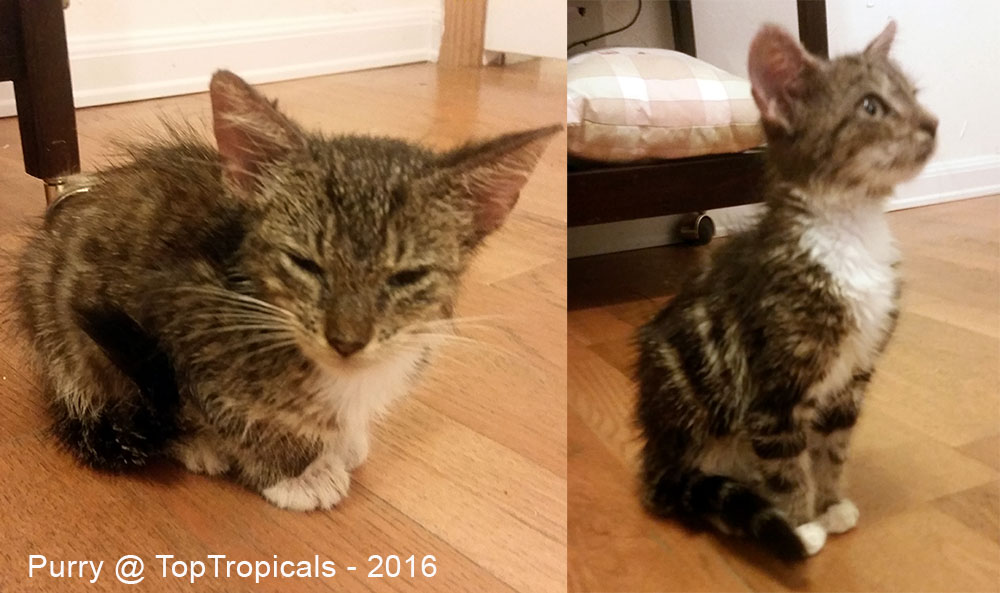
Purry - 2016
Date:
Meet PeopleCats of TopTropicals. Cat, Pet & Plant Community
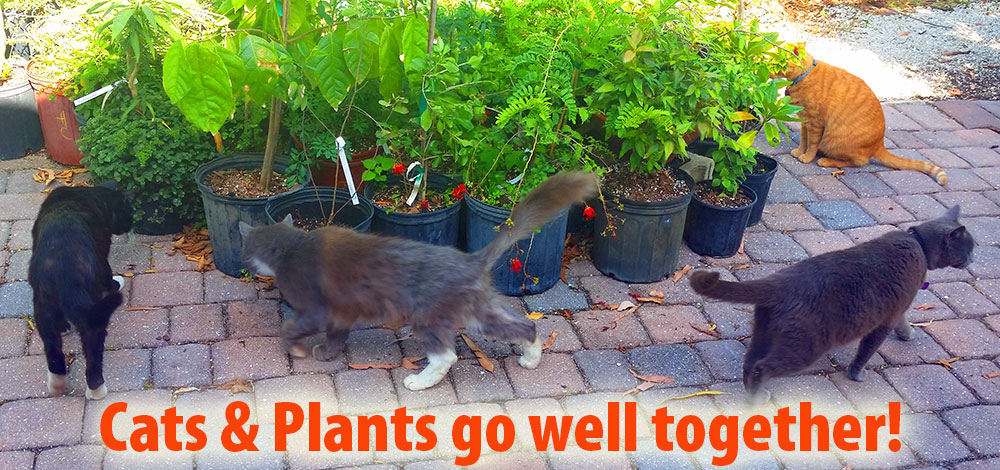
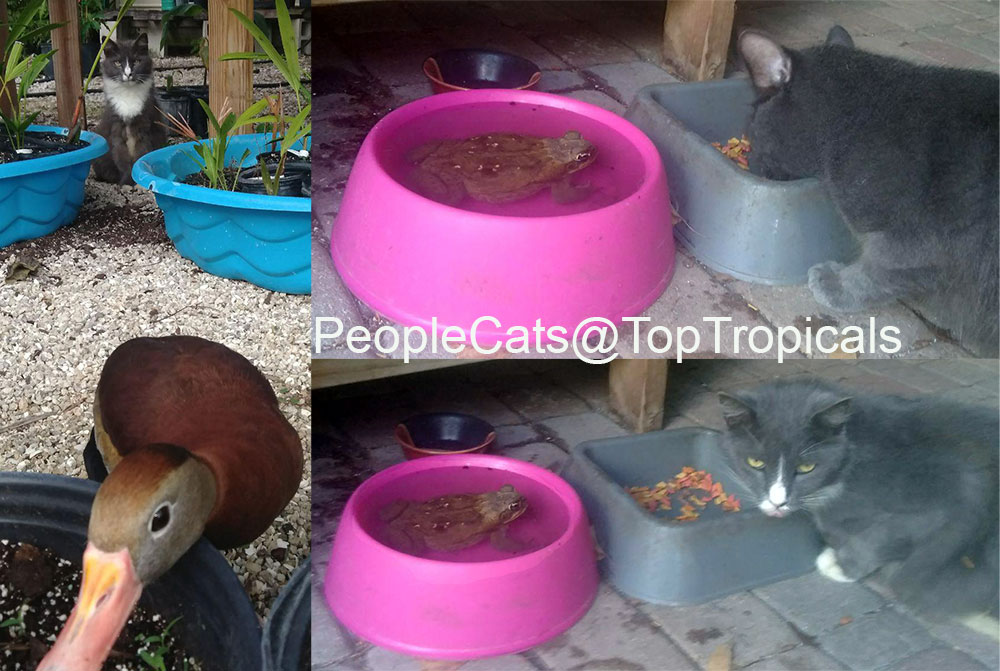
Marco watching Dobi Duck; King & Marco with their Pet Frog

Barcy, Wesley and Coconuts at sweet liquor tasting
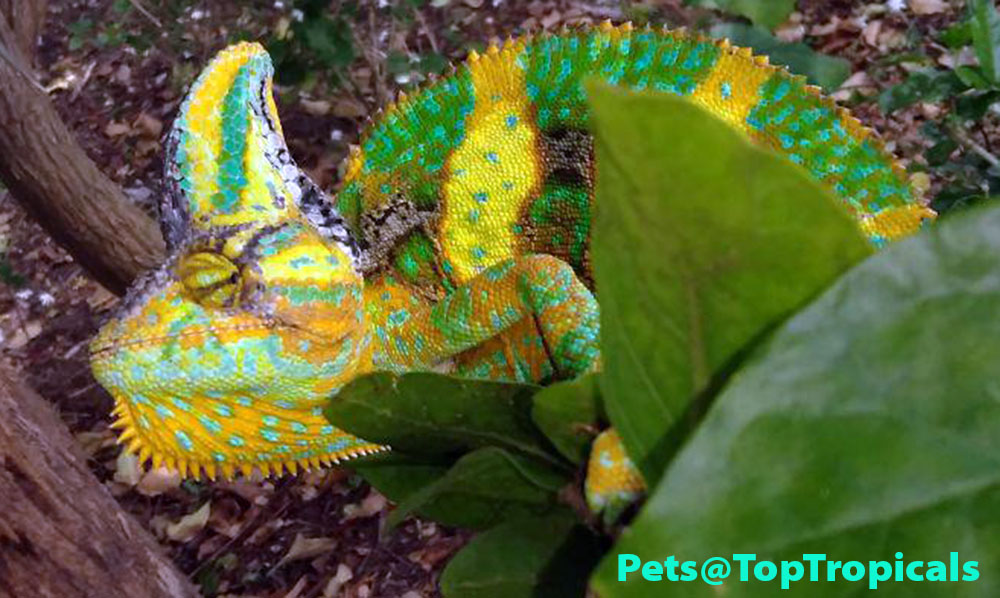
Anyone knows the name of this creature? He feeds on our Jasmines!
Date:
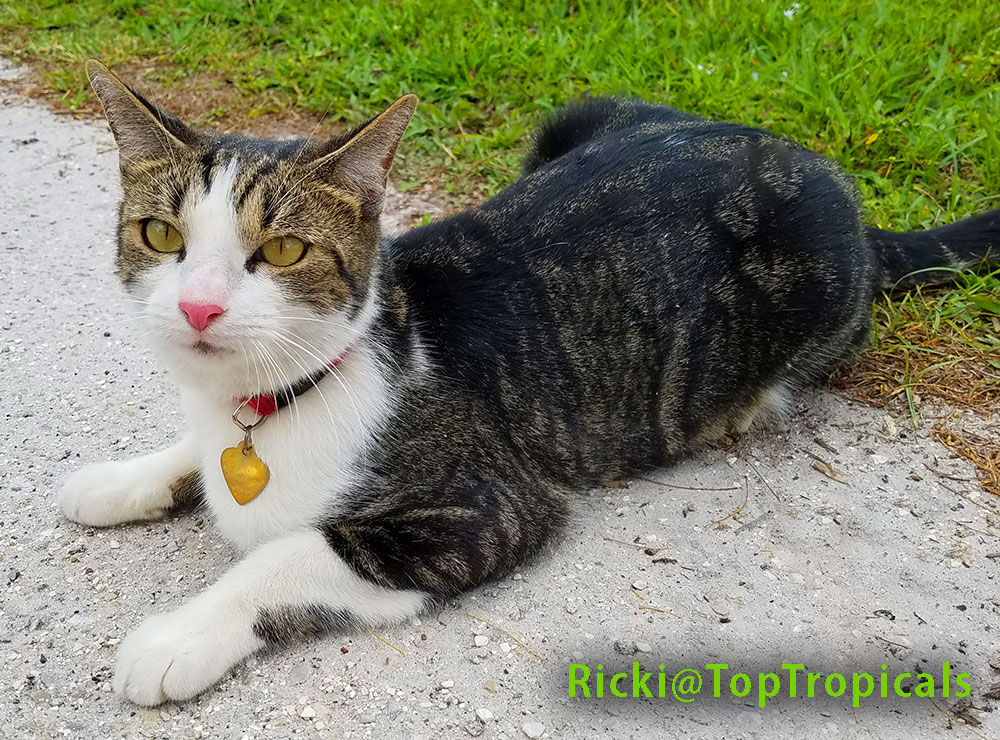
Meet PeopleCats of TopTropicals. Cat of the Day: Ricki
The Smallest Cat
Ricki is a tiny little cat. He is already 3 y.o. but still feels shy because he always has been the smallest one... He arrived to TopTropicals as a little kitten, along with his 3 sisters, Charlie, Purry, and LadyBug, in a box. Ricki was the last kitten in the littler and almost half the size of other kittens! But his ears were the biggest. So he became a very Wise Puuurson who knows how to Listen.
Not only Ricki was the smallest, but he also was pretty sick when we first got him at the age of 4 weeks. He had a bad infection in both eyes and could hardly see anything... His 2 sisters got adopted by employees, but no one wanted to adopt poor Ricki... so he stayed at TopTropicals. Almost 2 weeks of therapy finally helped him to get all better. Now he is one of the cutest Little People!
Ricki has his own spot at the corner of a dinner table. He is not interested in stealing any food (unlike Wesley), he just wants to be involved in a dinner conversation...
Ricki likes treats and remains very shy, staying indoors. If you visit our Garden Center, you may bring him a small treat - his favorite "Temptations".

Wesley and Ricki at Dinner conversation
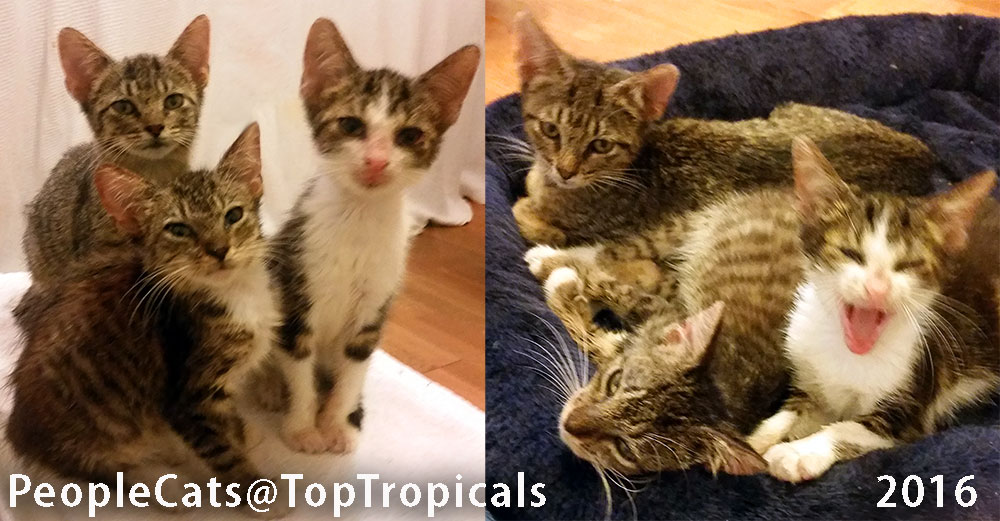
LadyBug, Purry, and Ricki, 2016.
Date:
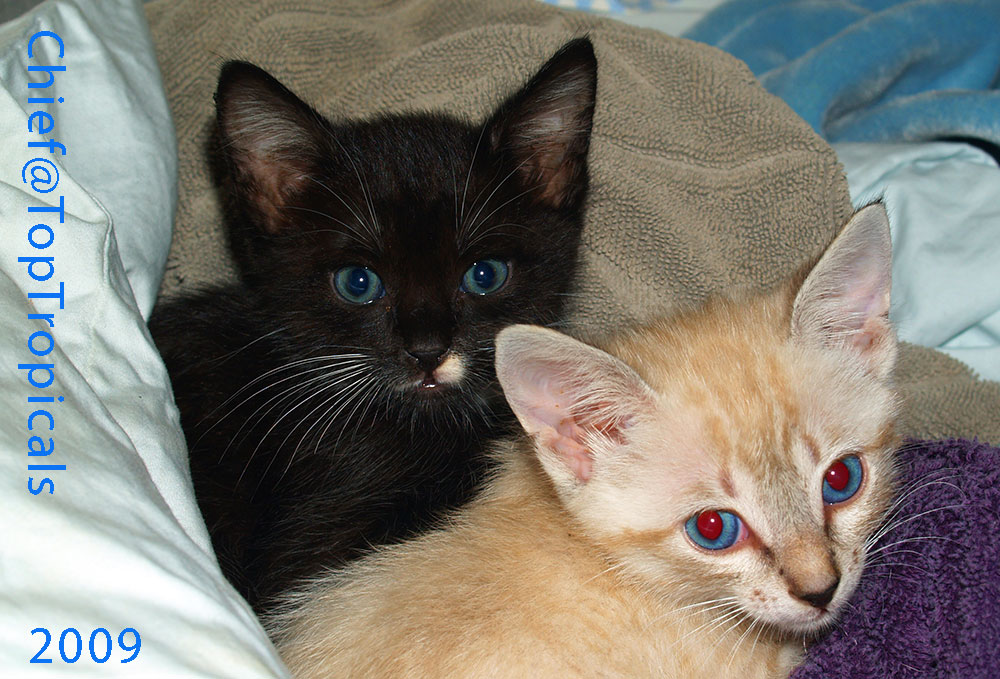
Meet PeopleCats of TopTropicals. Cat of the Day: Chief
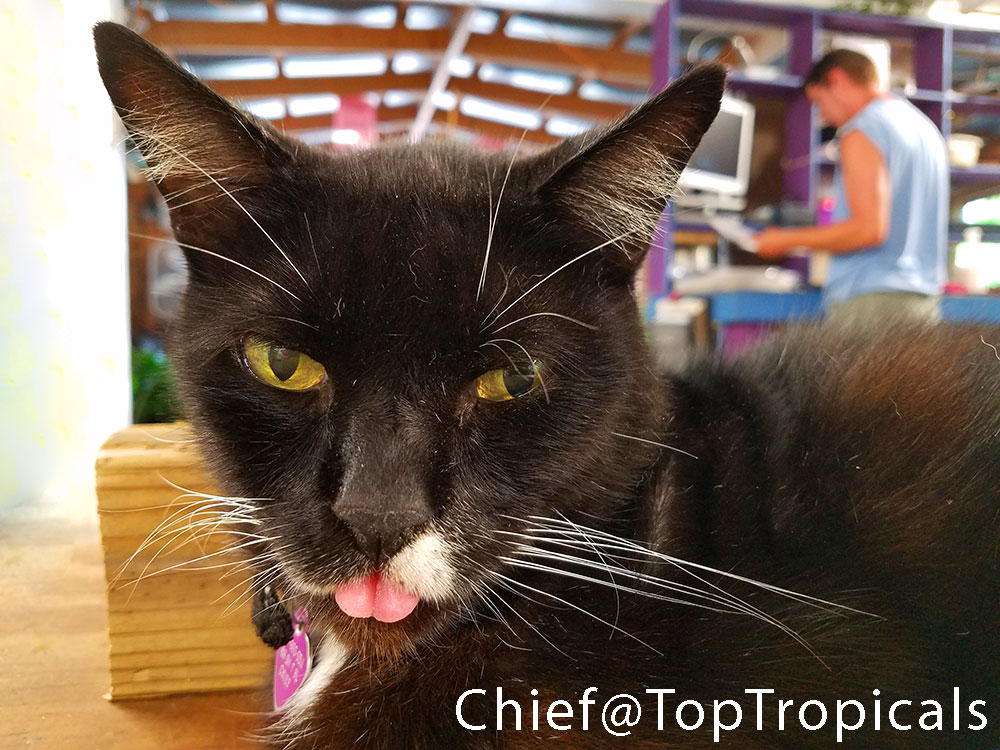
Shipping Department Supervisor
Chief is one of the oldest PeopleCats at TopTropicals. And of course the
most experienced one. So he is in charge of the Shipping Department.
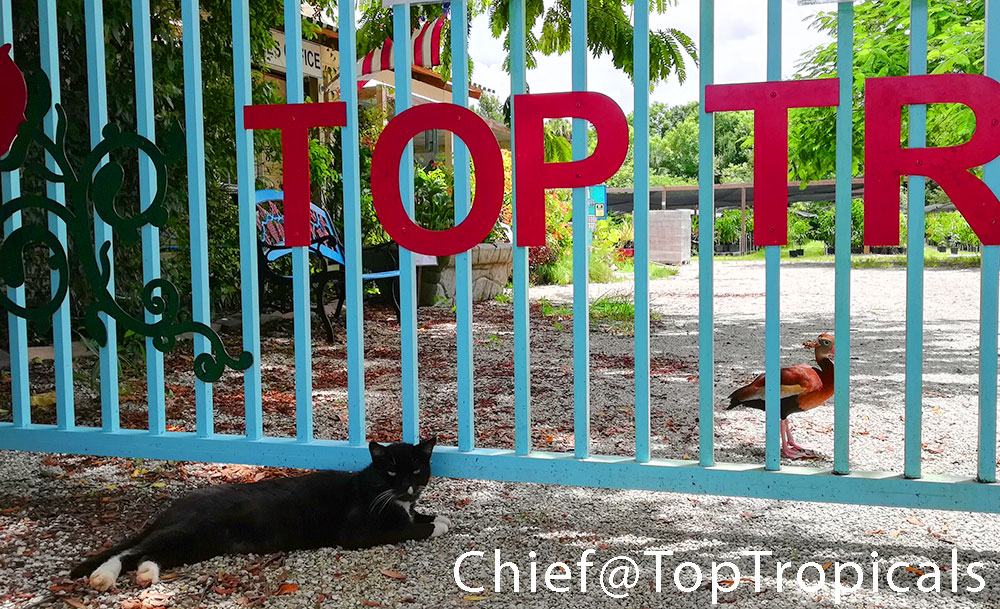
Chief likes to chill out in front of the nursery gate together with Marco, Lil S*t and Dobi Duck.
Chief doesn't like car rides to his vet and when it happens, he is very
loud. The sound he makes is "Oy-yo-yo-yooooy!!!"
Chief likes milk. He has a white spot on his black face - from drinking
so much milk! No matter how much milk we buy for him, there never seems to
be enough. Chief even has a refrigerator for his milk. If you come to visit
Chief at TopTropicals Garden Center, you may bring him a small bottle of fresh
milk!
Thank you for your purrrrrrchase for Chief!
Date:
Growing mango tree in California
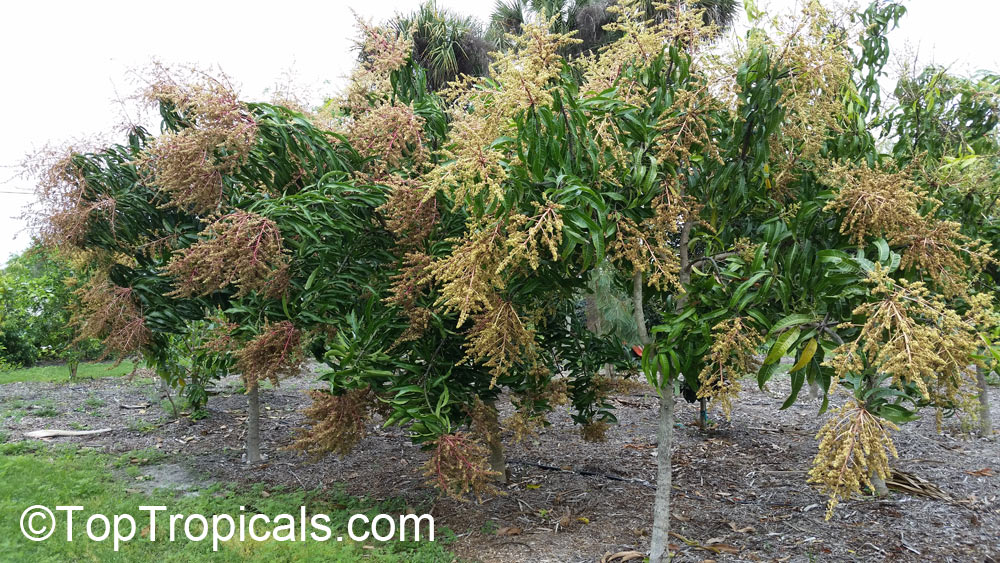
Q: I just ordered a mango tree. I live in Southern California and was wondering if you have any tips on how to acclimate the mango to our climate. I know it is coming from hot and humid Florida to hot and dry Southern California and don't want to kill it because of the differences in climate.
A: Mangos in fact prefer dry conditions rather then humid. It may
be perfect conditions for a mango tree at your place. Plant your tree in a
pot size of the root ball; give it ample water and then let the soil surface
slightly dry before watering again. Keep the plant in bright shade and
gradually move into full sun. Once the tree is recovered from shipping stress, you
may plant it in the ground and make sure to protect from freezing temperatures
in winter. Use Mango Food for quick establishing and better fruit production. More to
read:
Mango boosters
How to grow Mango in hot climates
Growing Mango in Arizona.
Date:
Growing desert roses
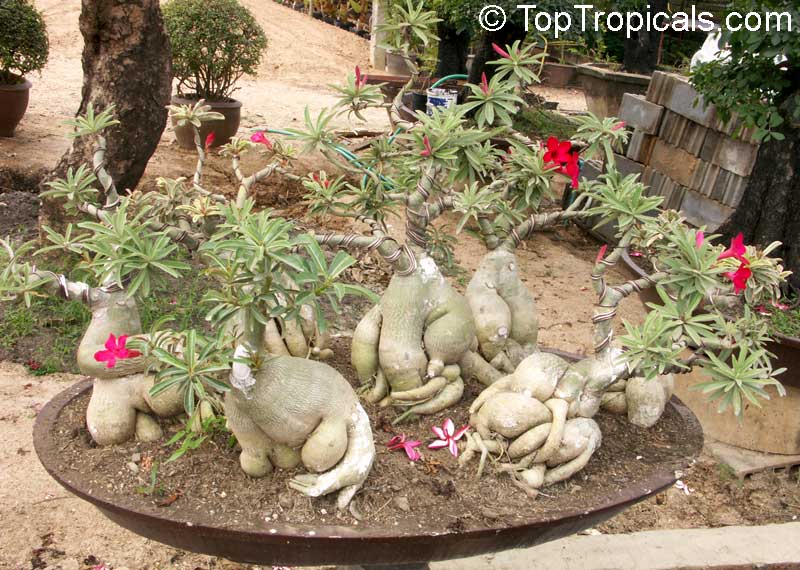
Q: I purchased a Desert Rose and planted it in Adenium mix. I keep it in full sun with once a week watering assuming this is a desert plant that likes lots of sun. Some leaves turned yellow and now I am not sure should I move it into shade or need to water more? Or maybe fertilize with something?
A: Desert Rose - Adenium, unlike cacti and other succulents, prefers filtered light. It can grow in full sun but leaves look healthier in light shade. Watering must be very moderate, however don't let soil harden like a rock: water again right after the soil gets dry. We suggest to use special Adenium Mix. Cactus mix may work well, as well as regular potting mix, in which case it is recommended to add a bit of limestone (we simply put sea shells on top of the pot - it looks very pretty!) - because adeniums prefer slightly alkaline soil (while most of tropical plants like acidic soils). If leaves turn yellow, this may be a sign of underwatering. Use water soluable fertilizer with high phosphate as foliage spray, and only on healthy plants, according to label dosage. It helps both caudex growth and flowering. Make sure to avoid fertilizer contact with a caudex.
RECOMMENDED SUPPLIES:
Adenium Plant Food - Flower and Caudex Booster
SUNSHINE-BC - Caudex booster
Adenium Soilless Mix
Read more about growing Adeniums:
What you need for successful growing Adeniums
Growing Exotic Adeniums
Date:
How to propagate plants from cuttings. Top (Tropicals) secrets.
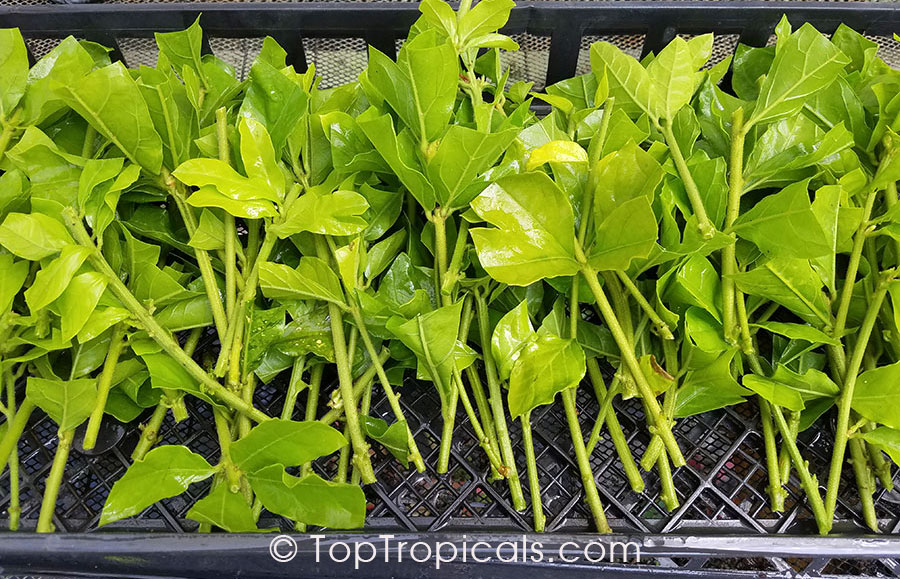
Q: After pruning my jasmine, I have so many branches and I don't have a heart to through them away, can I use them to make more plants? Please tell me what size cuttings and do I need to remove leaves? Should I just stick them in the ground? Will they root? I don't know if you will be willing to share your secrets?
A: We are always happy to know that you grow more plants, and make our World better! These are some useful tips for the propagation of tropical plants using cuttings:
- Cuttings and leaves. Use cuttings 2-5" long. Strip leaves from
the bottom. Cut larger leaves in half to reduce evaporation.
- Soak cuttings for 15-30 min in SUNSHINE solution.
- Mix. Use special well-drained mix with lots of soil conditioner: we
have a special professional propagation mix for cuttings.
- Mist. Put community pots or trays with cuttings in mist, or if you
don't have mist - cover the pot with a clear plastic bag to create a
mini-greenhouse.
- Shade. Keep propagation pots in bright shade and never allow direct
sun rays.
- Rooting hormone: yes, use it if you have it. Not only it promotes
root formation but also prevents from fungus so the cuttings won't rot. We use
Dip-N-Grow.
- Rooting and food. Check in 2-3 weeks for roots. Once you see the
little roots, begin fertilizing with a special Baby-Plant Food and make sure never exceed recommended doze otherwise
you may kill the cuttings.
- Establishing. Once roots start growing, plant in 4" pots in a well-drained potting mix and watch the beauty grow! Gradually move to
the full sun only when little plants establish and start new growth.
If you are lucky to make more rare plants than you can use, contact us, we will buy them from you or trade for your dream plants! In fact, one of our customers from many years ago started selling us baby plants that he propagated from our plants, and now has a successful business (Karma Nursery); we buy a lot of plants from him every month!
For more ideas on tropical plant propagation, see also:
- Secrets of turtle tank propagation
- 5 secrets of propagation