Garden Blog - Top Tropicals

Date: 2 May 2019

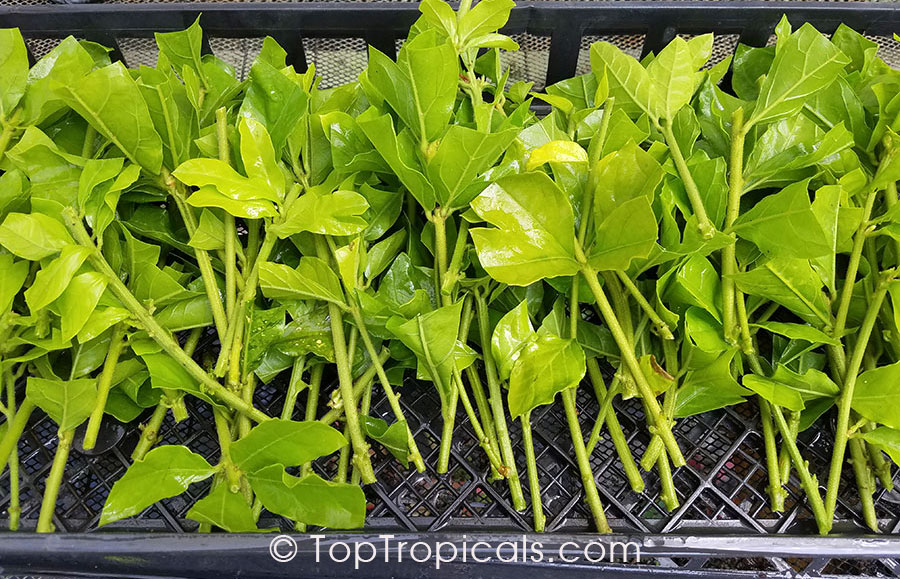
How to propagate plants from cuttings. Top (Tropicals) secrets.
TopTropicals.com

Q: After pruning my jasmine, I have so many branches and I don't have a heart to through them away, can I use them to make more plants? Please tell me what size cuttings and do I need to remove leaves? Should I just stick them in the ground? Will they root? I don't know if you will be willing to share your secrets?

A: We are always happy to know that you grow more plants, and make our World better! These are some useful tips for the propagation of tropical plants using cuttings:

- Cuttings and leaves. Use cuttings 2-5" long. Strip leaves from the bottom. Cut larger leaves in half to reduce evaporation.
- Soak cuttings for 15-30 min in SUNSHINE solution.
- Mix. Use special well-drained mix with lots of soil conditioner: we have a special professional propagation mix for cuttings.
- Mist. Put community pots or trays with cuttings in mist, or if you don't have mist - cover the pot with a clear plastic bag to create a mini-greenhouse.
- Shade. Keep propagation pots in bright shade and never allow direct sun rays.
- Rooting hormone: yes, use it if you have it. Not only it promotes root formation but also prevents from fungus so the cuttings won't rot. We use Dip-N-Grow.
- Rooting and food. Check in 2-3 weeks for roots. Once you see the little roots, begin fertilizing with a special Baby-Plant Food and make sure never exceed recommended doze otherwise you may kill the cuttings.
- Establishing. Once roots start growing, plant in 4" pots in a well-drained potting mix and watch the beauty grow! Gradually move to the full sun only when little plants establish and start new growth.

If you are lucky to make more rare plants than you can use, contact us, we will buy them from you or trade for your dream plants! In fact, one of our customers from many years ago started selling us baby plants that he propagated from our plants, and now has a successful business (Karma Nursery); we buy a lot of plants from him every month!

For more ideas on tropical plant propagation, see also:
- Secrets of turtle tank propagation
- 5 secrets of propagation

Date: 27 Apr 2019

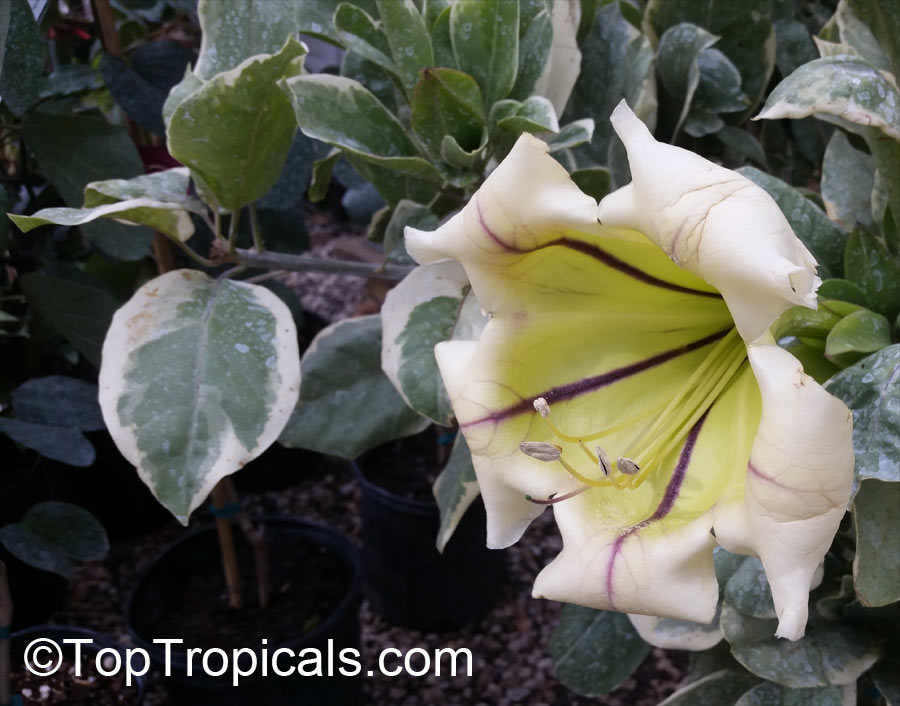
Impossibly exotic Chalice Vine

TopTropicals.com

By Onika Amell, our flower specialist

Q: I live on Sanibel Island, Florida and I'm looking for an exotic vine to cover the side of my house. A friend suggested Chalice vine. What can you tell me about it and will it tolerate the salty soil and salt spray of the island?

A: Chalice vine, or Cup of Gold - Solandra maxima - is a large, woody, scrambling tropical vine with huge, cup-shaped flowers. Variety Variegata has also amazing cream and green variegated foliage. The flowers are fragrant, especially in the evenings, with a lovely coconut-like aroma. This unusual vine will give you intermittent waves of large, wide flaring golden trumpets.
Even when not in flower, it is beautiful as new growth is bright and purple-bronze in color. It has a large and loose spreading habit. As this vine ages, flowers will appear along the entire length of branches off the main vine. So, just think about it - up to 100 feet vine and you will have about 500 flowers at the same time! They are very fast growing and usually bloom from February until May. Plant them... Sit back and wait... Four months of heaven!
They are great for seaside gardens as they are very tolerant of salt spray and salty soils. Will, in fact, thrive in most any well-drained soil.
Give it a large, sturdy pergola or trellis, or train it to grow up the side of a house where it will spill down over windows and doorways to take your breath away... Chalice vine is impossibly exotic!

Date: 27 Apr 2019

Quick shade for your driveway

TopTropicals.com

Q: Please help! We just moved into a new house in Florida and don't have any mature trees yet, but the sun is already brutal! Can you suggest any super-fast growing shade tree that can make shade over my driveway as soon as possible?

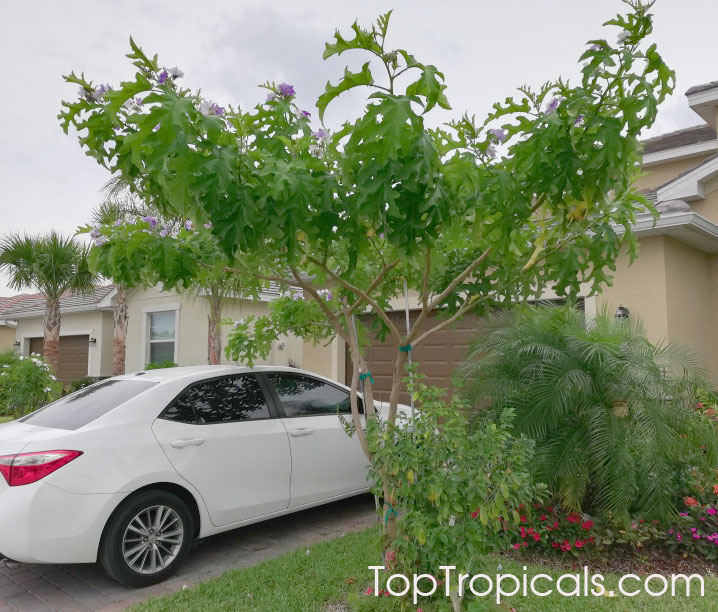
A: Check out Giant Potato Tree - it is very fast growing, has very large leaves plus very pretty purple flowers as a bonus year round! The pictured tree was planted from 3 gal only 6 months ago, and already covers with shade the whole car. It is small to a medium size tree, but one of the fastest growing. If you are looking for a larger tree and willing to be more patient, here is the full list of tropical and subtropical fast growing shade trees. Most of them may take a few years until they reach a mature size, however, in order to enjoy your shade tomorrow, you must plant the tree today!

TopTropicals.com

Date: 23 Apr 2019

Fruit tree size and production

TopTropicals.com

Q: I am interested in a Strawberry Tree... does this tree produce fruit while still small or do I have to wait until it is large before it produces? Should I fertilize it so it produces sooner? I ask because my garden is not large and I prefer to keep my fruit growing trees in a smaller size. Also, how big is the fruit and does it have a seed?

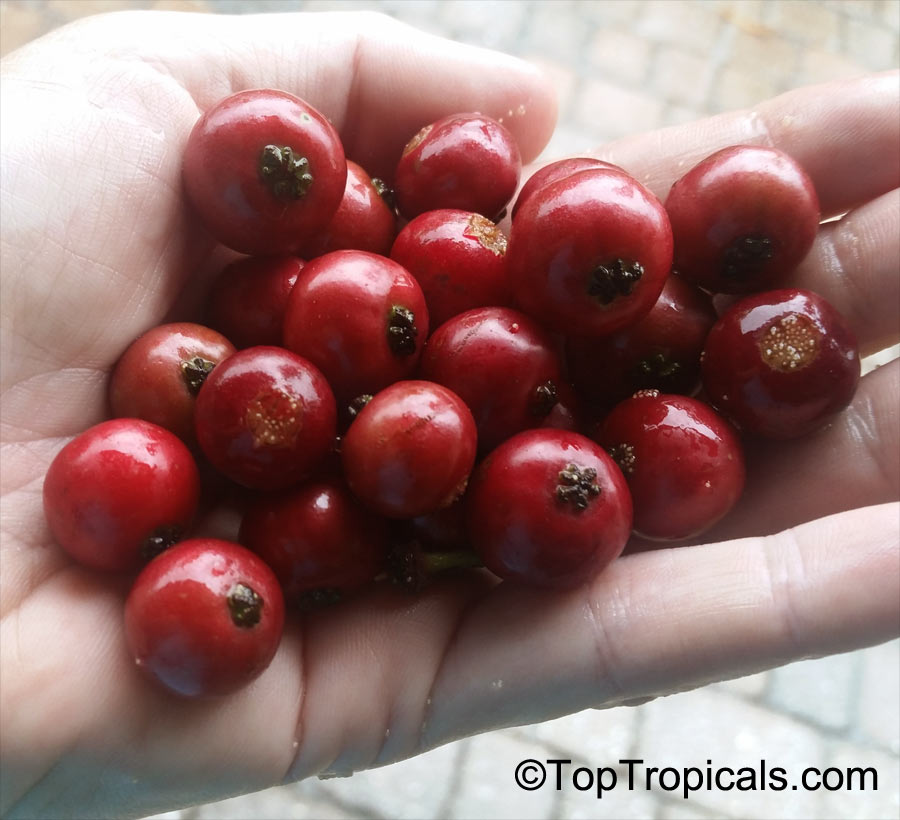
A: Strawberry Tree, Muntingia Calabura, is one of those fascinating fruit trees that starts flowering and fruiting in small size. We have plants growing in 1 gal containers that already have flowers. This tree is nearly year-round producer providing warm conditions. It is a fast grower, although a compact tree when mature, and can be trimmed to desirable size without affecting production.
Muntingia fruit is one of our favorites. It is super sweet and juicy, and the seeds are tiny small, not bigger than the strawberry seeds, so you don't have to spit them out. The fruit size normally about 1/2 inch, but we have a tree in our garden that produces almost cherry-size fruit! See picture above. The secret is, good watering and using fruit booster - SUNSHINE honey micro-element supplement. We also fertilize our fruit trees using Fruit Festival and Mango-Food fertilizers.

Date: 23 Apr 2019

Love (and FEAR) the black flowered Dead Rat Lily!

TopTropicals.com

By Mark Hooten, the Garden Doc

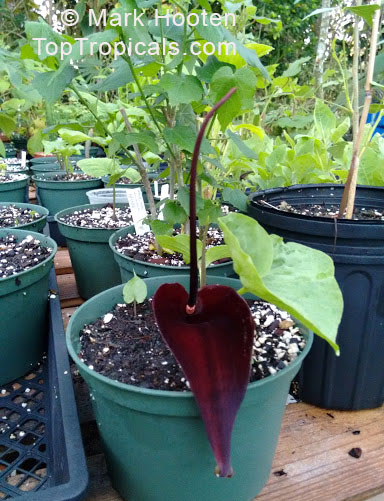
I acquired this rare and freaky aroid, (Typhonium roxburghii) when my wife Suzie and I were living in So. California in the early 1990's... When I first saw this plant (growing in a few pots of bamboo, along with other weeds), it had perhaps the most unusual flowers of anything I had ever seen...

Continue reading...

TopTropicals.com