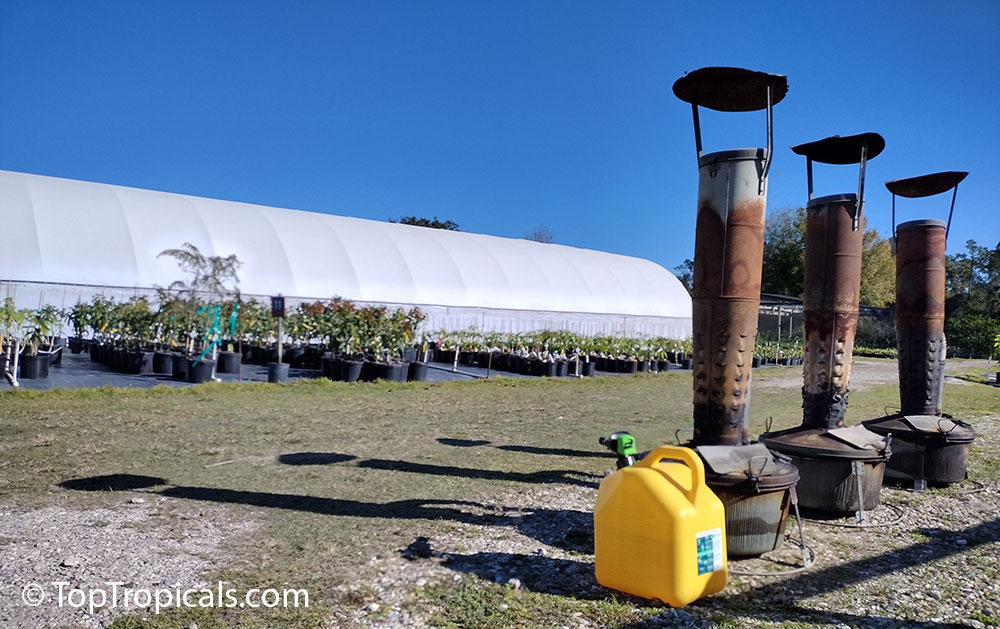
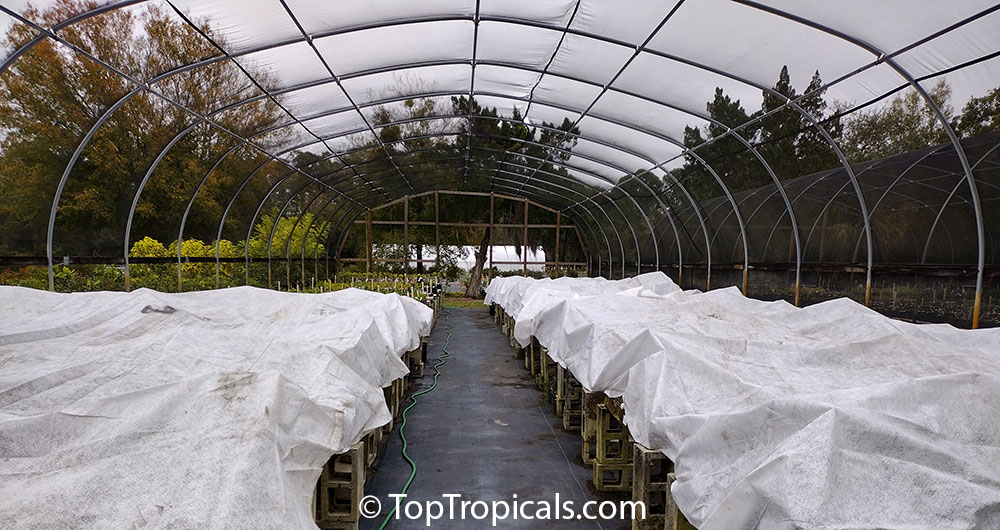
Smokey and Sunshine Wrap Up the Garden with Frost Cloth Before the
Chill.
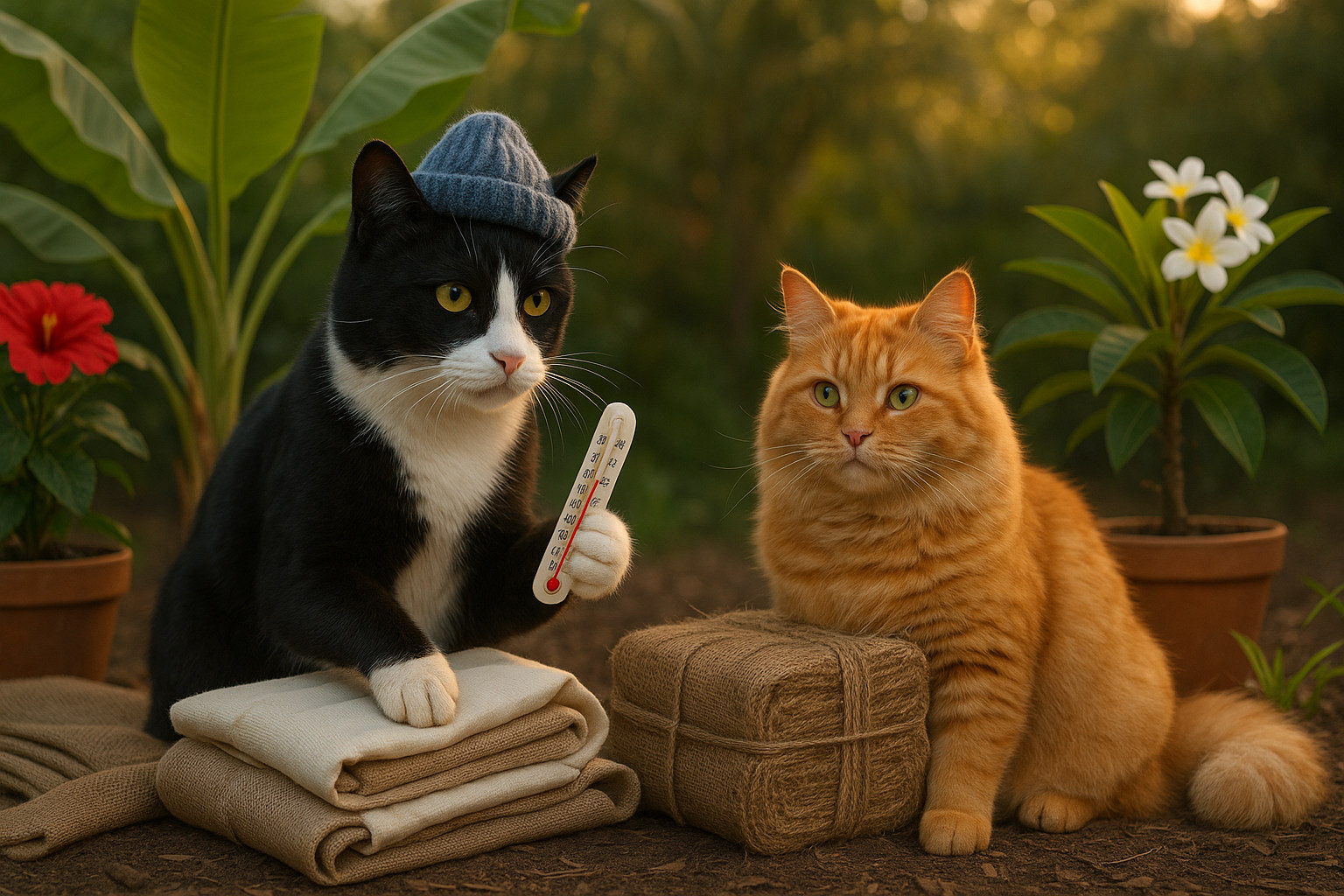
Smokey: "Thermometer says 45. Time to wrap the bananas!"
Sunshine: "You wrap the bananas. I’ll guard the mulch… from this
sunny spot."
Smokey: "Teamwork, Sunshine. Teamwork."
🌡️ Cold nights are coming - but your
tropicals do not need to shiver!
Even in sunny Florida and other warm zones, one cold snap
can undo months of growth. Preparation is everything. Tropical plants can
handle a lot, but they dislike surprises. Let’s make sure
your garden stays safe, strong, and happy all winter long.
Tips from Tatiana Anderson, Top Tropicals Plant
Expert
👉 Group and Check Your Plants
You already know which plants are in pots and which are in the ground.
What matters now is prioritizing by cold sensitivity.
Identify the tender tropicals – papaya, banana, plumeria, adenium,
heliconia – and decide which ones get covered first when temperatures
drop.
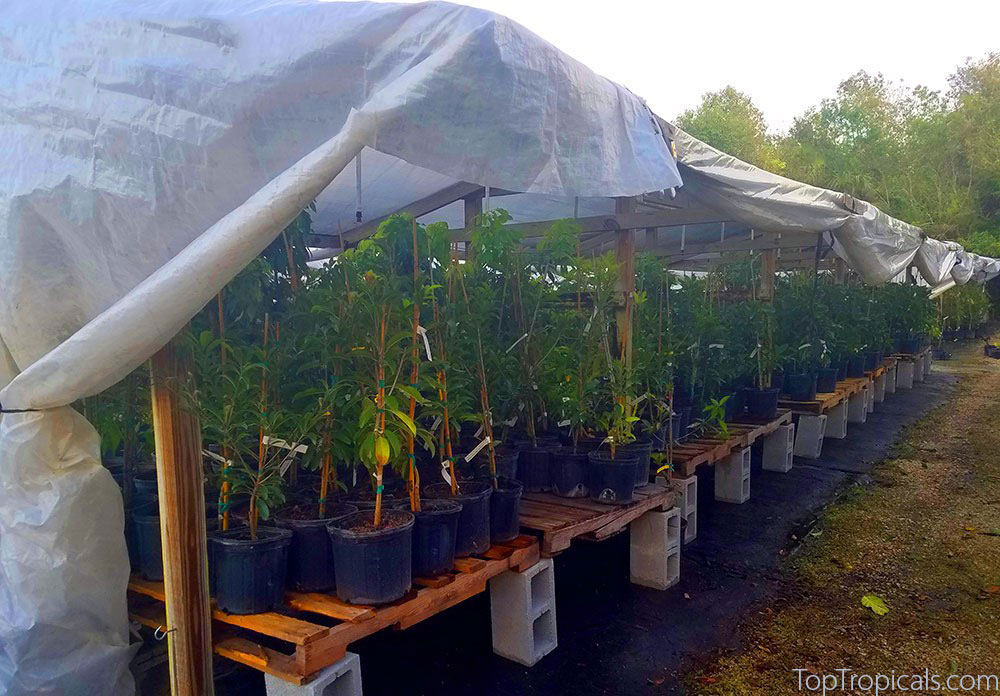
Keep frost cloths or old sheets near those areas, ready to grab fast. If
your garden is large,
label protection zones or mark plants that always need extra care. The goal
is to have a plan, not a panic, when the cold alert hits.
Once you know your priorities, you can plan the rest of your protection
strategy.
👉 Feed and Mulch
Stop using high-nitrogen fertilizers by late fall. They push soft new growth
that freezes easily.
Add compost around the base of your plants and top with 3 to 4 inches of
mulch. Mulch acts like a blanket: it keeps warmth in, protects the roots,
and keeps soil moisture steady. Just make sure the soil drains well; cold
and soggy soil leads to root rot. In raised beds, check that water flows
away easily.
After you feed and mulch, it is time to look at how your local zone changes
the game.
👉 Zone-by-Zone Tips
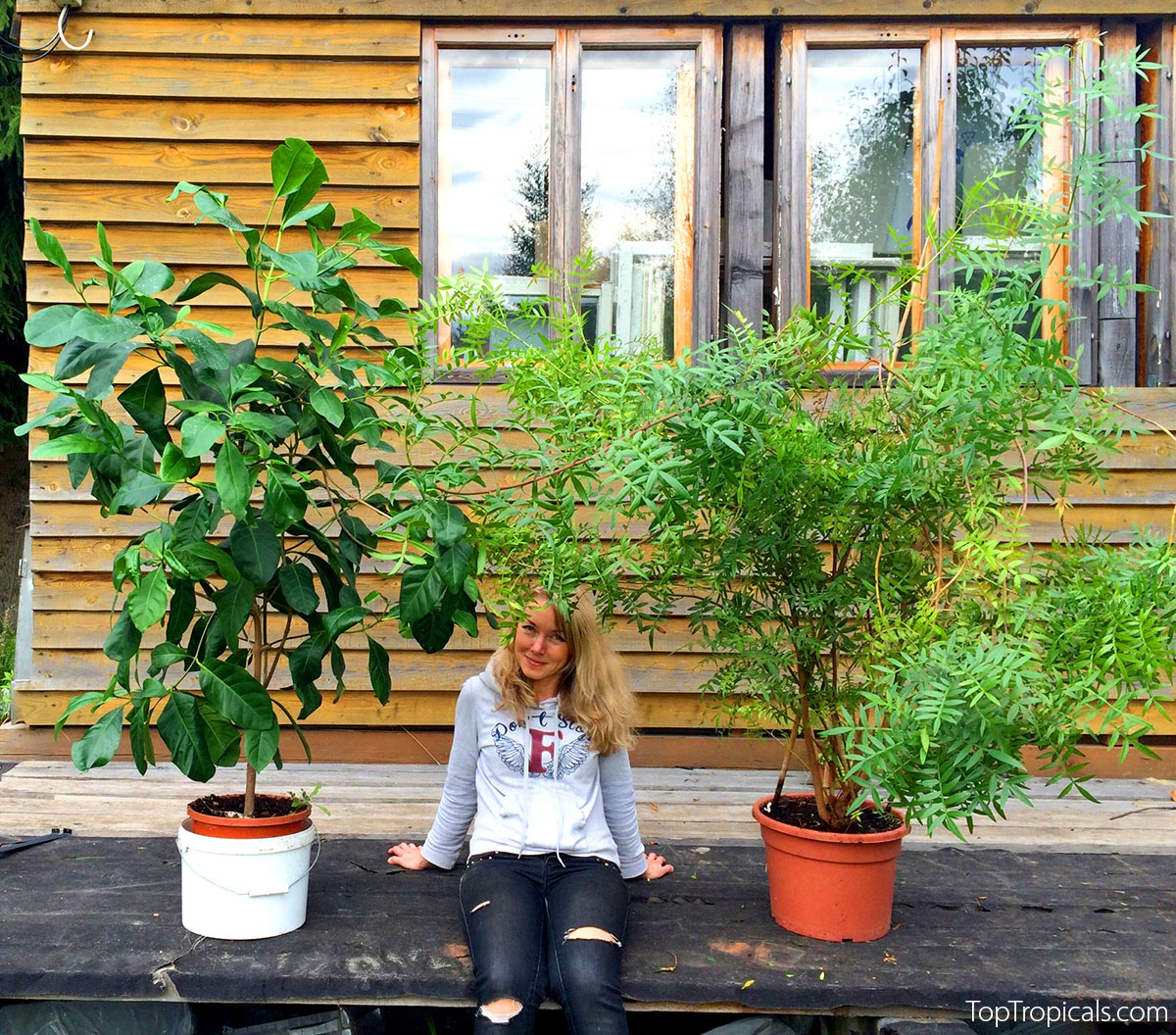
Moving Tropical Plants Indoors for Winter Protection
Zone 10: You are lucky! This is mostly a maintenance season.
Watch for root rot after heavy rain, trim lightly if needed, and protect
tender young trees during surprise chills. Keep some frost cloth ready just
in case.
Zone 9: This is the main action zone. Nights can dip into the
30s. Deep-water your trees once before cold nights to insulate the roots.
Apply heavy mulch, and have frost protection ready to go. If you grow
tropical fruit like mango or guava, consider wrapping young trunks in burlap
or foam pipe insulation.
Zone 8: This is where tropical gardening becomes creative. Stick
to cold-hardy tropicals such as loquat, guava, or cold-hardy avocado
varieties. Use portable greenhouses, wrap trunks, and move smaller plants
indoors or to a heated porch when frost threatens.
Now that the garden beds are set, let’s look at your pots and
containers – your most mobile plants.
👉 Container and Patio Plants
Potted plants are the easiest to protect but also the quickest to freeze.
Start reducing watering now so roots do not stay too wet in cooler weather.
Before moving them, check for insects hiding under leaves or in the soil.
Group your pots close to a wall for reflected heat and wind protection.
If you plan to bring them indoors, do it gradually. Move them closer to the
house for a few days before bringing them all the way inside to help them
adjust to lower light and humidity.
When the chill starts, many gardeners rush to move everything inside at once
– but a smooth transition works much better.
👉 Indoor Plants
When bringing plants inside, give them a good rinse to remove dust and bugs,
and flush the soil to wash out salts from summer fertilizing. Keep
them separate from your houseplants for a week to make sure no pests come
along. Expect some leaf drop – it is normal as they adjust to lower
light. Give them bright light near a window, and cut watering by about half
until spring. Avoid misting too much; good airflow matters more than
humidity during winter.
Many tropicals, like hibiscus, brugmansia, and crotons, may look tired for a
while, but they will bounce back quickly once days get longer.
👉 Timing Is Everything
The key is to prepare before the first cold warning. Check your weather app
regularly once nights start dropping into the 50s. Keep covers, mulch, and
supplies ready so you are not running outside at midnight with a flashlight
and a frozen hose. Have your frost cloths labeled by plant group and stored
in an easy spot. A little organization now saves a lot of stress later.
Many tropicals, like hibiscus, brugmansia, and crotons, may look tired for a
while, but they will bounce back quickly once days get longer.
Remember: the goal is to help your plants rest safely. Many gardeners prune
or fertilize too late in the season – we will talk about why that can
be risky next week." — says Tatiana Anderson, Top Tropicals Plant
Expert
Coming next mail-list: The best gadgets for cold protection (lights,
heaters, frost covers) and what NOT to do in winter.
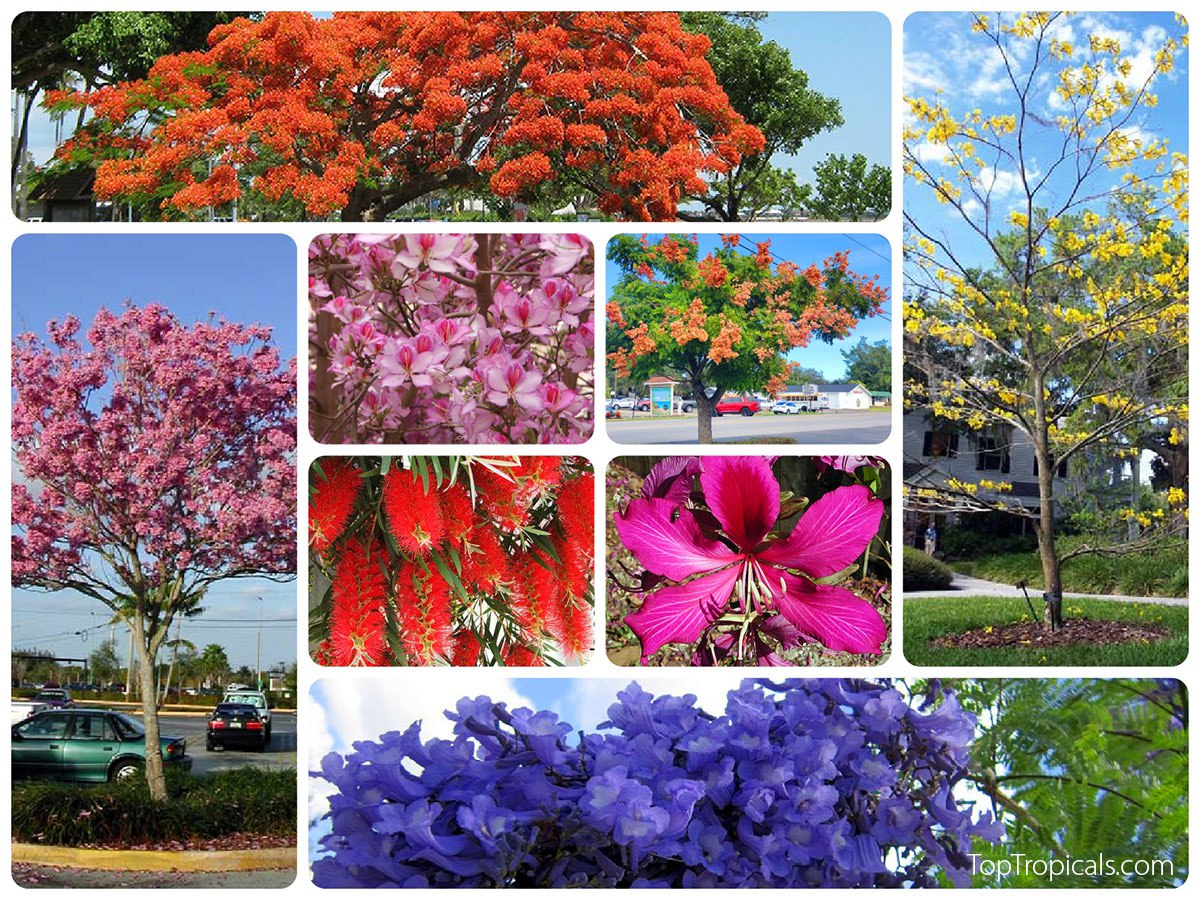
The diva of tropical trees. Huge red-orange flowers blanket the branches
from late winter through summer. If you’ve ever seen one in full
bloom, you know — it stops traffic.
Best in large yards or open spaces, but young ones do great in big pots for
a few years.
🛒 Shop Tatiana: “If you want a tree that makes
people
say ‘wow,’ this is it.”
Tabebuia chrysotricha – Dwarf Golden Tabebuia
Small tree, big drama. It turns solid gold just before new leaves
appear.
Blooms while completely bare — a stunning contrast of yellow on brown
wood.
Perfect for patios, courtyards, and containers. Handles cool nights down to
the mid-20s F.
Bright, cheerful, and forgiving — the kind of tree that always looks
like it’s celebrating. 🛒
Shop
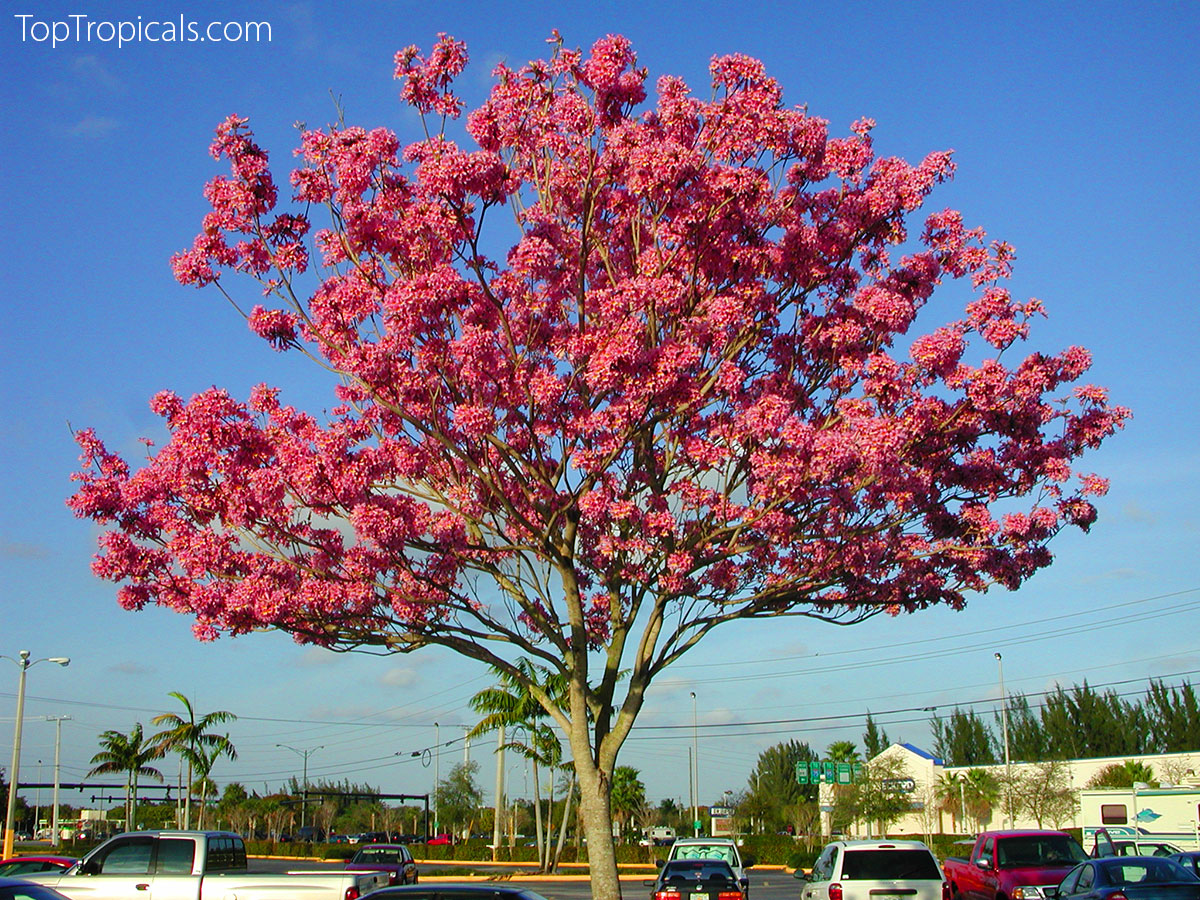
The Florida “cherry blossom.” Pink-lavender flowers smother
the branches each winter, often before any leaves return.
Thrives in sandy soil, tolerates drought, and grows beautifully in large
planters or pots indoors near a sunny window.
Ideal for seasonal residents or anyone who wants color when everything else
is asleep. 🛒
Shop
Jacaranda mimosifolia
If color had music, this would be jazz.
Soft, fern-like leaves and cascades of violet-blue trumpet flowers —
airy, elegant, unforgettable.
Outdoors, it makes a graceful shade tree; in containers, it stays compact
with regular pruning.
Jacarandas reward patience — they bloom bigger each year. 🛒
Shop
Koelreuteria paniculata – Golden Rain Tree
A favorite for its surprises — golden blooms in summer, pink paper
lantern pods in fall, and bronze leaves before rest.
Fast-growing, tough, and easy. Loves full sun and moderate water.
Great for open lawns or patio tubs. The kind of tree that gives you
something new to look at every month. 🛒
Shop
Callistemon citrinus – Bottlebrush Tree
The hummingbird magnet.
Bright red, brush-shaped flowers bloom several times a year —
sometimes even in cool weather.
The dwarf form, ‘Little John,’ stays about 4 feet tall, perfect
for pots or small borders.
Trim lightly after flowering to keep it compact and colorful. 🛒
Shop Tatiana: “If you’ve never grown a
tropical tree before — start here. It’s the friendliest
one.”
Bauhinia variegata – Pink Butterfly Tree
Graceful, fragrant, and forgiving.
Its pink-lavender orchid-like flowers open from late winter through spring,
filling the garden with color and pollinators.
It’s fast-growing, drought-tolerant, and excellent for both ground
and pots.
Even the buds are edible — a fun bonus for adventurous gardeners. 🛒
Shop
Bauhinia blakeana – Hong Kong Orchid Tree
The queen of them all.
Huge magenta-purple blooms that last for months, from fall through spring.
Fragrant, clean (no messy seed pods), and perfect for patios or large
decorative containers.
Give it sun, a little water, and it will reward you with bloom after bloom.
🛒 Shop Tatiana: “It’s the one tree that never lets winter
win.”
A note on grafted Hong Kong Orchid Trees:
Most Hong Kong Orchid Trees are grafted, and that’s actually a big
advantage.
Because they don’t grow from seed, grafted plants mature faster and
begin blooming while still small — sometimes within the first year.
That makes them perfect for patio pots or small gardens where space is
limited.
Bringing the Tropics Home
Whether your garden faces the Gulf or your window faces the snow, these
trees let you live in color year-round.
Plant them outdoors in warm zones or grow them in pots indoors — they
adapt, they bloom, they brighten every corner.
Gardening isn’t about waiting for spring — it’s about
finding joy in every season.
And when a tree blooms in January, that joy feels twice as sweet.
Yes! Smaller species like Bottlebrush ‘Little John,’ Dwarf
Tabebuias,
and many
Bauhinias bloom beautifully in pots with bright light or grow lamps.
Q: Do they lose their leaves in winter?
Some, like Tabebuias
and Jacarandas,
drop leaves right before blooming — it’s normal
and part of their charm. Others, like Bottlebrush,
stay evergreen.
Q: What fertilizer works best?
We use Sunshine
Boosters — gentle, balanced, and perfect for tropicals.
Feed every 2–3 weeks during active growth.
Q: How do I know when to water?
Touch the soil! If it’s dry an inch or two down, water deeply.
Overwatering is the main mistake with tropicals.
Q: Can they handle frost?
A quick dip into the upper 20s F is fine for most mature trees. Cover
young ones or move containers under shelter if colder.
Q: Which are best for beginners?
Start with Bottlebrush ‘Little John’ or Golden Tabebuia
— compact, colorful, and nearly foolproof.
Q: When will they bloom?
Usually within few years if they get enough sun and warmth. Grafted
plants blooms much sooner
Q: Which of these trees are best for pot
growing?
For patios, balconies, or indoor sunrooms, choose the compact or grafted
types:
...Who doesn't like tropical beauty? Everyone wants tropical plants. But not everyone lives in a warm climate. Is it possible to grow tropicals outside of Tropics?
Top Tropicals horticulturist Mark Hooten, who is well known to many
gardeners as the Garden Doc with his
Saturday Plant Clinic, is answering gardeners' questions about how to prepare and protect tropical plants during winter...
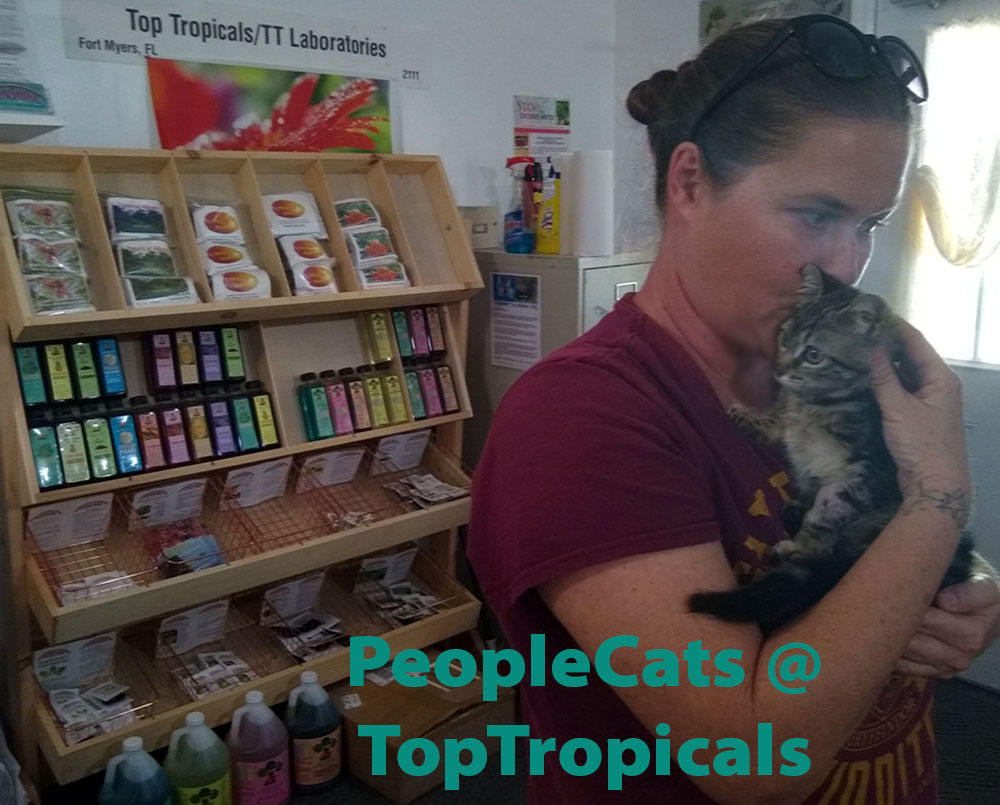
PeopleCats of TopTropicals. Cats of the day: Biggy's Cat Hospital
Biggy checking on patient Abu when he couldn't walk
During these challenging times for the whole planet, we receive kind
letters from our customers checking on how our PeopleCats are doing, especially those that previously were ill. And
since we promised to follow up on everyone, including heart-breaking story of
Raja and Abu, today's report is about everybody's progress!
As we mentioned in our previous newsletter, several cats in TopTropicals
Cat Sanctuary had a coronavirus (we call it COVID-Cat-20), or simply a cat respiratory infection. Chiefy, Snitch, Marco and Biggy had it really bad, but some other PeopleCats surprisingly didn't
get it! Just like with humans. Lucky King didn't have a single sneeze!
Finally, everybody has recovered by now, but it has been a very stressful
couple of weeks for us, considering limited vet availability at this stay-home
time. On top of that, Lil S had an abscess and was also contained in a home hospital, away
from flu-quarantined PeopleCats. Our homes become real cat hospitals!
We are thankful to our customers support, especially Silvia who made
several donations for our PeopleCats, and also recommended antiseptic pads - those worked great for Lil S! Abu and Raja's adventures were not over... After 2 weeks of seeing a
vet treating their infections and injuries, they got worse... Then after a
couple of weeks in another hospital (and a couple thousand more in bills) we were
suggested to put them down as hopeless since they would never walk again...
But Kristi did not want to believe it, she did not give up! The kittens heard
her. They won. Today, they are all better, walking, jumping and playing!
Thank you Kristi!
Never give up hope!
Stay safe and healthy with your PeoplePets!
TopTropicals PeopleCat Club
Thank you everybody for supporting us in helping PeopleCat Community! Make
your kind donation today and receive a surprise gift from us. Every little
bit helps! Thank you and God bless you and your pets!
Date: 22 Oct 2025
💞 Cassia or Bauhinia?
Looking for a small tree that blooms like fireworks but still fits on
your patio? We hear this question all the time at Top Tropicals: Cassia or
Bauhinia? Both are tropical showstoppers, but they shine in very different
ways.
🌞
Cassias: Sunshine Fireworks
Cassia trees
are some of the most rewarding tropical bloomers you can
grow. Fast-growing, free-flowering, and surprisingly cold-tolerant, they
thrive in full sun and summer heat. Their bright clusters come in shades of
yellow, orange, pink, red, and even multicolor blends. The famous Rainbow
Cassias
show swirls of coral, gold, and rose on the same tree, creating a living
fireworks display.
Cassias can also be grown in pots with pruning and
patience. Once mature, they reward you with breathtaking color that turns
any patio
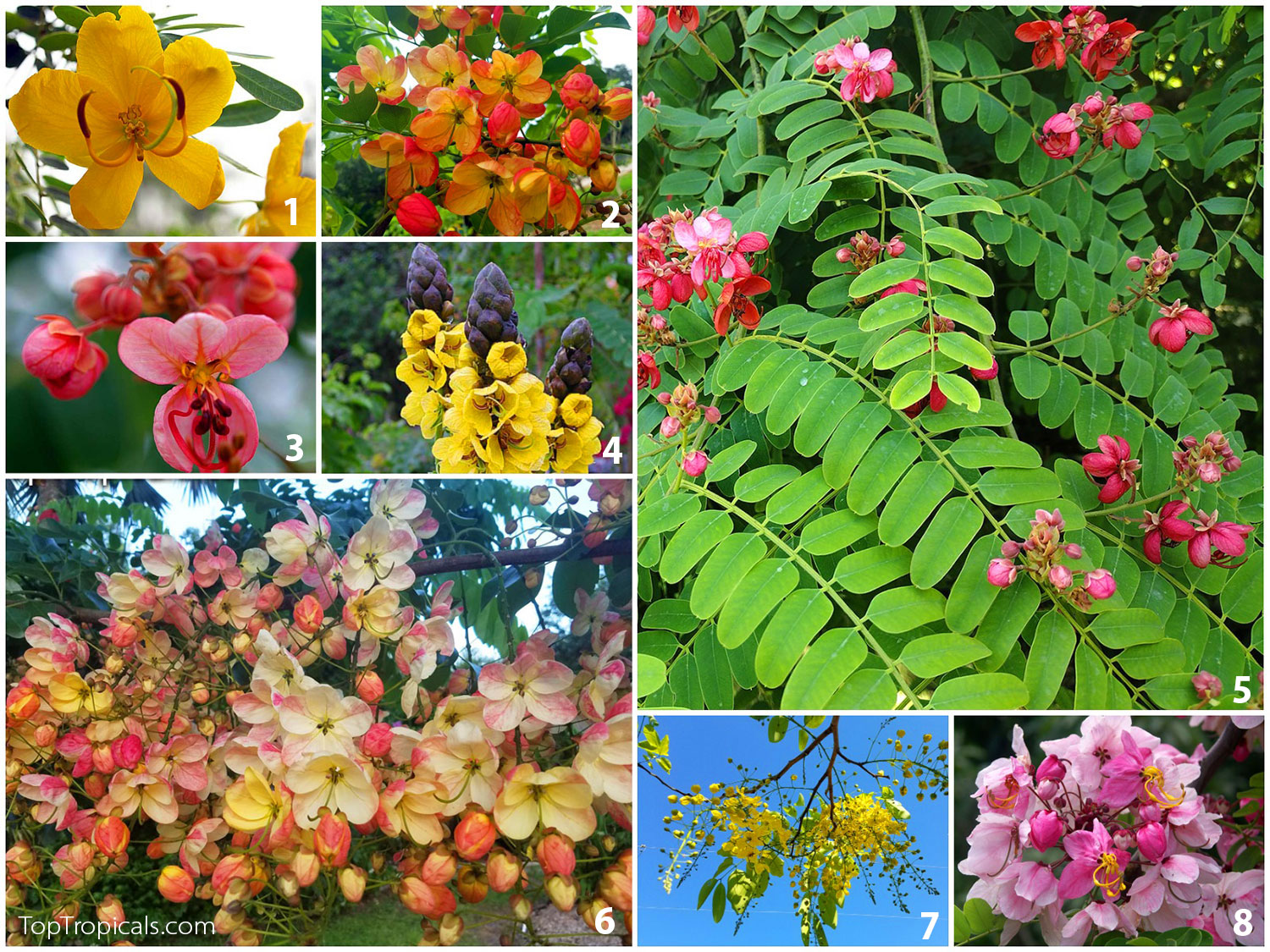
or pool deck into a tropical show. Most showy cassias (numbers correspond to
the photos in the collage above):
Cassia
bicapsularis (Butterfly Bush) - is a fast-growing,
low-maintenance shrub covered in bright yellow, butterfly-like blooms from
fall
through winter.
Cassia roxburghii (Ceylon Senna) - graceful tree with spreading,
drooping branches appearing to be overweighed by its wealth of clustering
red
blossoms.
Cassia
x nodosa (Pink Shower) - is a spectacular medium-sized, fast-growing
tree with cascading clusters of fragrant pink-and-white appleblossom blooms
in spring and summer.
Cassia fistula (Golden Shower) - to many tropical gardeners, the
most beautiful of cassias with masses of bright gold flower clusters appear
on
almost every branch.
Cassia javanica (Apple Blossom) - dazzles with dense clusters of
pink-to-white blossoms that change shades as they bloom, creating a
spectacular
display that lasts for months.
"Cassias love the heat and sunshine," says Tatiana
Anderson, Top Tropicals Plant Expert. "They are perfect for anyone
who wants big
bursts of color and doesn’t mind giving them space and light to grow."
Bauhinia Magic: Orchid-Like Blooms in a Compact Size
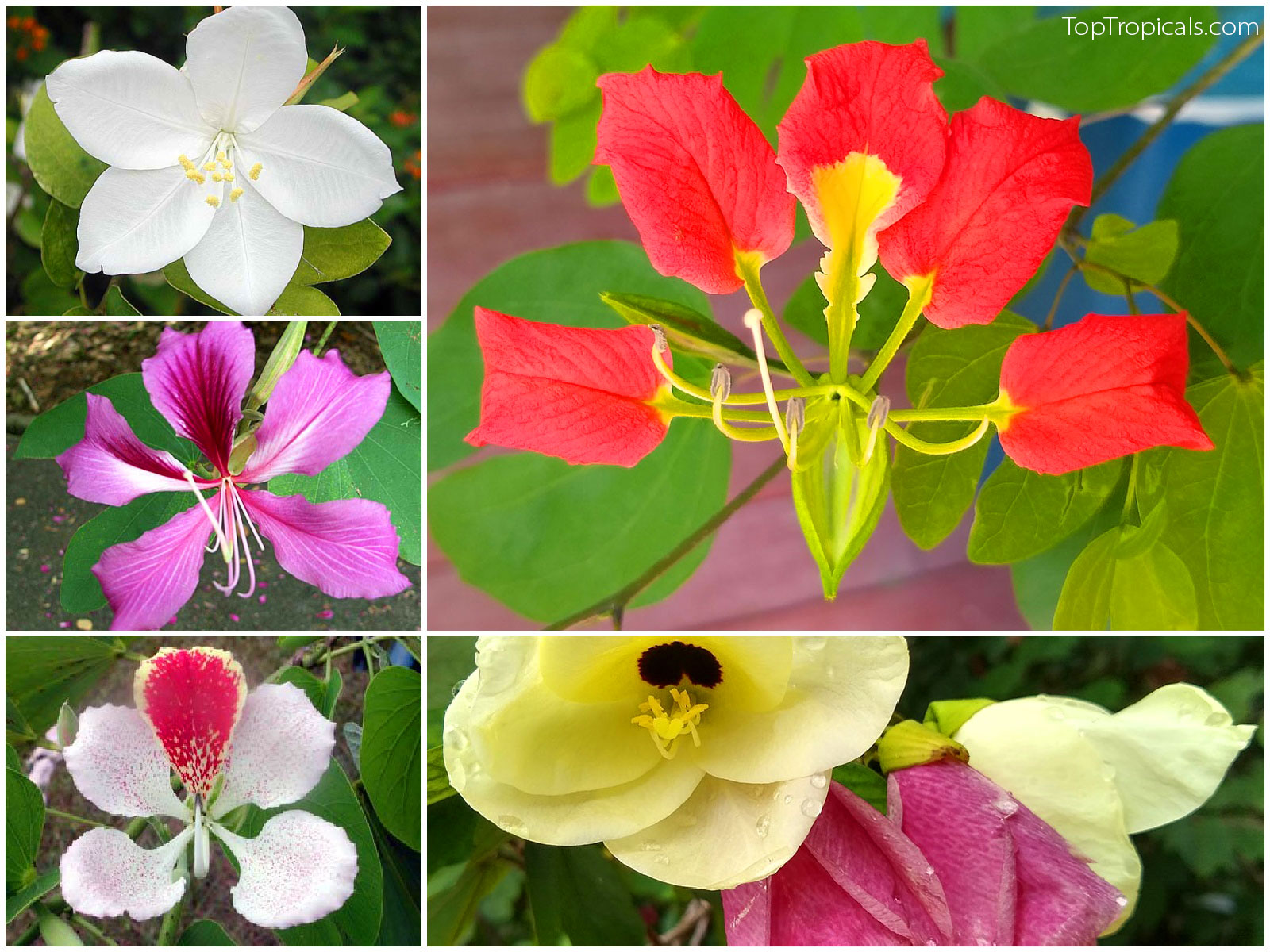
Bauhinia orchid trees: top left
– Bauhinia acuminata (Dwarf White Orchid Tree), middle left –
Bauhinia blakeana (Hong Kong Orchid Tree), bottom left – Bauhinia
monandra
(Napoleon’s Plume Orchid Tree), top right – Bauhinia
madagascariensis (Red Dwarf Orchid Tree), and bottom right – Bauhinia
tomentosa
(Yellow Orchid Tree)
Bauhinia trees
known as Orchid Trees, bring a touch of tropical luxury
to any space. Their butterfly-shaped leaves and orchid-like blossoms appear
in shades of red, pink, purple, white, and yellow, often lasting up to ten
months a year. Bauhinias are ideal for gardeners who want nonstop color in a
manageable size. Most species grow well in large pots and bloom young, often
within the first season.
The following compact varieties stay neat and flower almost
continuously in warm weather:
Bauhinia blakeana (Hong Kong Orchid Tree). A large tree in the
ground, but compact in pots if trimmed. Grafted trees flower right
away.
Winter bloomer, cold hardy to light frost.
The Hong Kong Orchid Tree is especially prized because it
is sterile and produces no messy seed pods, keeping patios clean. Grafted Buhinia
blakeana trees begin blooming while still small, making them perfect for
containers or tight spaces.
"Bauhinias are generous bloomers," Tatiana explains. "They respond
beautifully to regular feeding and full sun. If nights turn too cold, just
move the
pot to a sunny porch - they’ll keep their tropical charm most of the
year."
Give them full sun, regular fertilizer, and a well-drained
mix such as Sunshine
Abundance, and they will reward you with months of vivid
blooms. When nights turn too cold, simply move the pot to a sunny porch or
bright
window. Bauhinias adjust beautifully and keep their tropical grace year
after
year.
🎥
Watch Short Videos:
💲
Special Offer – 20% off Cassias and Bauhinias!
Get 20% OFF Cassias and Bauhinias with code
RAINBOW2025
Min order $100. Excluding S/H, valid online only,
cannot be combined with other offers.