Garden Blog - Top Tropicals

Date: 7 Mar 2026

SUNSHINE Boosters: The Professional Advantage

By Tatiana Anderson, Horticulture Expert at Top Tropicals with Smokey & Sunshine help

Sunshine  Boosters  plant  fertilizers  lineup  including  Bloom,  Pikake, 
 Robusta,  Omnibus,  Ananas,  Mango  Tango,  Citrus,  and  MegaFlor

Sunshine Boosters for different types of plants

Here is why SUNSHINE Boosters are the smart choice for your garden this spring:

  • Amino Acid Stability: Unlike traditional fertilizers that use synthetic EDTA chelators, our formulas are amino-acid based. This means 100% of the nutrients are bioavailable and consumed by the plant, leaving zero toxic residues or salt build-up in your soil.
  • Safe for Every Watering: Because our concentrations are scientifically balanced and mild, they are safe for daily use. This eliminates the "feast or famine" cycle of dry fertilizers and prevents accidental root burn.
  • Pure Taste for Edibles: Our delicate formulas do not contain excess salts, urea, or ammonium salts that can ruin the flavor of your harvest. Your fruit and vegetables will retain their pure, natural taste.
  • Pollinator Friendly: Our boosters are designed to be safe for honeybees and other beneficial insects, making them the responsible choice for an organic-style garden.

🌿For Potted Plants: Breaking the "Foodless" Cycle
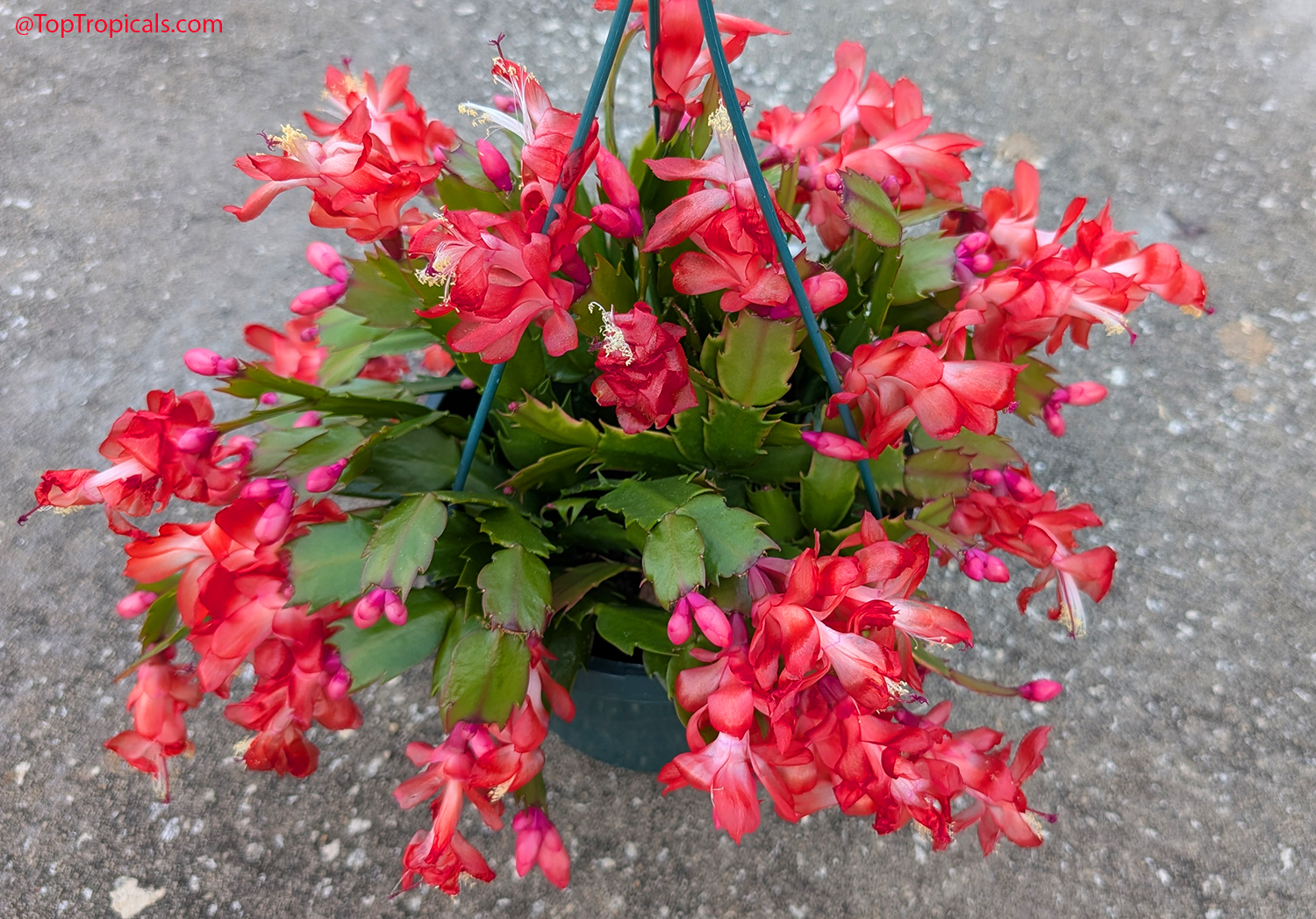
Schlumbergera  Christmas  cactus  with  abundant  red  blooms  after  feeding 
 with  Sunshine  Megaflor  fertilizer

Schlumbergera - Christmas cactus - after boosting flowers with Sunshine Megaflor

Container-grown plants are trapped in soilless mixes (peat, bark, perlite) that are structurally great but naturally nutrient-deficient.

  • Total Nutrition: Since pots lack the natural "buffet" of the ground, SUNSHINE Boosters™ provide every essential mineral the plant cannot find on its own.
  • No Salt Build-up: Our amino-acid based formulas are consumed entirely by the plant, leaving zero toxic residue or root-burning salts behind.
  • Daily Safety: Our mild concentrations eliminate the "feast or famine" cycle of dry fertilizers, making them safe for use with every single watering.

For In-Ground Plants: Unlocking the Soil
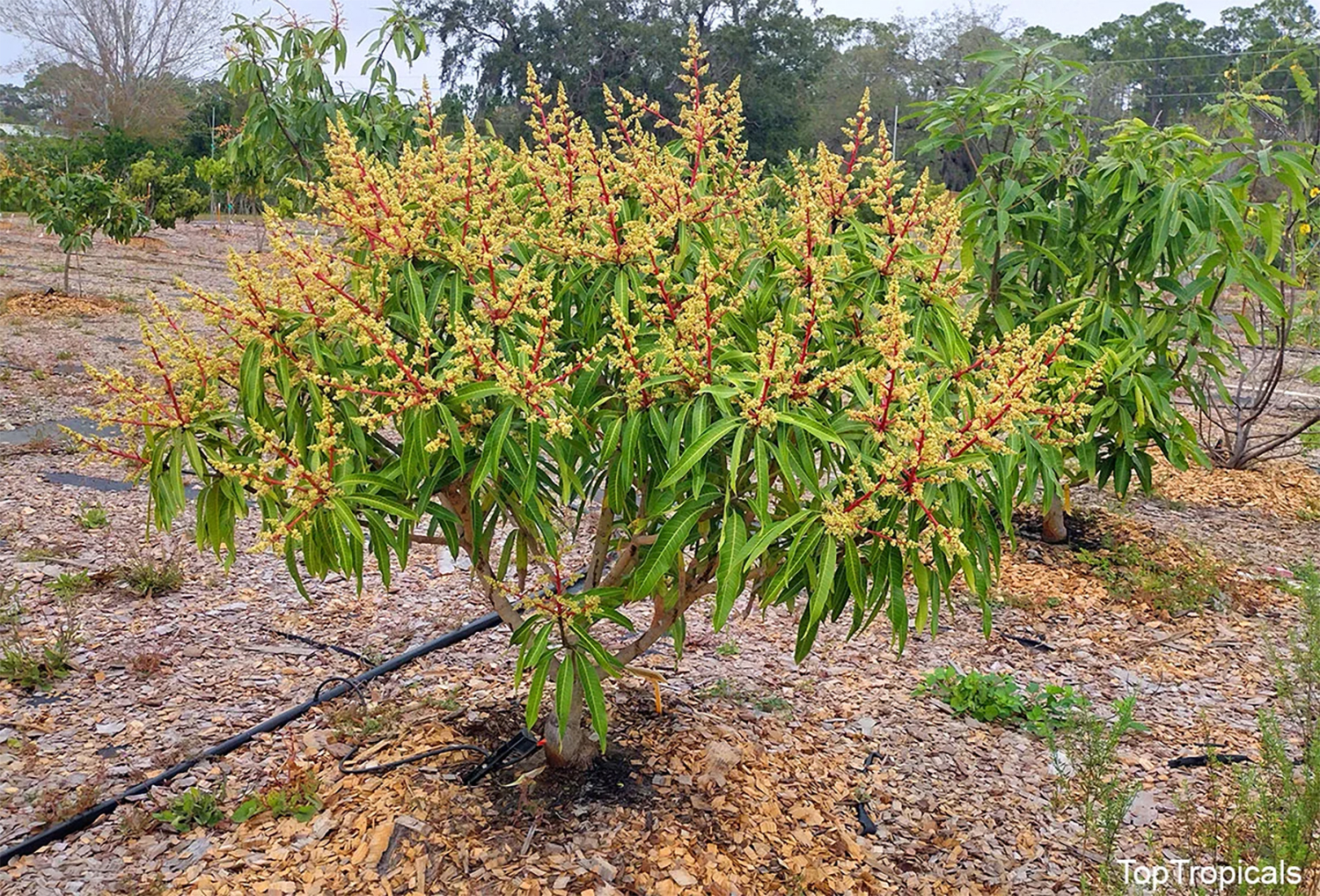
Mango  tree  blooming  produsely  after  applying  Sunshine  Mango  Tango 
 Booster

Mango tree blooming produsely after applying Sunshine Mango Tango Booster

Even in the ground, plants often struggle to absorb what they need because soil compounds can "lock up" nutrients.

  • Enhanced Solubility: SUNSHINE Boosters create a slightly acidic environment that helps dissolve stubborn salts in the soil, making them accessible to roots again.
  • Precision Delivery: We provide mobile elements like Nitrogen precisely when the plant needs to push new spring growth.

🌿The Foliar Advantage: Direct-to-Leaf Delivery

Did you know a plant leaf can absorb nutrients even more efficiently than the roots? Foliar feeding is your "emergency button" for instant results.

  • Quick Fix: Foliar applications with Sunshine Superfood are the fastest way to correct yellowing leaves or visible deficiencies.
  • Metabolism Boost: Sprays like SUNSHINE-Epi act as a bio-regulator, helping plants recover from the stress of spring temperature swings.
  • Better Fruit: SUNSHINE Honey is applied to leaves to naturally move sugars to the fruit, increasing sweetness and flavor.

🌿The Calcium Problem: Solved

As your plants wake up this Spring, they need structural strength. Think of Calcium as the "cement" that holds plant cells together. Without it, new spring growth is doomed to fail.

Signs Your Plant is Starving for Calcium:

  • Deformed Leaves: New growth looks twisted, hooked, or curled.
  • Blackened Tips: The very edges of young leaves turn white, then quickly blacken and die.

The Industry Secret: The "Missing" Mineral

Most fertilizers, both dry and liquid, completely skip Calcium. Why? Because it’s a chemical nightmare to keep stable in a concentrated solution. Most manufacturers rely on your irrigation water to deliver Calcium, but tap water is inconsistent and often fails to provide what a hungry, growing plant needs.

The SUNSHINE Boosters: Stable Calcium in Every Bottle

We have successfully stabilized Calcium directly into every single Sunshine Booster formula. Whether you are using Bombino, Robusta, or Megaflor, you are delivering a precise, stable dose of Calcium with every watering. No lockout, no sediment, and no relying on the "luck" of your tap water. Just strong, healthy cell walls and perfect spring growth.

🌿SUNSHINE-Epi: The Year-Round Bio-Regulator

Whether it’s the transition of spring, the extreme heat of summer, or the dry air of indoor wintering, SUNSHINE-Epi is your plant’s primary defense. This natural Brassinosteroid acts as a powerful immune booster, helping plants navigate stress wherever it comes from.

  • Universal Stress Shield: Protects against temperature swings (both heat and cold), drought, and transplant shock.
  • Vigorous Development: Dramatically improves root growth and speeds up the metabolism of young seedlings and cuttings.
  • Eco-Safe: 100% non-toxic to humans, pets, and pollinators.

Note: While Epi is highly effective, it is a performance booster, not a substitute for proper care. It works best when paired with the right light, water, and a consistent feeding program. It won't bring a dead plant back to life, but it will help a struggling one find its footing.

🛒 Feed your plants

Don't let your garden wake up to an empty nutrition plate.
Smokey: Save your gas money for donuts. We're shipping the boosters for free.
Sunshine: Agreed. My charm covers the delivery cost.

No coupon code required: The free shipping is automatically applied at checkout.

Complete Nutrition: Stock up on Robusta, Superfood, and Epi for the Spring growth push.
Offer valid through 03/14/2026. Free shipping offer is valid on SUNSHINE Boosters liquid products only. Not valid on previous purchases and cannot be combined with any other offers, coupons, or discounts. Offer subject to change or cancellation without notice.

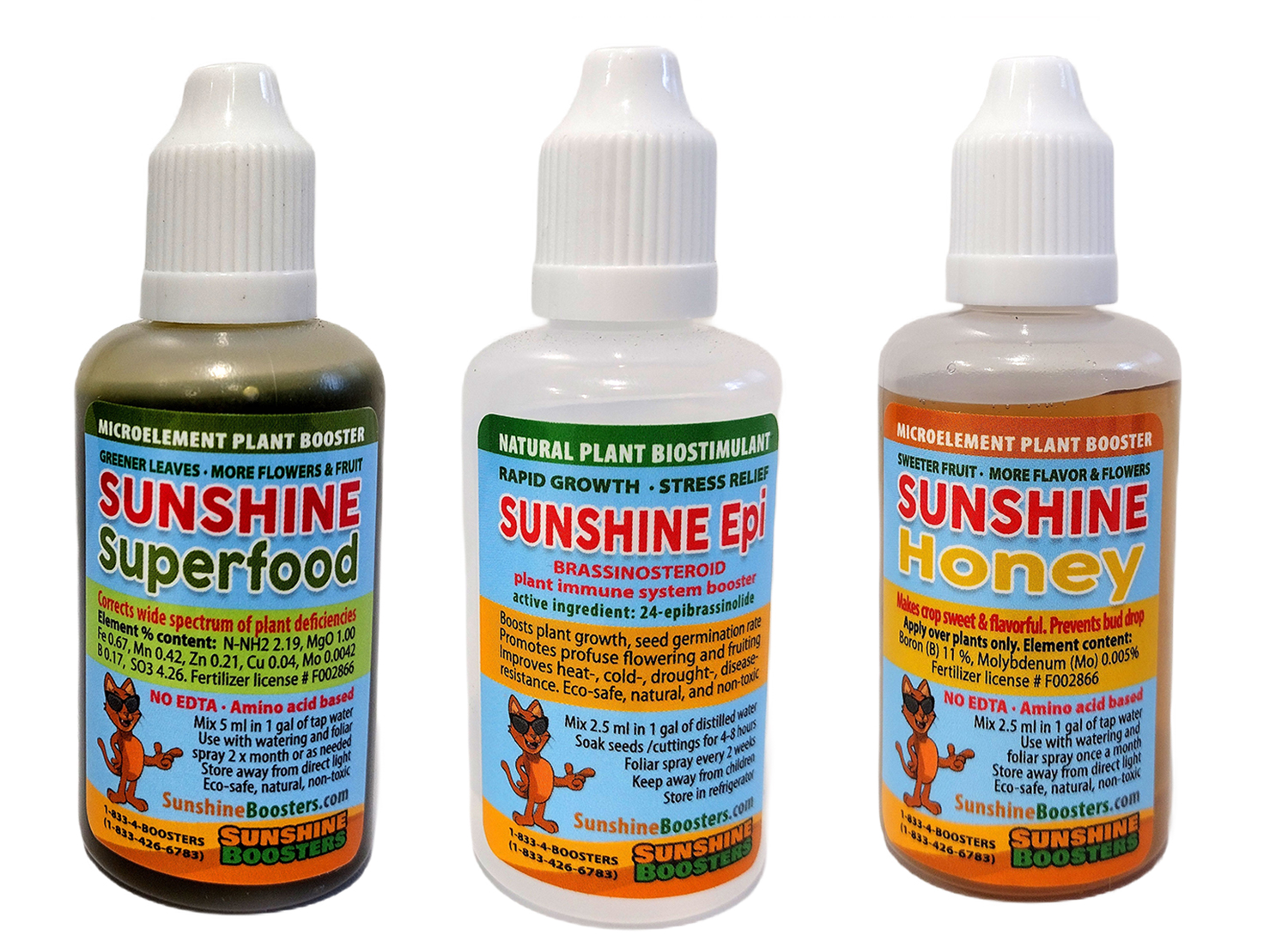
Sunshine  Boosters  plant  supplements  including  Superfood  micro  element 
 complex,  Epi  biostimulant,  and  Honey  fruit  enhancer

Sunshine Boosters micro elements and supplements - Superfood micro-element complex, Sunshine Epi biostimulant and Sunshine Honey supplement for better fruit

❓Frequently Asked Questions: SUNSHINE Boosters™

  • What water should I use for foliar spraying?
    Tap water works perfectly for most. However, if your water is very "hard" (leaving white mineral spots on leaves), switch to distilled water for a cleaner finish and better absorption.
  • How long does a diluted solution last?
    For maximum potency and to avoid nutrient degradation, try to use your diluted mixture within a few hours of preparation. Keep away from direct sun. Fresh is always best!
  • Can I use SUNSHINE Boosters as a daily foliar spray?
    Yes! You can mist your plants daily to maintain high vigor, but you must reduce the dosage (use half the recommended strength) to avoid over-feeding.
  • Can I mix boosters with pesticides or fungicides?
    It is best to apply them separately. Mixing fertilizers with chemical pesticides in one tank can trigger reactions that "lock out" nutrients or reduce the efficacy of the treatment.
  • Will the liquid stain my patio or hands?
    No. Unlike traditional fertilizers with heavy blue or pink dyes, our solutions are clear or very light-colored. If you spill it, simply rinse with water—no stains, no mess.
  • Can I mix different SUNSHINE Boosters together in one sprayer?
    Yes. All SUNSHINE Boosters are chemically compatible. You can combine a "growth" booster like Robusta with a "micro-element" complex like Superfood in the same water to save time.
  • Are these products safe to use around my pets?
    Absolutely. Our formulas are 100% non-toxic and amino-acid based. Just ask Smokey and Sunshine—they are perfectly safe for households with curious cats, dogs, and children.
  • Can I use these boosters on indoor plants?
    Yes. They are ideal for indoor use because they don't produce a "fertilizer smell" and won't cause salt crusting on your decorative pots or furniture.
  • Is it safe to use on fruit and vegetables I plan to eat?
    Yes. Because our formulas contain no urea, nitrates, or harsh salts, they don't leave a "chemical" aftertaste. They actually help improve the natural sugars and flavor profile of your harvest.
  • What is the best temperature for foliar spraying?
    Apply when temperatures are below 85°F. Early morning or late evening is best; this allows the leaves to remain wet longer, giving the plant more time to absorb the nutrients.

What Fertilizer to Use and How?

Green Magic controlled release fertilizer keeps plants green during active growth season - apply only once in 6 months.
Sunshine: Smokey, you saved my coffee tree. But what do I do now so it stays happy?

Smokey: Simple. Spray Sunshine Robusta every five days during active growth.

Sunshine: Five days? Smokey, I barely remember where I left my coffee mug five minutes ago.

Smokey: That is exactly why we use Green Magic.

Sunshine: Fertilizer for forgetful gardeners?

Smokey: Controlled release. Sprinkle once and it feeds the plant for six months.

Sunshine: Six months? I can have a very good nap in that time.

Smokey: Exactly. The plant keeps eating slowly while you keep napping.

Sunshine: Perfect. Remember, I will bring the coffee. You bring the donuts.

Smokey: And next week we will show you exactly how Green Magic works and why plants love it. Stay tuned.

🛒 Feed your plants

✍️ Learn more about fertilizers

Date: 7 Jun 2026

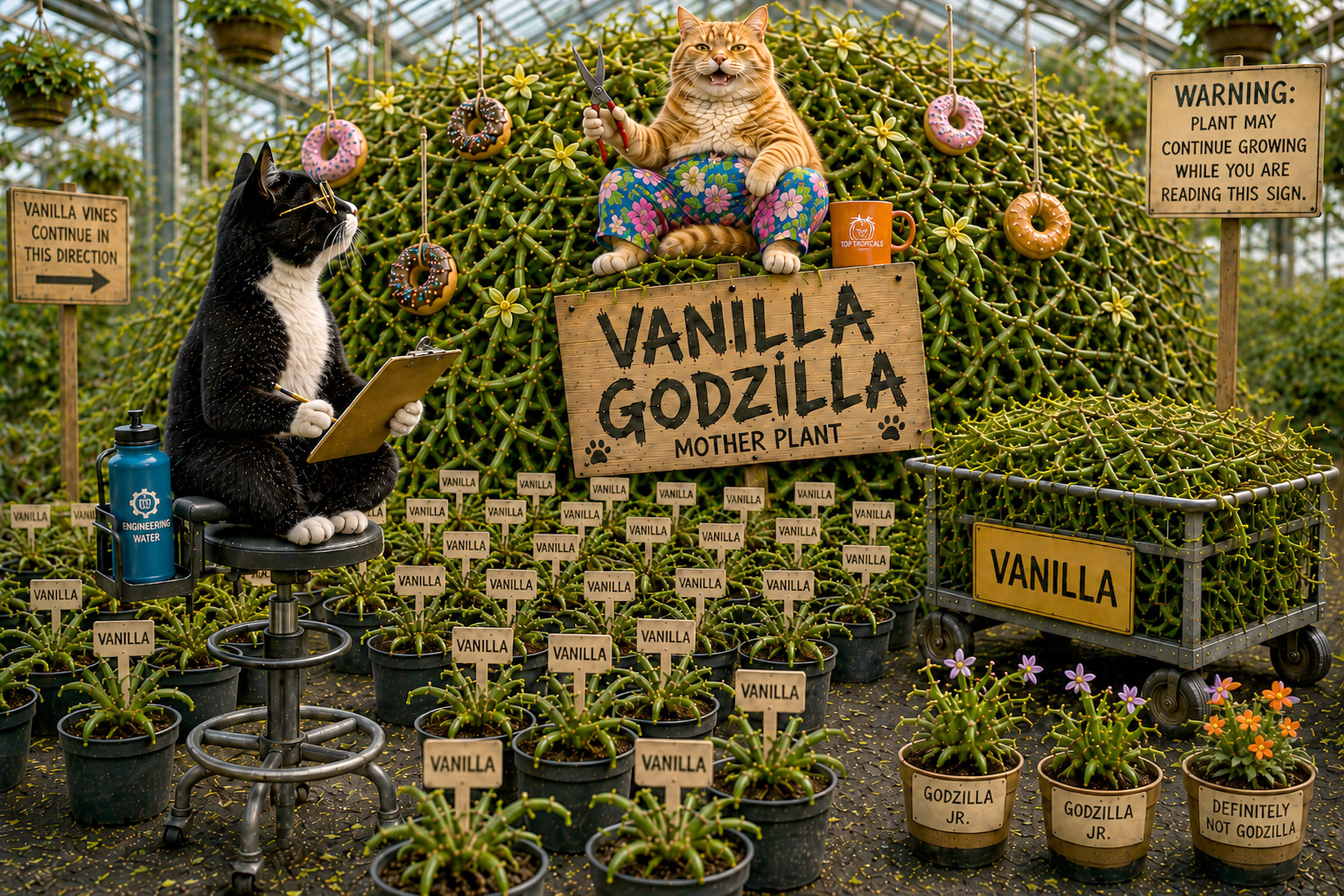
🌿 The Vanilla Plant That Outgrew Its 100-Gallon Container.

Smokey  the  tuxedo  cat  and  Sunshine  the  orange  cat  inspect  a  giant 
 Vanilla  Godzilla  mother  plant  in  a  greenhouse.  Sunshine  sits  atop  a  massive 
 mound  of  leafless  vanilla  vines  holding  pruning  shears,  while  Smokey  takes 
 notes  among  dozens  of  young  vanilla  plants  propagated  from  the  giant 
 specimen.
Smokey: Is that really the entire mother plant?
Sunshine: Most of it.
Smokey: What do you mean "most of it"? And why are there donuts hanging from the plant?
Sunshine: We still haven't found the other end. The donuts attract pollinators.
Smokey: Donuts do not attract pollinators.
Sunshine: Then explain why I keep visiting the plant.
Smokey: You work here.
Sunshine: That's what the plant wants you to think. It's called "Intelligent Design" for a reason.

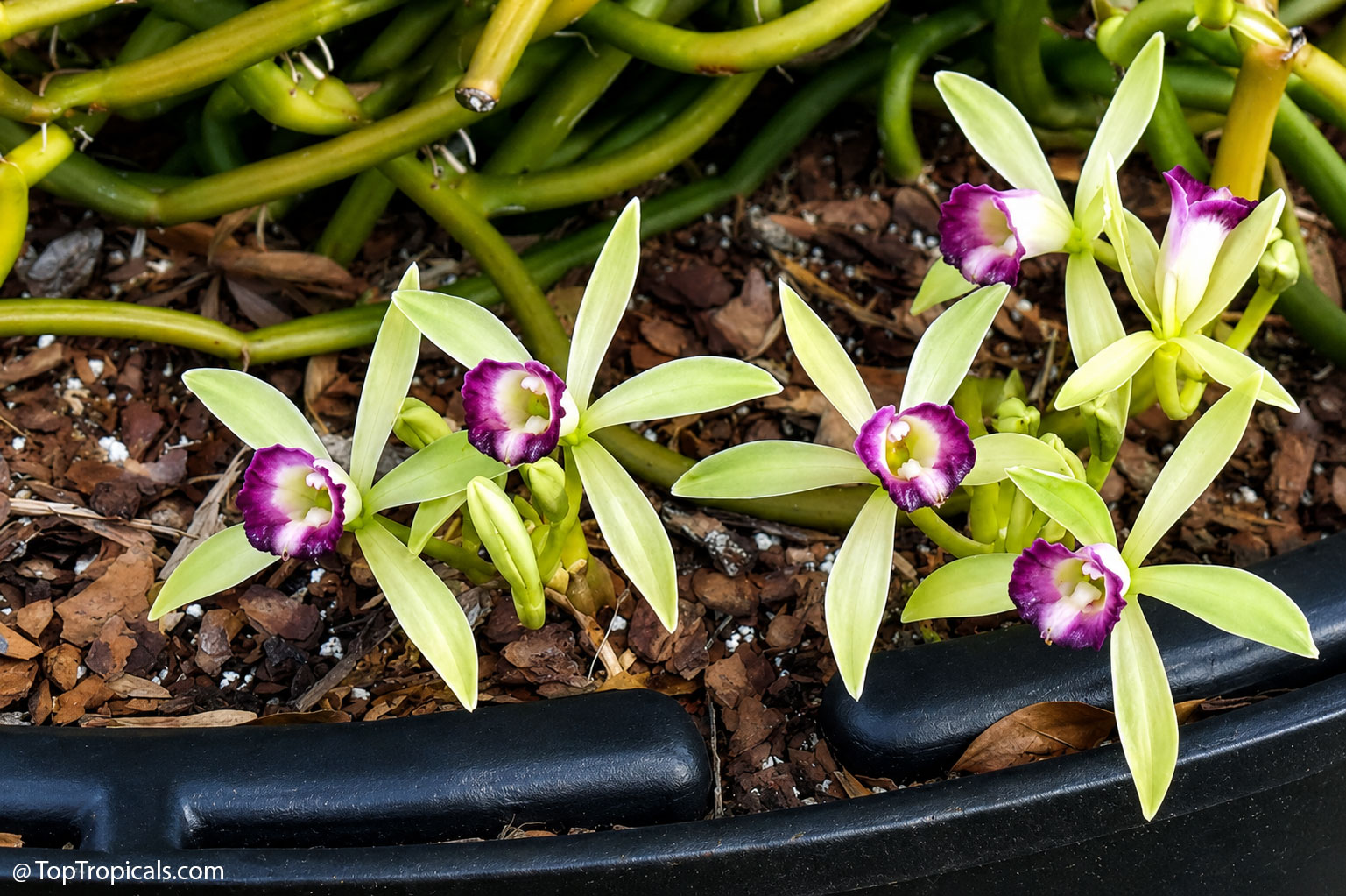
The plant Sunshine is perched on is not a hedge. It is not a wall. It is a single specimen of Vanilla dilloniana, Dillon's Vanilla, and it has a name: Intelligent Design. Unlike the familiar Vanilla planifolia — the commercial vanilla of ice cream and extract — dilloniana produces no leaves. The plant is essentially a green vine, photosynthesizing entirely through its stems. It is an unusual and striking grower, and in good conditions it can develop into an impressive, multi-branched specimen. It is classified as rare, and is considered vulnerable or endangered across portions of its native range.

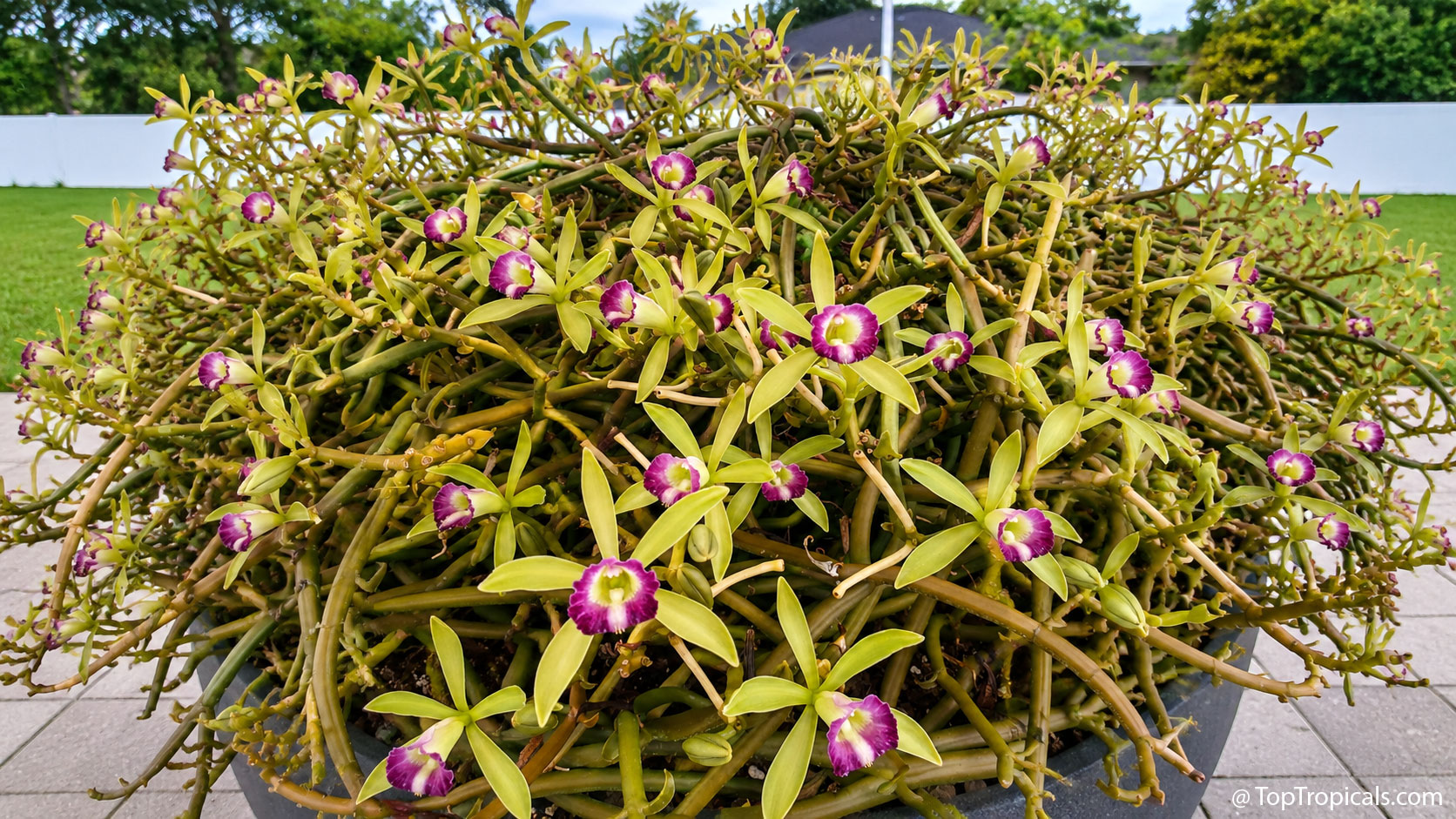
Close-up  of  the  Vanilla  dilloniana  mother  plant,  Intelligent  Design, 
 growing  in  a  100-gallon  container.  Hundreds  of  leafless  green  stems  weave 
 together  into  a  dense  mound  covered  with  pale  green  orchid  flowers  featuring
    vivid  purple  and  white 
 centers.

Vanilla dilloniana in full bloom before its next major upgrade.

Intelligent Design was grown and lovingly tended for years by Robert Riefer, a grower who is both a good friend of Top Tropicals and one of the most dedicated orchid collectors we know. The mother plant of this specimen traces its origins back to 1927 - nearly a century of continuous cultivation.

In 2011, the American Orchid Society recognized this remarkable plant with a Certificate of Horticultural Merit (CHM), one of the society's formal awards for plants of exceptional quality.

By 2017, the plant had already become well known in the orchid and tropical plant community, appearing in a video that documented Robert moving it into a 100-gallon container. That video became something of a legend among collectors.

🎥 Video: the biggest Vanilla Orchid in the world moving to 100 gal pot

Then the plant kept growing.

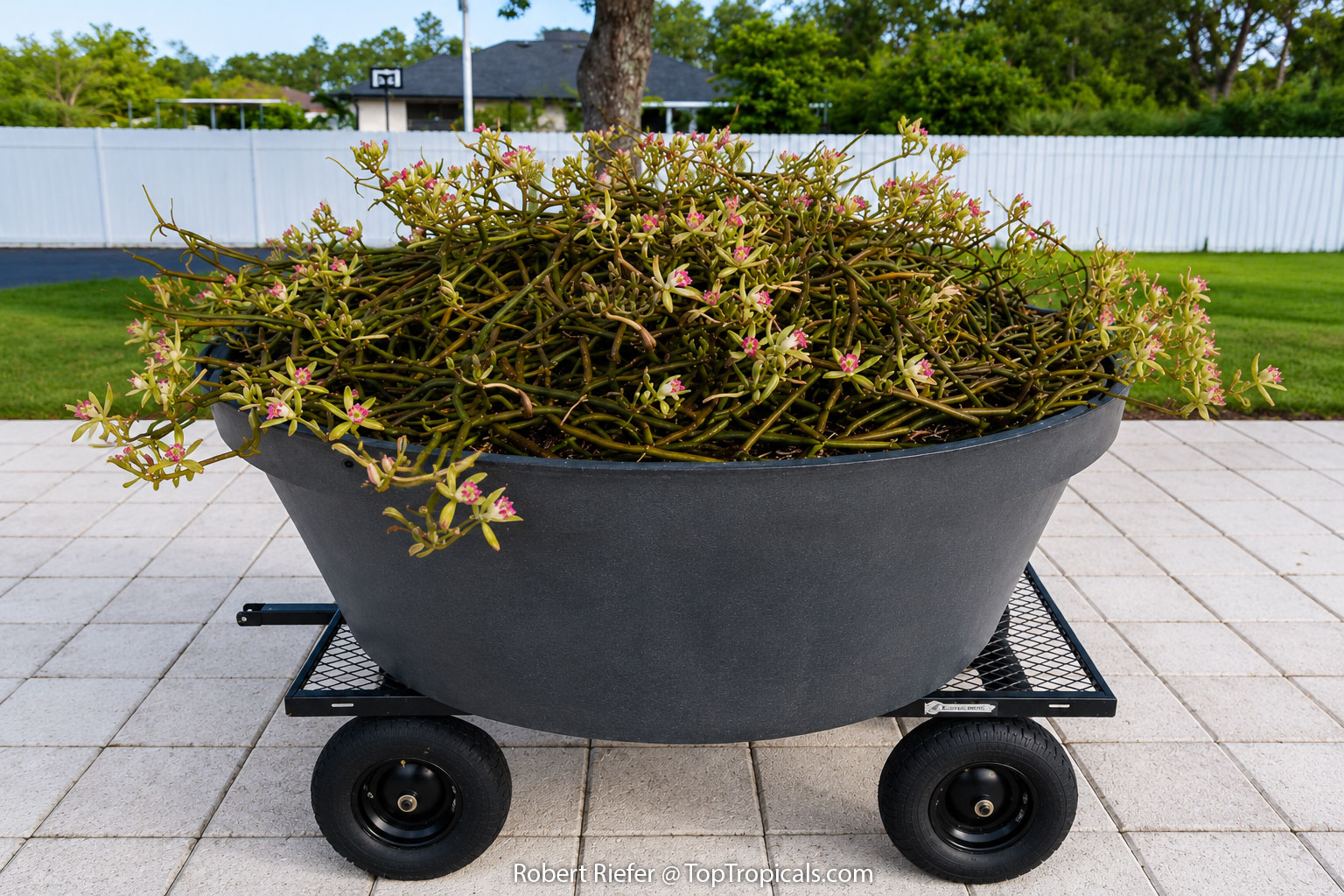
It outgrew the 100-gallon container. Robert eventually moved it into a 250-gallon pool on wheels - because when a plant refuses to stop, you give it room.

The  Vanilla  dilloniana  mother  plant,  Intelligent  Design,  growing  in  a 
 massive  250-gallon  container  on  wheels,  with  thousands  of  leafless  green 
 stems  forming  a  dense  mound  covered  in  small  orchid 
 flowers.

The move to a custom 250-gallon container allowed continued growth and flowering.

The plant is currently on display at Edison Ford Winter Estates museum and botanical garden in Ft Myers, Florida, during the month of June, where recent photographs show it larger and more floriferous than ever. It is, as best anyone can determine, the largest known cultivated specimen of Vanilla dilloniana in the world. If you are local or visiting Florida, don't miss the chance to see this world-famous orchid in person. It is expected to continue blooming through June.

And here's the remarkable part: the Vanilla dilloniana plants available from Top Tropicals are propagated directly from this exact plant - Intelligent Design itself.

🛒 Add Intelligent Design Vanilla to your collection

👉 A Piece of Living History - Direct from the Source

Young  Vanilla  dilloniana  plants  at  different  stages  of  growth,  showing 
 rooted  cuttings  trained  on  bamboo  stakes  in  1-gallon  pots  alongside  a  larger
    wrap-around  specimen  filling  a  7-gallon  container  with  thick  leafless 
 vines.

Every legendary Vanilla dilloniana starts somewhere. On the left are young Vanilla dilloniana plants. On the right is a more mature specimen in a 7-gallon pot beginning the characteristic wrap-around growth habit that eventually transforms this unusual orchid into a sprawling, sculptural giant.

Vanilla dilloniana is a rare species, considered vulnerable to endangered across parts of its native Caribbean range. Plants with documented provenance - especially provenance tied to a named, award-winning, century-old specimen - are genuinely uncommon in cultivation.

What you would be growing is a direct descendant of the famous Intelligent Design mother plant, carrying the same historic lineage recognized by the American Orchid Society.

For collectors, opportunities to acquire plants with this kind of documented history are exceptionally rare.

🛒 Start your own Vanilla Godzilla

Growing Leafless Vanilla

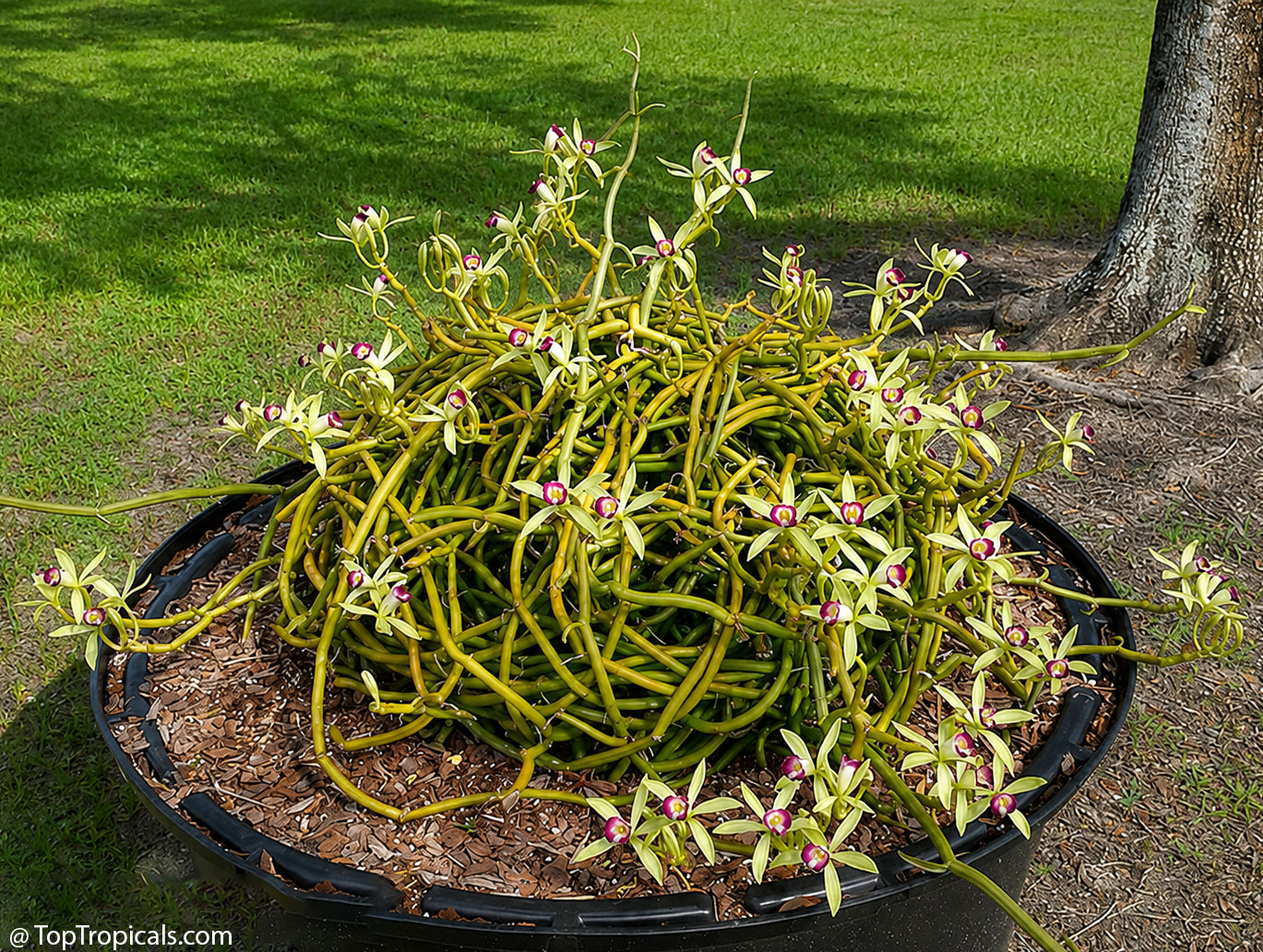
Large  specimen  of  Vanilla  dilloniana  growing  in  a  wide  container 
 beneath  a  tree,  with  a  dense  mass  of  leafless  green  vines  covered  in  unusual
    pale  green  flowers  with  purple 
 centers.

This is how the legendary Vanilla dilloniana mother plant, Intelligent Design, started its world-famous "Godzilla" journey in 50-gallon container. It's in full bloom, and its leafless stems form a living sculpture, dotted with dozens of striking orchid flowers that make this rare vanilla one of the most unusual cultivated orchids in the world.
  • Light: Bright filtered light is ideal. Morning sun is generally well tolerated. Avoid intense afternoon sun, especially during summer.
    Ideal: Dappled shade, eastern exposure, greenhouse conditions, or 30-50% shade cloth.
  • Temperature: Warm-growing tropical species.
    Best: 70-95F
    Protect below: 40F
    Not frost tolerant.
  • Cold Protection: In USDA Zones below 10, grow in a container and move indoors or to a protected greenhouse before temperatures drop below 40F.
  • Humidity: Prefers moderate to high humidity with good air circulation. Avoid cold, stagnant, damp conditions.
  • Watering: Water thoroughly, then allow the potting mix to partially dry before watering again. Do not keep constantly wet. In cool weather and winter, keep the soil on the drier side. Overwatering when temperatures are low is the most common mistake.
  • Potting Mix: Plant in a very fast-draining medium.
    Recommended: Top Tropicals Abundance Mix.
    The open structure allows excellent root aeration while retaining enough moisture for healthy growth.
  • Support & Growth Habit: Unlike most vanilla orchids that are trained vertically on posts or trellises, Vanilla dilloniana can be grown using the "Intelligent Design" method. Start with a sturdy support while the plant is young, then allow the stems to wrap around themselves in wide circles. As new growth emerges, continue guiding the vines around the container. Over time, the plant forms an impressive sculptural mound of intertwined stems.
  • Container Growing: Excellent for wide containers. The larger the mass of stems becomes, the more impressive the display and the greater the flowering potential. Unlike traditional vanilla culture, extensive vertical space is not required.
  • Repotting: Move to progressively larger containers as needed. Rather than growing upward indefinitely, the plant can continue expanding into a larger circular mass, making it well suited for long-term container culture.
  • Fertilizing: Feed lightly but consistently during active growth.
    Recommended: Sunshine Booster™ Orchidasm.
    Apply according to label directions every 2-4 weeks during warm growing weather. Reduce feeding during cool periods or when growth slows. Read our Guide to Sunshine Boosters™
  • Growth Rate: Moderate to fast under warm conditions. Established plants can branch freely and become surprisingly large over time.
  • The Flowers: Pale green to yellow-green flowers with a deeply fluted reddish-purple lip and yellow crest. Mature plants in bloom are highly prized by orchid collectors.
  • Collector Appeal: Unusual leafless growth habit. Historic provenance. Highly desirable among orchid collectors.

Why Is It Called "Intelligent Design"?

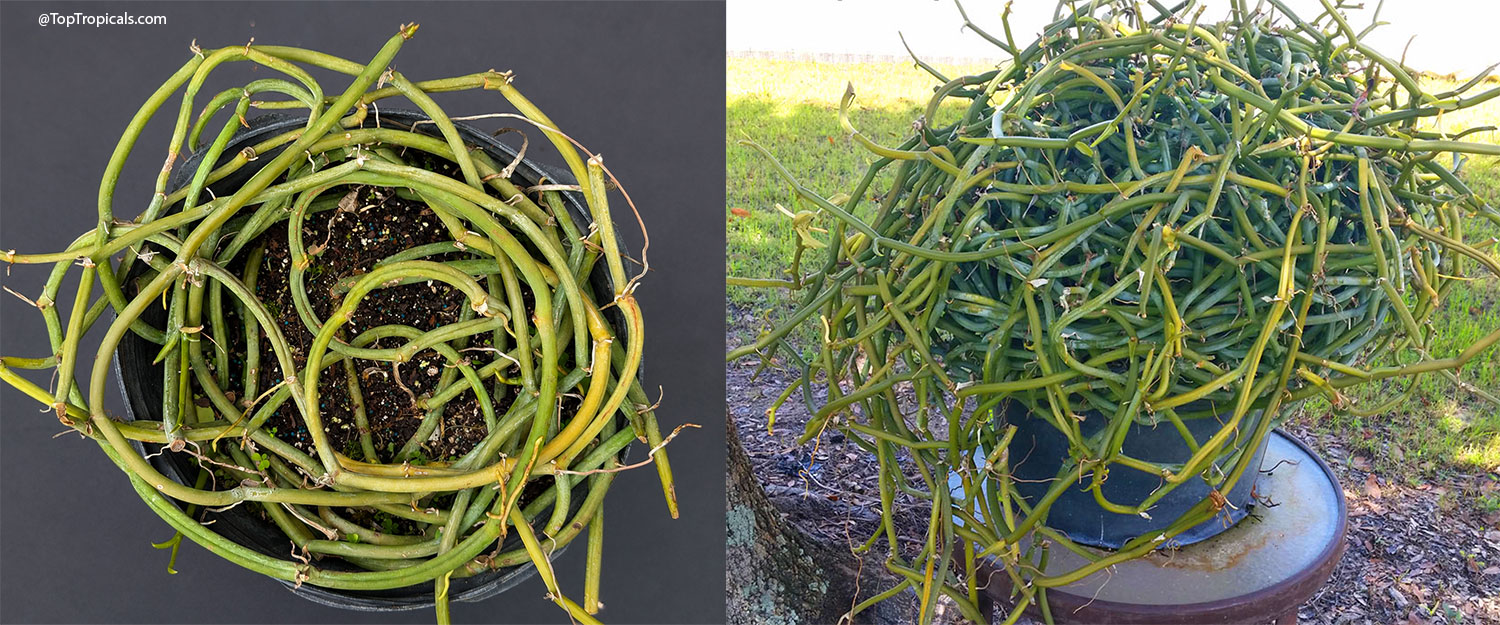
Side-by-side  comparison  of  a  young  Vanilla  dilloniana  in  a  7-gallon 
 pot.  The  left  image  shows  the  plant  beginning  to  wrap  around  the  container, 
 while  the  right  image  shows  the  same  plant  later  forming  a  dense  ball  of 
 leafless  green  vines  as  it  continues  its  characteristic  growth 
 habit.

The making of Intelligent Design. As Vanilla dilloniana grows, its long leafless stems naturally wrap around themselves, creating a dense sculptural mass of living vines. Even in a 7-gallon pot, the plant is already beginning to develop the unusual growth pattern that would eventually make its famous mother plant one of the largest cultivated specimens of its species.

The famous mother plant was named Intelligent Design by its grower, Robert Riefer. After decades of growth, countless blooms, container upgrades, and an apparent determination to occupy every available square foot of greenhouse space, the name seemed increasingly appropriate.

Unlike commercial vanilla, Vanilla dilloniana is grown primarily as a collector's orchid. Its leafless, sculptural stems create a living tangle of green architecture unlike almost any other cultivated vanilla species.

Ready to grow this remarkable Vanilla dilloniana? Start your own chapter in the story of Intelligent Design.

📚 Learn more from our Blog

🛒 Order Legendary Leafless Vanilla Dilloniana

Close-up  of  Vanilla  dilloniana  flowers  blooming  along  the  edge  of  a 
 large  container,  showing  pale  green  star-shaped  petals  with  striking  purple 
 and  white  centers  against  a  tangle  of  leafless  green 
 vines.

The unusual flowers of Vanilla dilloniana emerge directly from its leafless stems, creating a stunning contrast of pale green petals and vibrant purple throats.
Smokey: We cannot guarantee that your plant will eventually require a 250-gallon pool on wheels.
Sunshine: We also cannot rule it out.
Smokey: Officially, we cannot confirm that the plant possesses intelligence.
Sunshine: The evidence is mounting.
Smokey: What evidence?
Sunshine: It convinced humans to build larger containers, move it into a 250-gallon pool on wheels, transport it to museum exhibitions, and place its agents in collections across the country.
Smokey: That's called excellent horticulture.
Sunshine: That's exactly what the Intelligent Design plant wants you to think.

Date: 26 May 2026

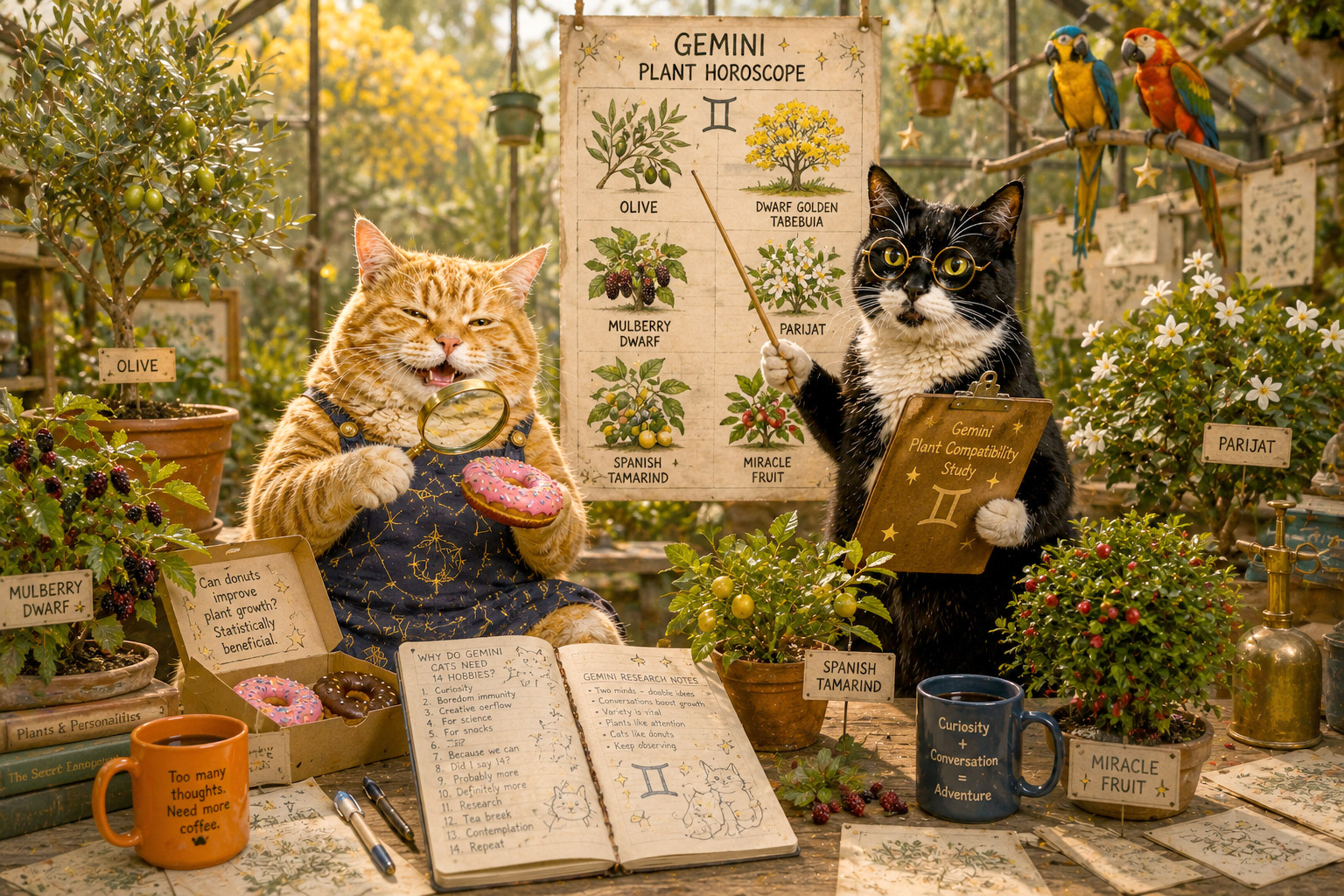
♊ Gemini Season Starts. We Are Five Days Late. Very Gemini.

Smokey  and  Sunshine  with  Gemini  tropical  plants  in  a  whimsical 
 greenhouse
Sunshine: I once met a girl and asked what she does. She said she assembles gyroscopes. I told her I don't believe in gyroscopes.
Smokey: You meant horoscopes.
Sunshine: That is what I said.
Smokey: You said gyroscopes.
Sunshine: Same thing.
Smokey: One predicts your future. The other stabilizes aircraft.
Sunshine: I don't believe in aircraft either.
Smokey: She left, didn't she.
Sunshine: She said she had to go assemble something.

♊ Gemini season started on May 21. Today is May 26 But honestly? That is not a problem. That is actually very Gemini. Gemini probably got distracted, opened three browser tabs, started a new hobby, forgot what it was doing, and came back five days later with a notebook full of ideas and zero apologies. So here we are.

Why these plants and not others

No, there is no scientific proof that olive trees belong to Gemini. We checked. The olives refused to comment. But if you are going to assign plants to zodiac signs — and we are — then Gemini deserves plants with intelligence, motion, surprise, fragrance, and a little chaos. Gemini is the sign of curiosity, conversation, and dual natures. It gets bored easily and talks to everyone at the party. These plants were picked because they fit that energy. And also because they are genuinely good plants worth growing, which Smokey insisted we mention.

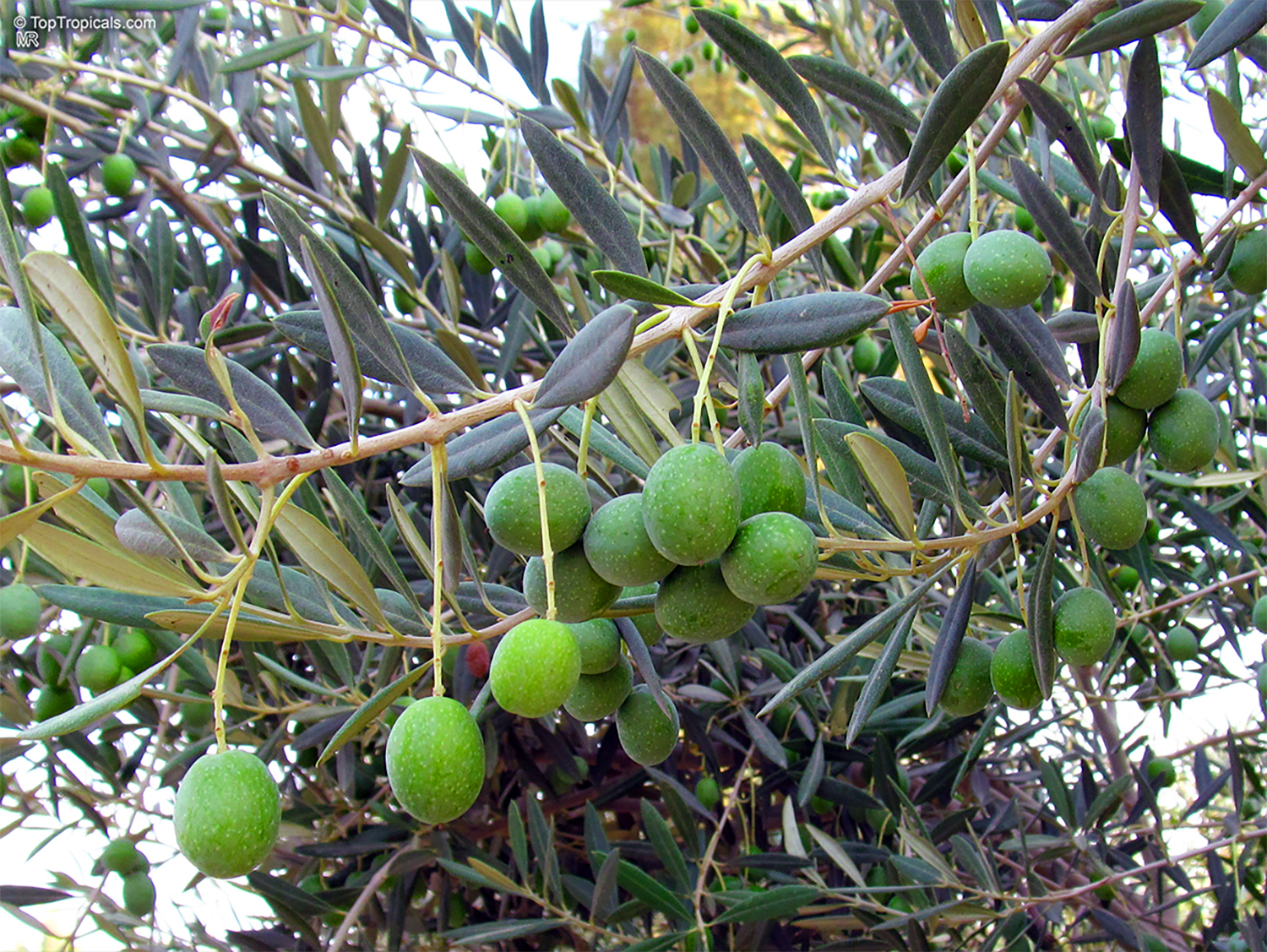
Olive (Olea europaea)

Close-up  of  an  olive  tree  branch  laden  with  clusters  of  green  olives 
 among  narrow  silvery-green  leaves.  The  fruit  is  ripening  on  the  tree  and 
 hanging  from  slender 
 stems.

Clusters of green olives developing on an olive tree branch. Olive trees are evergreen, drought-tolerant, and have been cultivated for thousands of years for both their fruit and the oil produced from it.

Olive is the thinking plant of this group. Ancient, silver-leaved, and quietly dramatic, it belongs to Gemini because Gemini loves history, long conversations, and plants that look like they know something you don't.

If you are growing olive in a container — which works very well — give it full sun, fast-draining soil, and a firm commitment to not overwatering it. Olive does not want wet feet. It wants to think in dry conditions, like a philosopher in a warm courtyard.

Smokey: Olive represents thousands of years of cultivation and human civilization.
Sunshine: And snacks with much better branding than they get credit for.

📚 More from garden blog

🛒 Shop olive trees

Dwarf Mulberry (Morus sp.)

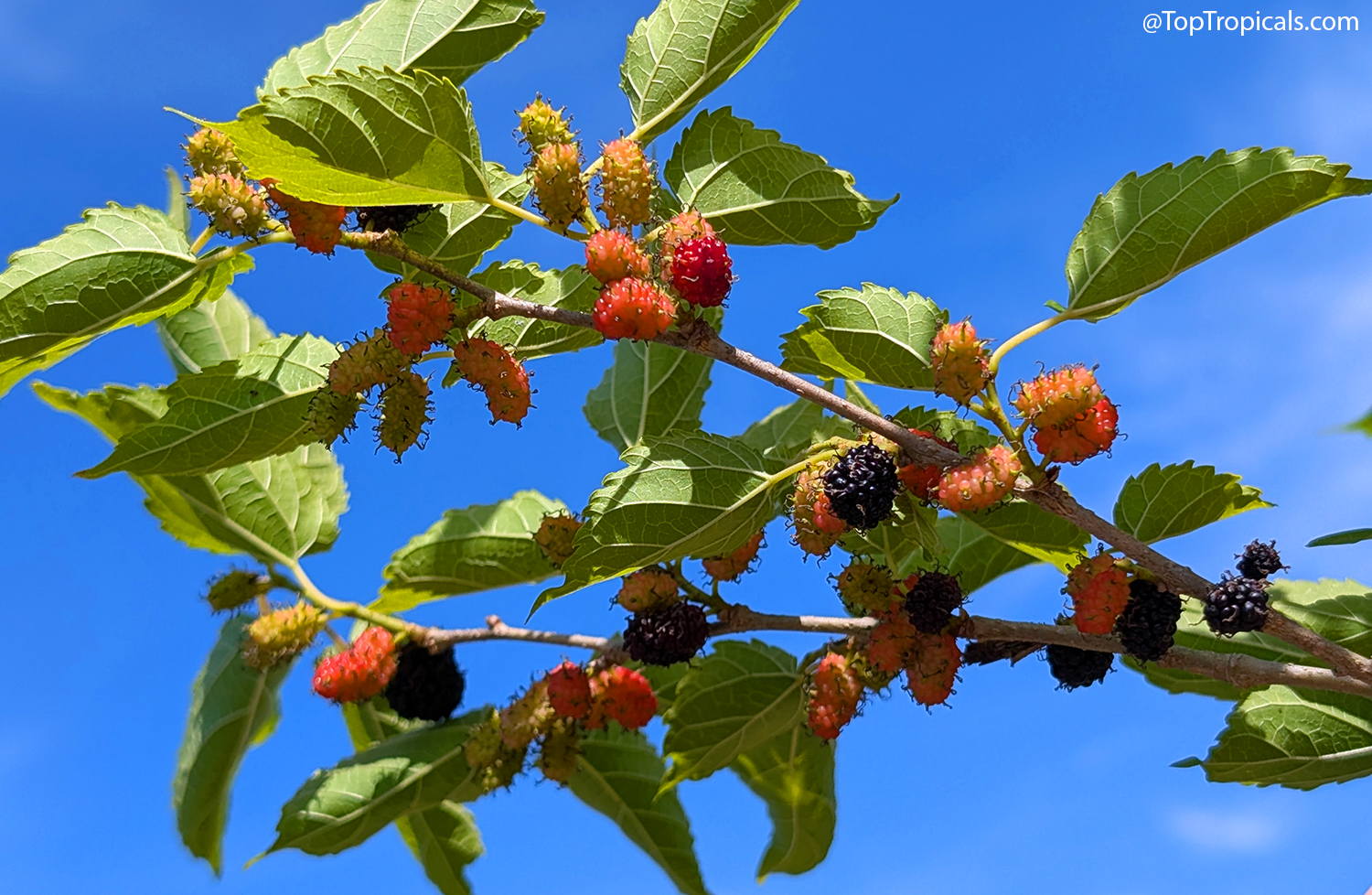
Branch  of  a  Dwarf  Everbearing  Mulberry  tree  displaying  fruit  in  various
    stages  of  ripening,  from  pale  green  and  pink  to  deep  purple-black,  against 
 a  bright  blue 
 sky.

Dwarf Everbearing Mulberry produces fruit over an extended season, often carrying berries in multiple stages of ripeness at the same time. The sweet, blackberry-like fruit is a favorite of both gardeners and wildlife.

Mulberry is Gemini in motion. It grows fast, produces generously, and absolutely refuses to be boring. A standard mulberry will take over your yard before you finish reading this sentence. A dwarf mulberry, however, is patio-friendly, container-happy, and still delivers fruit, birds, and mild garden chaos on schedule.

Prune after fruiting to keep the shape. Full sun. Large pot if you're growing in a container. This is the plant for people who want results and do not enjoy waiting.

Smokey: Efficient growth rate. Edible output. Compact habit. Reasonable choice.
Sunshine: Finally, a tree with a snack schedule.

📚 More from garden blog

🛒 Shop mulberry trees

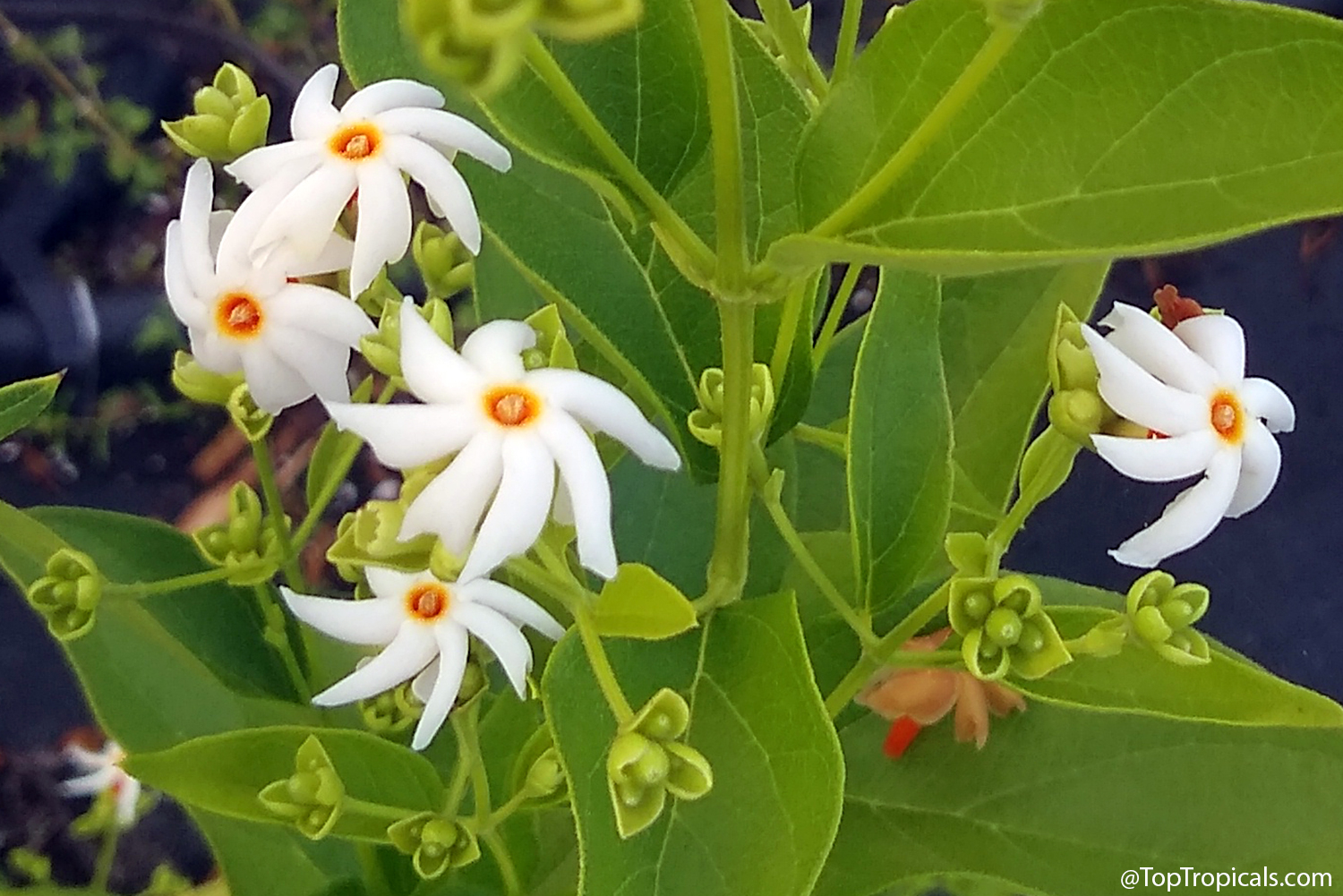
Parijat (Nyctanthes arbor-tristis)

Close-up  of  Parijat  flowers  (Nyctanthes  arbor-tristis)  with  white 
 pinwheel-shaped  petals  and  bright  orange  centers  surrounded  by  fresh  green 
 leaves  and  unopened  flower 
 buds.

Parijat, also known as Night-Flowering Jasmine, produces fragrant white flowers with vivid orange centers that open at night and often carpet the ground beneath the tree by morning.

Parijat belongs to Gemini's quieter, more poetic side. It blooms with small fragrant white flowers — orange centers, delicate petals — often at night. By morning, the flowers have fallen. They drop like little messages from the universe, which Sunshine finds meaningful and Smokey finds botanically interesting.

This one is for the gardener who wants something to actually stop and look at. Good in containers, good on a warm patio, needs decent light and warmth to do its best work.

Smokey: Night-blooming pattern. Fragrant ornamental. Grows well in warm climates.
Sunshine: It's a tree that leaves notes.

📚 More from garden blog

🛒 Shop parijat

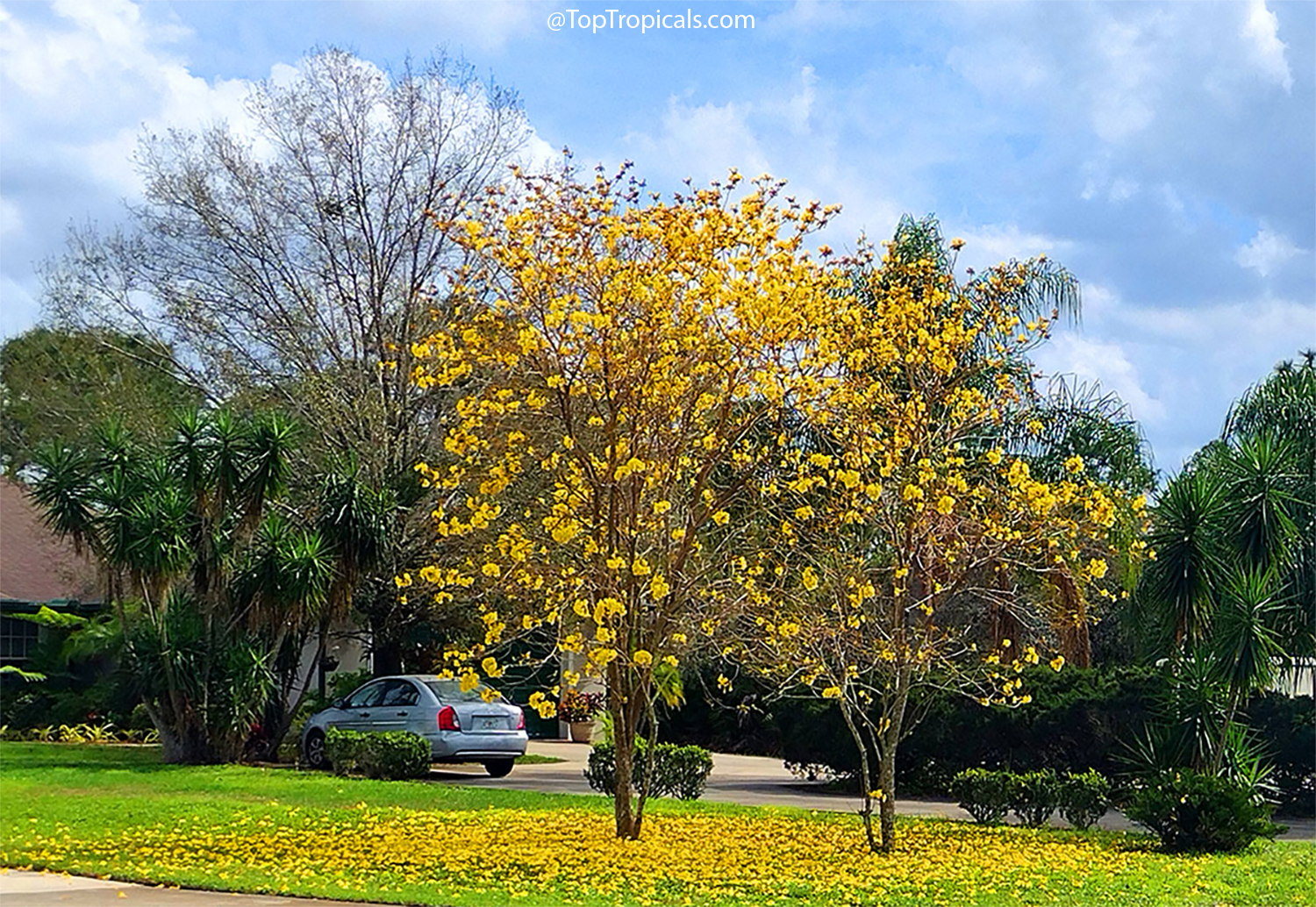
Dwarf Golden Tabebuia (Tabebuia chrysotricha)

Dwarf  Golden  Tabebuia  tree  covered  in  bright  golden-yellow  flowers, 
 standing  in  a  lawn  beneath  a  blue  sky,  with  a  carpet  of  fallen  blossoms 
 surrounding  the 
 trunk.

Dwarf Golden Tabebuia puts on one of the most spectacular spring displays, covering its branches with brilliant golden flowers before the leaves emerge. The fallen blooms create a striking yellow carpet beneath the tree.

This is the Gemini show-off. Quiet for most of the year, then suddenly covered in golden yellow flowers like it just remembered it has an announcement to make.

Dwarf Golden Tabebuia is compact enough for a large container or a sunny entrance, but it needs strong light to bloom well. Give it sun. Give it room. Then step back and let it perform.

Smokey: Seasonal flowering response triggered by environmental conditions.
Sunshine: Botanical applause.

📚 More from garden blog

🛒 Shop Dwarf Tabebuia

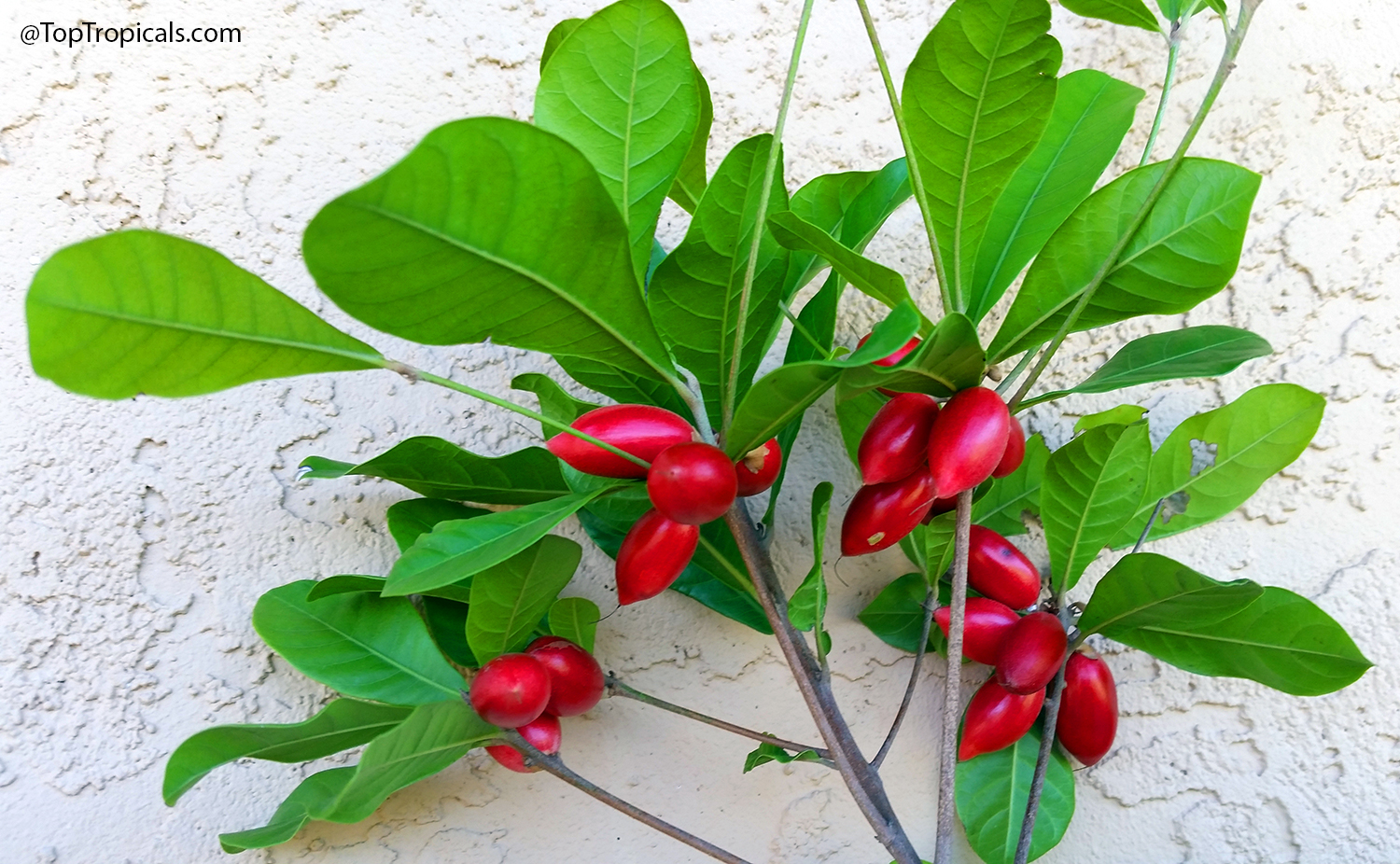
Miracle Fruit (Synsepalum dulcificum)

Clusters  of  bright  red  Miracle  Fruit  berries  growing  among  glossy  green
    leaves  on  a  compact  shrub.  The  elongated  fruits  stand  out  against  the  lush 
 foliage.

Miracle Fruit is famous for its unique berries, which contain miraculin - a natural compound that temporarily makes sour foods taste sweet. The attractive evergreen shrub produces bright red fruit and is well suited to containers and small gardens.

Miracle Fruit belongs on this list because it is, without argument, the most Gemini plant in existence. It does not taste like much on its own. But eat one berry and everything sour suddenly tastes sweet. Lemons taste like lemonade. Lime juice tastes like candy. A plain piece of sourdough becomes something you would pay extra for. The fruit literally changes how you experience everything that comes after it.

If that is not Gemini energy — dual nature, transformation, making you see the same thing two completely different ways — nothing is.

Miracle Fruit is a slow grower that likes warmth, humidity, acidic soil, and protection from cold. It does well in containers, which is good news because it genuinely hates frost. Keep it in a pot, bring it in when temperatures drop, and give it filtered light or morning sun rather than harsh afternoon exposure.

Smokey: The active compound is miraculin. It binds to taste receptors and distorts sour perception at low pH. Temporary effect, roughly thirty minutes to an hour.
Sunshine: It's a fruit that lies. Beautifully.

📚 More from garden blog

🛒 Shop Miracle Fruit

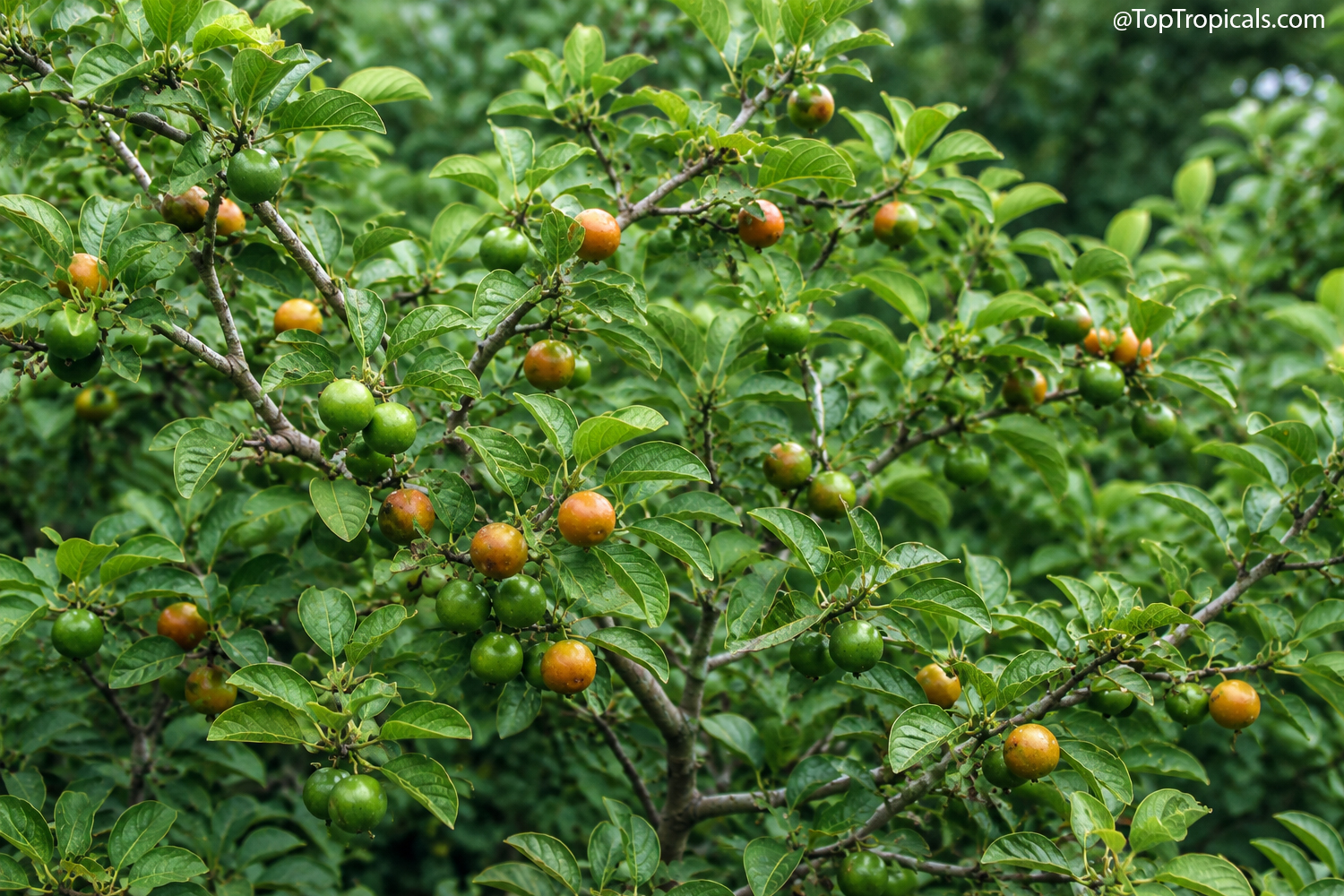
Spanish Tamarind (Wild Medlar, Vangueria infausta)

Spanish  Tamarind  (Vangueria  infausta)  tree  with  glossy  green  leaves  and
    clusters  of  round  fruit  in  various  stages  of  ripening,  from  green  to 
 golden-brown,  growing  on  branching  stems  in  a  lush  tropical  garden  setting.

Spanish Tamarind (Vangueria infausta) may be grown for its unusual fruit, but it also brings beauty to the garden with its lush foliage and heavy crops of ripening fruit. Green and golden-brown fruits often appear together on the tree, creating a colorful display.

Spanish Tamarind belongs to Gemini because it is unusual enough to start a conversation before anyone even knows what it is. The name alone does it. People will ask. You will explain. The fruit changes color as it ripens, the plant has collector appeal, and the whole thing feels like something you found in a book about plants that don't get enough attention.

This one needs warmth, sun, good drainage, and patience. It can live in a container with pruning. It rewards the gardener who is genuinely interested in something a little different.

Smokey: Tropical fruiting curiosity. Suitable for collectors.
Sunshine: Sounds like something I would order at a restaurant without reading the description.

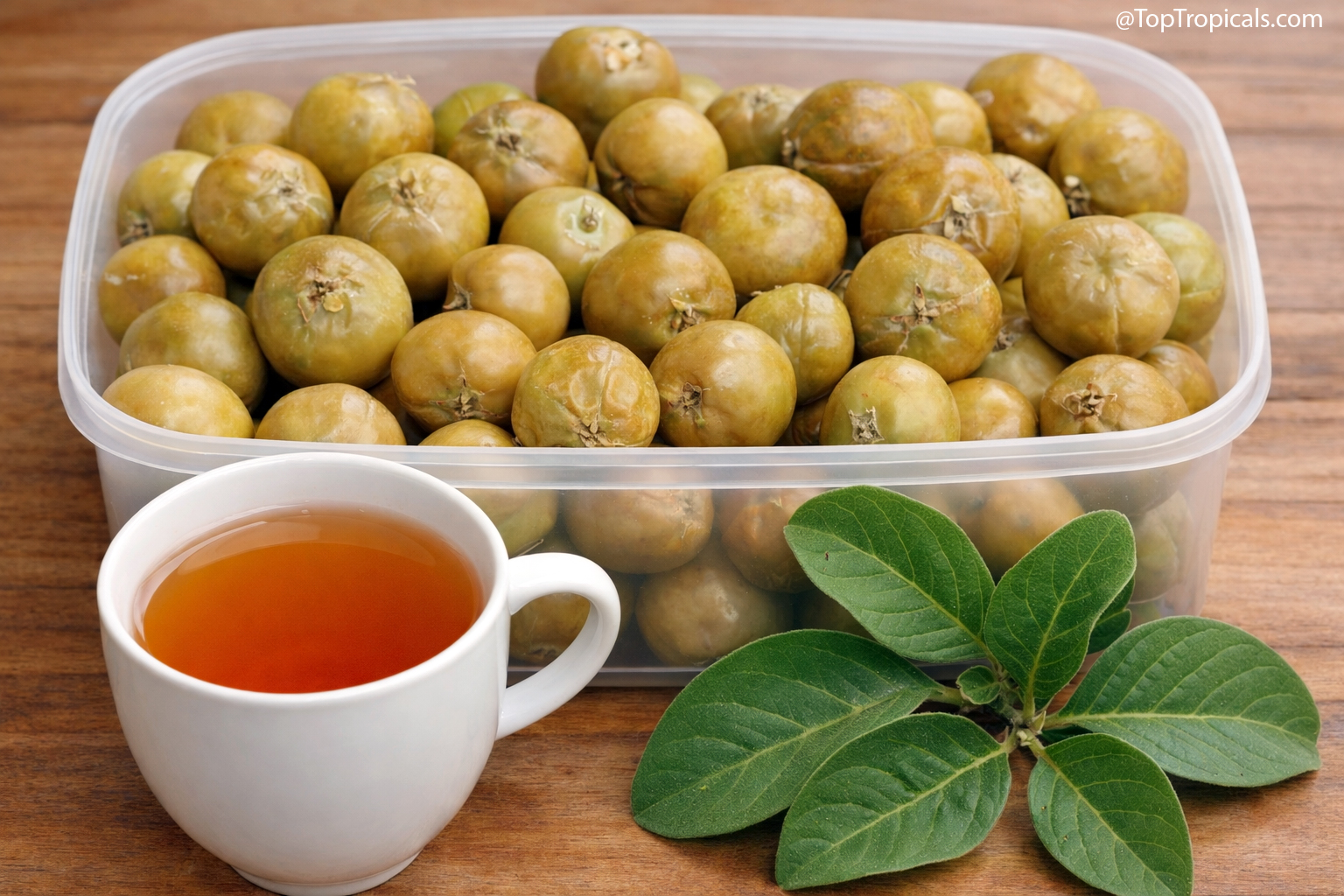
Container  filled  with  ripe  Spanish  Tamarind  (Vangueria  infausta)  fruit 
 on  a  wooden  table  beside  a  white  cup  of  amber-colored  fruit  tea  and  a  sprig 
 of  velvety  green  leaves.

One of the traditional uses of Spanish Tamarind (Vangueria infausta) is fruit tea. The ripe fruit can be dried and steeped to make a mild, refreshing drink rich in natural flavor, while the soft, velvety leaves have long been used in traditional herbal infusions.

📚 More from garden blog

🛒 Shop Spanish Tamarind

Horoscope aside — why these plants are actually worth growing

Even if Gemini energy has nothing to do with your garden, these plants offer real value: fruit, fragrance, flowers, container growing, and something interesting to look at or talk about.

  • Olive — full sun, excellent drainage, don't overwater, thrives in containers. Tropical varieties: USDA Zone: 8-10. Cold hardy to 15-20°F.
  • Dwarf Mulberry — full sun, large pot, prune after fruiting, fast results. USDA Zone: 8-11. Cold hardy to 20-25°F. Most mulberry varieties can be grown in USDA Zone 5-6 to 10 and cold hardy to 5°F.
  • Parijat — warmth, good light, patio or container, fragrant and ornamental. USDA Zone 9-11. Tolerates light freezing to about 30°F for short periods (mature plants). Young plants must be protected.
  • Dwarf Golden Tabebuia — strong sun, large container or sunny ground spot, compact but dramatic when it blooms. USDA Zone 9-11. Protect young plants from frost. Best flowering in full sun.
  • Spanish Tamarind — warmth, sun, drainage, patience, collector interest. USDA Zone 9-11. USDA Zone 10-11, possibly warm Zone 9b in protected microclimates. Protect from frost, especially young plants.
  • Miracle Fruit — warmth, humidity, acidic soil, filtered light, protect from frost. Best in containers. USDA Zone 10-11. Cold hardy only to about 40°F — bring it in well before first frost, not after.

Can you grow them in pots?

Yes. With the standard warning: a pot is not magic. Use a large container, fast-draining soil, full sun where the plant wants it, regular feeding with Green Magic conrolled-release fertilizer every 6 months and Sunshine Boosters - safe to use with every watering. Apply a bit of pruning when things get out of hand.

Smokey: A pot is just a smaller universe.
Sunshine: A pot is a drainage system with ambitions.

📅June gardening reality check

June is a good time to establish tropical and subtropical plants. The soil is warm, the days are long, and actively growing plants will take root faster than they would in cooler months.

👉 A few things to keep in mind:

  • Containers dry out fast even when rain increases. Check them. Don't assume rain did the job.
  • Don't let pots sit in standing water. Root rot is quiet until it isn't.
  • Feed actively growing plants. They are working hard and they need the input. We recommend Green Magic controlled release fertilizer during active growth (twice a year) and Sunshine Boosters for spray and daily watering year around.

    📚 More about fertilizers from our garden Blog

  • Watch new growth for pests. Tender leaves are the first target.
  • Prune lightly to shape if needed, but don't do heavy cutting in peak heat. Save that for after flowering or early in the season.
  • Mulch around in-ground plants to hold moisture, but keep mulch away from the trunk.

🌠 The stars don't care? Grow anyway!

Maybe the stars do not care whether your garden is a Gemini garden. Maybe olive trees are not receiving transmissions from Mercury. But a garden full of fruit, fragrance, flowers, and strange little stories is still a very good idea.

Smokey: That is the first reasonable conclusion in this entire article.
Sunshine: Second. The donut research was also important.

Happy Gemini gardening season from all of us!

🛒 Shop tropical fruit and flowers

🎤 NEW: Interview With Smokey & Sunshine

Date: 18 Jun 2026

Dating tips

Dating tips from Smokey and Sunshine

Dating tips from Smokey and Sunshine

🌹 Dating tips


Sunshine: Smokey, I have a date in one hour.
Smokey: Congratulations. Try not to order donuts.
Sunshine: I will try really hard. She is very smart. I need to sound intelligent.
Smokey: Then don't open your mouth. Your IQ will appear much higher.
Sunshine: You were on Jeopardy. Give me some random facts to impress her with my knowledge.
Smokey: I lost in the first round.
Sunshine: You still know more than me.
Smokey: Everyone knows more than you, Sunshine. How random?
Sunshine: Smart random. Not weird random.
Smokey: Those are the same category, Sunshine.
Sunshine: Just give me the facts.
Smokey: Avocados don't ripen on the tree. They mature there, then ripen after picking.
Sunshine: That sounds like personal growth.
Smokey: Plants warn each other about insects using chemical signals.
Sunshine: Romantic. Mysterious. Slightly terrifying.
Smokey: Bananas are technically berries.
Sunshine: Perfect. I'll say that and then stare thoughtfully at my coffee.
Smokey: Don't say everything you know in the first five minutes.
Sunshine: What if she asks about dessert?
Smokey: Then you'll be fine.
Sunshine: What if she doesn't?
Smokey: Lead with the banana thing. And please — not your ridiculous pants.
Sunshine: They are a statement.
Smokey: Yes. The statement is do not approach me


🛒 Explore plants and their facts

📚 Learn more:


·  About Smokey & Sunshine
·  Smokey & Sunshine interview

#PeopleCats

🟢 Join 👉 TopTropicals

Date: 7 Mar 2026

🌞 Spring Nutrition Strategy: How to Identify and Fix Plant Nutrient Starvation

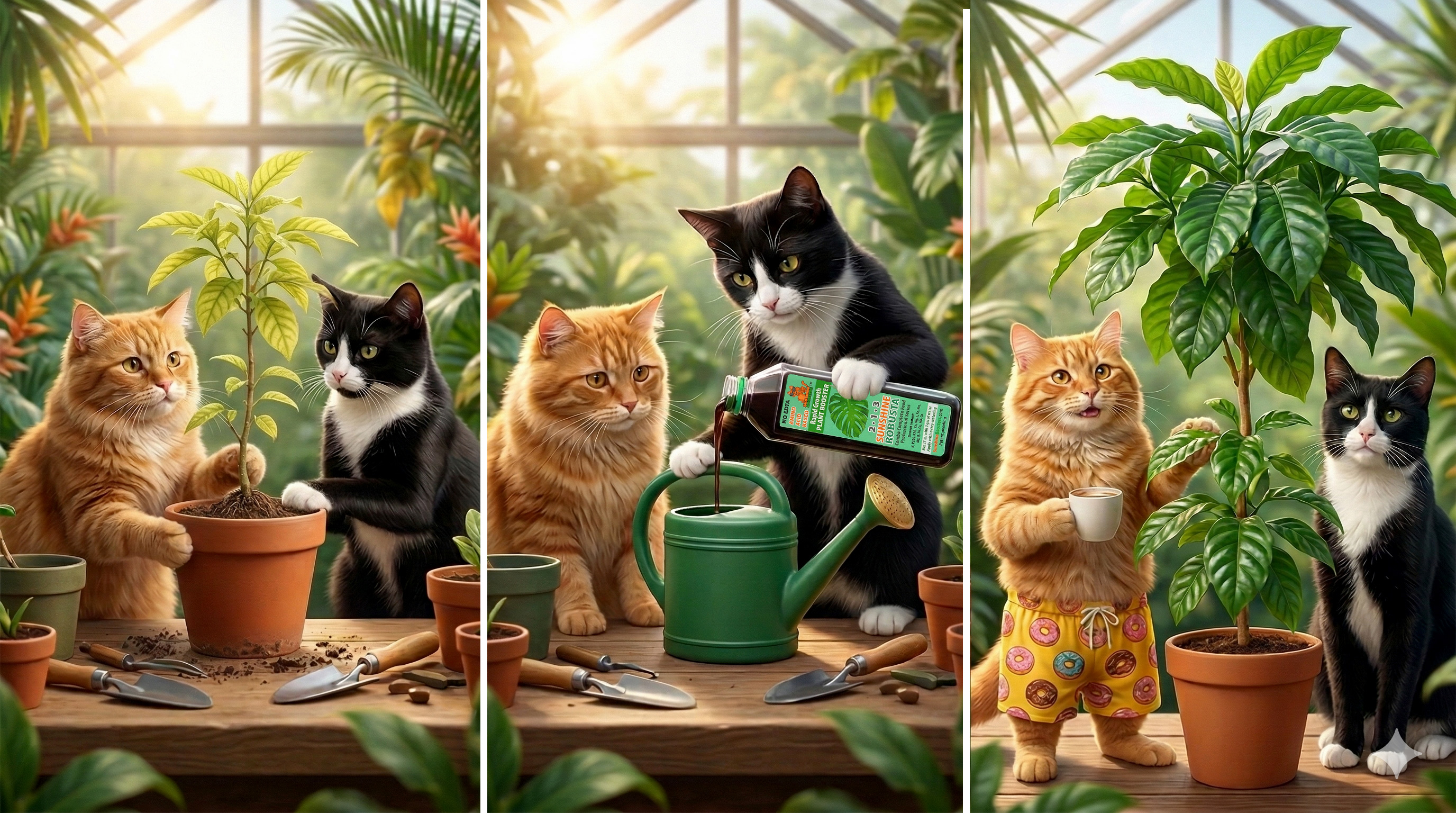
Smokey  and  Sunshine  PeopleCats  diagnose  a  starving  coffee  plant  and 
 revive  it  using  Sunshine  Robusta  boosters,  turning  a  weak  yellow  plant  into 
 a  healthy  green  coffee  tree  after  one  month..
Sunshine: I'm trying to fight rising coffee prices. So I planted my own coffee plant. But it's dying.

Smokey: It's not dying. It's starving. Classic nutrient collapse. Imagine going two days without donuts.

Sunshine: Two days? That's a PeopleCats rights violation. Catstitution First Amendment: food, including donuts, must remain available.

Smokey: Exactly. Plants feel the same. Let's feed it. Sunshine Robusta. Robusta is coffee, you know.

Sunshine: Obviously they named Sunshine Boosters after my charm. And since it's coffee, it should work perfectly.

One month later

Sunshine: Holy whiskers! You're a magician.

Smokey: No magic. Just boosters.

Sunshine: Great. Coffee is on me when this tree starts producing. You bring the donuts.

Read more about Smokey & Sunshine

Fellow gardeners,

Spring has arrived, and plants are coming back to life. New shoots are appearing, fresh leaves are unfolding, and roots are beginning to grow actively again. As plants enter this important stage of the season, they need more than just water to support their growth. Proper nutrition is essential for strong development and healthy plants. SUNSHINE Boosters provide the balanced nutrition plants need to start the growing season strong.

A simple rule we follow in our nursery: new growth responds best to foliar feeding. When nutrients are sprayed directly on the leaves, plants can absorb them quickly and efficiently.

  • Immediate action – nutrients are absorbed through the leaves and start working right away.
  • No delay traveling through soil – plants do not need to wait for nutrients to move down to the roots.
  • Avoids soil lockout – micronutrients can become unavailable in high pH soils, but foliar feeding bypasses this problem.
  • Supports stressed plants – when roots are cold, damaged, or newly transplanted, foliar feeding helps plants recover faster.

However, sometimes plants begin to show visible nutrient deficiencies. Yellow leaves, slow growth, brown leaf edges, or distorted new leaves are often early signs that the plant is missing essential elements needed for healthy development.

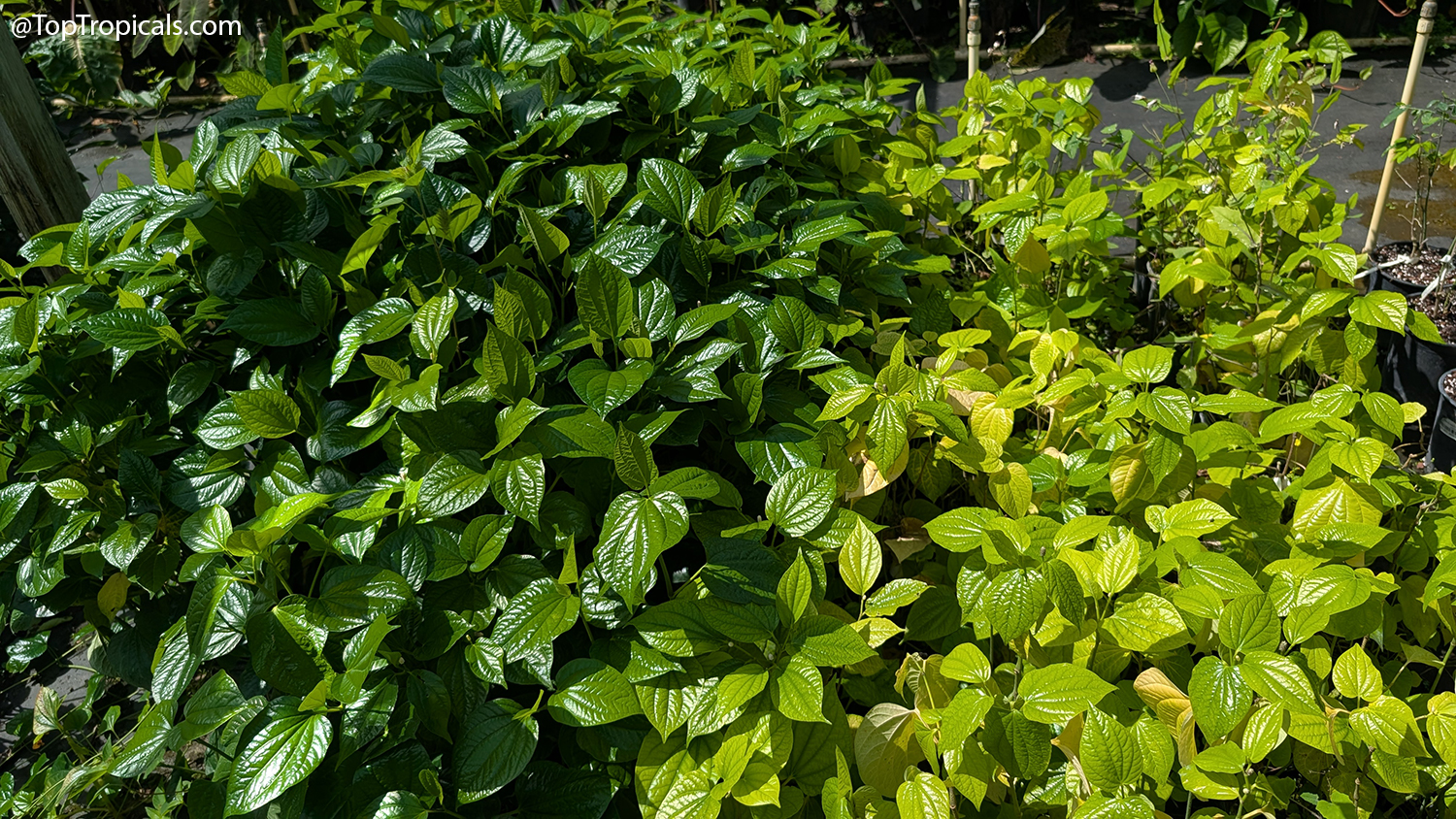
Piper  sarmentosum  Vietnamese  pepper  plants  comparison  with  fertilizer 
 on  the  left  and  without  fertilizer  on  the 
 right

Piper sarmentosum - Vietnamese Pepper - with fertilizer (left) and without (right)

Chaa-plu Plant Facts

Botanical name: Piper sarmentosum
Also known as: Chaa-plu, Vietnamese Pepper, Lalot, La Lot, Wild Betel Leaf
USDA Zone: 9 - 11
Highligths Vine or creeper plantSmall plant 2-5 ftSemi-shadeFull sunWatering: Moderate. Water when top soil feels dryWatering: Regular. Let topsoil dry slightlyOrnamental foliageSpice or herb plantEthnomedical plant.
Plants marked as ethnomedical and/or described as medicinal, are not offered as medicine but rather as ornamentals or plant collectibles.
Ethnomedical statements / products have not been evaluated by the FDA and are not intended to diagnose, treat, cure, or prevent any disease. We urge all customers to consult a physician before using any supplements, herbals or medicines advertised here or elsewhere.
Get personalized tips for your region

These symptoms are especially common in container plants, where nutrients can be quickly depleted or become unavailable due to soil pH and watering conditions.

Use the quick reference table below to identify common nutrient-related symptoms and the recommended SUNSHINE solution to correct them.

Symptom you see What to do
Pale leaves, slow growth, weak new shoots
(often nitrogen related)
Spray SUNSHINE Robusta to stimulate strong vegetative growth.
Brown leaf edges or weak plant vigor
(often potassium related)
Apply SUNSHINE Robusta to restore nutrient balance.
Yellow leaves with green veins
(iron or manganese deficiency)
Apply SUNSHINE Superfood to correct micronutrient deficiency.
Small distorted leaves or poor flowering
(zinc or boron deficiency)
Use SUNSHINE Superfood during active growth period.

🌿Foliar Feeding: How Much and How Often

For most plants, foliar feeding works best when applied lightly and regularly during active growth.

  • Regular feeding (maintenance): Mix with tap water according to the ratio on the label. For SUNSHINE Robusta use 25 ml (5 tsp)per gallon of water and spray leaves every 5-7 days during active growth.
  • Correction feeding ("medicine" dose): if plants show visible nutrient deficiencies, combine SUNSHINE Robusta with SUNSHINE Superfood and spray every 5–7 days until new growth appears healthy. All SUNSHINE Boosters products are compatible and can be mixed with water in the same sprayer.
  • Best time to spray: early morning or evening when temperatures are cooler and leaves can absorb nutrients efficiently.
  • Important: spray both the top and underside of leaves for maximum absorption.

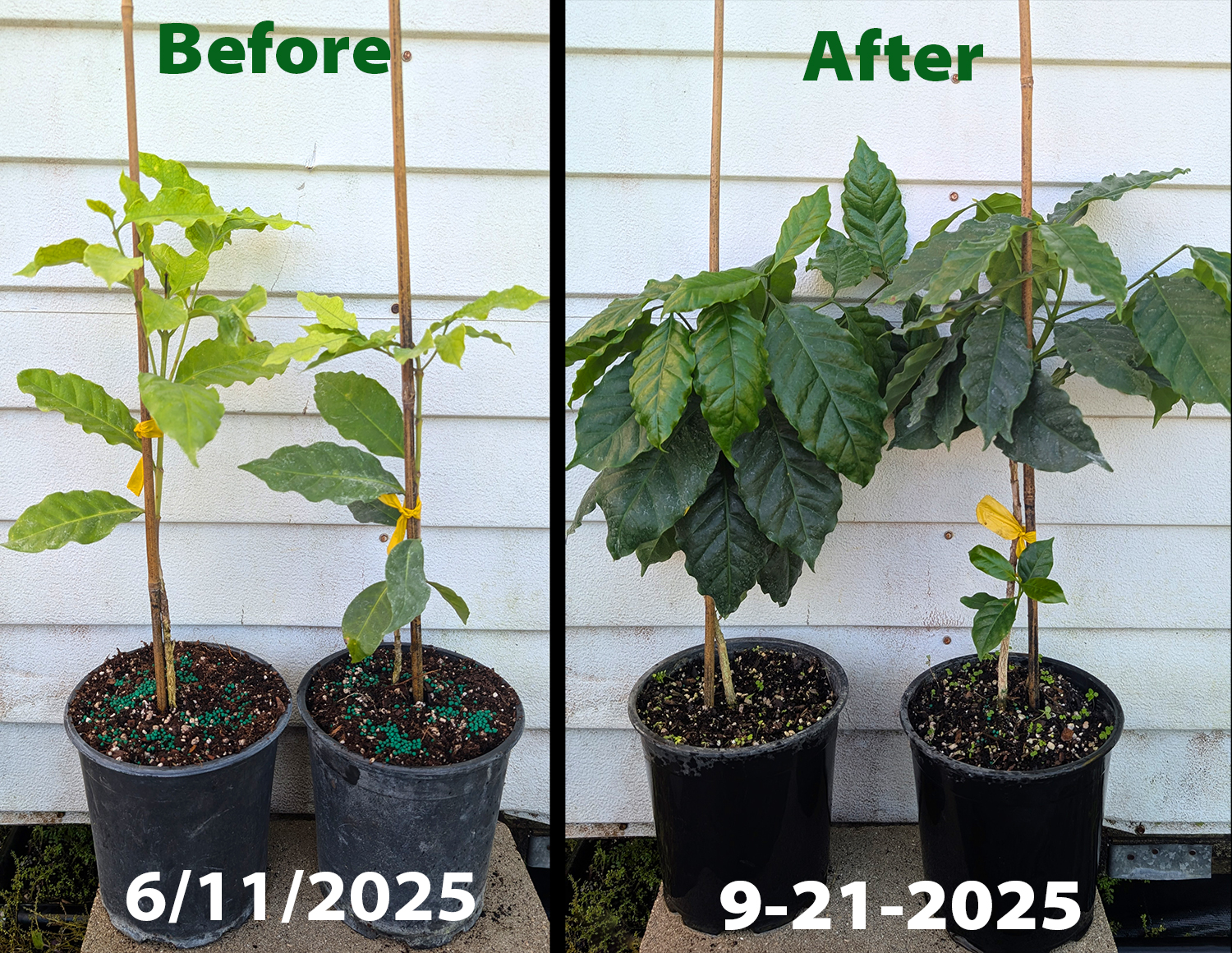
Coffee  plants  before  and  after  regular  Sunshine  Robusta  fertilizer 
 applications  showing  darker  leaves  and  stronger 
 growth

Coffee plants before and after regular Sunshine Robusta applications

🛒 Feed your plants