Garden Blog - Top Tropicals

Date: 29 Oct 2024

How to overwinter tropical plants indoors
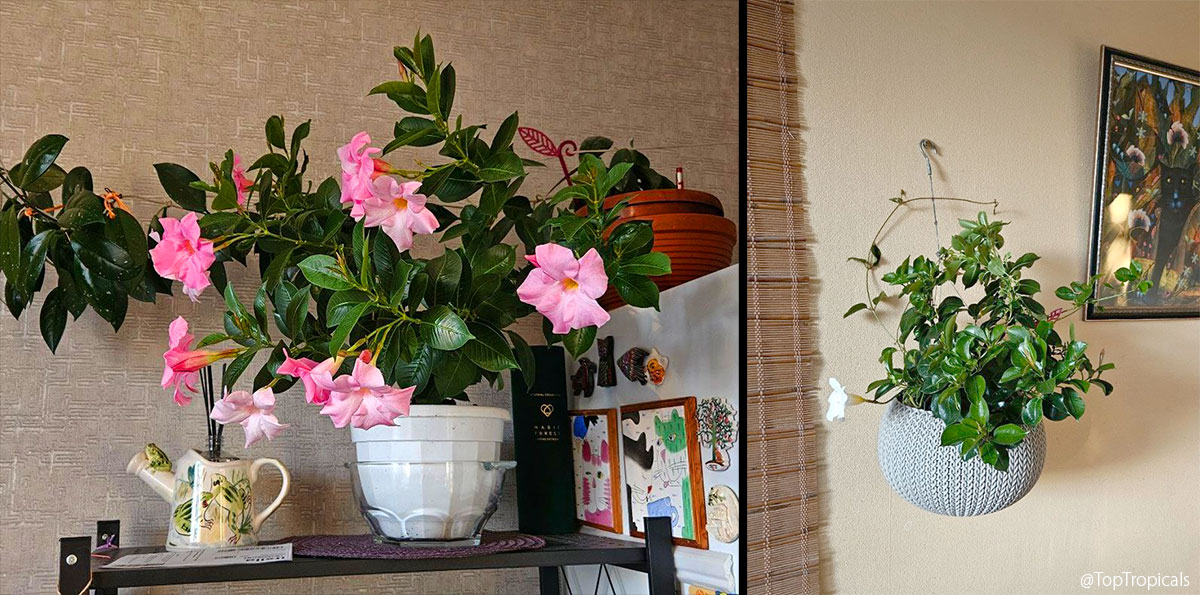
Mandevillas  indoors

10 key tips for successful overwintering

Q: I have two Mandevillas that thrived on my balcony all summer. Now that cold weather is approaching, I've moved them indoors to bright spots, but they're dropping and wilting leaves. How can I keep them healthy until spring? Should I fertilize them? Can Mandevillas grow indoors year-round?

A: First, keep in mind that the plants we call "indoor plants" or "house plants" are all tropical. However, not all tropical plants are suitable for indoor living. Some, especially shade-loving ones, thrive in indoor conditions, which is why we refer to them as "house plants" (philodendrons, monsteras, calatheas, peperomias, and many others, including some succulents). Others are less adaptable to the lower light and humidity typical of indoor spaces, but with a little extra care, you can overwinter them inside and move them back outdoors in spring. Mandevillas are no exception! Even tropical trees, including fruit trees, can tolerate a few months indoors if given the right conditions for semi-dormancy. Below are the 10 key tips for successfully overwintering tropical plants indoors.

1. Maximize Light: The more light, the better. There's no such thing as too much indoor light. If windows aren't enough, use LED grow lights, which stay cool and won't dry the air. Rotate plants every few days to prevent uneven leaf loss.

2. Reduce Watering: Less light and cooler temperatures mean plants need less water. Allow the soil to dry between waterings, and avoid overwatering - combination of cold + wet is especially harmful.

3. Maintain Moderate Temperatures: Most tropicals are happy with daytime temperatures around 75F and nights at 50-60F. In sunrooms or greenhouses, some can handle 45F if watering is kept to a minimum.

4. Boost Humidity: Avoid placing plants near heaters or vents that dry the air. Misting daily helps, or place pots on trays filled with water and pebbles to raise humidity around them.

5. Monitor for Pests: Check leaves weekly to catch insect problems early, as pests can cause serious damage or even kill the plant indoors.

6. Fertilize Smart: Use ONLY liquid, amino-acid-based fertilizers like Sunshine Boosters throughout winter; they won't burn roots since their dosage adjusts with reduced watering. Avoid dry, granulated, and EDTA-based fertilizers during winter and dormancy.

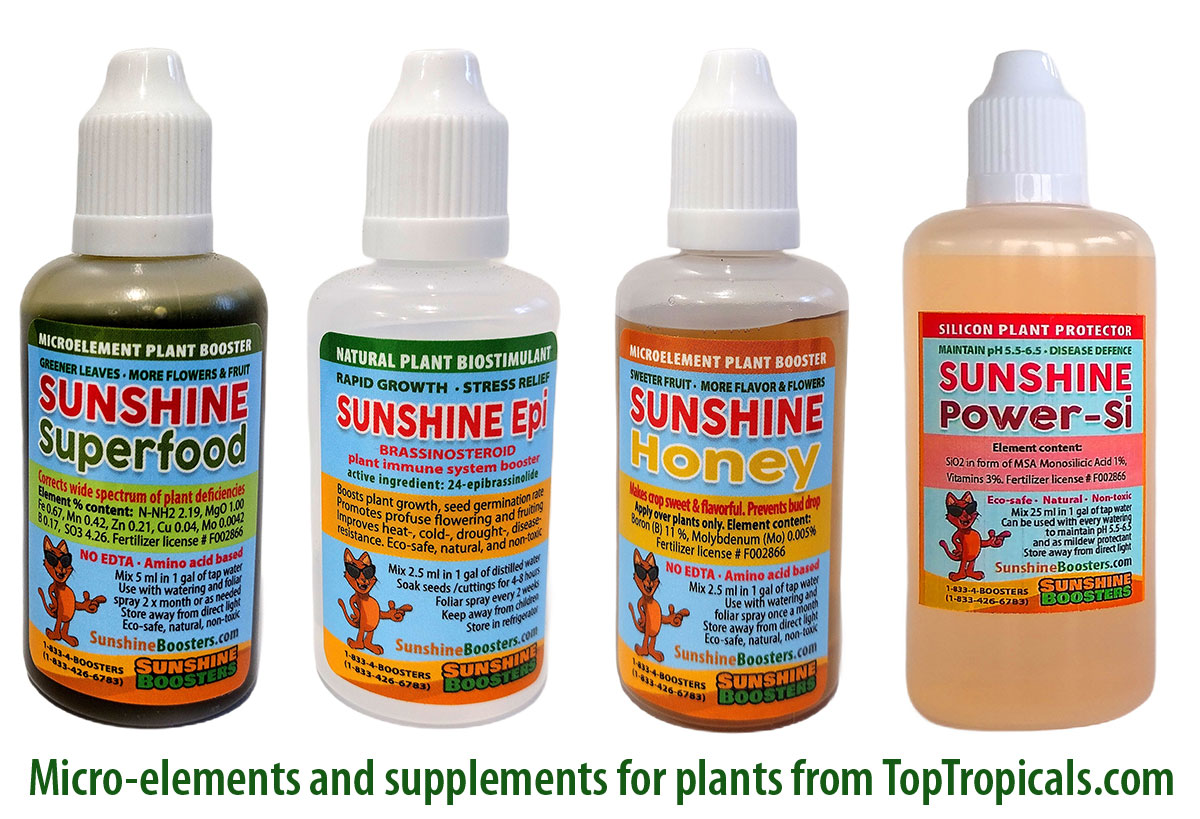
7. Use Micro-Nutrients: Along with macro-elements (fertilizers), supplement with micro-elements like Sunshine Superfood and bio-stimulants such as Sunshine Epi to build strong plants with robust immune systems, better able to withstand unfavorable conditions and resist diseases.

8. Hold Off on Pruning: Leaf drop and leggy growth are normal responses to winter. Wait until spring to prune, when new growth starts, to encourage branching and healthy foliage.

9. Don't Repot Yet: During dormancy, roots slow their growth. Repotting too soon risks root rot. Wait until spring when new growth appears to transplant into a larger container. Typically, roots grow in proportion to the above-ground parts.

10. Let Them Rest: Winter is a natural resting period. Avoid forcing growth - your plants will reward your patience with vibrant leaves and flowers when spring returns.
Cat  Indoor  Garden

Date: 27 Feb 2025

What Fertilizer to Use Now and How?
Five important keys to healthy plants

Sunshine  Boosters  Selection

Q: It's early Spring this year. Should I start fertilizing my plants sooner than usual?

A: Most fertilizer instructions recommend fertilizing tropical plants from March to November. This is because plants don't need as much food during the cooler months when many go dormant, and excess nutrients can burn the roots if not absorbed. However, for the most effective fertilizer program and healthy plants, consider these points:

1. Sunshine Boosters Year-Round

Liquid amino-acid-based fertilizers like Sunshine Boosters are safe to use year-round. Since watering is reduced in cooler weather, the intake of water-soluble fertilizer is also lower, providing plants with just the essential nutrients for their minimal needs.

2. Dry Fertilizer Schedule

Be cautious with dry fertilizers. Apply them only during active growth in the hot season.

3. Temperature Is Key

If March is still cold, delay dry fertilizer use. However, if nighttime temperatures in February stay above 65F, you can start a dry fertilizer program using slow-release, granulated plant food.

4. What Fertilizers to Use and How

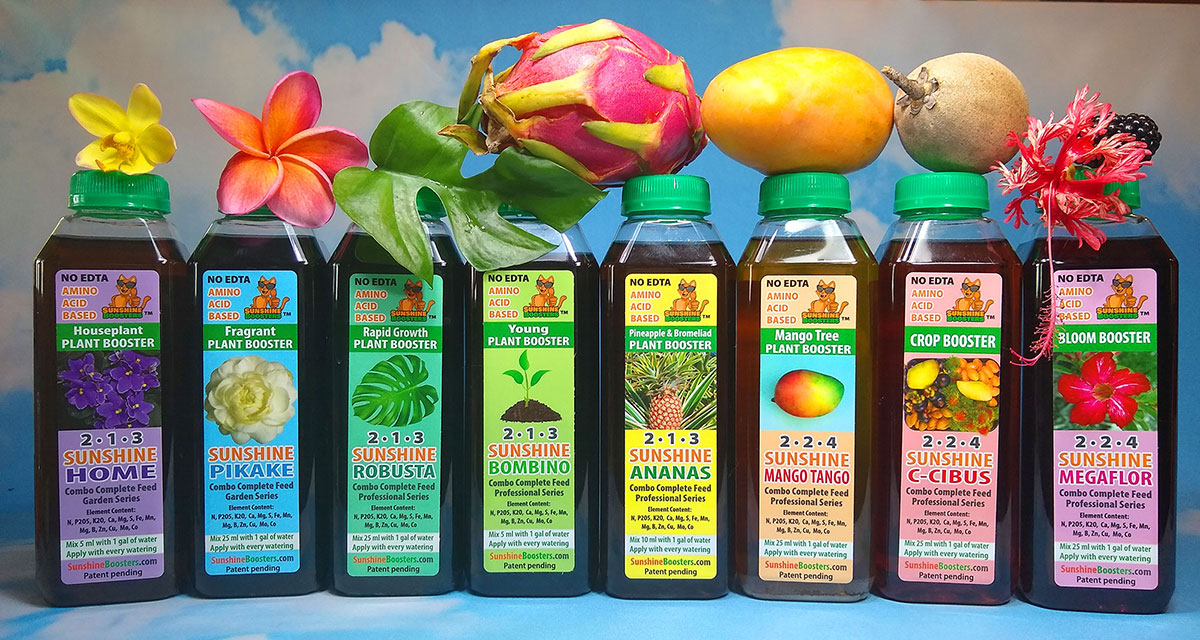
Check out our Sunshine Boosters selection for different types of plants and choose the right type for your needs. These can be applied as often as with every watering:

For Rapid Growth
Sunshine Robusta - Rapid Growth Booster: general fertilizer for both foliage plants and small starters that need an extra boost.

For Flowers
Sunshine Megaflor - Bloom Booster: boosts flowers on established plants; and Sunshine Pikake - Fragrant Plant Booster: best for fragrant flowers.

For Fruit Trees
Sunshine C-Cibus - Crop Booster: contains all necessary elements for fruit trees and their production. Sunshine Mango Tango - specifically formulated for Mango and Avocado trees, and Sunshine Citron - ideal for citrus trees.

For Tender Perennials
Sunshine Orchidasm - Orchid Total Feed and Sunshine Ananas - Pineapple and Bromeliad Booster: mild formulas for these tender perennials.

5. Microelement Supplements Are a Must

Besides macronutrients, plants need additional microelements, just like humans need vitamins. Be sure to apply these supplements along with your regular plant food:

For Green Leaves and Health
Sunshine SuperFood - Complex Microelement Supplement: a must for healthy plants. Apply once a month.

For Stress Relief
Sunshine-Epi - Brassinosteroid Plant Hormone: essential for plants recovering from stress (shipping, transplanting, drought, insect damage, cold stress, etc.). Apply as needed.

For Sweeter, Bigger Fruit
Sunshine Honey - Fruit Sugar Booster: application on fruit trees will make fruit bigger and sweeter by directing sugars to the fruit from other plant parts, and helps to prevent bud drop. Apply 4 times a year: at bud setting, flowering, fruit setting, and after harvesting.

For Better Resistance
Sunshine Power Si - Silicon Protector - enhances resistance to insects, diseases, drought, and frost, while boosting growth. Apply once a month, along with Sunshine SuperFood.

Need Help? Our Plant Experts Are Ready to Assist!

Microelements  and  supplements  for 


plants

Date: 24 Sep 2025

The SECRET growers never tell you: simple trick how to bring plants back to life and keep green

Green Magic Fetilizer makes plants green

🌳 The SECRET growers never tell you: simple trick how to bring plants back to life and keep green

  • 💚 Green Magic is plant food that really works. It keeps your plants green, strong, and growing steady.
  • 💚 We call it Magic - because it even brought back plants we thought were gone! So thу Green Magic can bring dead to live!
  • 💚 The secret is slow release. Most dry fertilizers dump everything at once, burn the roots, then disappear. Green Magic feeds little by little for six months straight. No burn, no guesswork, just steady food that plants love.
  • 💚 It's perfect for potted fruit trees, ornamentals, and houseplants. One handful is all it takes, and your plants stay fed for half a year.


✔️ How to use:


Mix in 1 teaspoon per gallon of soil when potting, or sprinkle on top once every six months. That's it!

✔️ Why it works:

  • Feeds slowly and evenly for six months
  • Keeps leaves green and plants healthy
  • Strong growth, even for weak or struggling plants
  • Works in any climate, indoors or out
  • Great for containers, trees, and ornamentals
  • This isn’t a flower booster. It’s a growth booster. The kind of steady food that builds strong plants for life.

  • 👉 Watch your plants come back to life and thrive with this professional-grade, controlled-release fertilizer - Green Magic. Even struggling plants can turn lush and green again.
Give it a try - your plants will thank you!

🛒 Buy once, feed for 6 months!

📚 Learn more


#Fertilizers #How_to
🟢 Join 👉 TopTropicals

Date: 10 Nov 2022

Fertilizing indoor plants in Winter

Sunshine  boosters  for  indoor  palnts

What is the best fertilizer for indoor plants?
Can I fertilize house plants in Winter?

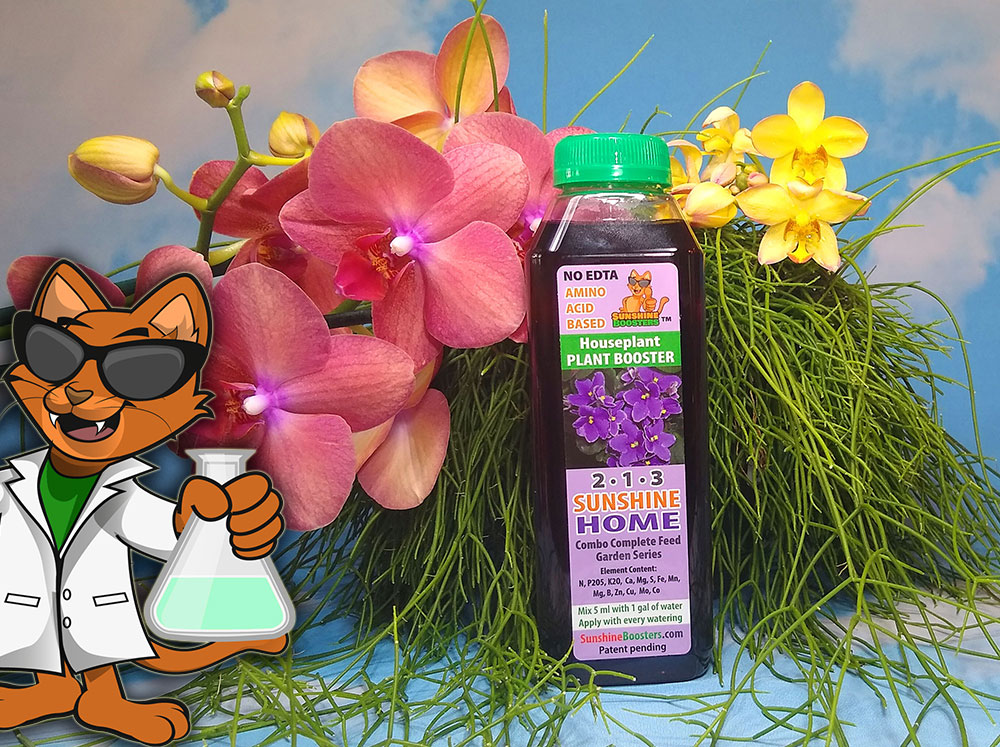
The best fertilizer for indoor plants is liquid fertilizer Sunshine Boosters (TM). It is amino-acid based, natural, and is safe to use with every watering and year around. Unlike dry fertilizers that are not recommended to use during Winter, Sunshine Boosters formula is mild and scientifically balanced. Your houseplants will consume exactly as much nutrients as they need even during cooler months of less active growth. Sunshine boosters will not burn roots and won't create nutrient lockup (excessive salts that often caused by dry fertilizers). Sunshine Boosters is a perfect food for all kinds of plants, and different boosters available for different plant types (flowering, fruiting, even for orchids). Check out Sunshine Boosters selection.

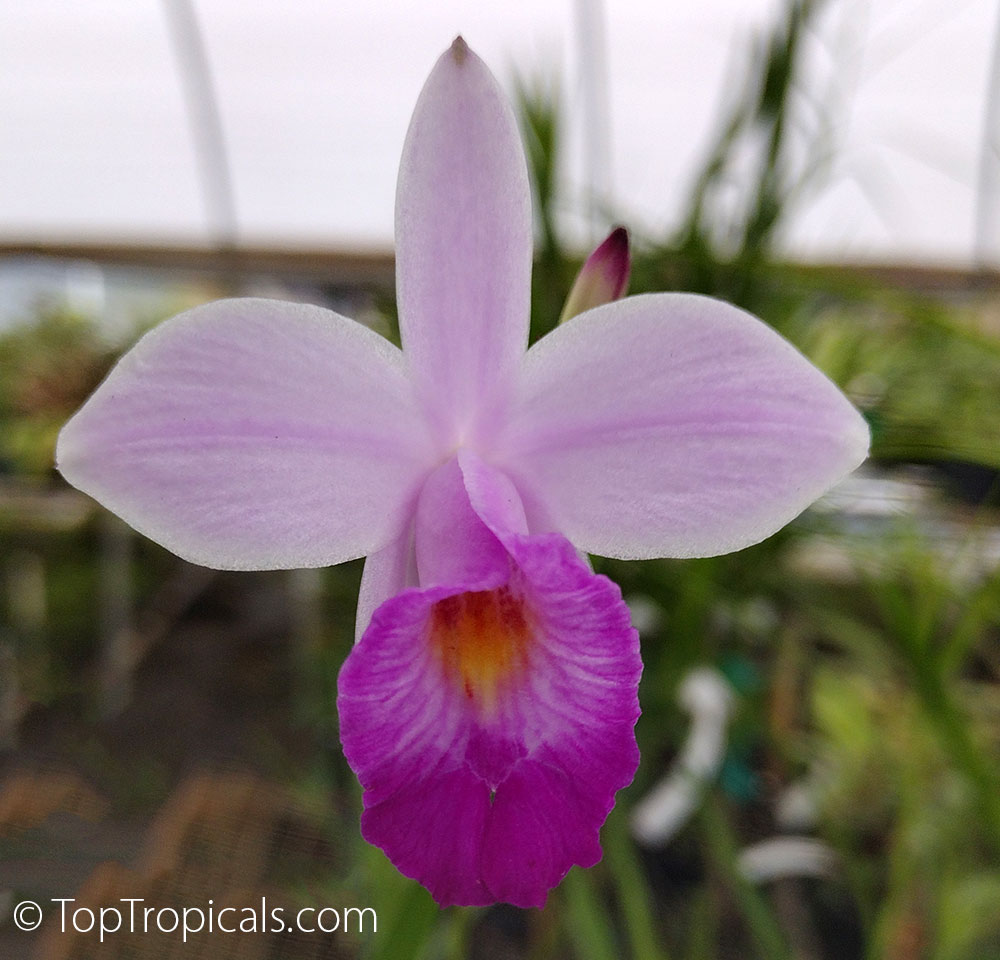
Arundina  graminifolia  -  Bamboo  Orchid,  Bird  Ground  Orchid

Grow Purple! In the photo: Arundina graminifolia - Bamboo Orchid, Bird Ground Orchid - Winter flowering orchid that grows in regular soil. These plants are in bloom right now, picture taken this week!

Date: 15 Aug 2021

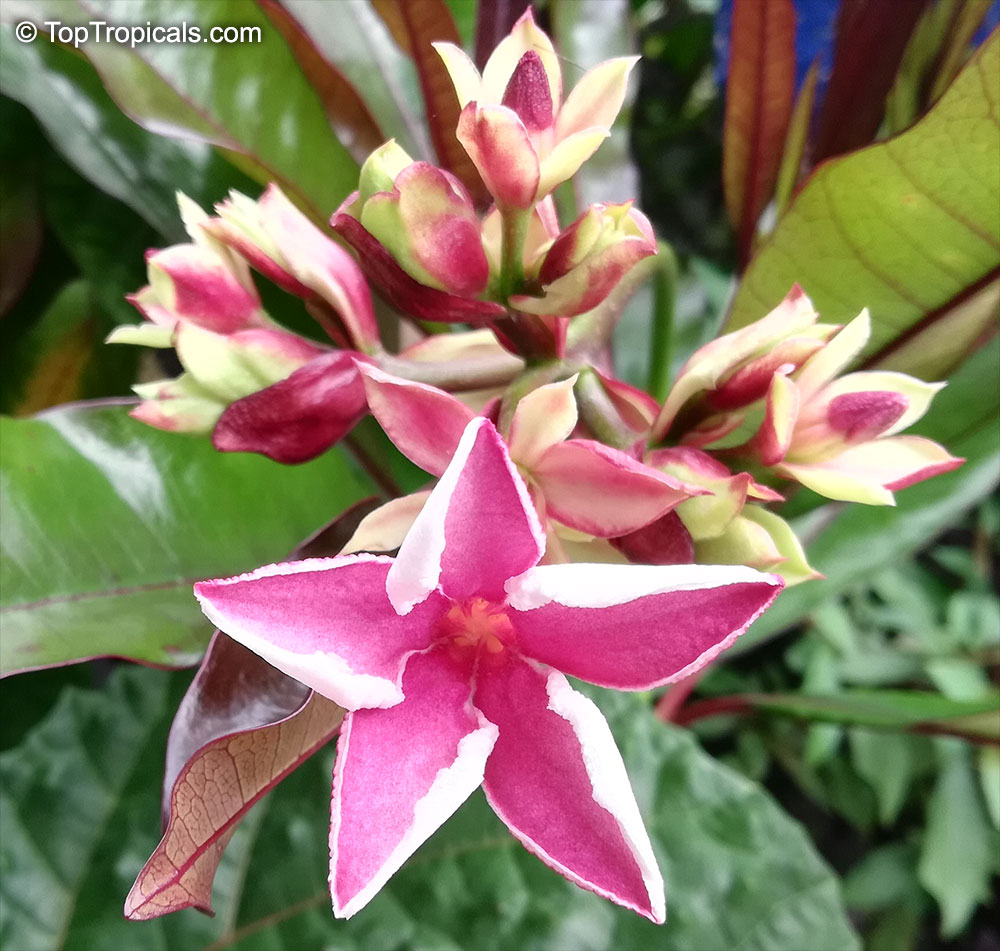
How to grow Cerbera and make it flower

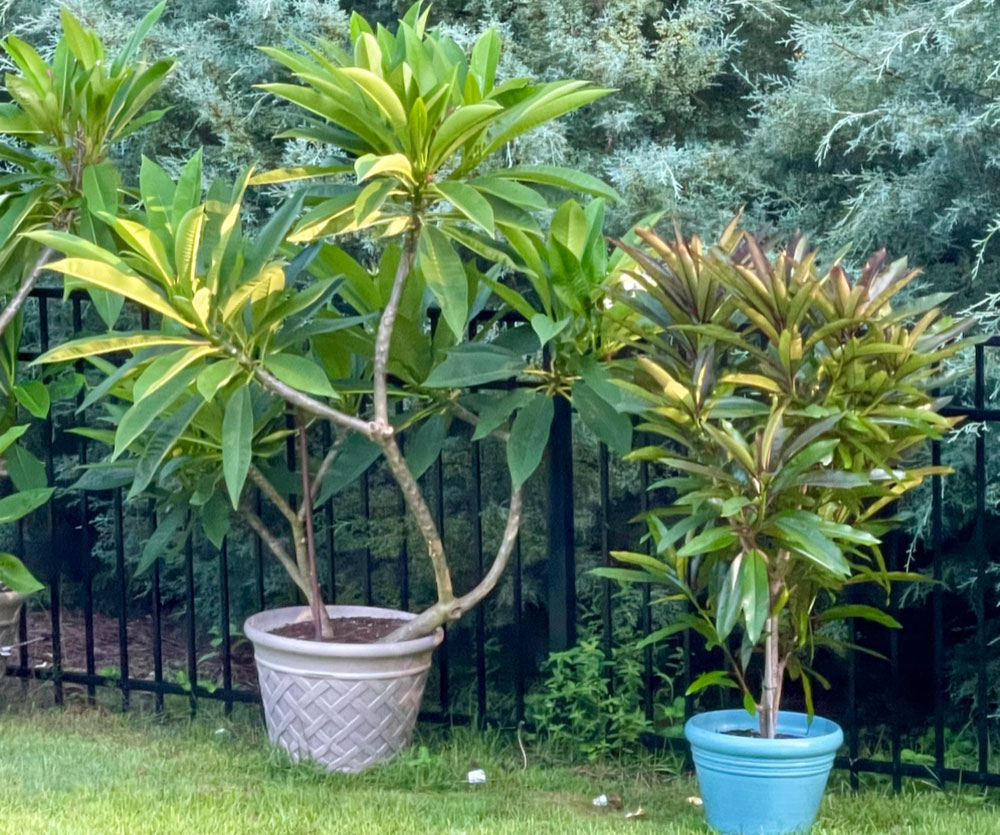
Q: I purchased Cerbera manghas - Enchanted Incense a year ago. As you see from the photo, it's doing great however, no blooms. I fertilize properly and very often and use worm castings for micronutrients. Yes it's not "your" fertilizer, but my plumerias, that are also in pots they are over 5 feet tall and blooming like crazy. I don't see any inflows coming on the Cerbera at all and it is hot and humid here in North Carolina, so it's happy but no sign of blooming. What is your advice?

A: Top Tropicals first brought Cerbera manghas into the US plant market a few years ago, it was recommended to us by our friend, plant taxonomist John Mood who visited Thailand, and among other exotic plants noted this fragrant beauty. Since then we've been successfully growing this plant, it has become one of everybody's favorites.

Generally speaking, Cerbera culture is very similar to Plumerias. These plants are closely related. So if you know how to grow Plumeria, you sure will succeed with Cerbera. Hot and sunny location, well-drained mix, moderate water and bloom boom fertilizer will do the trick. However, we have noticed a few distinctive features that make this plant somewhat challenging at times.

1) Flowers

For past years, we've been studying what triggers its flowering. Sometimes these plants start flowering in 1 gal pot, 1 ft tall. Other times a large developed tree 5-6 ft tall, in 5-7 gal pot, grows beautiful foliage with no signs of flowers. Eventually all of them bloom, no matter how stubborn they are, it's just some individual plants start flowering sooner than others, all grown in the same conditions.
One of our plants in the ground, a well-branched tree, was covered with flowers for a few months, but only on the 3d year after planting. Before that, it only produced a few random blooms. Others bloomed in pots at very young age.
The following factors benefit to Cerbera flowering:
- full sun at least 10 hours a day
- hot temperatures above 85F
- regular water but not heavy rains
- regular fertilizer - Bloom Booster type
- very good drainage and drying out before waterings. If root ball stays moist, the plant may look healthy but won't set flower buds. Keeping on a dry side will encourage flowering. Very similar to Jasmines: they bloom like crazy in April while it's hot and dry in Florida, but once our summer rainy season starts, they reduce blooming.

We highly recommend using Sunshine Megaflor bloom booster or SUNSHINE Pikake in combination with micro-element supplements Sunshine Honey (B-Mo) and Sunshine Superfood (complex micro) that induce flowering. Dry and granulated fertilizers may not supply exactly what a plant needs: certain elements that trigger flowering may be missing. Sunshine Boosters formulas are scientifically balanced, they contain precise amounts of nutrients needed for setting flowers. Besides, excessive salts from regular dry fertilizers create nutrient lock up that may retard plant metabolism; with liquid amino-acid based Sunshine boosters, plants consume the whole menu of elements without building them up in the soil.

2) Fruit

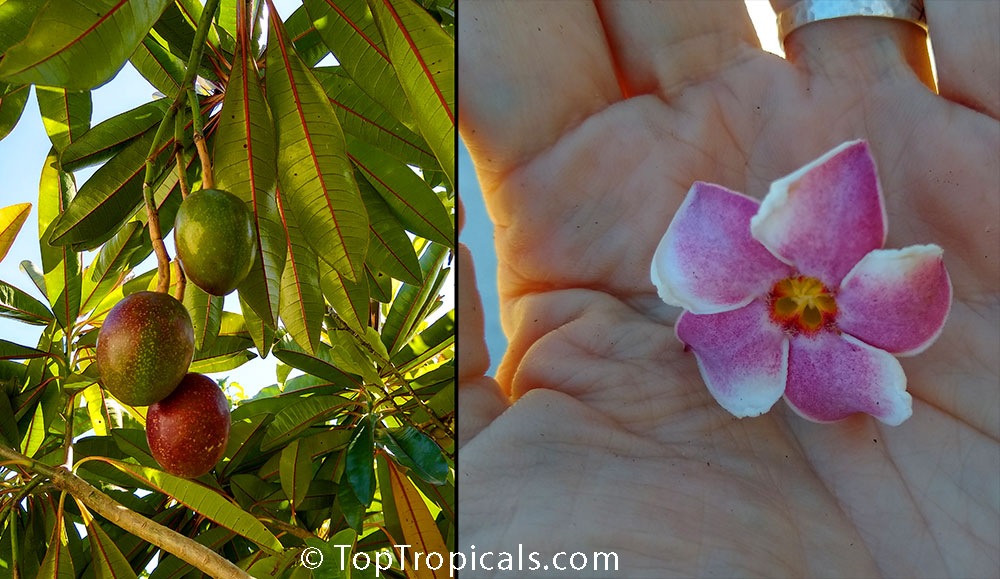
Fruit of Cerbera are very pretty and cover the tree after profuse flowering. To inexperienced eye they may look very much like small mango or avocado fruit - so make sure kids or visitors don't try to eat them! Cerbera seeds are extremely poisonous.

3) Leaves

If you ever grew Passiflora or Milkweed, you know how leaves can be eaten by caterpillars overnight. This may happen to Cerbera too, as we discovered. In Florida environment this exotic plant doesn't have natural predators for protection from certain insect species that may feed on it. So watch out and if noticed first signs of leaves damage - its time for insect control.
Other than that, Cerbera foliage is usually beautiful and colorful, here in Florida it looks much healthier than that of Plumerias often affected with rusty residue during high humidity months.

Hope this helps. The Cerbera fragrance is enchanting, it is worth the efforts and waiting!