Garden Blog - Top Tropicals

Date: 3 Aug 2018

Featured Plant. Monstera deliciosa - Swiss cheese plant

TopTropicals

Monstera deliciosa - Swiss cheese plant

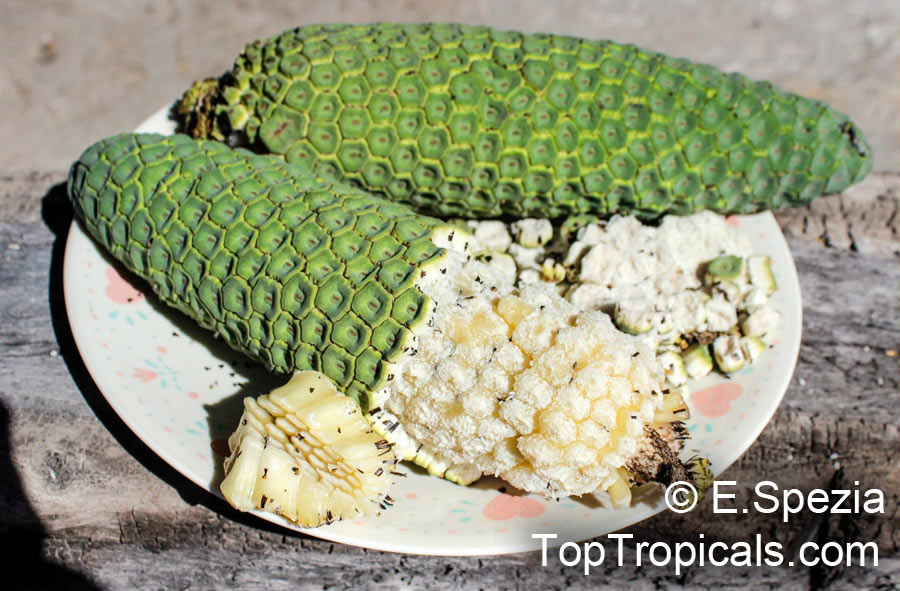
Swiss cheese plant is a jungle climbing relative of the philodendron from Mexico and Guatemala. It is seen in gardens in tropical and subtropical areas, growing well in partial sun or shade. The plant begins bearing fruit after three years. The large deep green, cone-like fruit is actually an unripened flower spike, covered with hexagonal scales that dry out and separate as the fruit ripens from the base upwards, revealing the white pulp. It takes a little longer than a year to mature to an edible stage. The fruit tastes kind of like a cross between a sugar apple and a pineapple. Very perfuming smell and taste! It's so amazing, can't figure the consistency, but totally a pineapple sugar apple cross... But wash the black specks off before eating - they will sting your tongue.

Check out this plant...

Date: 24 Oct 2025

I got flowers on my mind!

Cat Bob

Cat Bob

💐 I got flowers on my mind!

"I am the king of the jungle, just ruling the couch temporarily."


🐈📸 Cat Bob ruling TopTropicals PeopleCats.Garden.

#PeopleCats

🟢 Join 👉 TopTropicals

Date: 31 Jul 2025

Anthurium Collector Set

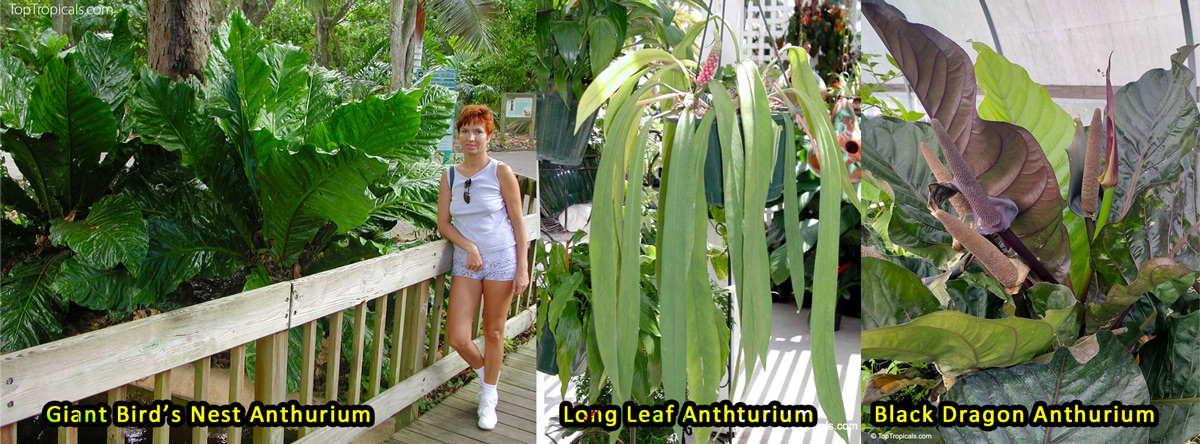
Giant  Bird's  Nest,  Long  Leaf,  and  Black  Dragon  Anthuriums  side  by 
 side,  showcasing  their  dramatic  foliage  and  size

These aren't your typical tropicals - they're collector-grade Anthuriums grown for foliage and texture. Each one brings something different, but they all thrive in the same kind of setting: shade or filtered light, warmth, and humidity. Perfect for growing in containers indoors or out.

Anthurium Black Dragon

This is the most dramatic of the trio. Upright, leathery leaves shift from dark green to nearly black depending on light. Instead of bright flowers, it produces a dark brown spadix and glowing red berries. A hybrid not found in the wild, it's grown from seed - no two are exactly alike.

  • Best for: Indoor focal plant, shaded patio, black ceramic pot
  • Height: 2–4 ft in container
  • Texture: Thick, architectural leaves
  • Highlight: Color shifts with light intensity

Grow Your Own Black Dragon

Read more about Black Dragon Anthurium

Anthurium hookeri – Giant Bird's Nest

This one's about scale. Broad, crinkled leaves with a cardboard-like texture form a bold rosette. It can get huge with time - up to 6 feet across. Perfect for gardeners who want the "instant jungle" look.

  • Best for: Shaded garden, large pots on porches
  • Height: Up to 5 ft; width even more
  • Texture: Wrinkled and leathery
  • Highlight: Bright red berries in maturity

Buy Giant Bird's Nest Anthurium

Read more about Giant Bird's Nest Anthurium

Anthurium vittariifolium – Long Leaf Anthurium

Graceful and rare, this species sends out narrow strap-like leaves that can reach 5–6 ft long. Ideal for hanging baskets or mounting. Bonus: it produces small pink fruit against deep green foliage.

  • Best for: Hanging displays, vertical planters, bright bathrooms
  • Height: Leaf length, not upright height - up to 6 ft
  • Texture: Smooth, ribbon-like
  • Highlight: Cascading growth and color contrast

Buy Long Leaf Anthurium

Read more about Long Leaf Anthurium

✅ How to Care for Anthuriums

  • Light: Bright, indirect light is best. Avoid direct sun, especially mid-day. These plants evolved in rainforest understory - think "dappled light under trees."
  • Water: Keep the soil lightly moist but not soggy. Let the top inch dry before watering. They hate wet feet.
  • Humidity: These are tropicals - they'll do fine in 50-60% humidity, but thrive at 70%+. Use pebble trays or place near other plants. Bathrooms with windows work great.
  • Soil: Use an airy mix: orchid bark + perlite + peat or coco coir. Drainage is key. Never use plain potting soil.
  • Fertilizer: Feed with SUNSHINE Robusta every 2–4 weeks during warm seasons. It's formulated for aroids and won't burn roots.
  • Potting: Use shallow, wide containers. Repot only every 2–3 years, or when roots crowd the pot. They don't like frequent disruption.
  • Temperature: Ideal: 65–85 F. Short dips to the 30s F are tolerated by mature plants, but avoid cold drafts.

Shop All Anthuriums

Date: 9 Aug 2025

Anthurium with leaves longer than you!

Anthurium vittariifolium- Long Leaf Anthurium

🍃 Anthurium with leaves longer than you!

  • 🌿 Ever seen an Anthurium with leaves longer than you are tall? Anthurium vittariifolium - Long Leaf Anthurium - is a true rainforest treasure from South America. Its strap-like leaves can reach an incredible 6 feet in length but stay only about 2 inches wide, creating elegant green ribbons that drape down like a waterfall.
  • 🌿 Grow it in a hanging basket and you’ll get a cascading curtain of foliage that instantly turns any space into a jungle hideaway.
  • 🌿 As if the leaves weren’t enough, this rare beauty produces clusters of bright pink berries that pop against the deep green leaves, adding an unexpected splash of color!
  • 🌿 It's rare, it's dramatic, and it's the kind of plant that makes people stop and ask, “What on earth is THAT?”


🛒 Grow the 6-foot leaf Anthurium

📚
Learn more:
#Nature_Wonders #Container_Garden #Shade_Garden
🟢 Join 👉 TopTropicals

Date: 13 Apr 2021

Healthy Plants: Q&A from Mr Booster
Why my Avocado is not flowering?

Q: I have 5 avocados. Three of your cold hardy varieties and two others that have all flowered and set fruit in the past. The last two years including this year, not a single one of them has put out any flowers. I am getting lots of new growth like one would expect on a tree too young to flower. The last two years have been very mild with out any damaging frost where in previous years they lost all their leaves due to frost yet started putting out flowers once winter was over. I am confused because they have all flowered and set fruit previous years. Any ideas would be appreciated.

A: From information you provided, and considering the trees get lots of full sun and cold was not an issue, the only explanation is - lack of nutrients. Here is an example.
Very common situation: you get a small 2-3 ft Avocado or Mango tree in 3 gal pot (or even smaller) from a nursery, full of flowers, and sometimes even a small fruit. You bring it home, plant it in the ground or a bigger pot, it looks happy and grows like crazy. Then next year - oops, no fruit, sometimes not even flowers. What happened?
When the tree lived in a nursery, it was provided with all necessary nutrients through the injector systems (continuous feed); or some nurseries may use top dress smart release on regular schedule. Regardless of fertilizer type, professional grower's set up delivers plant food non-stop, on regular basis, with balanced formulas. Plants are not only growing fast but also ready to produce, since nutrients are always available for a full growth cycle.
When you plant a tree in the ground (or larger pot), conditions change. They may be beneficial for the plant: lots of room for roots to establish, hence lots of vegetative growth. Even if you planted it using good quality fertile soil, this soil may contain mostly nutrients responsible for vegetative growth (branches and leaves). Chances are, your soil may be rich in Nitrogen (good for green growth), but poor in other elements responsible for flowering and fruiting (Phosphorous, Potassium, and many important micro-elements such as Molybdenum, Boron, Iron, etc.). Besides, existing soil gets exhausted quickly, and within a year a two, if you don't add fertilizer, flowering and fruiting may be reduced or even stopped. This is why fertilizing program is very important for fruit trees that are expected to bring a crop soon.

We recommend:

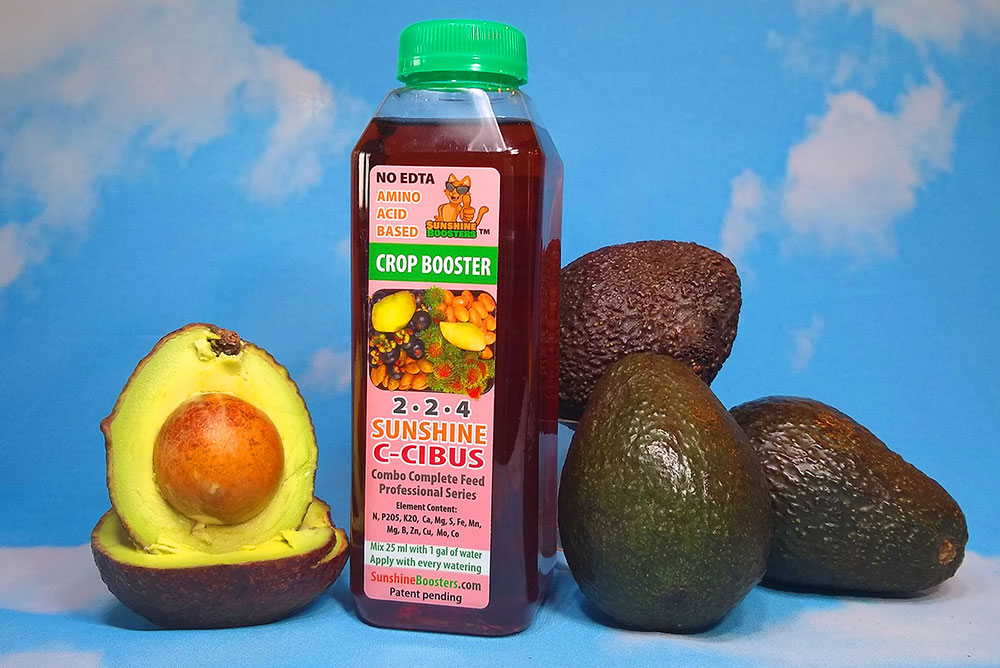
- SUNSHINE C-Cibus - Crop Nutrition Booster - balanced food for fruit trees
- SUNSHINE-Honey - sugar booster - promotes more efficient blossoming and pollination, makes flowers bigger and reduces bud drop
- SUNSHINE SuperFood - for improving fruit trees production

Also keep in mind that some fruit trees have a habit of "skipping" a year and may either produce less or not produce at all every other year. In any case, balanced nutrition program can help to fix this "bad habit".