Date: 23 Jul 2016
Leo Zodiac lucky plants


Leo - 7/23-8/22. Naturally, Leo is a FIRE sign ruled by the brilliant Sun. Leo's plants are usually large and gold or orange in color, have heart-shaped leaves or a radiating shape, or have association with victory (like the Bay Leaf). Leo loves this colorful and special spice, which is known for amplifying prosperity and abundance.
The part of the body ruled by Leo the Lion is the heart. Plants related to Leo are primarily associated with the cardiac system, but also with the spine, the thymus gland, and the eyes. They strengthen and tone the heart, regulate blood pressure, raise the spirits and have an uplifting effect. Keep in mind that all cardio-active medicinal herbs should be used only in consultation with a qualified professional.
Leo Zodiac lucky plants: Sunflower tree, Delonix, Hibiscus, Abutilon, Mahoe, Hawaiin Sunset Vine (Stictocardia), Campsis, Passion flower, Calendula, Mexican Flame Vine, Bay Leaf, Safflower, Mint, Rosemary, Ruda - Ruta graveolens, Marigolds, Sunflowers, Palm trees, Lemon and orange trees, Grapefruit, Dieffenbachia , Croton, Lemon Balm, Chamomile, Tarragon, Kaligottu (Stereospermum chelonoides), Bel Fruit, White Madaar, Peppers, Pineapple, Coconut, Anise, Heliotrope, Gingers, Lavender, Ashoka Tree, Dombeya, Jacquemontia, Lychee, Mulberry, Philodendrons, Macaranga, Anthuriums, Aphelandra, Orchid trees, Leonotis.
For other signs information, see full Plant Horoscope
Date: 27 Apr 2020
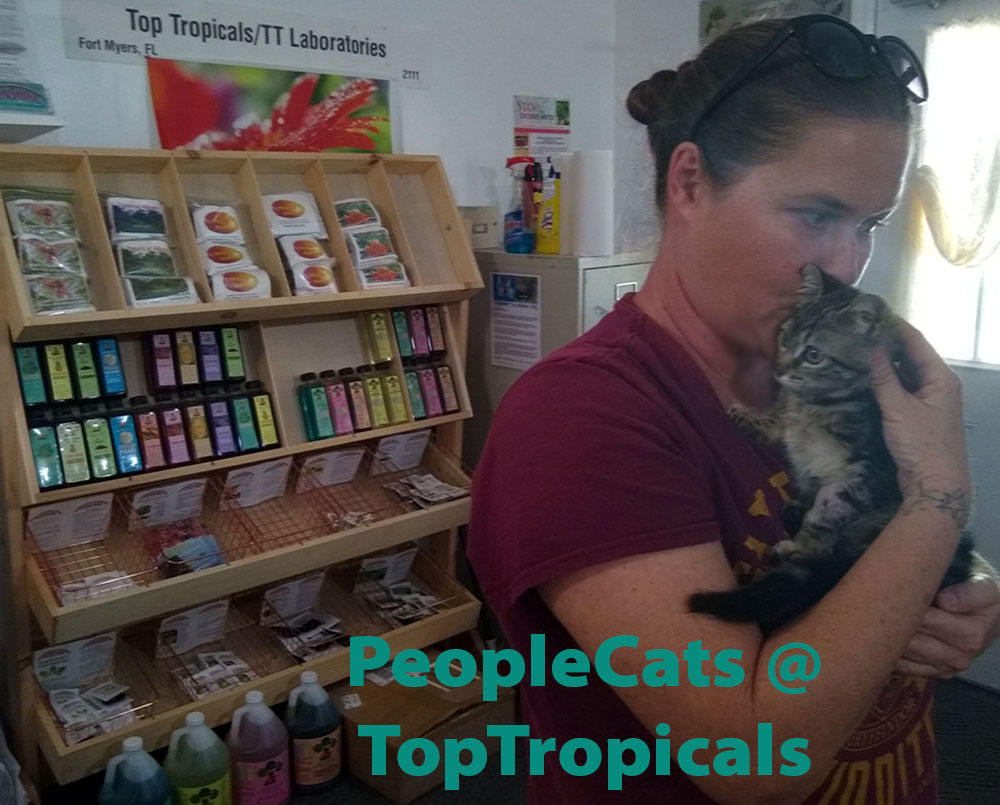
PeopleCats of TopTropicals. Cats of the day: Biggy's Cat Hospital

Biggy checking on patient Abu when he couldn't walk
During these challenging times for the whole planet, we receive kind letters from our customers checking on how our PeopleCats are doing, especially those that previously were ill. And since we promised to follow up on everyone, including heart-breaking story of Raja and Abu, today's report is about everybody's progress!
As we mentioned in our previous newsletter, several cats in TopTropicals
Cat Sanctuary had a coronavirus (we call it COVID-Cat-20), or simply a cat respiratory infection. Chiefy, Snitch, Marco and Biggy had it really bad, but some other PeopleCats surprisingly didn't
get it! Just like with humans. Lucky King didn't have a single sneeze!
Finally, everybody has recovered by now, but it has been a very stressful
couple of weeks for us, considering limited vet availability at this stay-home
time. On top of that, Lil S had an abscess and was also contained in a home hospital, away
from flu-quarantined PeopleCats. Our homes become real cat hospitals!
We are thankful to our customers support, especially Silvia who made
several donations for our PeopleCats, and also recommended antiseptic pads - those worked great for Lil S!
Abu and Raja's adventures were not over... After 2 weeks of seeing a
vet treating their infections and injuries, they got worse... Then after a
couple of weeks in another hospital (and a couple thousand more in bills) we were
suggested to put them down as hopeless since they would never walk again...
But Kristi did not want to believe it, she did not give up! The kittens heard
her. They won. Today, they are all better, walking, jumping and playing!
Thank you Kristi!
Never give up hope!
Stay safe and healthy with your PeoplePets!



TopTropicals PeopleCat Club
Thank you everybody for supporting us in helping PeopleCat Community!
Make
your kind donation today and receive a surprise gift from us. Every little
bit helps! Thank you and God bless you and your pets!
Date: 22 Oct 2025
💞 Cassia or Bauhinia?
Looking for a small tree that blooms like fireworks but still fits on your patio? We hear this question all the time at Top Tropicals: Cassia or Bauhinia? Both are tropical showstoppers, but they shine in very different ways.
🌞 Cassias: Sunshine Fireworks
Cassia trees are some of the most rewarding tropical bloomers you can grow. Fast-growing, free-flowering, and surprisingly cold-tolerant, they thrive in full sun and summer heat. Their bright clusters come in shades of yellow, orange, pink, red, and even multicolor blends. The famous Rainbow Cassias show swirls of coral, gold, and rose on the same tree, creating a living fireworks display.
For gardeners in warm regions, these trees become spectacular focal points in the landscape. In containers, compact yellow forms like Cassia didymobotrya (Popcorn Cassia) and Senna alata (Empress Candles) stay manageable and bloom freely through summer.
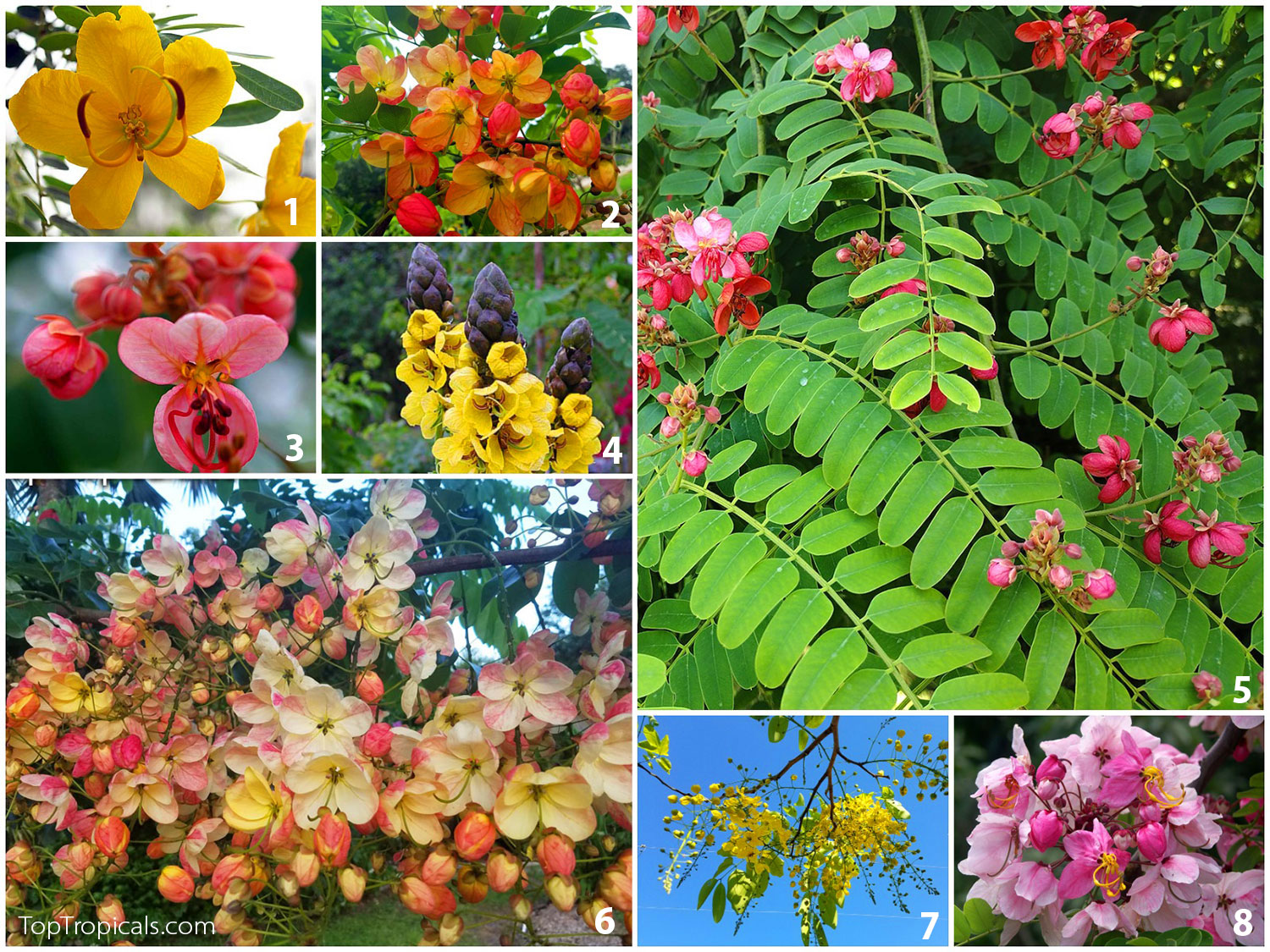
Cassias can also be grown in pots with pruning and patience. Once mature, they reward you with breathtaking color that turns any patio or pool deck into a tropical show. Most showy cassias (numbers correspond to the photos in the collage above):
- Cassia bicapsularis (Butterfly Bush) - is a fast-growing, low-maintenance shrub covered in bright yellow, butterfly-like blooms from fall through winter.
- Cassia x natalensis (Rainbow Cassia)
- Cassia grandis (Red cassia) - a medium size tree having profuse blooms of dark pink to crimson flowers throughout the Spring.
- Cassia didymobotrya (Popcorn Cassia), small tree producing golden-yellow flowers with a distinct scent of peanut butter that open from brown buds in late summer and autumn. Similar to Senna alata (Empress Candles)
- Cassia roxburghii (Ceylon Senna) - graceful tree with spreading, drooping branches appearing to be overweighed by its wealth of clustering red blossoms.
- Cassia x nodosa (Pink Shower) - is a spectacular medium-sized, fast-growing tree with cascading clusters of fragrant pink-and-white appleblossom blooms in spring and summer.
- Cassia fistula (Golden Shower) - to many tropical gardeners, the most beautiful of cassias with masses of bright gold flower clusters appear on almost every branch.
- Cassia javanica (Apple Blossom) - dazzles with dense clusters of pink-to-white blossoms that change shades as they bloom, creating a spectacular display that lasts for months.
"Cassias love the heat and sunshine," says Tatiana Anderson, Top Tropicals Plant Expert. "They are perfect for anyone who wants big bursts of color and doesn’t mind giving them space and light to grow."
Bauhinia Magic: Orchid-Like Blooms in a Compact Size
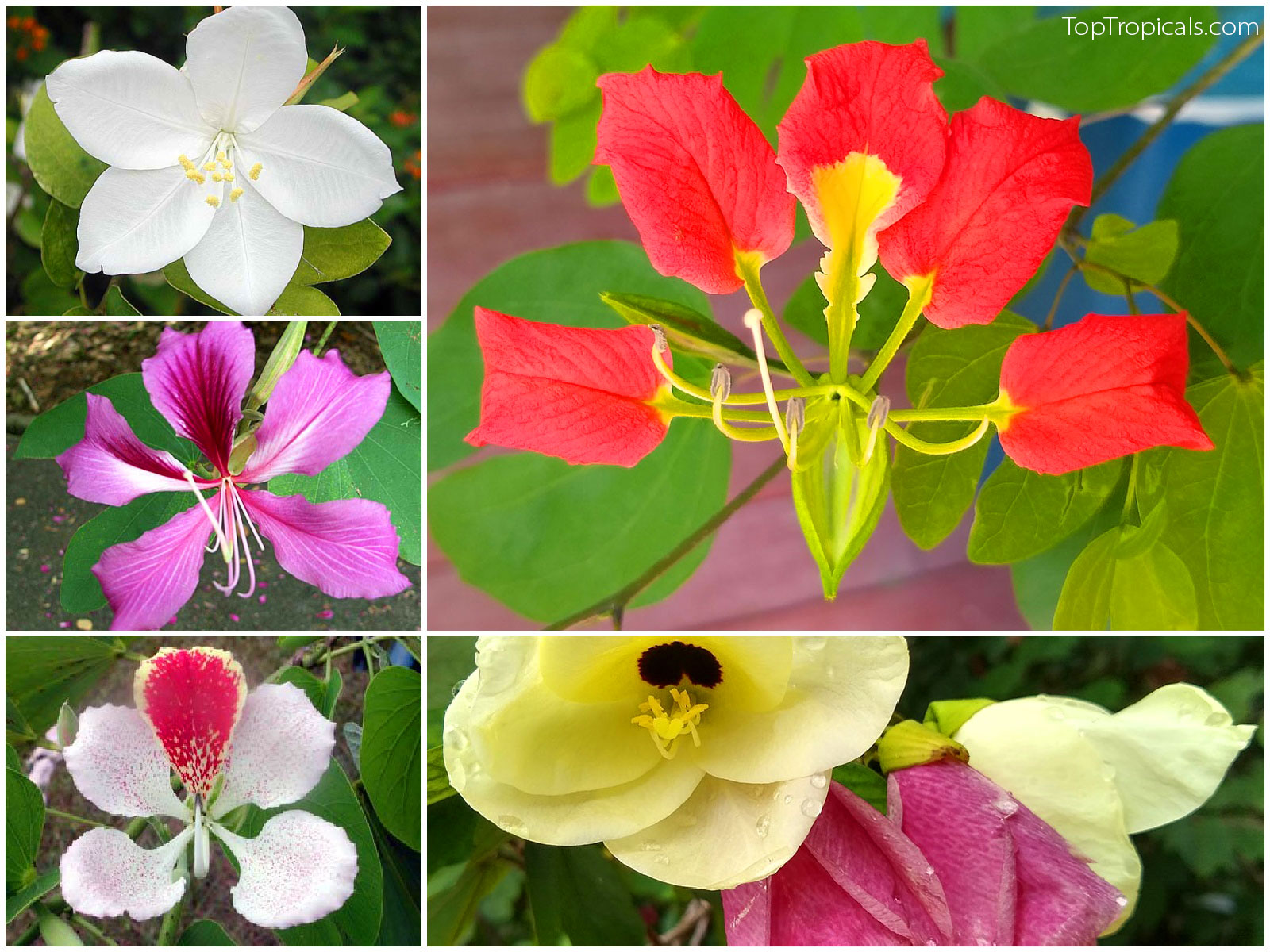
Bauhinia orchid trees: top left – Bauhinia acuminata (Dwarf White Orchid Tree), middle left – Bauhinia blakeana (Hong Kong Orchid Tree), bottom left – Bauhinia monandra (Napoleon’s Plume Orchid Tree), top right – Bauhinia madagascariensis (Red Dwarf Orchid Tree), and bottom right – Bauhinia tomentosa (Yellow Orchid Tree)
Bauhinia trees known as Orchid Trees, bring a touch of tropical luxury to any space. Their butterfly-shaped leaves and orchid-like blossoms appear in shades of red, pink, purple, white, and yellow, often lasting up to ten months a year. Bauhinias are ideal for gardeners who want nonstop color in a manageable size. Most species grow well in large pots and bloom young, often within the first season.
The following compact varieties stay neat and flower almost continuously in warm weather:
- Bauhinia madagascariensis (Red Butterfly Orchid Tree). Blooms from winter through fall, up to 10 months a year. The most cold-hardy of all.
- Bauhinia blakeana (Hong Kong Orchid Tree). A large tree in the ground, but compact in pots if trimmed. Grafted trees flower right away. Winter bloomer, cold hardy to light frost.
- Bauhinia tomentosa (Yellow Orchid Tree). Flowers from Winter through Summer, cold hardy to light frost.
- Bauhinia acuminata (Dwarf White Orchid Tree). Blooms from summer through winter. Less cold hardy.
- Bauhinia monandra (Napoleon's Plume Orchid Tree). Almost everblooming with the longest flowering period. Less cold hardy.
The Hong Kong Orchid Tree is especially prized because it is sterile and produces no messy seed pods, keeping patios clean. Grafted Buhinia blakeana trees begin blooming while still small, making them perfect for containers or tight spaces.
"Bauhinias are generous bloomers," Tatiana explains. "They respond beautifully to regular feeding and full sun. If nights turn too cold, just move the pot to a sunny porch - they’ll keep their tropical charm most of the year."
Give them full sun, regular fertilizer, and a well-drained mix such as Sunshine Abundance, and they will reward you with months of vivid blooms. When nights turn too cold, simply move the pot to a sunny porch or bright window. Bauhinias adjust beautifully and keep their tropical grace year after year.
🎥 Watch Short Videos:
💲 Special Offer – 20% off Cassias and Bauhinias!
Get 20% OFF Cassias and Bauhinias with code
RAINBOW2025
Min order $100. Excluding S/H, valid online only, cannot be combined with other offers.
Hurry, offer expires October 30, 2025!
Date: 22 Mar 2016
Plant Horoscope. Aries Zodiac lucky plants: Aloe and Erythrina

Aries - 3/21-4/19. Aries is a FIRE sign ruled by the planet Mars. Plants associated with this element and planet very often have thorns or prickles. They can be also spicy or bitter in flavor, or red in color.
Because Aries rules the head, eyes and face, the plants for Aries purify the blood, stimulate the adrenal glands, and/or are high in iron (Mars rules the mineral iron). Mars-ruled Aries is assertive, energetic and fearless. Mars rules the red blood cells, the muscles, and metabolic processes, as well as the motor nerves and the head. These plants help you when you want more get-up-and-go and the courage to take on the world.
Aries Zodiac lucky plants - Governors plum, Hibiscus Karkade, Tapioca, Mamey Sapote, Ruda, Baobab, Euphorbia, Acanthus, Aloe, Caesalpinia, Erythrina, Opuntia, Dragon Fruit, Pachypodium, Pomegranate, Chilli peppers, Syngonium, Begonia, Geranium, Red Sandalwood, Jamiaca pepper (Pimenta, Allspice), Camphor, Jujube, Anise, Red Roses, Tiger Lily, Impatiens, Calendula, Tarragon, Ginger, Coriander, Basil, Ruda, Amaryllis, Wild Indigo, Gooseberries, Sesbania, Campsis, Red Oleander, Maple, Schotia brachypetala, Momordica, Coffee, Amla , Ephedra, Red Kapok.
For other signs information, see full Plant Horoscope.
Date: 2 Jul 2016
Cancer Zodiac lucky plants

Cancer - 6/21-7/22. Cancer is a WATER sign and is ruled by the Moon. Cancer's plants generally have soft or Moon-shaped leaves, contain a lot of moisture, or are found near water. Oftentimes they have white, pale blue or pale yellow flowers. Cancer rules the stomach, diaphragm, and liver, so plants that aid digestion or affect the subconscious are associated with the sign of the Crab. Maternal Cancer also governs the breasts, the womb, and the ovaries. It rules all fluid secretions, including menstrual blood, fluids in the eye, and tears. The moon is often associated with conditions involving irregular periodicity: irregular menstruation and related moods, epilepsy, insomnia, hysteria. Lunar herbs tend to have white or yellow flowers and soft, juicy leaves. They often live in or near water. As they are so nurturing and warm, Cancer loves the homey smell of cinnamon. This sweet spice is good for gently heating things up; it also promotes movement and flow in life. Its familiar scent is soothing and calming for those who need a little retreat every now and again.
Cancer Zodiac lucky plants: Lilies, Eucomis, Magnolia, Nicotiana, Brugmansia, Dombeya, White flowers, Water lilies, Lotus, Maidenhair fern, Monstera, Cinnamon, Sage, Aloe, Lemon Balm, Bay leaf, Palasa - Butea monosperma, Acai, Mahogany, Mango, Banana, Apple, Pear, Geranium - Pelargonium, White roses, Solandra Chalice Vine, Butter Cup, Acalypha, Cornutia, Ruda, Oregano, Camphor plant, Grapes, Brunfelsia, Alocasia, Colocasia, Canna, Cyperus, Iris, Equisetum, Mangroves.
For other signs information, see full Plant Horoscope