Garden Blog - Top Tropicals

Date: 18 Jun 2026

Smokey,  Sunshine,  and  their  mini-me  kittens  arrive  at  the  Top  Tropicals
    Father's  Day  Plant  Market.
Smokey: The best Father's Day gift is a plant.
Sunshine: Because it grows?
Smokey: Because every garden is a promise to the future.
Sunshine: Then we'd better choose carefully. We brought our future with us.

Father's Day Belongs in the Garden

Some gifts are forgotten by next month.

A plant is different.

A fruit tree planted today may provide fruit for decades. A flowering tree may bloom every spring long after the holiday is over. The best gardens aren't built in a single afternoon - they're built one season at a time, one generation at a time.

This Father's Day weekend, come spend the day the way it was meant to be spent: outdoors, unhurried, surrounded by growing things.

Top Tropicals is hosting our Summer Solstice Plant Market, and this is one of the best times of the year to visit the nursery. The longest days of summer bring out the flowers, the fragrance, and the fruit. Thousands of plants at their peak, in the kind of Florida light that makes everything look like it belongs on a postcard.

📅 Saturday, June 20, 2026
⏰ 9:00 AM - 4:00 PM
📍 13890 Orange River Blvd, Ft Myers, FL 33905
Phone: 239-689-5745, 866-897-7957
📍 9100 McRoy Rd, Sebring, FL 33875
Phone: 863-401-4004, 866-897-7957

You'll find rare fruit trees, flowering trees, fragrant plants, and collector varieties rarely available elsewhere. There will be event specials, raffle prizes, free plants with qualifying purchases, tropical music, and cold drinks. And somewhere in the shade, King, Snitch, and the rest of the PeopleCats will be doing what they always do - making themselves at home and pretending to supervise.

But the real reason to come isn't the event. It's the reminder.

Whether you're planting your first fruit tree or adding one more chapter to a garden that's been growing for years, Father's Day is a good day to remember what we're really building. Not just a yard. Something that keeps giving long after the I love you, Dad card is forgotten.

Plant something today.

Every garden is a promise to the future.

👉SEE FULL FATHER'S DAY EVENT DETAILS

Date: 11 Mar 2026

📅 Do Not Miss: March 21 - Spring Equinox Plant Market

🍩 Saturday, March 21, 2026: 9 am - 4 pm

Smokey  the  tuxedo  cat  in  work  clothes  studies  the  Spring  Equinox  Plant 
 Market  poster  at  the  Top  Tropicals  nursery  entrance  while  Sunshine  the 
 ginger  tabby  cat  rides  a  bicycle  balancing  coffee  and 
 donuts.
Sunshine: Smokey, look at me! See what I can do on my bike? I'm practicing to give people what they like: coffee and donuts.

Smokey: You'd be perfect for a Gulf beach cafe. But gardeners don't come here for donuts.

Sunshine: Really? Then why do they come?

Smokey: Some gardeners lost plants to the freeze. Others want trees that will handle winter better. Cold-hardy avocados. Macadamia. Grumichama. And some just come for fun - to see the PeopleCats.


Sunshine: And my charm... and my donuts will make it more fun.

Read more about Smokey & Sunshine

Ft Myers Garden Center: 13890 Orange River, Ft Myers, FL
Sebring B-Farm : 9100 McRoy Rd, Sebring, FL

More Spring Equinox Plant Market details

🌞 Welcome to our Spring Equinox Plant Market, proudly hosted by the PeopleCats of Top Tropicals.

This one feels different.

After Florida’s record freeze, many gardens are brown, trimmed back, or missing a few old friends. We felt it too. And now - we rebuild.

The equinox marks equal day and night. More light ahead. New growth beginning.

And the PeopleCats are ready🐾.

  • 🐱King is back on gate duty - inspecting every vehicle for proper plant-hauling capacity.
  • 😺Paisley is rearranging freeze survivors and new arrivals like a design consultant.
  • 😼Snitch is supervising recovery efforts from a comfortable chair.
  • 😸Persephone is checking under tables for "hidden spring energy."
  • 😻Sushi and Loki are preparing for guided garden tours - recovery edition.

This is not just a plant market. This is the spring reset.

👍 Why You Should Come

It is finally warm in Florida. After several nights of hard freeze, some plants survived - and some didn’t. This event is your chance to see real freeze champions in person.

If you lost plants, you are not alone. If you are ready to plant smarter, this is your moment.

Walk the gardens. See proven winter survivors. Discover cold-hardy fruit trees and resilient ornamentals. Get practical advice about replanting after freeze. This is rebuilding - Florida style.

♥️ What Makes This Event Special

We are featuring:

  • Verified freeze survivors
  • Cold-hardy fruit trees
  • Tough flowering trees and shrubs
  • Replacement plants for damaged landscapes
  • Smart layering ideas for frost-resilient gardens
  • You will see which species handled 25F with wind and multiple nights of freeze - with no protection.

Real-world test. Real results.

Cold hardy fruit favorites include:

Avocado Plant Facts

Botanical name: Persea americana, Persea gratissima
Also known as: Avocado, Alligator Pear, Aguacate, Abacate
USDA Zone: 9 - 11
Highligths Large tree taller than 20 ftSmall tree 10-20 ftFull sunWatering: Regular. Let topsoil dry slightlyEdible plantSubtropical plant. Mature plant cold hardy at least to 30s F for a short time
Get personalized tips for your region

🌸 Cold hardy subtropical flowering trees including:

And many other cold hardy plants

Mexican Bird of Paradise Plant Facts

Botanical name: Caesalpinia mexicana
Also known as: Mexican Bird of Paradise, Dwarf Poinciana
USDA Zone: 9 - 11
Highligths Small tree 10-20 ftSemi-shadeFull sunWatering: Moderate. Water when top soil feels dryYellow, orange flowersIrritating plantFragrant plantSubtropical plant. Mature plant cold hardy at least to 30s F for a short timeSeaside, salt tolerant plant
Get personalized tips for your region

🎉Event Highlights

  • 30% OFF online prices
  • FREE plants with purchase
  • $5-10 specials
  • Exciting raffle prizes

🌳Don't just mow - grow!

Start your food forest, beat rising prices, and plant a future your family will thank you for.

🌿 Friendly Reminder
Just a quick reminder before we go: Sunshine Boosters are still shipping free. If you were thinking about stocking up for the season, now is a great time to do it while the offer is still active.

🛒 Feed your plants

Date: 10 May 2026

🍑 Tree-Ripened Peaches Change Everything

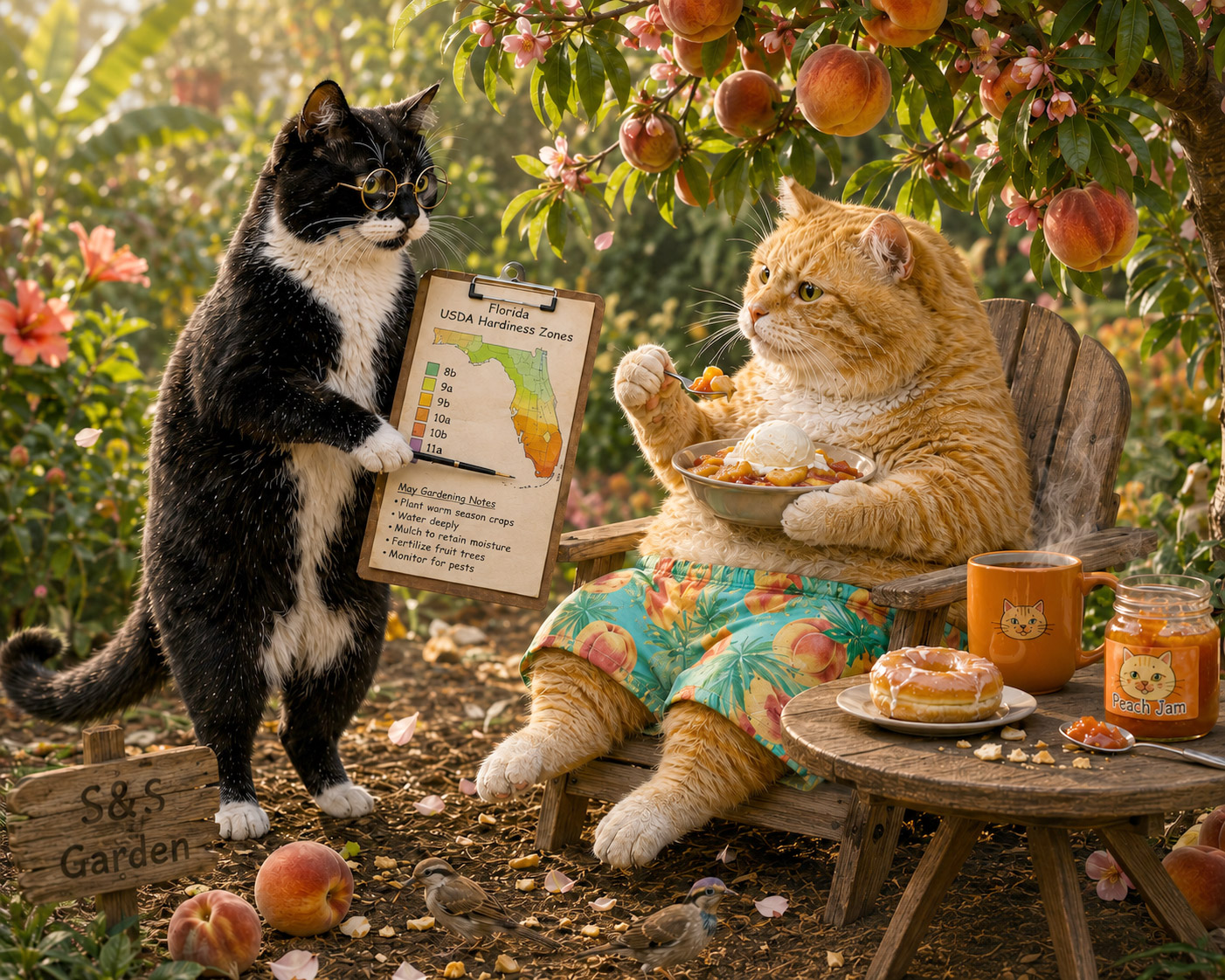
Smokey  and  Sunshine  relax  under  a  peach  tree  in  the  S&S  Garden, 
 discussing  low-chill  peaches  for  Florida  while  enjoying  peach  cobbler  with 
 ice 
 cream.
Sunshine: I love peach cobbler. Smokey, why are peaches on the tree so early?
Smokey: Low-chill peach varieties for Florida. They ripen much sooner.
Sunshine: I thought peaches were for Georgia.
Smokey: Not if you plant low-chill peaches. And speaking of peaches, do you know about donut peaches?
Sunshine: Donut peaches? Finally, horticulture I can understand.

Some fruits carry memories before you've even tasted them.

There's something about a peach still warm from the tree - the way it gives a little when you pick it, the smell that hits you before you even take a bite. It makes you slow down. It makes summer feel like it actually meant to show up.

Peach Plant Facts

Botanical name: Prunus persica, Amygdalus persica
Also known as: Peach
USDA Zone: 5 - 10
Highligths Small tree 10-20 ftFull sunWatering: Regular. Let topsoil dry slightlyWhite, off-white flowersPink flowersEdible plantDeciduous plantSubtropical plant. Mature plant cold hardy at least to 30s F for a short time
Get personalized tips for your region

For Florida gardeners, that moment used to feel borrowed. Peaches were a Georgia thing, a Carolina thing. You'd admire someone else's harvest and quietly file it under not for us.

Low-chill peaches rewrote that story.

Here's the thing about regular peaches - they need cold. Not just a cool night or two, but a real winter. We're talking 600 to 1,000 hours below 45F. That's how they know to wake up in spring and actually fruit. South Florida just doesn't deliver that. The trees will grow fine, look healthy even, and then give you almost nothing come harvest time. Frustrating doesn't cover it.

Low-chill varieties are different. They were bred specifically for places like ours - warm winters, mild springs. Some only need 100 hours of chill. A hundred. That's a few cold fronts, not a season. And because they're working with our climate instead of against it, they fruit reliably. Every year.

They're not just a Florida trick either. Gardeners in coastal Texas, southern Louisiana, southern California - anywhere in that Zone 8b to 10 range - have been growing these successfully. If you've got warm winters and thought peaches weren't for you, they probably just weren't the right peaches.

🛒 Shop Low-Chill Peach trees

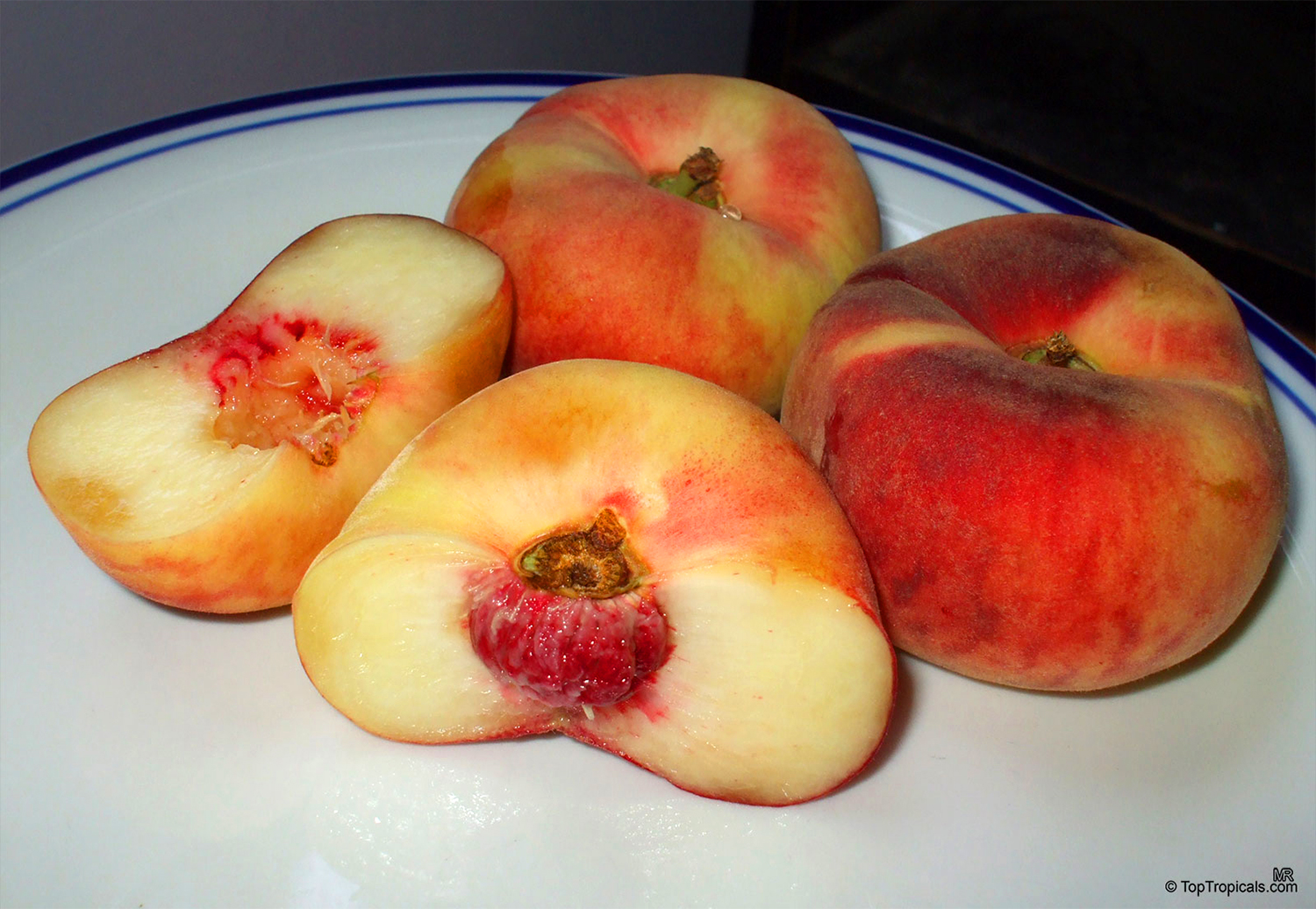
Several  ripe  flat  peaches,  also  known  as  donut  peaches  or  Saturn 
 peaches,  displayed  on  a  white  plate.  Two  peaches  are  cut  open,  showing  the 
 pale  white  flesh  and  small  central  pit  with  pink-red  coloring  around  the 
 seed 
 area.

Flat peaches - sometimes called DONUT peaches - are known for their sweet white flesh, low acidity, and fun squashed shape.

Date: 4 May 2026

🎉 Work First. Celebrate Anyway. That Is the Plan.

Sunshine  cat  holding  large  mango  tacos  in  a  garden  nursery  while  Smokey
   works  on  laptop  with  margarita  and  donuts  on 
 table
Smokey: Work first. Celebrations later.
Sunshine: I am celebrating efficient workflow.
Smokey: Impressive. Somehow your workflow smells like tacos.
Sunshine: I assembled mango tacos. Join my festivities.

Cinco de Mayo has a way of sneaking up the right way. The weather settles, the evenings stretch a little longer, and suddenly everything moves outside - plants, people, and whatever happens to be for lunch. It is the kind of day where you stay out longer than planned, something cold is sweating on the table, and dinner becomes whatever sounds good.

This year, it was mango tacos. Not a recipe we planned - just a few ripe mangoes that needed a purpose and the kind of lazy inspiration that shows up around 5pm in the garden. Nothing complicated. Just something warm from the pan and a quick assembly that somehow feels like a celebration.

Mango Plant Facts

Botanical name: Mangifera indica
Also known as: Mango
USDA Zone: 9 - 11
Highligths Large tree taller than 20 ftSmall tree 10-20 ftFull sunWatering: Moderate. Water when top soil feels dryYellow, orange flowersPink flowersEdible plantSeaside, salt tolerant plant
Get personalized tips for your region

It's funny how a good meal can send you down a rabbit hole. One bite of something fresh and you start wondering where it came from, whether you could grow it yourself, and how much better it might taste if you did.

That is really the point. A small shift from planning to picking, where the line between the garden and the kitchen starts to blur. If you are growing fruit, or thinking about it, this is your reminder: the best meals usually start about ten feet from your back door.

🛒 Start with one plant - Shop Fruit Trees

Date: 22 Apr 2026

When Mango Ripens on the Tree, Everything Changes

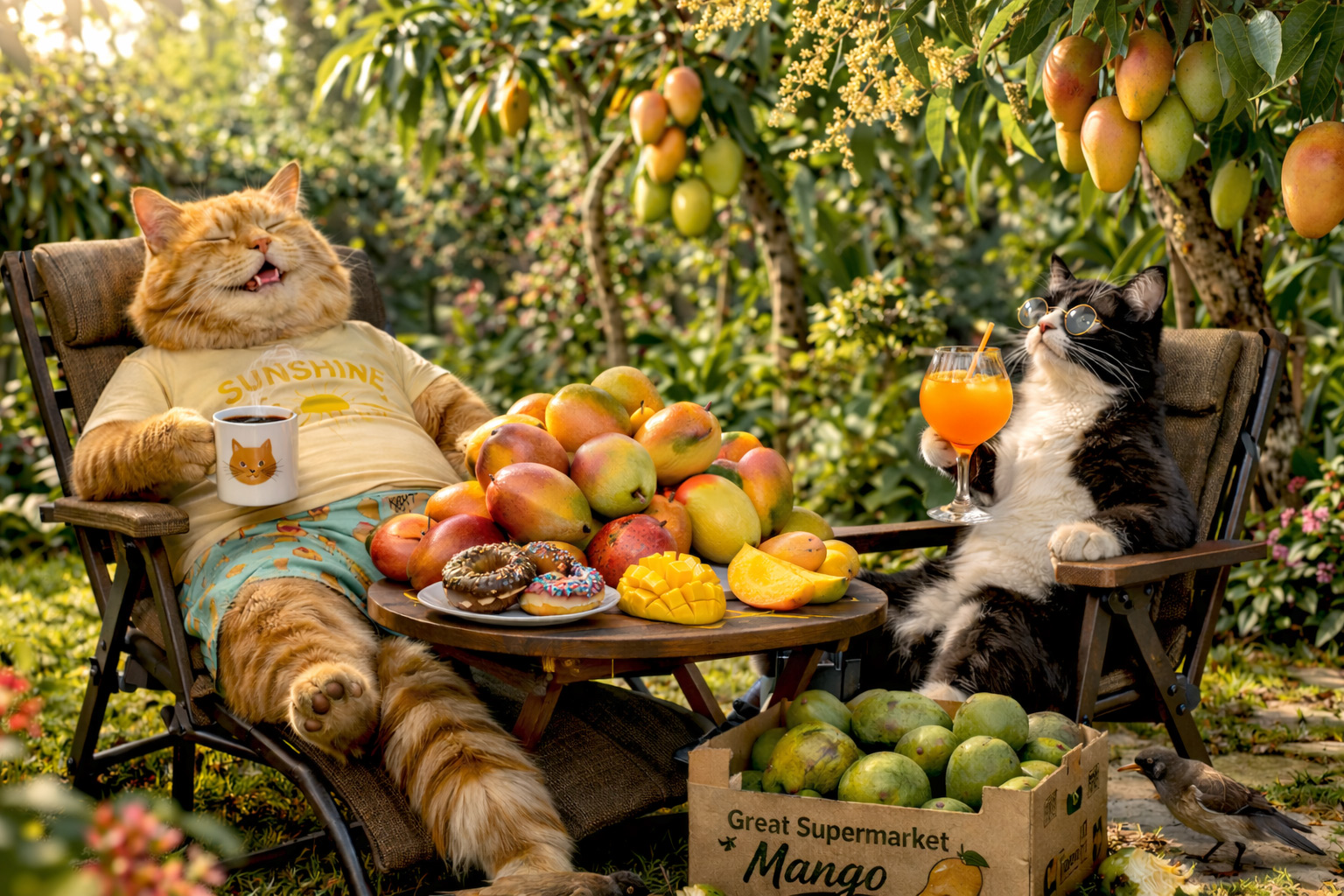
Smokey  and  Sunshine  enjoying  fresh  homegrown  mango  harvest  in  garden
Sunshine: Never understood the passion for Mango. I tried store Mangoes. I really tried. Just disappointment. So this is what real Mango is supposed to taste like?

Smokey: Now you know.

There is a moment when a Mango is perfectly ripe — soft to the touch, warm from the sun, fragrant before you even cut it open. The skin gives way, and suddenly there is color, juice, and a sweetness that feels almost unreal. Not sugary, but deep and layered, like something that took its time to become what it is. In that moment, it feels less like fruit and more like something truly given, exactly as it should be.

Mango Plant Facts

Botanical name: Mangifera indica
Also known as: Mango
USDA Zone: 9 - 11
Highligths Large tree taller than 20 ftSmall tree 10-20 ftFull sunWatering: Moderate. Water when top soil feels dryYellow, orange flowersPink flowersEdible plantSeaside, salt tolerant plant
Get personalized tips for your region

What you find in most supermarkets is something else entirely. Picked early so it can survive shipping, it never gets the chance to finish ripening process. It softens, it turns yellow, but the depth never comes. The flavor stays thin, and the texture often turns fibrous — strings in the flesh that get stuck in your teeth instead of melting away. That fiber is not an accident. It helps the fruit stay firm enough to handle transport without damage. It looks like a Mango, but it never becomes one.

The only way to close that gap is simple — let the fruit ripe where it belongs. On the tree. When you grow your own Mango, you control that moment. You pick it when it is actually ready, not when it has to survive a truck ride across the country. And that one difference is everything you taste.

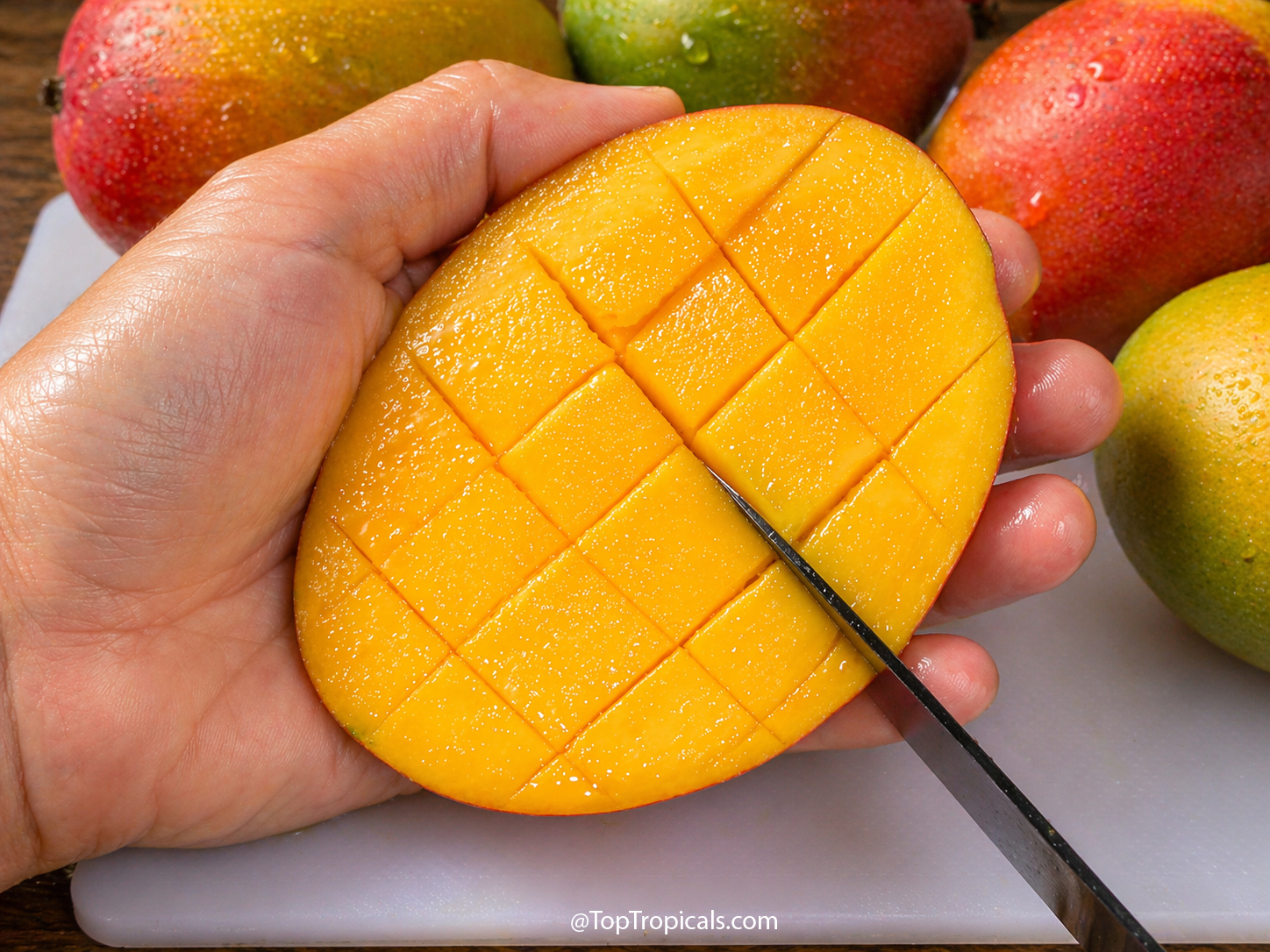
Close-up  of  a  hand  holding  a  mango  cheek  while  scoring  the  bright 
 orange  flesh  into  a  grid  pattern  with  a  knife,  with  whole  mangoes  in  the 
 background.

Scoring a Mango cheek into cubes - the easiest way to prepare clean, ready-to-eat pieces.

📚 Learn more about Mango varieties

🛒 Shop Mango Trees

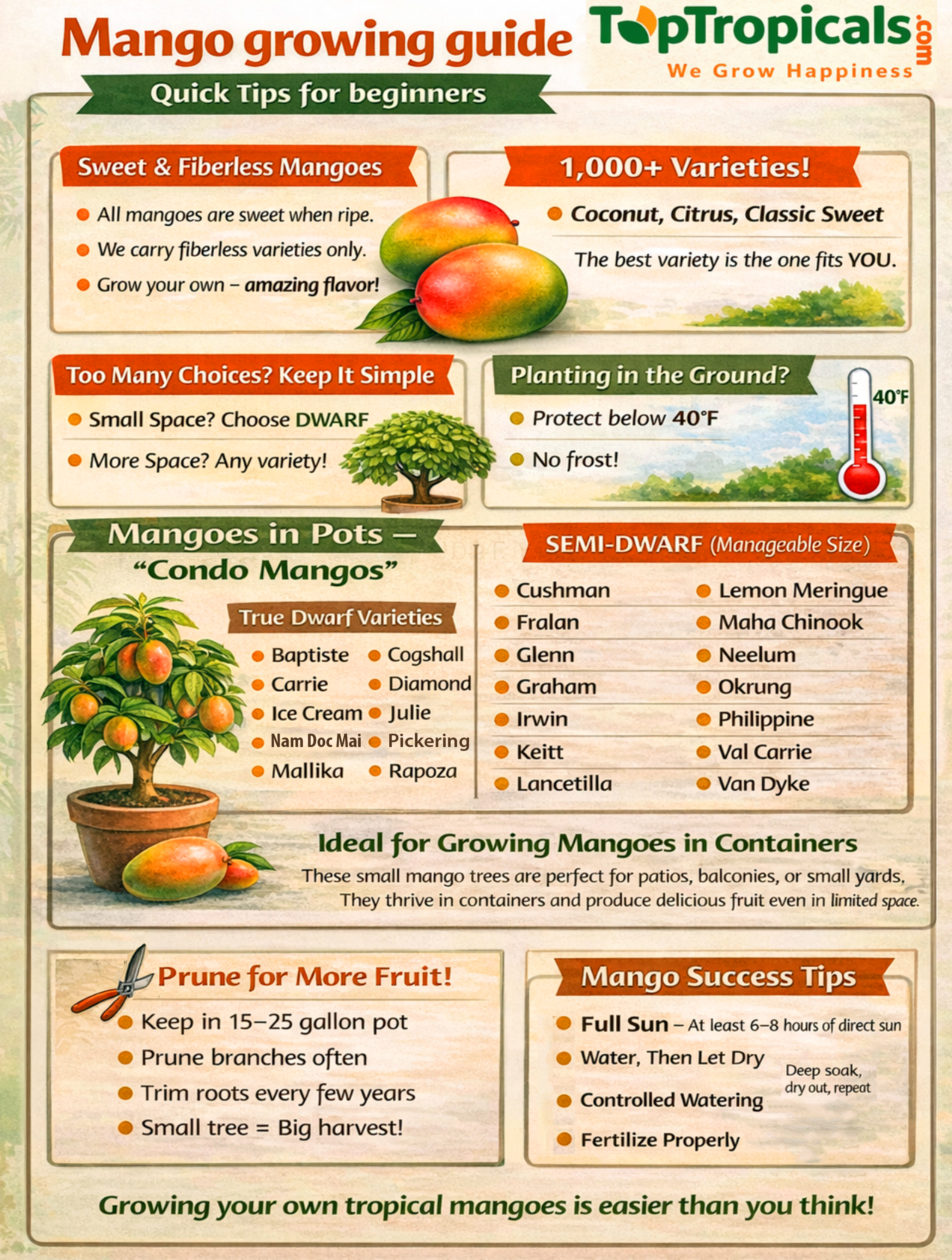
Educational  infographic  titled  mango  growing  guide  showing  beginner 
 tips  for  growing  mango  trees,  including  sweet  fiberless  varieties,  dwarf  and
   semi-dwarf  options  for  containers,  planting  tips,  pruning  advice,  watering,
   sunlight,  and  fertilizing  recommendations,  with  illustrated  mango  trees  and
   fruit.

Quick beginner guide to growing Mango trees - from choosing the right variety to pruning, watering, and container growing tips.