Garden Blog - Top Tropicals

Date: 28 Apr 2021

Cold hardy tropical fruit trees for Zone 9

Q: Can you suggest tropical fruit that can be grown (cold hardy) in Zone 9?

A: There are quite a few tropical/subtropical trees that will grow well in zone 9. Our favorites are: Figs - very cold hardy and drought tolerant.
Loquats - grafted trees that start fruiting right away, reliable producers.
Tropical Mulberry - very fast growing trees that can take freeze, heavy producers.
Macadamia - these trees are of a compact nature, very easy to grow and start producing nuts right away.
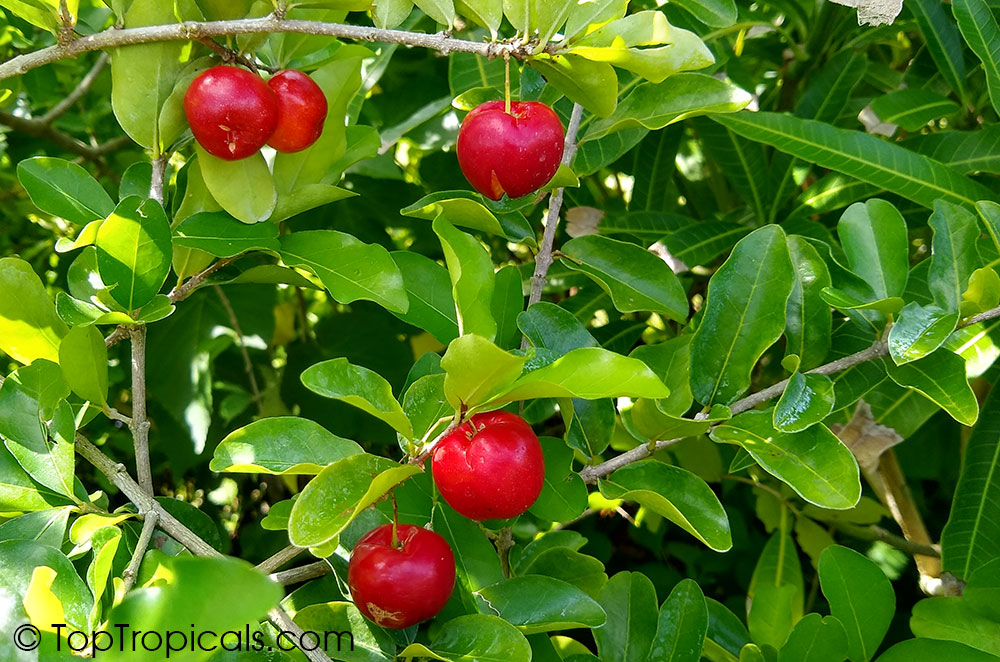
Many different varieties of Eugenias - tropical cherries - all-time favorites. Another tropical cherry - Malpighia, or Barbados cherry - starts fruiting in small size under one food tall! Great for containers.
Tropical (Low Chill) Peaches, Nectarines, and Plums. See full list of low-chill, relatively cold hardy fruit trees.
And of course - Bananas!

Don't forget to fertilize your fruit trees to improve their cold hardiness!

Date: 31 Jan 2017

Plants of Love. TopTropicals Webinars

Plants of Love - Valentines Day Sale. For Valentines day, look beyond roses for a plant that will last a lifetime! It is not a surprise that the most popular plants that has been ordered from TopTropicals for Valentines day for the past 3 years, are: Vanilla, Chocolate, Grape, Strawberry tree, Rose apple - all things you get for your Valentines!

This year we are celebrating Valentines day with our special local event - "Aphrodisiacs, or Plants of Love".

When: Saturday, February 11, 2017, from 10 am to 2 pm
Where: Toptropicals Garden Center, 13890 Orange River Blvd, Ft Myers, FL 33905
Agenda:
10:00 am - Explore the grounds: Customers can come in to look through the nursery and guided tours through gardens.
12:00 pm - Aphrodisiac plants. Class on plants used for aphrodisiacs throughout history.
1:00 pm - Plant giveaway. Must be present to win one of the aphrodisiac plants in lecture.
2:00 pm - sale ends.
Special Love Discounts for local visitors! Snacks and drinks.

Just a few examples of the most famous plants of love that we will be talking about -
Coffea arabica - in East Africa and Arabia it was a sacred beverage to African sufis. For aphrodisiac results mix in cardamom and honey.
Banisteriopsis caapi, Ayahuasca - giant liana from tropical Amazon forests psychedelic, ritual inebriant that promotes potency. Drink is made from the bark and is taken in love rituals to revive the mythical past of the tribe.
Areca catechu, Betel Nut - seeds have stimulating effect on the entire body and eros. It's a traditional aphrodosiac in Ayurvedic medicine and is counted among the eight types of pleasure in the Brahmanic tradition. It has magical and religious properties and used as an offering to the Gods.
Theobroma cacao, Chocolate - mild stimulant, beans contain aphrodisiac. Antient Indian "recipe of chocolati" will be shared at the event! Cocoa was considered the "food of gods".
Cinnamon - in Southern Asia used as stimulant, in food or massage oil for erotic stimulation.
Cola nitida, Cola nut - used in love magic, was used as currency in W Africa.
Cananga odorata, Ylang-Ylang - increases eroticism with oil inhaled. Prescribed to treat impotency and frigidity.
Butea monosperma, Flame of The Forest - is traditionally used to manage male sexual disorders.
Mimosa pudica, Sensitive Plant - significantly increases the libido and hormonal levels of testosterone.
Satureja Viminea, Kama Sutra Mint Tree - used for love gel...
- and much more!

TopTropicals Webinars. Welcome to Top Tropicals Webinar! Discover the world of Rare Plants and surround yourself with a Tropical Paradise! Our plant experts will be answering your garden questions. Our next LIVE air time is just before Valentines Day - Saturday February 11, at 2 pm ET, with a topic of... of course, Aphrodisiac Plants! Get your questions ready!

Date: 7 Aug 2020

Healthy Plant Food

Q&A from Mr Booster

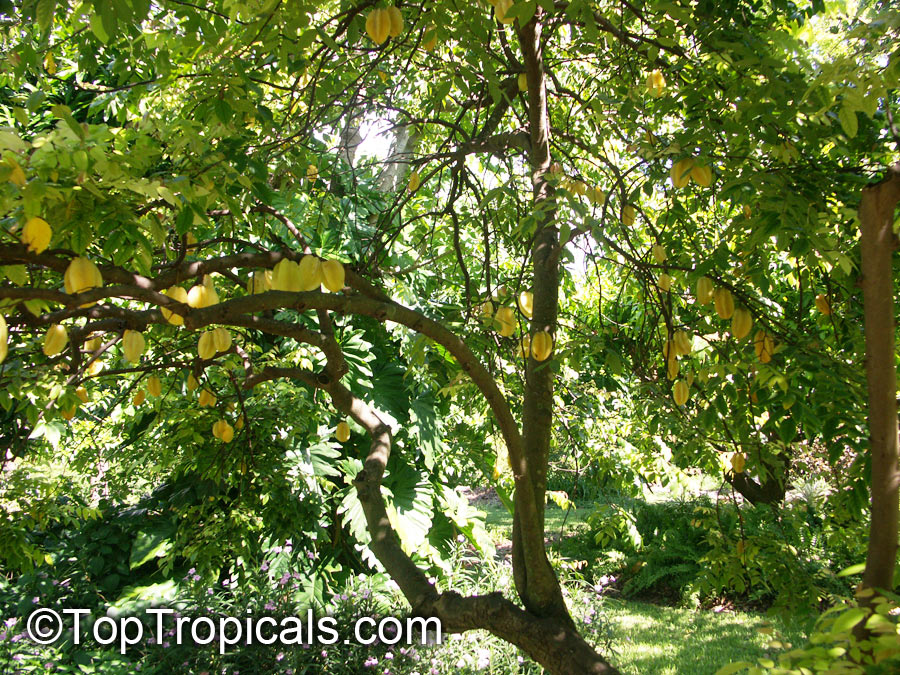
Plant food for a Star Fruit

Q: I have 2 Starfruit plants from you. One on the left is B10 has a lot of flowers but no fruit is developing. On the rite is Kenjeng. This one has no flowers at all. Both plants are growing very well. Plenty of sun and water. I am located in Boynton Beach Florida. So what to do?

A: Your trees on the pictures look very healthy, congratulations with a great care!
Starfruit, as well as other grafted fruit trees (like mango, avocado, etc) usually flower/fruit easily and readily while in pots in the nursery. Sometimes, once planted in the ground, they may reduce flowering or even stop flowering. What happened?
The answer is simple. In pots, we fertilize them on regular basis. In our nursery, we have fertilizer injector inline with irrigation system that dozes plant food with EVERY watering. In other nurseries, they may also use slow-release fertilizers, but it is still a regular routine to provide plant food to potted plants.
In the ground, especially in Florida poor soils, fruit trees may stop flowering or delay fruiting due to lack of nutrients, or dis-balance of elements in the ground. Without fertilizer, a tree may take extra time to develop bigger root system to reach out for necessary elements, and eventually will start fruiting anyway.
But we want it to fruit soon! The only way to fix the problem is to provide fertilizer on regular basis for a young tree. It is especially important during hot summer months when plant metabolism is fast due to high temperatures, plus nutrients may get washed away with frequent summer rains (like we have in Florida) even if you've added some fertilizer at time of planting.

You can use smart release fertilizer once a month during hot season, this one or similar:
Mango-Food - Smart Release Fruit Tree Booster.

But the most effective way to get a tropical tree to flowering and fruiting, is frequent applications of liquid fertilizer. We use Sunshine Boosters with every watering on our plants. They work great even on hard cases and weak plants, and you see the difference in a matter of weeks, sometimes even days.
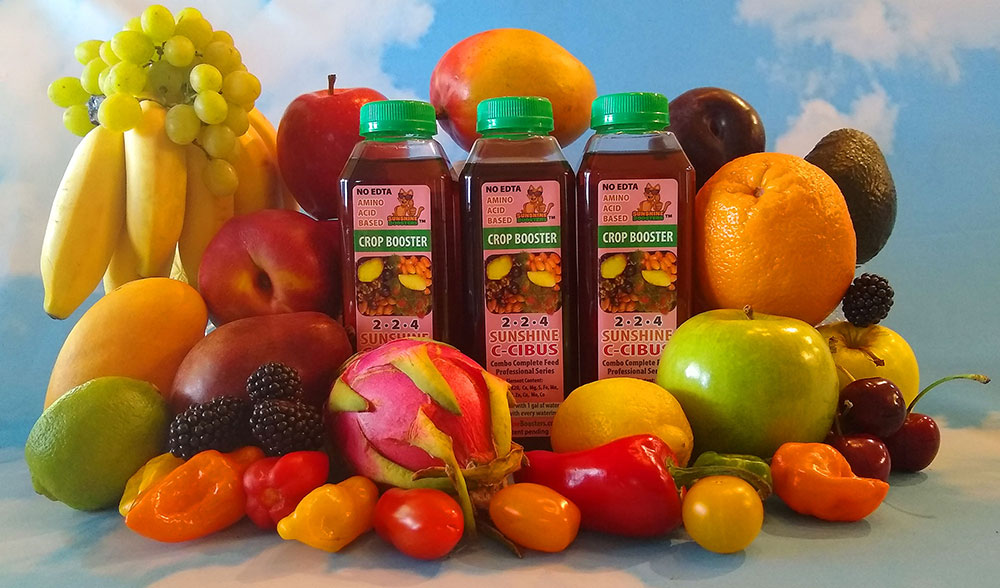
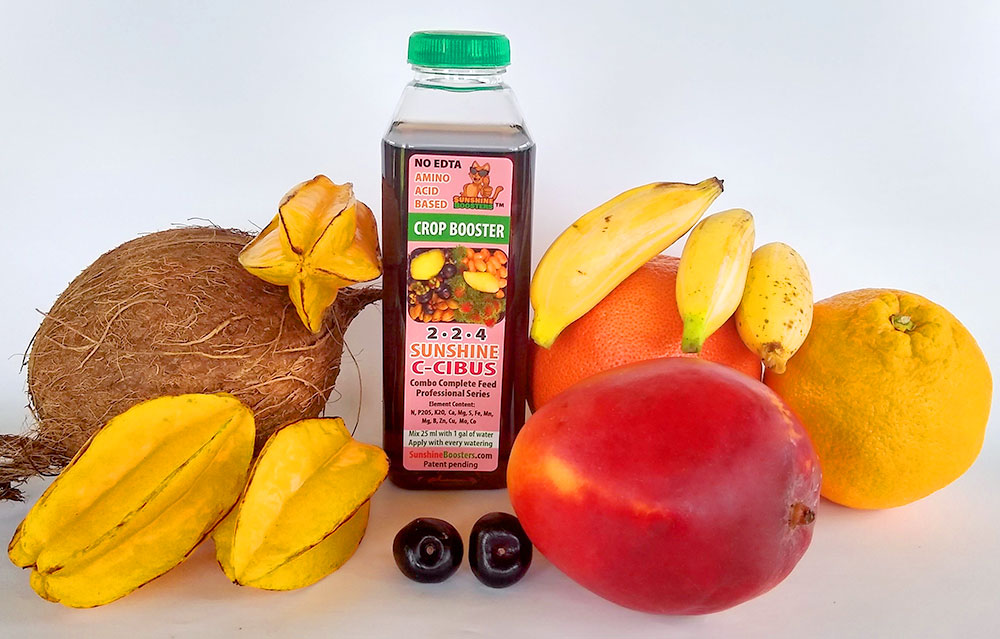
We recommend the following fertilizer that contains all necessary elements for young fruit trees: SUNSHINE C-Cibus - Crop Nutrition Booster

SUNSHINE C-Cibus - Crop Nutrition Booster from Garden Series, or Combo Total Feed Collection - all nutrients in just one bottle, for fruit trees and edibles.

Date: 24 Jun 2016

Coastal plants. Suggestions for coastal regions


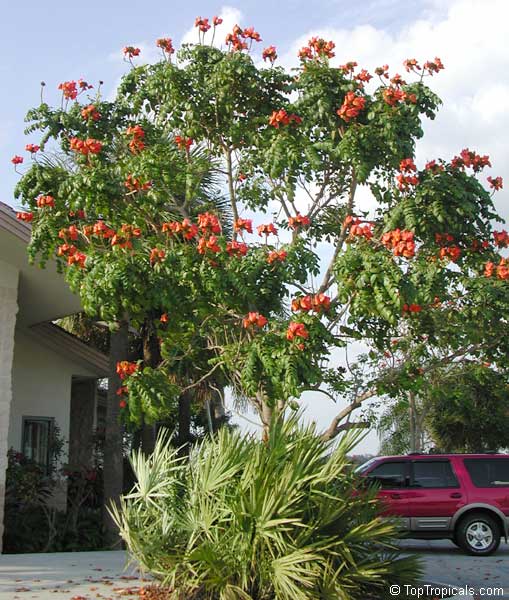
Spathodea campanulata - African Tulip Tree

Q: I'm looking for a plant to replace a Torrey pine that was sadly cut down. The pine made the soil very acidic and it's already silty, sandy, and salty from being near a coastal marsh. I was thinking of a Kei Apple. However, there are only seeds available on the website and I'd prefer a sapling to get things started faster. Are there other trees you'd suggest for that environment?

A: Here are some fast growing salt tolerant trees that we can suggest, just to name a few: Bucida buceras - Florida Black Olive Tree, Callistemon citrinus - Weeping red Bottlebrush, Capparis cynophallophora - Jamaica Caper, Cassia fistula - Golden Shower Tree, Coccoloba uvifera - Sea Grape, Cordias, Delonix regia - Royal poinciana, Flamboyant, Elaeocarpus grandiflorus - Fairy Petticoats, Ficus lyrata - Fiddle-Leaf Ficus, Ficus religiosa - Bo-Tree, Peepal, Sacred Ficus, Mahoe, Peltophorum pterocarpum - Yellow Poinciana, Plumeria, Spathodea campanulata - African Tulip Tree (shown on right). See full list of salt tolerant plants.

15% on all mango trees! This weekend only. Offer is valid through Sunday, June 26. See all mango varieties available.

Date: 25 Nov 2019

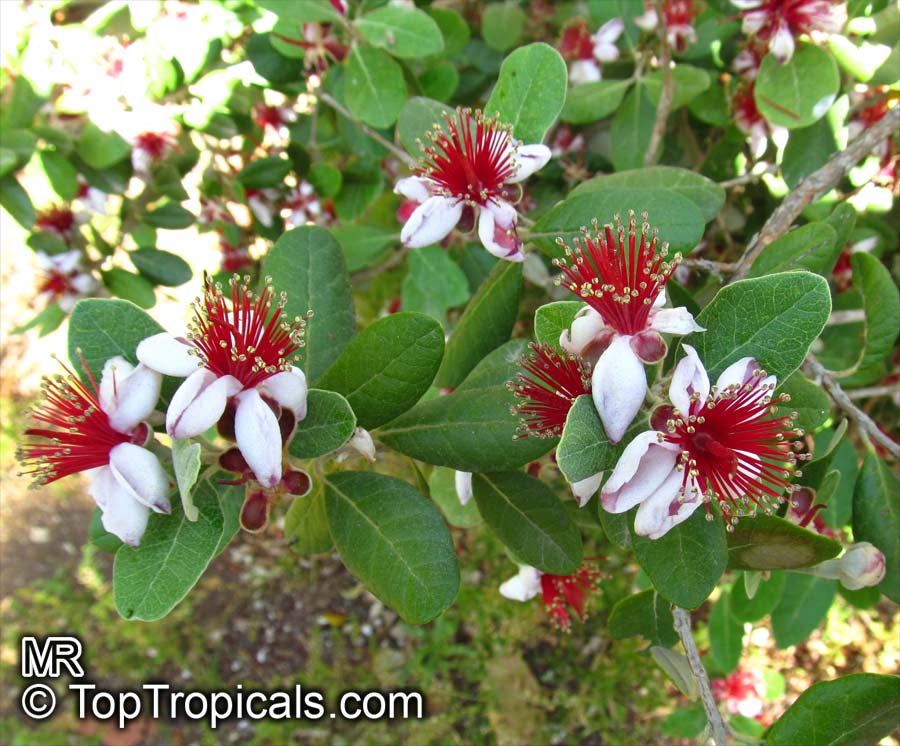
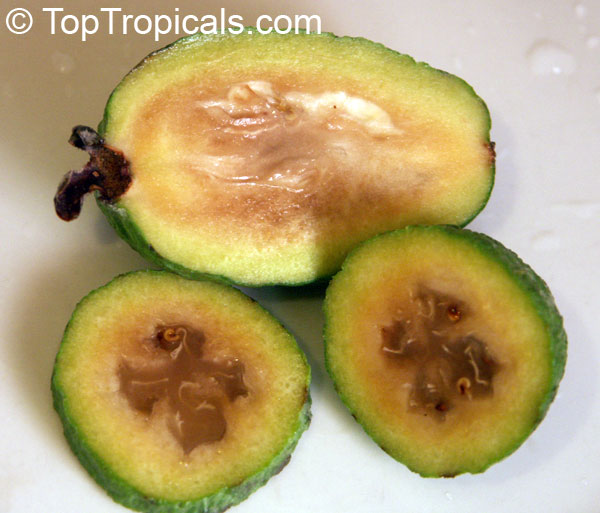
Flavor of Feijoa Superfood
by Onika Amell, tropical plant specialist

Q: What exactly is Feijoa - Pineapple Guava? Does the fruit really taste like pineapple? I am curious to know if it is easy to grow.

A: Feijoa is certainly one of the easiest fruit trees to grow as it does not require much care. It is an attractive, evergreen tree or large shrub with dark green, oval, leathery leaves. It has an abundance of uses in the garden and produces lovely edible flowers and fruit! The fruit is eaten fresh, added to smoothies or fruit salad and is also commonly used to make delicious jams and wicked chutneys. Feijoa fruit go a long way in flavor.
This plant is drought tolerant and will grow in almost any soil type. It loves full sun or partial shade and is wind resistant. A lot of gardeners like to grow it as a wind barrier for this reason. It can easily be shaped into a dense, informal hedge or screen that needs very little pruning. Because of this density, it provides excellent shelter for all kinds of wildlife. Butterflies, birds, and butterflies will all love you for growing Feijoa!
Space the plant five feet apart to create a wind barrier hedge. Heat does no not bother it at all and it will also withstand temperatures to 10 degrees F.
The plant gets its names from the delicious perfume it emits. Some folks seem the fruit taste like pineapple, with a slight minty undertone. Others feel the flavor reminds them of juicy fruit gum! The texture is described as smooth and slightly gritty - almost like a pear, but firmer.
If you prefer to grow this plant as a tree rather than a large shrub, simply remove the lower branches up to one-third of the tree's height over a period of time. The Pineapple Guava can grow up to 15 feet wide and tall. They also do really well as a container plant on patios where you can truly enjoy the lovely fragrance of the fruit. It prefers rich, organic, well-drained soil and will need light fertilization every other month in most soils.

We recommend:

Fruit Festival Plant Food - Super Crop Booster
Mango-Food - Smart Release Fruit Tree Booster
SUNSHINE-Honey - Sugar booster
SUNSHINE C-Cibus - Crop Nutrition Booster

Pretty, pink, edible flowers will wow you from May to June, followed in late summer or fall by the delicious and fragrant fruit. An interesting thing about this fruit is that you don't pick it. It falls to the ground when it is ripe. Or simply place something under your tree, like a tarp, and shake the tree. The ripe fruit will fall off. You can store the fruit in your refrigerator for up to a week. And remember! The fruit of the Feijoa is not only a very rich source of soluble dietary fiber, but also an excellent source of Vitamin C, and very rich in antioxidants. They are also low in calories. Each fruit only holds 55 calories.