Date: 30 Jun 2020
Plants like to snack!
How to feed Poinciana tree
(and other tropical flowering trees)
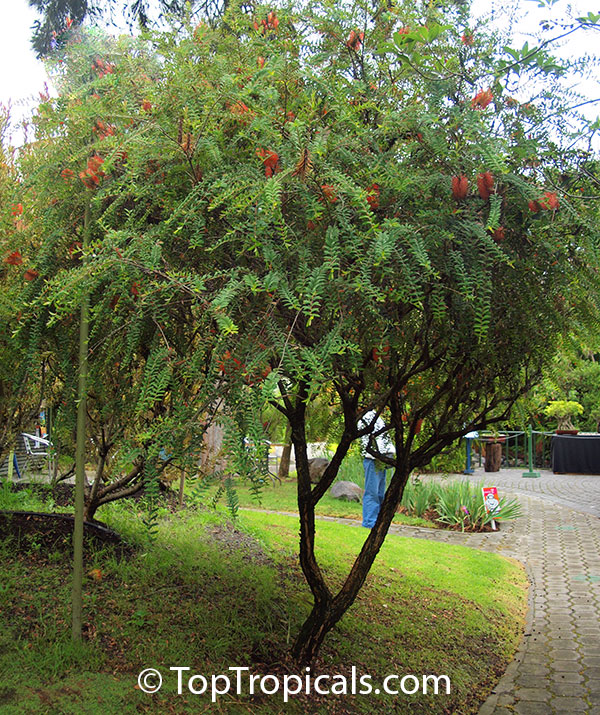
Q: We purchased a Royal Poinciana tree from TopTropicals not too long ago and we gradually gave it more sun until finally we were able to plant it in direct sunlight where it's been for a week or so. Rain has been sporadic lately so I'm giving it a little bit of water every day. It seems to be doing fine. I do have a question about whether the leaves are as green as they should be? I read online that I should fertilize it with gardenia / ixoria fertilizer in March, June, and October. I looked on homedepot.com but didn't really find anything that goes by that name. Would fertilizer help? Can you suggest a fertilizer?
A: Your Poinciana tree looks pretty healthy and happy,
congratulations with a great job!
Traditional (old-school) fertilizer recommendations usually suggest feeding
a plant 2-3 times a year with a slow-release fertilizer. And although a
plant will benefit from any fertilizer application (extra food is always good),
however, for the best results, faster growth, sooner and more profuse
blooming, your should use complete plant nutrition products - liquid fertilizers (see
why liquid
fertilizers are better than dry).
Here is an example. Some people eat a big heavy meal once a day which we
all know, is not very healthy. Other people eat balanced food more frequently
but in smaller portions - this is always the best way to go.
From this point, plants prefer SNACKING - frequent feeding, but with less
concentrated, mild and balanced nutrients.
For your beautiful Poinciana tree (and other flowering plants), we suggest
the following nutrition program:
1) SUNSHINE Megaflor - Bloom Nutrition Booster - you may use this fertilizer as frequent as with every watering, it won't burn the roots, and will provide a complete nutrition for all plant needs throughout the year. You can continue fertilizing with Megaflor even during winter time. Sunshine Megaflor will help you to keep the plant healthy, vigorous, and resistant to stress and diseases. It turns leaves green and makes the plant strong so it will start flowering sooner for you.
2) Tropical Allure - Smart-Release Booster. Apply it once a month during hot season only (in Florida - from March to November).
Date: 25 Jun 2019
How soon will Guava tree fruit?
Q: Can you tell me how your Guava trees are propagated? Grown from seed vs. air grafted, etc.? I'm interested especially in the Barbie variety. In particular, I'd like to know how long it takes them to bear fruit - I live in Southern California zone 10b, with good sunlight.
A: Guavas can be propagated by seed, air layers, or grafting.
Propagation method depends on the species.
Cattley guavas - Psidium littorale - are usually grown from seeds and start flowering
and producing as early as in 2-3 years from seed. Tropical guavas, Psidium guajava - especially named varieties, are propagated usually by
air layers, and the rarest varieties like Variegated Honey Moon are often grafted, although they will come true
from seed (it's just takes them longer to fruit). Both air-layered and grafted
plants start producing right away, usually on the same year of planting or
next year, depending on growing conditions.
Barbie Pink is a superior variety, very popular among fruit lovers. It
produces large aromatic fruit with a bright pink pulp and very few seeds. This
variety is air-layered; in our nursery, these plants start flowering and
setting fruit in 3 gal containers.
Plant this tree in full sun and provide regular watering, guavas don't
like to dry out. Use fertile soil, with at least 50% of compost, and add some
soil conditioning components for better drainage: bark, sand, perlite, etc.
Mulch well, just make sure to keep mulch 2-3"away from the trunk. Follow our
detailed planting instructions that come with every plant, and you are good
to go!
Recommended fertilizers:
Fruit Festival Plant Food - Super Crop Booster
Mango-Food - Smart Release Fruit Tree Booster
Date: 16 Jan 2019
Climate change is wiping out the Baobab, Africa's tree of life...
According to The Guardian News and Media, Africa's "tree of life" may not have much
longer left... These highly important species are threatened with
extinction, due to climate change and human development. Some species may not survive
the next century. While plants have generally adapted to extended droughts,
climate change is different, and with the Anthropocene, we are already
witnessing the loss of these impressive trees. Africa's largest, oldest inhabitants,
that have played silent witness to numerous generations, are already paying a
heavy price for the environmental crimes of foreign lands.
Baobab forms an integral part in people's livelihoods. In West Africa,
it is also called the "palaver tree" because of its social functions: when
there is a problem in the community, meeting under the Baobab tree with the
chief or the tribesmen would be synonymous with trying to find a solution to
that problem; it reinforces trust and respect among members of the community.
Its extinction would not simply be an environmental tragedy...
Every tropical gardener should have a Baobab to help to save this amazing species for the planet!
Date: 18 Nov 2018
How to grow the biggest fruit on Earth...
Q: When I visited Thailand I bought this huge fruit at the market and the taste was amazing and unique! Now I see you have this Jackfruit tree for sale. I am excited to grow it but not sure if it will survive our winters. I live in Huston, TX. Also are there any special conditions required for successful fruiting?
A: Jackfruit indeed is one of the most fascinating tropical fruit. In spite of reputation being ultra tropical, the tree is not as cold sensitive as everyone believes. Mature trees can withstand light frost for a few hours without significant damage. The only thing, after cold snaps it may be not as profuse producer as in frost-free climates. Keeping Jackfruit in a pot is also an option in colder areas. The tree is quite unique not only about fruit but also about growth habit. The fruit is so large and heavy that the tree has a smart feature to produce only at the base of the trunk. This makes it possible to keep Jackfruit tree at very short height - 6-7 ft tall. We have many varieties of Jackfruit, and all of them can be grown in containers considering regular topping/pruning.
5 secrets of
Jackfruit successful production:
1) Frost free temperatures (occasional cold spells are not critical if
SUNSHINE-T cold protection booster is used)
2) Soil rich of organic matter (compost, manure, peat moss)
3) Moist soil and regular watering
4) Constant pruning and keeping under 7-10 ft
5) Regular application of fertilizer, microelements and SUNSHINE-Honey for better quality fruit.
Date: 24 Jun 2018
Mysterious Night Blooming Cactus - Epiphyllum. How to grow it?
Q: My friend has a huge Queen of the Night Cactus, and the blooms are so gorgeeous! She gave me a cutting but I am not sure how do I plant it? How long will it take till it starts blooming? Is it true that it has only one flower once a year and only at night?
A:
Queen of the Night is a very popular and yet mysterious
plant. The flowers open once a year after sunset for one
night. However the flowering period can last a month or
two during the warm season. So each flower lasts only one
night, but there will be more flowers to come! In the
Nature, Epiphyllum oxypetalum - Queen of
the Night - grows on trees in the jungles of Central
and South America. It is actually very easy to grow as an
indoor plant in colder climates. Here is South Florida we
grow them outside in hanging baskets. This is how to start
Queen of the Night from a cutting:
1) Put the cutting in a dim, dry place for three days,
with no soil and its base exposed to the air, so it will
form a callus.
2) Fill a 4-6-inch pot with slightly damp potting soil or succulent mix. Insert the
cutting 1 or 2 inches into the soil and tamp the soil
around its base.
3) Place the pot where the cutting will get bright light,
but no direct sun. Spritz it occasionally with a spray
bottle of water to keep the soil only slightly moist. It
should root in couple weeks.
4) Keep the plant on an east- or west-facing windowsill
where it will receive direct sunlight only in early
morning or late afternoon. Water the cactus until water
runs out of the pot's drainage holes. Dump the excess out
of the pot's saucer immediately, and wait until the
surface of the soil is dry to the touch before watering
your cactus again.
5) Fertilize once a month from March through October with
a balanced plant food, and
apply micro-elements once a month
for a healthy vigorous growth. Refrain from feeding the
plant in December and January.
6) Position the cactus in partial shade under a porch roof
or tree, if you decide to move it outdoors during the
summer. This plant likes summer humidity!
7) Repot the cactus only once every two years or so, to
keep it slightly root bound. Wait until after it flowers
in summer, and repot it after it blooms. Prune off any
damaged growth at that time as well.
8) Move the plant to a cooler room over the winter months,
one that remains dark during the evening hours with
temperatures above 45 degrees. Reduce the frequency of
watering, waiting until its soil is dry. Resume regular
watering in March.
If grown from cutting, it may take 2-3 years until the plant starts blooming, so if you don't want to wait that long - just get a blooming size plant from our store!
We only have a few plants... if sold out, add to wish list and we will have more soon!