Garden Blog - Top Tropicals

Date: 11 Jan 2021

Tropical gardener beginning-of-year checklist

Final pre-Spring check of whatever we had forgotten! For a gardener, the year ahead is a chance to do things you want, as a way to achieve the things you need to do. If your number one New Year's resolution is to garden more (a want-to item), you also will be exercising more (a need-to). Or if you plant a new edible garden (want, want, want), you will end up checking off "eat more leafy vegetables and fruits" from your to-do list!

12 steps to get ready for 2021 season:

1 - Spray fruit trees and houseplants with insecticide and micro-elements
2 - Continue spraying SUNSHINE-Epi to improve plant hardiness
3 - Protect tender plants during cold spells and especially from freeze
4 - Reduce watering during cooler months, keeping the root zone on a dry side
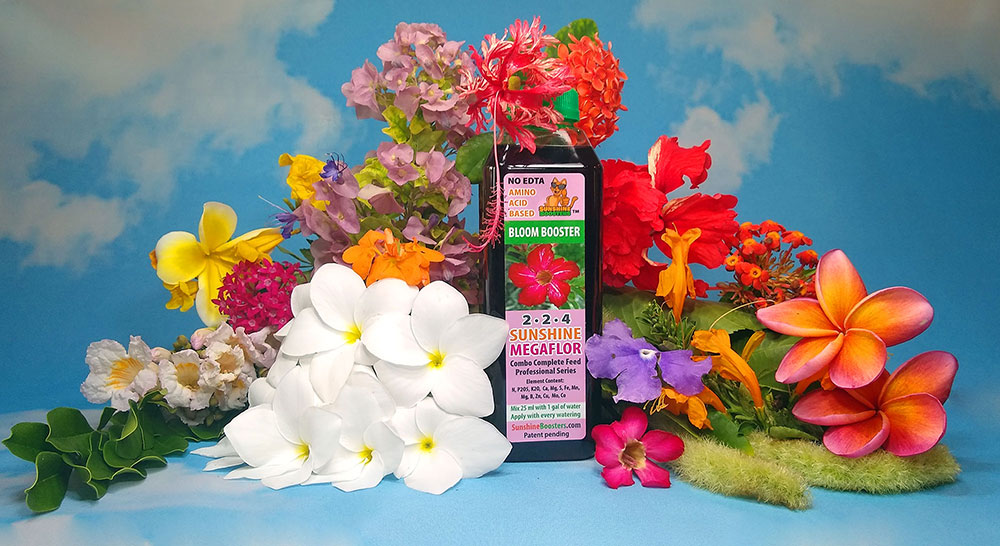
5 - To give your plants a kick start, fertilize with liquid SUNSHINE Boosters fertilizers - they are safe to be used year round
6 - Plant fruit trees: winter planting is beneficial to avoid heat stress for roots
7 - Plant Butterfly and Hummingbird Attractants
8 - Plant bulbs, vegetables and herbs. Use eco-safe, natural SUNSHINE boosters for all your edibles.
9 - Plan your summer garden and order seeds early
10 - Start tropical plants from seeds (indoors for cooler climates)
11 - Start ordering tropical plants and beneficial soil mix to get them established after shipping in pots
12 - Clean and oil garden tools

Date: 5 Jan 2021

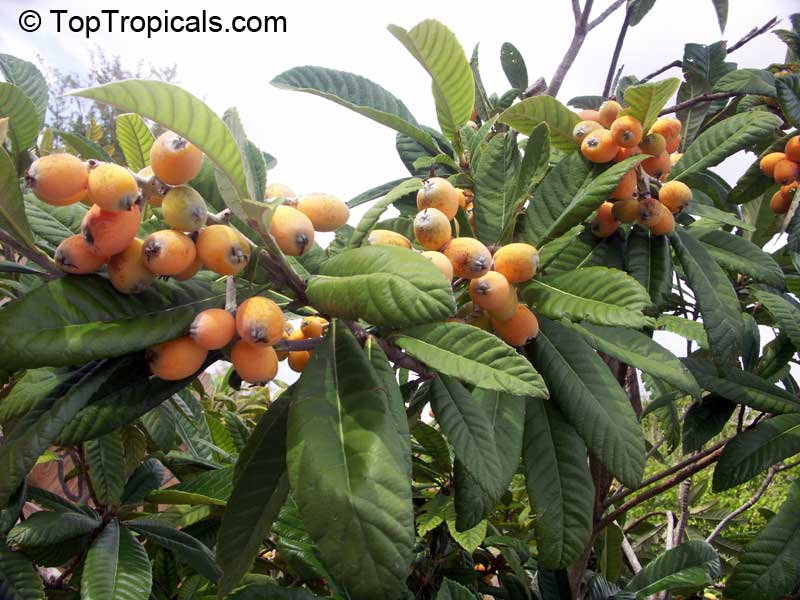
Growing Loquat in container

Q: I purchased a Sherry Loquat tree from you in April of 2020. It got off to a slow start initially, but now is five feet tall with healthy leaf growth! It is in a 15-gallon pot and was brought into the house by October 15th. I live in Zone 6 and kept the plant outside from end of May to October 15th. I have given the tree artificial lights in addition to slow release fertilizer. Can you please advise me on what steps I need to take to get the Sherry Loquat tree to fruit? E.g., lighting requirements, soil pH, soil type, etc.

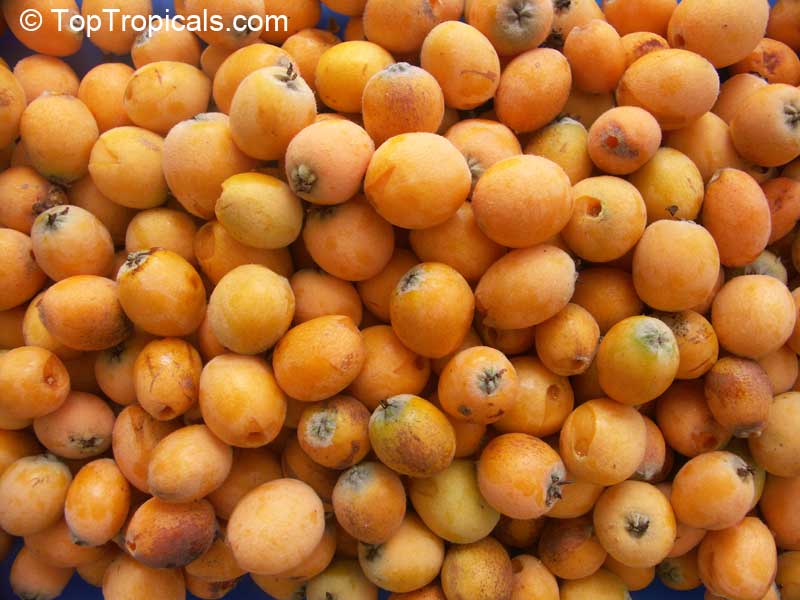
A: Loquat is normally winter flowering and spring fruiting tree, here in Florida it is usually heavily covered with fruit by April. With a proper care, you may see flowers throughout the winter and they may set some fruit for you. Considering that during this time you have to keep the plant indoors, here are some recommendations:

1. Soil. Well-drained, porous potting mix. Do not use any heavy garden soils. For our plants we use the following mix which is excellent for containers: Abundance

2. Light. The brighter the better. Sunroom would be great, or at least put the tree next to a large window. Extra lighting with grow lights is beneficial. Any type of light will work, you can even use a simple clip-on light, the brighter the better. 8-10 hours a day.

3. Water. Loquat is drought tolerant but for fruiting it will need regular watering; just don't keep soil soggy, let is slightly dry before waterings.

4. Fertilizer program. Use liquid fertilizer. We recommend Sunshine Boosters that are safe to use with every watering and year around - SUNSHINE C-Cibus - Crop Nutrition Booster.
We recommend to switch plants from traditional"slow-release"fertilizer to the liquid one because it makes a huge difference in plant growth and flower/fruit quality and quantity. Sunshine Boosters are scientifically balanced fertilizers that supply all necessary elements for daily plant needs. They are natural and eco-safe, great for any edibles.

5. Micro-elements. These are essential for potted plants, because in containers roots can't reach out to elements that are usually present in soil when trees grown in the ground.

Apply micro-element remedies that are very effective for improving fruit production, especially when flower or fruit drop occurs:
SUNSHINE Honey - promotes more efficient blossoming and pollination, makes flowers bigger and reduces bud drop.
SUNSHINE SuperFood - improves plant vigor and quality and size of flowers
These are all natural, eco-friendly supplements that work great for fruit trees and other edibles.

Read more about Loquat trees: The best grafted Loquat varieties.

Date: 29 Oct 2020

The Best Pineapples

Q: What varieties of the Pineapple are the best for planting in Florida? When do they fruit? I have a small yard, with a room for one or two, but can I keep more in pots? I am excited to grow my own pineapples!

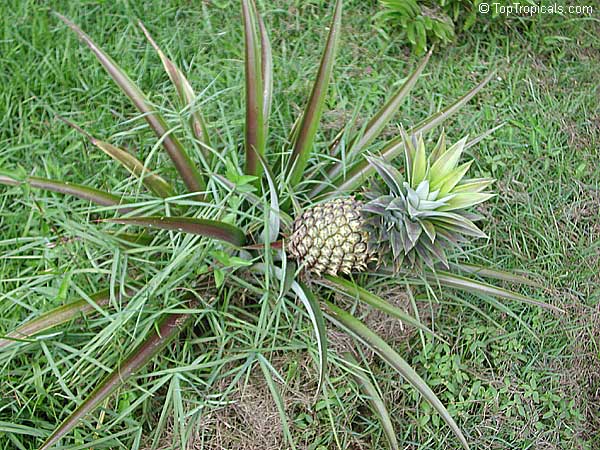
A: Pineapple is truly the King of fruits! One of the most delicious fruits in the world. They start flowering from January to March in Florida and yes, they happily grow in the ground as well as in pots. Heaviest fruiting is in Summer (May to September), and some staggered throughout the year.
Be careful with watering, keep in mind that like any bromeliad, Pineapple needs very little water and needs the soil to get dry between waterings. Use only acidic soil and acidic plant food.
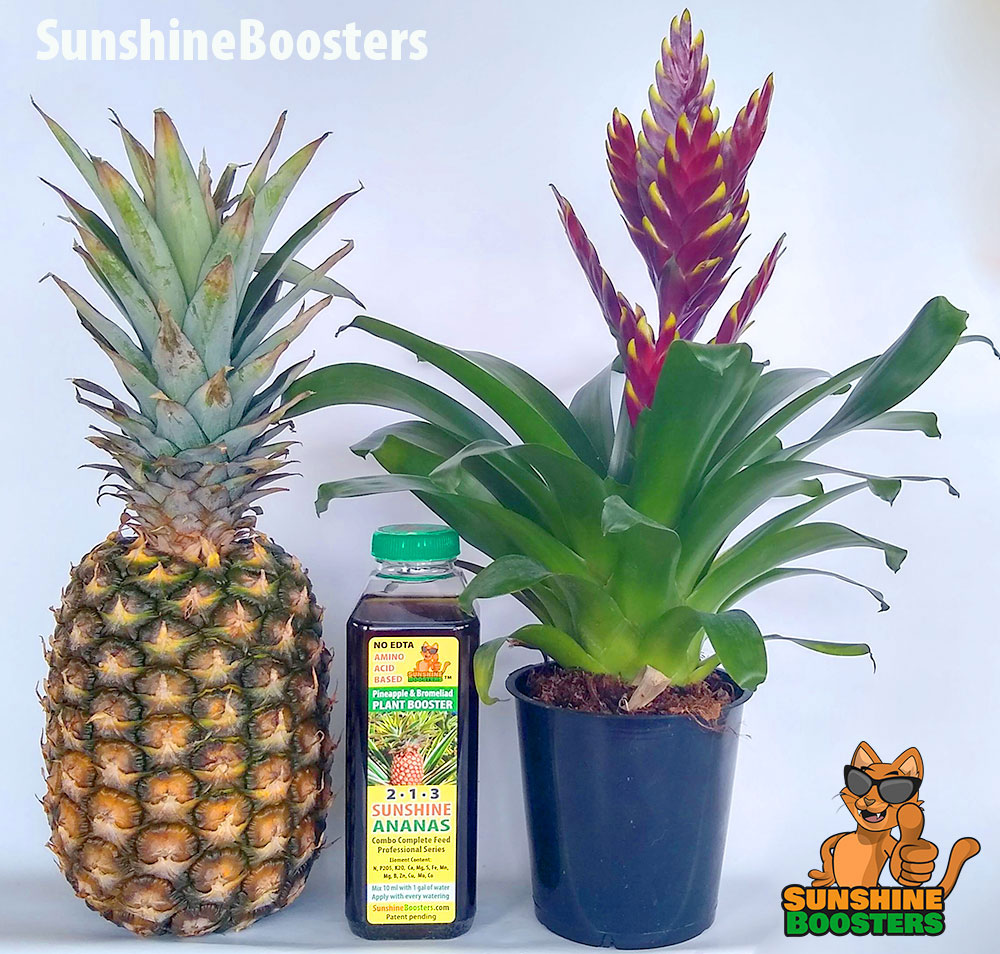
Make sure to feed these plants on regular basis, especially if grown in pots. Pineapples are heavy feeders but are also very sensitive like all bromeliads, so be careful with traditional fertilizers, do not exceed recommended dosage. It is safe to use liquid amino-acod-based Sunshine Boosters Ananas fertilizer year round.

The mot popular pineapple varieties for home growers are:
Elite Gold
Royal Hawaiian - Royale
Sugar Loaf

Date: 9 Nov 2019

Saving Fallen Papaya Tree

Q: Hope there is help for my beautiful amazing papaya tree! There where a loooooooot of fruits on it, but it broke! First of all, it was leaning and friends tried to straight my beautiful tree. What can I do? Will it get fruits again?

A: A couple months ago we also had a Papaya tree loaded with fruit that fell down (see photos). It was heart-breaking. We secured it and it continued growing for a couple of weeks but unfortunately, at the end the tree still died, leaving us a million fruit. The Papaya tree has a very sensitive root system and is hard to re-establish once the roots are damaged.
However, if it just has a broken top, it has a good chance to grow back from the side shoots.
Of course, remove all the fruit so they don't take energy from the recovering tree.
When a tree is loaded with fruit, it is important to provide support for heavy branches and for the trunk if needed. Always support the fruiting tree to prevent from possible falling BEFORE it starts leaning down and may become broken by even a light wind.
In the photo, you can see how we fixed boards around, but it was already after the tree fell. Unfortunately, it was too late since the roots got damaged. Always need to stake the tree up before the branches get too heavy!

RECOMMENDED FERTILIZERS:
Fruit Festival Plant Food - Super Crop Booster
Mango-Food - Smart Release Fruit Tree Booster
SUNSHINE-Honey - sugar booster

Maradol Papaya $10 Hot Sale

Only local pick up from our Garden Center
Hurry up, while supply lasts!

Date: 8 Nov 2019

Trimming Mussaenda bush

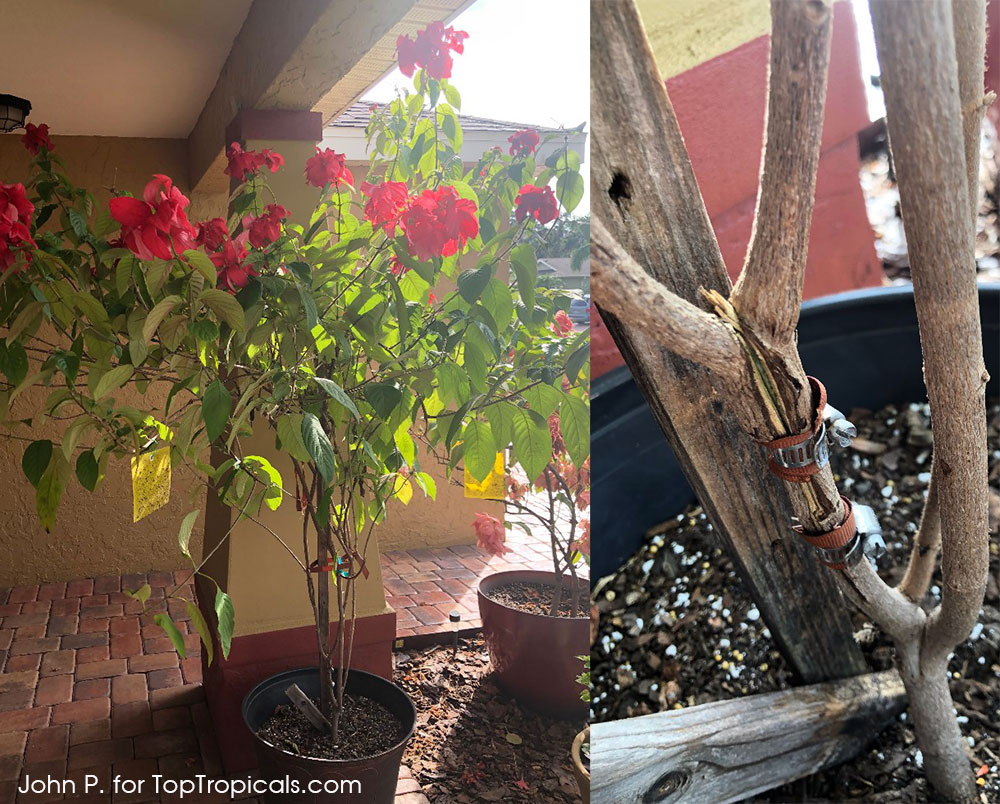
Q: My wife and I bought a Dona Evangelina from you this year. It thriving and has grown to 6-8 ft. It has become top-heavy and in wind, it falls over. Main stems have split twice but still continues to grow. I usually prune Dona Luz back to 3-4 ft and am wondering how much you would advise me to lop off your plant. Any advise will be appreciated.

A: Mussaendas, indeed, have very fragile stems that break often, especially in Florida wind storms. The good news is, these plants grow vigorously once established.
You did a good job trying to tie together the split stems and in fact, cracks do grow back together as long as the dressing is tight. Try to use green tape or even electric tape to tighten the broken spot.
However, do such repairs only if it is critical for a plant. When possible, simply cut off the broken branch and give the plant a chance to grow a new stronger branch. You may trim the bush pretty short. Mussaendas respond well to pruning which promotes more side growth and makes the plant bushier.
Keep in mind that during cold weather, Mussaenda may drop all leaves and go into dormancy until spring.

RECOMMENDED FERTILIZERS:
Pink N Good Daily Plant Food - Flower Booster
Tropical Allure - Smart-Release Booster