Garden Blog - Top Tropicals

Date: 4 Feb 2017

Groundhog Day Feb 2

On Groundhog Day Feb 2: Groundhog Punxsutawney Phil saw his shadow on Thursday morning, predicting six more weeks of winter during Groundhog Day festivities at Gobbler's Knob, a small hill just outside Phil's hometown.
According to folklore, if it is cloudy when a groundhog emerges from its burrow on this day, then the spring season will come soon; if it is sunny, the groundhog will supposedly see its shadow and retreat back into its den, and winter weather will persist for six more weeks.
Phil promised long winter, however, we should not cry in despair but starting to get ready for Spring!

Spring Check List:
- Make sure min temperatures are above 45F before you start bringing potted plants outside.
- When active new growth appears from buds, after-winter pruning can be done.
- You may start weekly fertilizing as soon as night temperatures raise above 55F.
- Start planting in the ground as soon as there are no more chances of frost, until then keep newly arrived plants in pots so they get better established.
- Low chill cold hardy fruit trees including Peaches, Nectarines, Plums, Apples, Mulberry, Loquats go in the ground first, so you can enjoy their blooms and early fruit set. Plant Pomegranates, blueberries and cranberries, raspberries and blackberries, grapes.
- Water as needed, still keeping on dry side until afternoons get hot and plants start using more water.
- Start seeds indoors. The sooner the better, to give seedlings more time to establish before planting out in the ground.

Overwintering Magnolia (Michelia)

Michelia alba Question: I have a question about Michelia alba. My Michelia alba leaves turning yellow and losing leaves. When I brought it inside for the winter, after the leaves falling off new one grow back not all of them grow back and now the new the branches start to die. I water once a week.

A: Whenever moving a plant in or out of the home it is always best to do it gradually. Moving a plant all in one day will cause stress to the plant due to environmental changes such as, new humidity levels, new light levels and new watering requirements. Michelias usually loose their leaves once in the spring and once before winter but grow them back right away. Now that your plant is inside with less humidity, light and leaves, you only need to water once the soil as almost dried out. You will need to stick your finger in the soil to see if it is still wet as the top layer dries before the under layer. If the branches are starting to die at the tips this usually means too much water. Move the plant to a bright light window, decrease water and you may want to also use a humidifier.

Date: 8 Sep 2021

Fertilizer and the Fall Garden

by Ed Jones, the Booster Guy

...Well Labor Day has come and gone. Summer is winding down and depending on where you live, thoughts are now turning to pumpkin spice, witches, fall decor and gardening. Wait, did I just say gardening? Yes, if you live in the deep south, and I do, it is time to think about fall gardening and fertilizer. Even those of you in the north can put in a few quick crops now for fall. Think onions, radishes, lettuce and other greens and of course, garlic...

Next month, we can start putting out our plants that do better in cooler weather. We will put out some beans and of course cabbage. We may do some potatoes too. What do you like to grow?
But what about fertilizer? Glad you asked. Now, most of us have our favorite brand of fertilizer. Some of us had some secret fertilzers that we used in the past. For me it was composted alpaca manure. Yes, we raised alpacas in the north, but that is another story for another day....

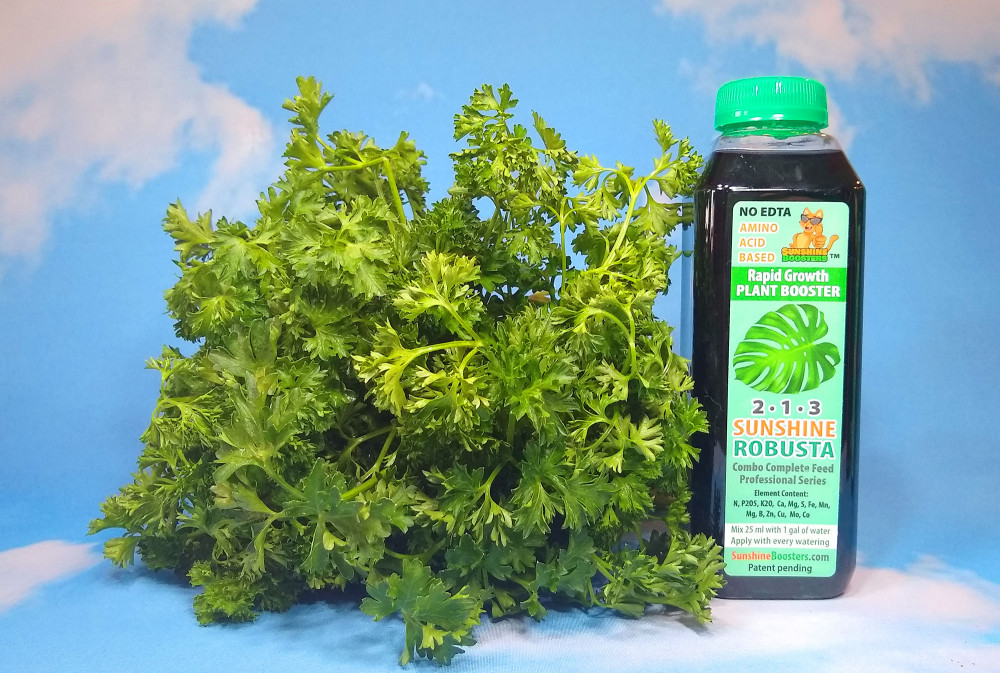
...Once the temperatures have begun to drop, it is better to use a good liquid fertilizer. The one I will be using this year is SUNSHINE Robusta. SUNSHINE Robusta is an organic amino acid based liquid fertilizer that is safe to use with every watering. It uses amino acids to chelate (bind) micro-nutrients and makes it easier for plants to take them up from the soil. Most fertilizers use EDTA to chelate their micro-nutrients and plants must use about 4 times more energy to break them down than they do with SUNSHINE Boosters. This means that your plants will have more energy to put into growth. And isn't that what we are after?
With Special Seasonal price for 16 oz bottle reduced to only $19 with FREE shipping, this is your best choice of organic, safe fertilizer for your vegetable garden!..

CONTINUE READING >>

Date: 15 Oct 2020

Healthy Plants. Q&A from Mr Booster: Fertilizing Mango trees in Winter

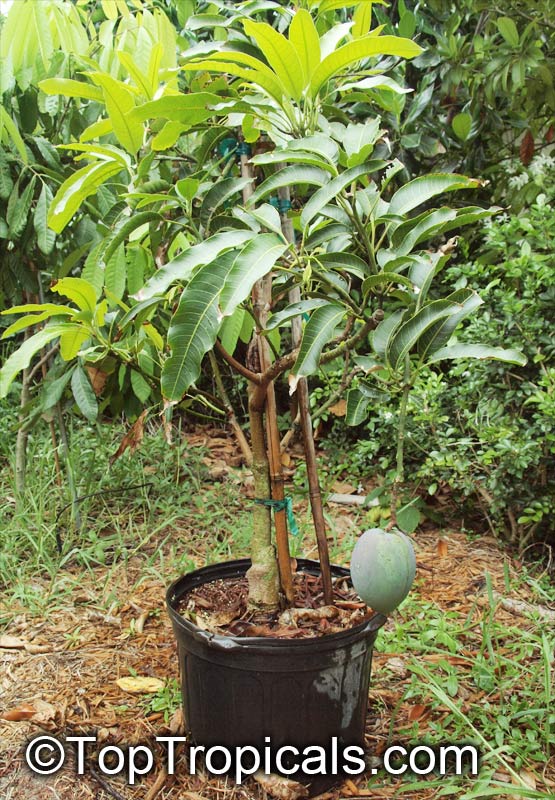
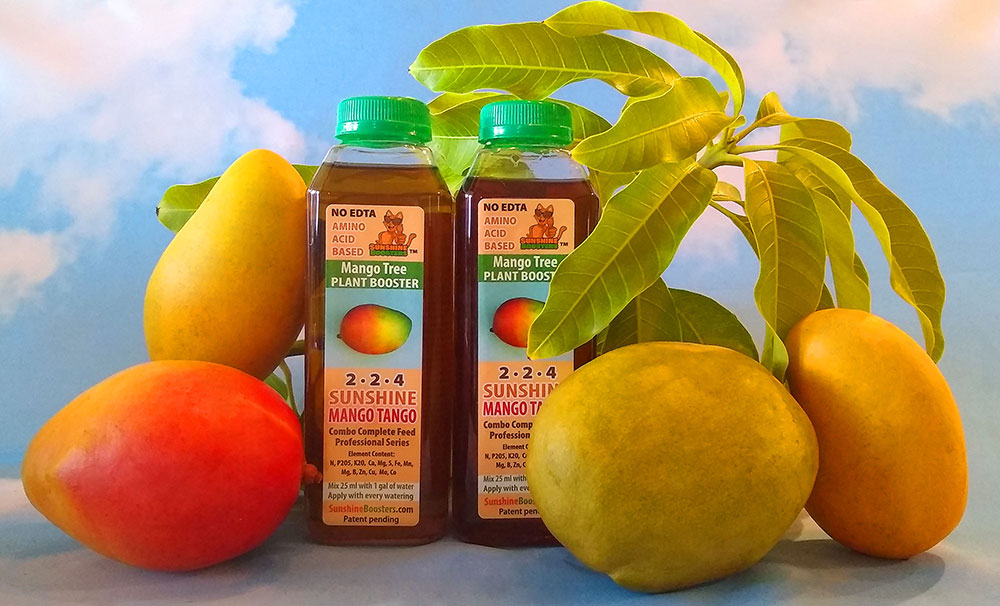
Q: I'm living in Maryland growing zone 7A and would like some info on when to fertilize my potted mango trees. I ordered your Sunshine Mango Tango 2-2-4. All your mango trees are in pots.

A: You can start using this fertilizer right away, any time of the year, and every time you water your plants.
Sunshine Mango Tango, as well as other Sunshine boosters, is an amino-acid based liquid fertilizer that is scientifically developed for daily plant needs in all necessary nutrients. This means, you may use this fertilizer with every watering, including winter period.
Traditional fertilizers (both granulated and soluble, EDTA-chelated) can only be used during hot months while plants grow actively, and must be limited or not used at all during cooler months, to avoid nutrient lock up in soil (which basically means "building up unused elements"). With Liquid Sunshine Boosters, it is safe to add them every time you water your tree.
During cooler weather and when plant metabolism slows down, a tree will consume less water (as well as food), and you will automatically reduce watering, to keep over-wintering plants on a dry side. This means, less fertilizer too. This allows you to control elements intake naturally, like you control water amount just as much as the plant needs.

Date: 4 Jun 2019

Pretty in Pink... and Purple Prince for her!

TopTropicals.com

By Onika Amell, tropical plant specialist

Q: I have a bare spot in my front garden, behind a low wall, in part-sun. I'm hoping to find an evergreen, flowering ground cover that will cover it quickly. Any ideas on finding something with the ability to eventually also cascade over that wall? I live on Marco Island, Florida.

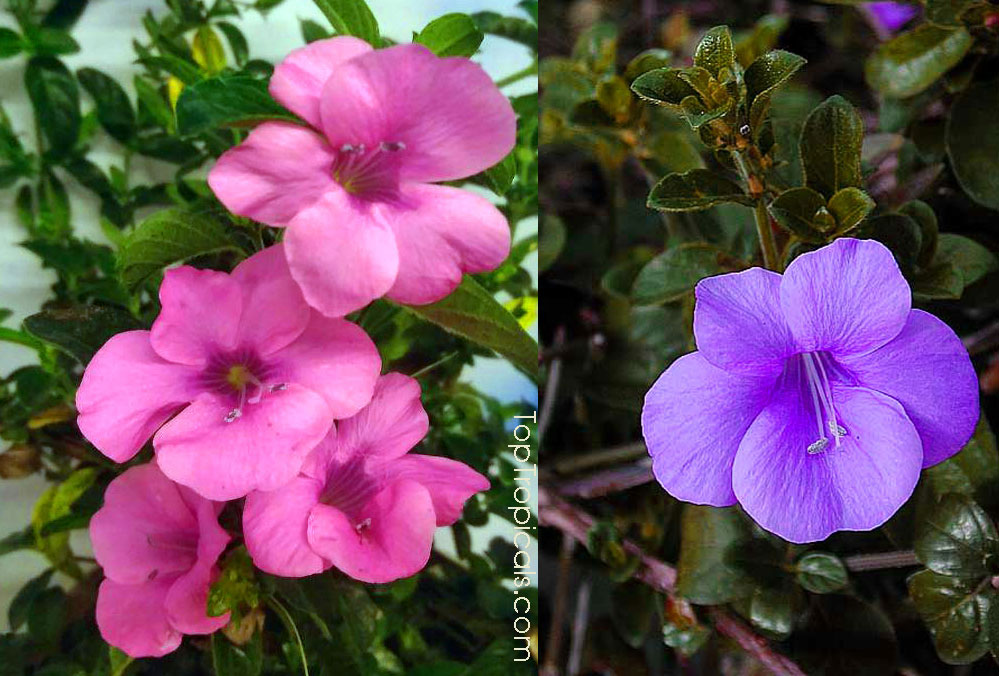
A: Barleria Repens - Small Bush Violet, is a tough, fast-growing evergreen that blooms from late spring to autumn. Of the many Barleria we see in the tropics, Pretty in Pink is one of the most striking! The name tells the whole story: pretty and pink. A lot of gardeners enjoy using them as a ground cover. They will quickly cover a large area - their stems root readily as the plant crawls along. They are easily propagated by lifting the rooted runners or using cuttings. They also reseed easily. Flowers are followed by seed pots that explode open when dry, dispersing 4 seeds at a time! But perhaps best liked by many gardeners, is their habit to cascade. It will be well suited for covering the bare area in your garden and spilling over that wall beautifully.
When used as a ground cover, remember to pinch out young shoots to encourage bushiness and prune the plant back hard after flowering to keep it neat.
Barleria repens will also adapt to different situations in a garden if you need them to. Although they usually form a rounded to spreading bushy shrub, 2 ft high by 3 ft wide, they will climb when you give them support. They are often allowed to lean into nearby trees and shrubs.
Hardy to 28F, Barleria repens is pest-free and fairly frost-tolerant. They love sun and part shade, as well as well-drained soil and plenty of organic material. Avoid planting it in deep shade as it will get leggy and reluctant to flower.
They will thrive when fed with a slow release fertilizer at intervals of 6-8 weeks, throughout the growing season.

There is another cultivar of this exact variety that has blue-purple flowers, it is called Purple Prince! It couples perfectly with Pretty in Pink! :)

See all Barlerias from our store


Recommended fertilizers:
Pink N Good Daily Plant Food Flower Booster
Tropical Allure Smart-Release Booster

Date: 24 May 2019

Heavenly Angel's Trumpet

TopTropicals.com

By Onika Amell, tropical flower specialist

Q: Can you please tell me which zones are the best for growing Angel Trumpets? When do they bloom and is there a specific fertilizer to use on them? Do you sell any variegated varieties?

A: If you are lucky enough to live in an area that doesn't freeze or only has light frosts, you can grow Brugmansia (common name Angel Trumpet) outside all year long. They are only entirely hardy in USDA zones 9-12, but they remain very popular throughout the United States. They do really well in coastal settings in the Southwest. They are simply glorious in the coastal areas of South California. In the southwestern states, as well as in the tropics, they bloom spectacularly throughout the spring, summer, and autumn.

Angel Trumpets are very heavy feeders and they need huge amounts of nitrogen. You can use a standard balanced slow-release fertilizer on Brugmansia, but then you must apply it very generously. We've created a specialized fertilizer just for them. Angel Trumpet Delight is a perfect Brugmansia food for frequent monthly feed. It's a 30-day Smart-Release formula that works wonders for Angel Trumpets. A a well-balanced combination of macro- and micro- nutrients with a slow release action, it provides continuous feed, maintains vigor and disease resistance. It also contains coated nitrogen, early release nutrients and extra iron (water soluble and chelated) for quick green-up.

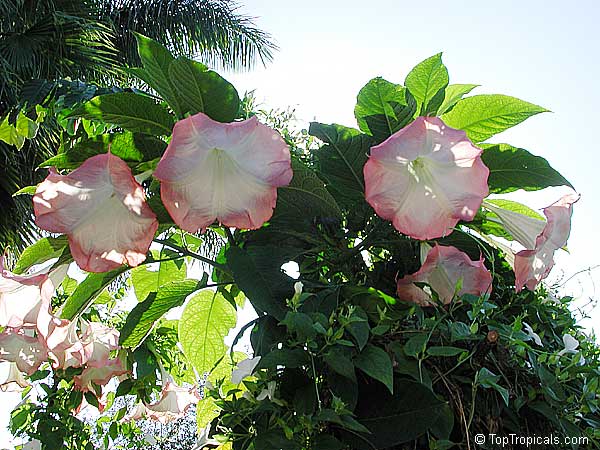
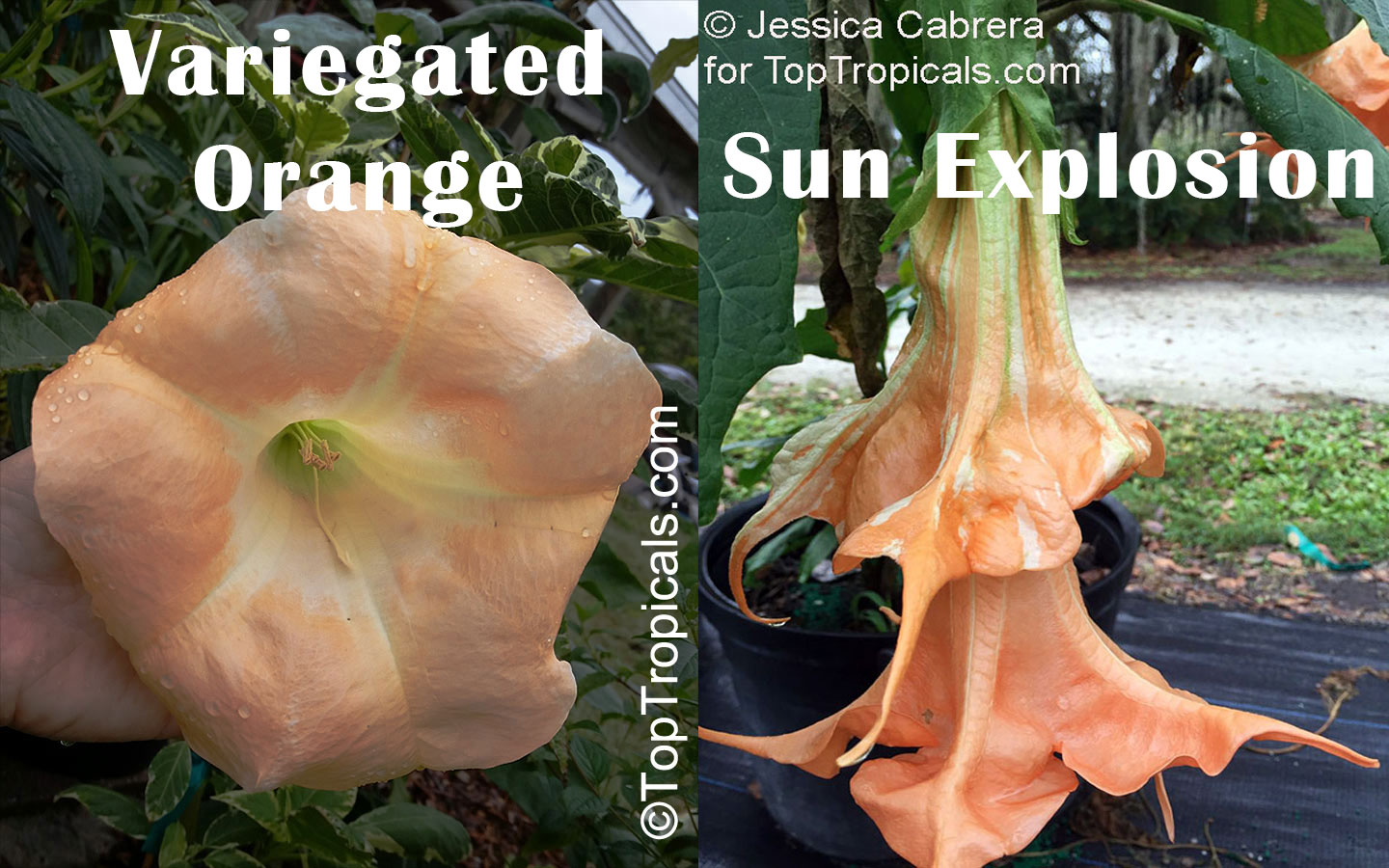
Angel Trumpets come in a dazzling array of colors: orange, yellow, green, white, pink, red, emerald and even purple (closely related Datura). One of our favorites is the beautiful Variegated Orange Angel Trumpet, a new hybrid with variegated leaves and a large single bloom that starts white and turns orange. Another amazing variety is "Sun Explosion" - with a variegated orange flower.

Most folks are usually in awe of the enormous trumpet flowers when they see it for the very first time. They most definitely need to be planted where they can be admired… near a deck, terrace, lanai or, entryway. The blossoms are short-lived, but numerous, continuous, and truly show-stopping! And they smell so good! This is a must have in any tropical garden. They can be grown either as a bush or a small tree. They are easy peasy to grow and root extremely easily, making them great as pass-along gifts for friends. They are sun-loving and super fast-growing plants. Plenty of water and fertilizers keep them happy and at their best. Did I mention they smell good too? ;)

TopTropicals.com