Garden Blog - Top Tropicals

Date: 18 May 2021

Mark your calendar:
June 19, 2021
Summer Solstice Celebration with PeopleCats

Special Event you can't miss!

First day of Summer and the longest day of the year! Live Jazz in the Garden, lots of cool vendors and "A Roof for Rufus" cat adoptions...
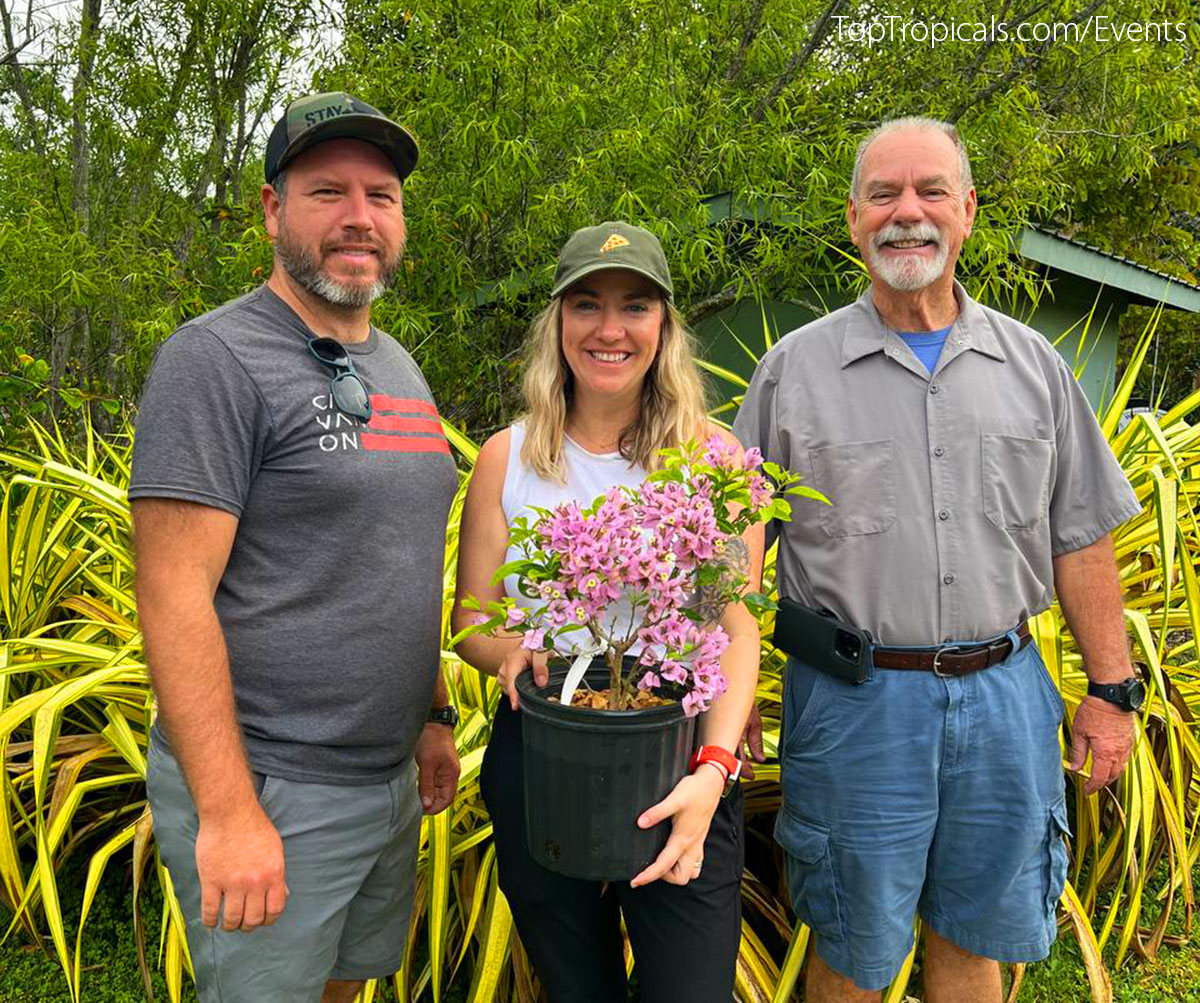
Come join the Top Tropicals crew for the longest planting day of the year. Onika, Bella, Mark and David will be here soaking in the sun and helping you to pick the right plants...

Saturday, June 19th
9:00 am - 4:00 pm

Top Tropicals is proud to partner with A Roof for Rufus cat adoptions. Each cat attending this event has been hand picked and approved by King.
Don't miss this event! Talk to the kitties and find your companion in life. PeopleCats never betray and they will love you forever!

SEE KITTIES PROFIILES >>

In the photo: PeopleCats from Roof for Rufus Rescue waiting for their forever homes.

Date: 18 Feb 2021

Red Stopper Cherry

Rare plant from Key West

by Mark Hooten, the Garden Doc

Eugenia rhombea, commonly known in Florida as "Red Stopper", is one of four species of Eugenia native to North America. It is a beautiful small tree, bearing small shiny deep green leaves which are pinkish-orange-red when young, giving them the appearance of a flowering tree at a distance when flushing out new growth a number of times a year.
Its native range includes Florida, Bahamas, Cuba, Hispaniola and part of Eastern Central America. However, here in Florida, it is federally listed as an endangered species, only known from the lowermost Everglades and Keys, where even there it is rare.
These elegant little trees grow to perhaps 12 or so feet tall, developing an elegant, umbrella shaped canopy. At a distance, they rather resemble Ficus benjamina, yet with a more orderly and refined appearance. In addition, they develop fluffy white flowers with a delightful fragrance, followed by holly-like long lasting red berries which are relished by wonderful song birds.
Although appearing delicate, this tropical species is surprisingly hardy, and would likely even make striking, a one-of-a-kind houseplant in the North.
These very few plants were grown from seeds collected near Royal Palm Hammock in the Everglades, and and may not be available again for some time...

Date: 11 Feb 2021

Schlumbergera x New Deal

A remarkable Christmas cactus hybrid

by Mark Hooten, the Garden Doc

...This hybrid, completely lost to the trade today, is being offered here for the first time after it was originally offered for purchase at the Brooklyn Botanic Garden over 80 years ago. That institution was having a special rare plant sale on the day of the famous presidential election on November 8, 1932, when F.D.R. was historically voted in as the next American president.
The plants we are offering are all 3rd generation vegetative propagations from an original specimen (still alive btw) of a plant purchased from them that very day. Its name is identical to that president's main campaign slogan!..

CONTINUE READING >>

Date: 28 Dec 2020

Spanish Lime Tree

Q: Do I need two plants of the Spanish lime to have fruits? Do you have a grafted tree that I would only need one plant?

A: From our experience with Spanish Lime trees - Melicoccus bijugatus, fruiting habit really depends on variety. There are self-pollinating varieties that only require one tree. Seedling usually require cross-pollination between two trees for better production. It doesn't mean that one tree won't bloom or fruit - it will, but production may be lower than if they were cross-pollinated.
The Spanish Lime trees we currently have in stock are seedlings from a good, self-pollinating variety Key West, however, only grafted trees are precisely true to variety since they are technically clones. Seedlings normally take a few years (3-4) until they start fruiting. Spanish Limes don't have to be grafted to produce quality fruit, however, grafted trees may take less time till they fruit.
This species is really hard to obtain and we do not have any grafted trees now, and probably not for another year. So if you really want this fruit tree, you may want to try at least with a seedling. We only have a few left in stock and many people want them. Otherwise, you may sign up for the wish list and wait until we (hopefully) have grafted specimens (enter Melicoccus bijugatus in wish list).

Date: 20 Dec 2020

Mango ID and ripeness

Q: As the World's Leading Authority on Tropical Plants, I hope you can help us out. We obtained a mango tree from a City giveaway, and planted it a few years ago. This is the 1st year it has produced fruit. They are almost all green color, & range from 6-7 inches in length. Attached are a few photos of the tree & its fruit. Please help to identify the type, and how to determine when they would be ready to pick. Or should we just wait until they fall off of the tree?

A: If the tree is grafted, it normally starts flowering within a year after planting. If the tree is over 6 years old and just now started fruiting - chances are, this is a seedling (possible at giveaways) without specific variety. However the fruit looks pretty good size and shape, hopefully it tastes great. You will find out soon!
Based on the pictures, there maybe a few possible choices, including varieties (or their seedlings) Keitt, Rosigold, it can be even Lancetilla if fruit grows bigger than 7" long. The next step would be, wait until the fruit get some color, then it will be easier to narrow down the variety. Also see if there is a lot of fiber or no fiber.
You may wait until at least one fruit ripens on the tree and let it fall naturally - that will be the color (can be all green, but in your case it looks like it's turning yellow blush). After that, you may pick full size fruit before they fall and let them ripen on a kitchen table. Usually once the fruit starts showing color, it is close to ripening. For all-green varieties, just wait till fruit grows to maximum full size. You may also check if the fruit gets softer to touch, then it's ready.