Garden Blog - Top Tropicals

Date: 2 Sep 2025

Ballistic buttons shooting from the mattress like popcorn!

Dorstenia bahiensis - Mattress Button Plant

🚀 Ballistic buttons shooting from the mattress like popcorn!

  • 🔘Dorstenia bahiensis - Mattress Button Plant is a shade-loving oddball. Its glossy green leaves are topped with flat, wavy discs that really do look like old-fashioned upholstery buttons scattered across the garden floor. But these button heads aren't just for show - on their surface are tiny clusters of male and female blooms, all crammed together like a mini city of flowers.
  • 🔘The real fun begins when those button heads ripen. Instead of quietly dropping seeds like most plants, Dorstenia goes full popcorn mode. With a little "pop!" the seeds are catapulted yards away, just like squeezing a watermelon seed between your fingers. One moment it's calm, the next it's launching its offspring across the yard!
  • 🔘At only 6-12 inches tall, this little understory dweller doesn't take up much space, but it makes up for it with personality. Content in the shade, thriving in any soil, and ready to surprise you with its seed-shooting tricks. Grow it in a pot, use it as quirky groundcover, or just keep it around as a party fun.


🛒 Get your own Mattress Button Plant

📚 Learn more:


How many buttons in this ballistic mattress?

#Shade_Garden #Container_Garden #Nature_Wonders

🟢 Join 👉 TopTropicals

Date: 5 Oct 2025

Whats that fragrance in the dark?

Brunfelsia - Lady of the Night

🌠 What's that fragrance in the dark?

  • 💐 Brunfelsia? People often ask: what can you plant in a shady spot that blooms year-round and smells amazing? The answer is Brunfelsia, known as Lady of the Night.
  • 💐 This Brazilian beauty is a compact, shade-loving shrub that thrives in low light and rewards you with creamy white flowers. As the sun sets, the blooms release a sweet, unforgettable perfume that lingers through the night. It’s like nature’s way of setting the mood for evening strolls.
  • 💐 Brunfelsia is more than just fragrance. Its flowers attract butterflies and hummingbirds, turning shaded corners into lively little stages. Low-maintenance, pollinator-friendly, and elegant, it’s the answer to your prayers: shade, flowers, and fragrance all in one plant.
  • 💐 The most fragrant Brunfelsias are the creamy-white varieties, often called Lady of the Night.
Popular species include: B. americana, B. isola, B. nitida, B. lactea, B. manaca, B. densifolia, B. gigantea.

Do you already grow Brunfelsia? What kind do you have in your garden?

🛒 Experience Brunfelsia fragrance

📚 Learn more about Brunfelsias:


#Perfume_Plants #Hedges_with_benefits #Container_Garden #Shade_Garden

🟢 Join 👉 TopTropicals

Date: 8 Jun 2016

How to get Clerodendrum to bloom?
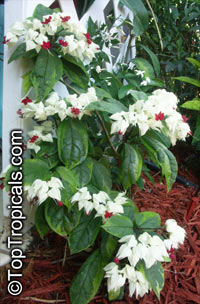
Q: My Clerodendrum thomsoniae is not blooming. Actually it is not doing much of anything except putting out weak growth and small leaves. I purchased this plant May 26. 2015. Over the winter it was in a heated sunroom, at night 60 degrees, where it received some direct sun from the skylights. I reduced the water to prevent excessive leggy growth. I don't see how this plant can take full sun or even part sun. Temps here in Raleigh NC are 80-85 degrees and 65-70 at night, at the moment. I figured I would gradually expose it to more direct sun after being in a sunroom but the leaves burn. I had this plant in San Jose many years ago where it did quite well, blooming with no special treatment. So thought I'd give it a try again. Any advice?

A: Clerodendrums are all time favorites, appreciated by both gardeners and house plant collectors, for their showy, fragrant flowers and very easy culture. When growing Bleeding Heart (Clerodendrum thomsoniae), a few things should be taken in consideration:

1) Temperature.Like most clerodendrums, this plant is semi-decidious outside of tropics and goes dormant in winter. It may lose some or all leaves if temperatures drop below 60-65F. It is not too cold sensitive, the plant can even take some light freeze. However when it is not hot and humid, it slows down metabolism. This means, water should be reduced during cooler months.

2) Light. This plant can grow in both sun and shade like most clerodendrums - this is the beauty of this genus. However like with all flowering plants, more sun promotes more bloom. In shade, it will grow beautiful dark green foliage (leaves will be bigger than in the sun) on the account of flowering; in full sun leaves turn lighter color and sometimes may even get unattractive "faded" look, but flowering will be profuse. Also remember that Arizona full sun is different than New York full sun. Here in Florida, Bleeding Heart can take some full sun, but if exposed to sun all day long, leaves often get sun burn.

3) Acclimation. Also called acclimatization - this is a process when a living organism adjusts to environment changes. Acclimation is always the case when growing plants indoors, even in a sun room. When Spring comes, and especially when we start taking outdoors those plants that have spent a few months indoors, light level increases dramatically, and this may cause leaf loss, and leaf burn. It is not necessarily a bad thing, it is just a mechanism of acclimation. Example: imagine yourself after living in a warm tropical climate, moving to a cold country. For a while your body will feel discomfort from "too much cold", while native residents may feel comfortable. We call it "My blood has thinned after living in Florida" - and this is a physiological fact. And vice versa, if you are a Northerner, moving to hot climate may be a challenge; it will take a while until you get used to hot and humid tropical summers. Same thing with plants: during cooler and darker period, their body (leaves and stems) becomes "winter type", with some serious chemical restructuring. Immediate environment change, like bright light and high temperature, causes a shock to those "winter cells", and as a defense mechanism, the plant gets rid of those useless "winter" leaves, replacing them with new "summer" leaves with completely new chemistry and metabolism.

From what you described, you know your plants, and you know what you are doing. You did everything right by reducing watering in winter and gradually moving the plant into brighter light. You still may see some stress, and this is normal. If you patiently keep changing environment slowly, eventually your plant will generate new healthy "summer" growth, it will also improve more vigorous root grown which will help the plant to establish better and to be stronger. You will see larger, thicker leaves, and definitely some flowers.

Date: 15 Jun 2021

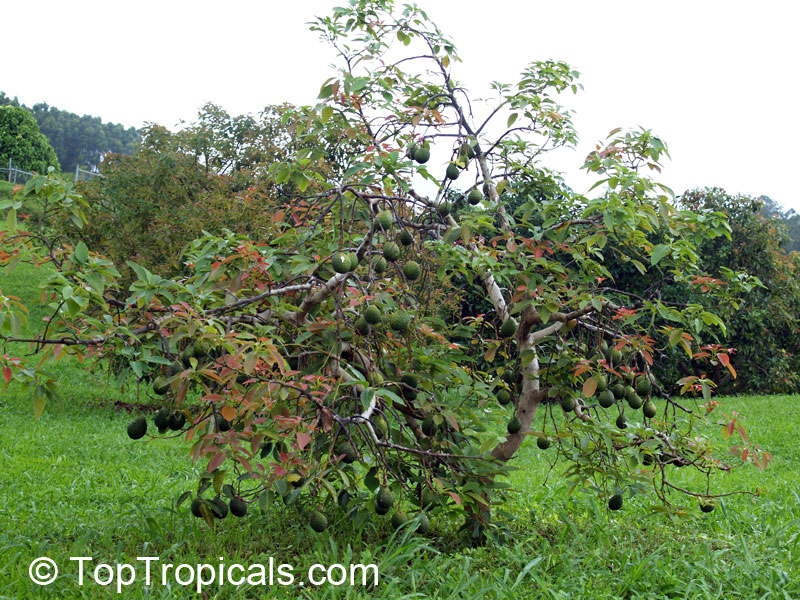
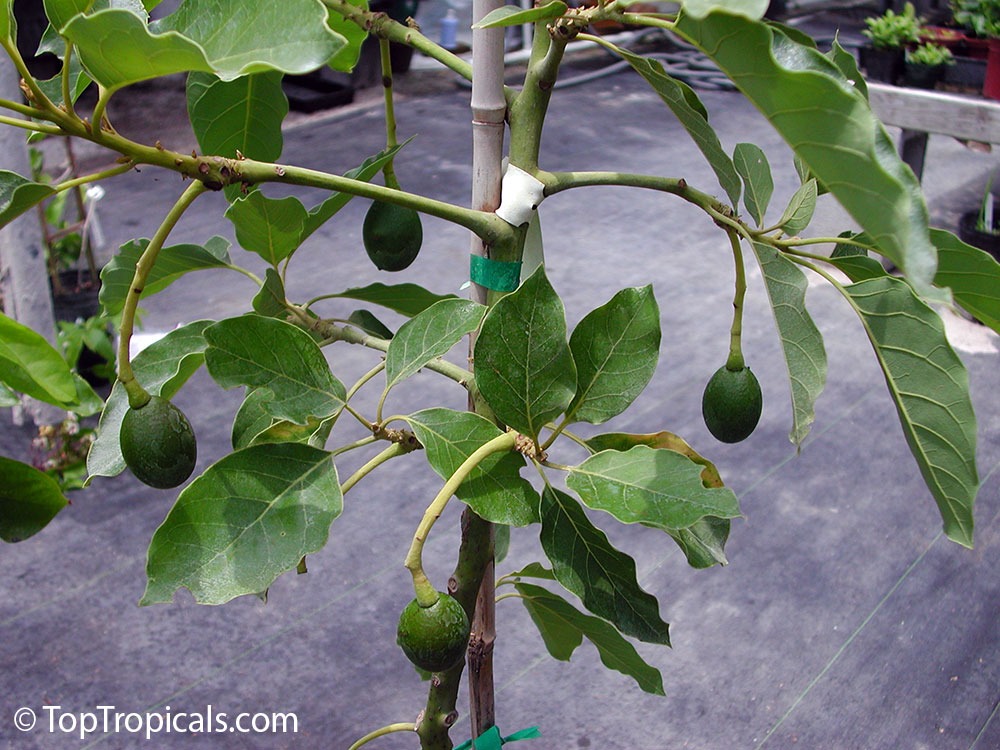
Establishing Avocado tree after shipping

Q: Received my Avocado tree last week and I'm a bit concerned. Is this wilting normal with a new plant? No yellowing, or dropping of leaves. We moved it out of the sun but not sure how to handle?

A: This is normal for after-shipping stress. You did right, position the tree away from direct sun, in shade, preferably under roof (patio?) so it doesn't get over-watered with too much rain and you can control water amount. We recommend to spray the leaves with pure water and put a large clear plastic bag just over the crown (leave the soil to breath). Keep in shade. Within couple days the leaves should perk up. Do not overwater. Water only when the top of soil gets slightly dry. In a week or so, once the plant recovers, you may start moving it gradually into full sun, then to its permanent spot where you want to plant it.
Avocado is not an easy plant to establish. So be careful. It needs lots of water, however, it doesn't like wet feet - so must be planted in a well-drained spot, with at least 4-6" elevation (on a little "hill") so it never gets water-logged. It needs daily water to establish and may need more than just a sprinkler system, use additional hose water when establishing in the ground.

Date: 31 Jul 2025

Anthurium Collector Set

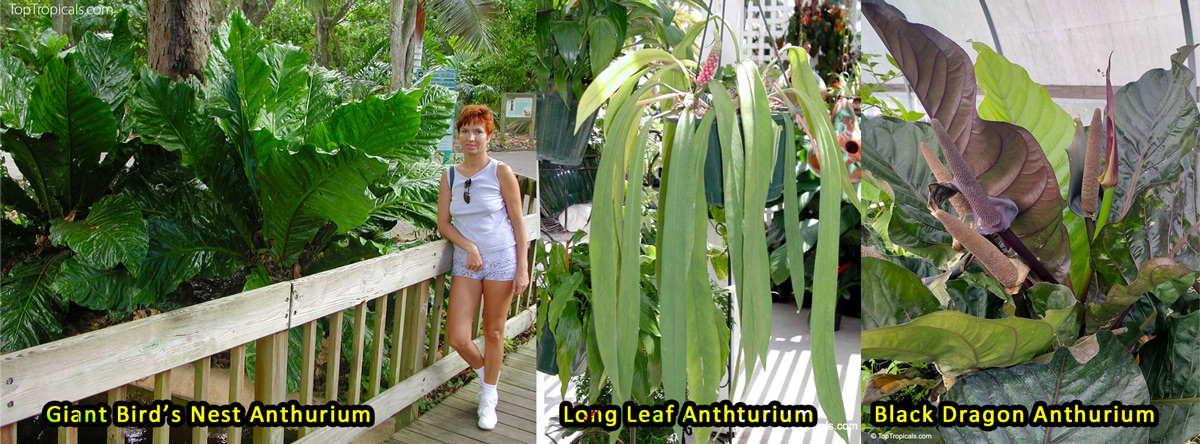
Giant  Bird's  Nest,  Long  Leaf,  and  Black  Dragon  Anthuriums  side  by 


side,  showcasing  their  dramatic  foliage  and  size

These aren't your typical tropicals - they're collector-grade Anthuriums grown for foliage and texture. Each one brings something different, but they all thrive in the same kind of setting: shade or filtered light, warmth, and humidity. Perfect for growing in containers indoors or out.

Anthurium Black Dragon

This is the most dramatic of the trio. Upright, leathery leaves shift from dark green to nearly black depending on light. Instead of bright flowers, it produces a dark brown spadix and glowing red berries. A hybrid not found in the wild, it's grown from seed - no two are exactly alike.

  • Best for: Indoor focal plant, shaded patio, black ceramic pot
  • Height: 2–4 ft in container
  • Texture: Thick, architectural leaves
  • Highlight: Color shifts with light intensity

Grow Your Own Black Dragon

Read more about Black Dragon Anthurium

Anthurium hookeri – Giant Bird's Nest

This one's about scale. Broad, crinkled leaves with a cardboard-like texture form a bold rosette. It can get huge with time - up to 6 feet across. Perfect for gardeners who want the "instant jungle" look.

  • Best for: Shaded garden, large pots on porches
  • Height: Up to 5 ft; width even more
  • Texture: Wrinkled and leathery
  • Highlight: Bright red berries in maturity

Buy Giant Bird's Nest Anthurium

Read more about Giant Bird's Nest Anthurium

Anthurium vittariifolium – Long Leaf Anthurium

Graceful and rare, this species sends out narrow strap-like leaves that can reach 5–6 ft long. Ideal for hanging baskets or mounting. Bonus: it produces small pink fruit against deep green foliage.

  • Best for: Hanging displays, vertical planters, bright bathrooms
  • Height: Leaf length, not upright height - up to 6 ft
  • Texture: Smooth, ribbon-like
  • Highlight: Cascading growth and color contrast

Buy Long Leaf Anthurium

Read more about Long Leaf Anthurium

✅ How to Care for Anthuriums

  • Light: Bright, indirect light is best. Avoid direct sun, especially mid-day. These plants evolved in rainforest understory - think "dappled light under trees."
  • Water: Keep the soil lightly moist but not soggy. Let the top inch dry before watering. They hate wet feet.
  • Humidity: These are tropicals - they'll do fine in 50-60% humidity, but thrive at 70%+. Use pebble trays or place near other plants. Bathrooms with windows work great.
  • Soil: Use an airy mix: orchid bark + perlite + peat or coco coir. Drainage is key. Never use plain potting soil.
  • Fertilizer: Feed with SUNSHINE Robusta every 2–4 weeks during warm seasons. It's formulated for aroids and won't burn roots.
  • Potting: Use shallow, wide containers. Repot only every 2–3 years, or when roots crowd the pot. They don't like frequent disruption.
  • Temperature: Ideal: 65–85 F. Short dips to the 30s F are tolerated by mature plants, but avoid cold drafts.

Shop All Anthuriums