Garden Blog - Top Tropicals

Date: 28 Oct 2016

Devil Flowers - Bat Lilies - for Halloween!
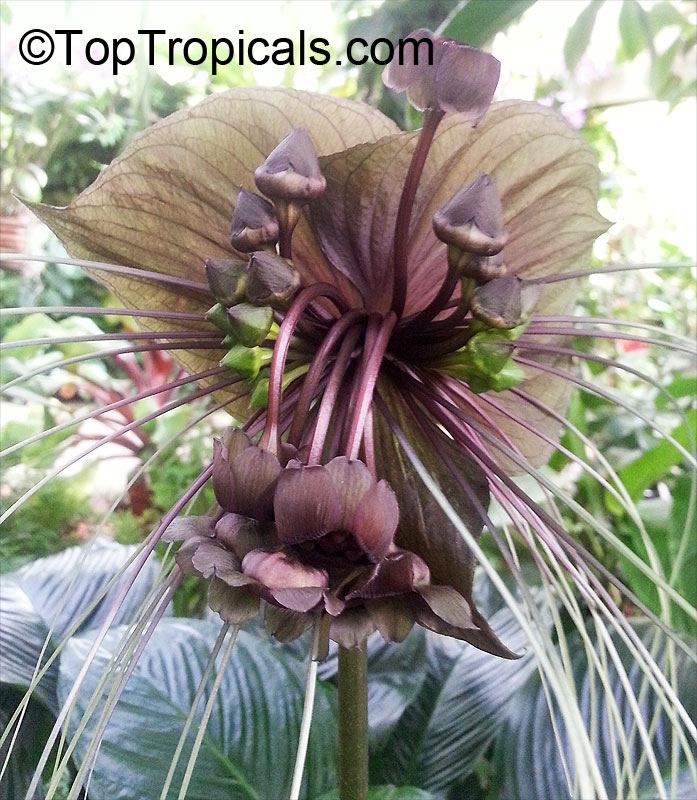
Tacca. Growing Tacca is a great way to have an unusual flower or novelty plant, both indoors and out. Tacca is an exotic plant with flowers that mimic a bat in flight, deep purple (or white), with ruffled wings and long, hanging filaments. Curious, bat-like inflorescence both in shape and color, with wide spreading, wing-like bracts of rich maroon-black (some varieties have white flowers), accompanied by long trailing filaments or "whiskers"; the small black flowers are succeeded by heavy berries; corrugated olive-green leaves with oblique base surround the bloom... Those in warm areas can learn how to grow the beautiful and unique bat flower outdoors. In more seasonal areas, bat flower info says the plant and frilly flower grows vigorously indoors when it is happy with the conditions.

How to Grow Bat Flower. Growing bat flowers requires a little extra care, but blossoms of this unusual specialty plant makes it worthwhile. Large plants usually have a greater rate of success than smaller ones. Keep your bat flower away from cold temps and away from direct sun. When growing this plant outside, plant it in the shade. Care of bat flower indoors will include a shady location as well, and yearly repotting for the rapidly growing plant. This plant does not like to be root bounded. Pot up until reaching a 10- or 12-inch pot; after that, trim the roots and return to the same size pot, if desired. Well-drained soil is a must when growing Tacca bat flowers and should remain slightly moist. Soil should be light and retain moisture but never allowed to get soggy. Our special potting mix will work best for this plant.
The plant should be allowed to dry out during dormancy. Keep this in mind during its time of rest, in fall and winter. In warmer areas, bat flowers reportedly do not experience a dormant period. Fertilize monthly or every six weeks with a slow-release plant food.
For improving cold hardiness in winter, and heat tolerance in summer, apply SUNSHINE-E booster once a month. Tacca, as well as most plants with large lush foliage, responds well to such treatments, the plant will look greener, healthier, and bloom more readily.

Black Tacca and White Tacca, as well as Tacca seeds are available from our store.
Date: 19 Aug 2016

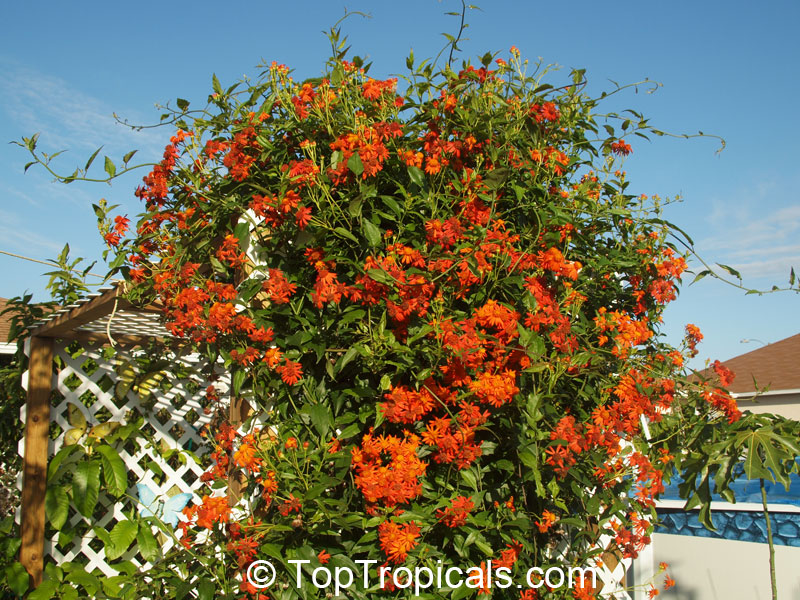
Growing Mexican Flame Vine as an annual

Q: While down in Fort Myers a few years ago, I saw this plant - Senecio confusus or Mexican Flame Vine, growing over chain-link fencing. At any rate, I fell in love with the plant then and there, only to later see it up here in Wisconsin, albeit down in Madison at The Centennial House, a noted botanical garden. This has led me to believe it may be possible to use this plant up here in the north as an annual. I could really use the orange coloration in mixed containers, etc. What I would like to try to find out is, will it grow and flower sufficiently within one of our growing seasons up here to make the choice worthwhile? Again, seeing it at Centennial House at least leads me to believe it may be possible. China where the flower was admired for its beauty and believed to have medicinal properties that promoted good health and long life. The Japanese Emperor was so smitten with the kiku flower that he adopted it as his personal crest, and it remains the insignia of the imperial family today. The art of growing and displaying Kiku for the Emperor's garden represented by amazing Imperial styles: Ozukuri, Ogiku, Kengai... Imagine growing out of one stem a single chrysanthemum trained to produce hundreds of simultaneous blossoms in a massive, dome-shaped array.

A: Mexican Flame vine is a good candidate to be grown as annual, thanks to these features:
- extremely fast growing
- it flowers in small size and young age
- long flowering period (2-3 months depending on conditions), throughout early Spring into Summer, sometimes it has a second blooming season by end of Summer.
- we keep large mature plants in stock year round, so you can have blooming size specimen as early as spring once your temperatures reach 65F so the plant will feel comfortable and develop quickly.
- easy to propagate - more plants can be made for next year season.

In winter, a potted plant can be cut back and kept in semi-dormant state indoors - garage, enclosed patio, with temperatures around 50F and above. Some gardeners from North prefer to plant a tropical specimen with a pot into the ground (make sure to add extra drainage holes), and when winter comes, it makes it easier to dig it out and save till warm season.

Date: 12 Jul 2016

RARE AFRICAN GINGERS

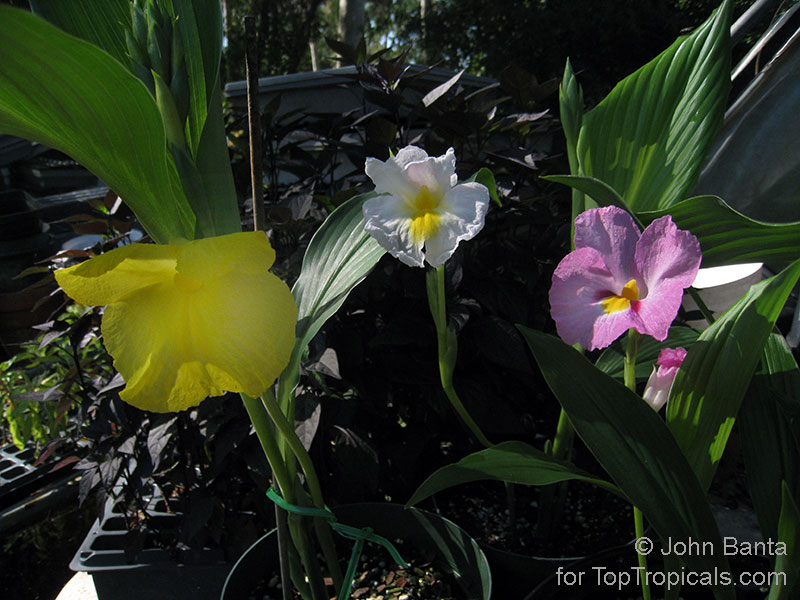
By John Banta. The rarity of African gingers is only matched by their beauty. The rarest, and most costly is the remarkable blue flowered, Siphonchilus beachystemon. It was discovered in Kenya in 1957 by an English tourist. It reminded her of the beautiful blue Himalayan poppy, Meconopsis grandis, she often admired at the Edinburgh Botanical Garden so she had her guide collect a plant or two that she took back to Edinburgh. The few plants available in horticulture today come from that original collection over 50 years ago. Fortunately there are about 15 species of Siphonchilus found in Africa and some of most outstanding ones make grand additions to our gardens. Listed in order of their vigor and availability they are:
Siphonochilus decorus. The large butter yellow flowers only last for a day but they continue to develop for weeks. In Zimbabwe it is considered one of the outstanding native plants. It is closely related to the next ginger and forms hybrids with it that are usually sterile. Read more...

Date: 18 Apr 2016

Seeds germination in summer

Q: What is the best way to germinate seeds in summer? Should I keep trays indoors or put them outside?

A: Summer is the best growing season for plants, and for their propagation. Seed germination process of tropical plants usually benefits from warm, and even hot temperatures, so keeping pots with seeds outside in full or partial sun can be the best way. However some seeds may be more sensitive than others, or require slightly cooler or higher temperature for germination. These are a few tips that may help:

- For seed germination, use only well drained mixes, containing either peat moss or coconut fiber to retain moisture. Some succulents may require adding sand to the germination mix. You may also try our Professional Formula Seed Germination Mix.

- Large tropical seeds, like palms, or seeds of Fabaceae (Bean) family, can be grown in full sun. Their germination will benefit from higher temperatures (up to 90-95F). Make sure to keep soil moist. Cover them well, with 3/4 to 1 inch of soil.

- Fruit seeds (large size) should be germinated either in individual cells or small pots (3-4"diameter).

- Small to medium size seeds can be grown in so-called community pots. Seedlings can be separated after they establish their first roots.

- Tiny seeds should be planted closer to the surface, covered with only 1/4-1/8 inch of soil; some seeds require bright light for germination, so full sun will be a plus. Some small seeds like Ficus for example, prefer to be broadcasted on the surface, uncovered. Put containers with such seeds in bright shade, as you don't want the surface of the soil to dry out.

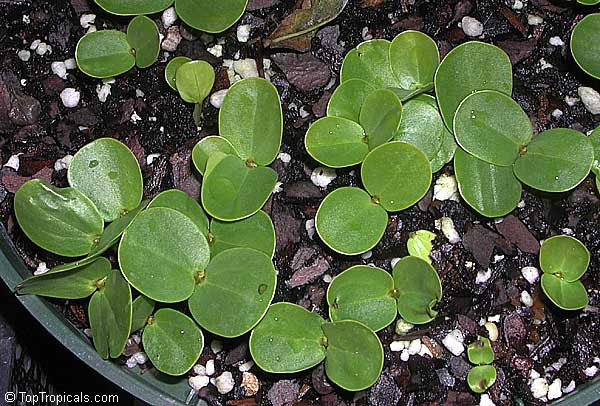
- Once your seeds sprouted, move them in filtered light - bright to medium shade depending on tenderness of the species. (Gingers prefer shade, while succulent sprouts can stay in brighter light). Regardless of water/sun needs of the species, all young sprouts and first leaves are sensitive to hot sun and may get burned or even killed. Once a baby plant has a few leaves and well-branched root system, you may start moving trays into a brighter light.

- Do not overwater young seedlings, keep soil slightly moist but not soggy.

See full list of available seeds.

Date: 20 Mar 2016

Easter Lily Vine creates a fragrant privacy fence of virtually unlimited size

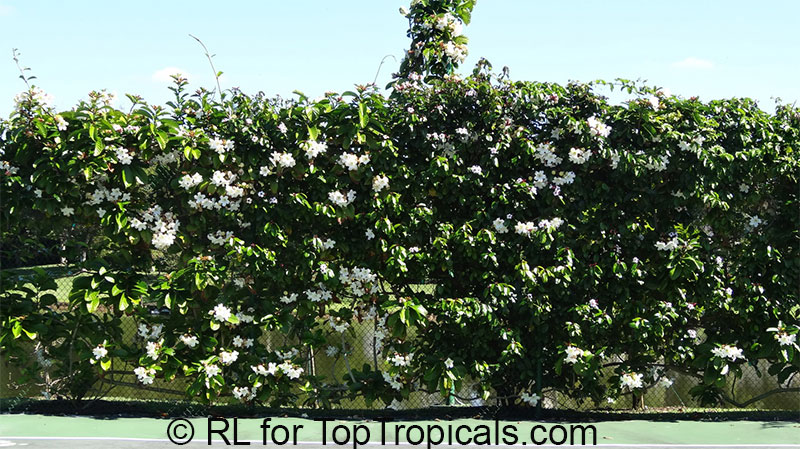
By Ron, South Florida. Easter Lily Vine (Beaumontia grandiflora) is a magnificent woody evergreen climber of unlimited growth potential. A branch of this vine will grow simply until you cut it. I have branches of up to 30 ft. and longer.

I've used two plants to turn a chain-link fence into a privacy screen that is 40 ft. wide by 10 ft. tall, but even a single plant can cover a much wider space if trained properly.

Easter Lily Vine's growth rate is moderate, so it doesn't require constant pruning to keep under control like other vigorous vines. I bought mine in 7 gallon pots, and planted them in the ground immediately. It took about 2 years to completely cover the fence. Since then, I prune it 3-4 times a year.

Keep in mind that these plants are heavy and require a solid structure as support. They twine by nature, but only around items with 3” diameter or more. Mine twined around a near-by lighting pole!

The absolute key in training Easter Lily Vine is to force it to grow horizontally. I recommend planting a young 3 gallon size vine in the ground diagonally, so it grows horizontally. Tie it no more than a foot above ground and let it grow a single branch until the end of the space you want to cover. Then force it to make a U-turn and let it grow the other way. See the following diagram for illustration..

.

See step-by-step full size pictures and the rest of the article...