Garden Blog - Top Tropicals

Date: 25 Jun 2019

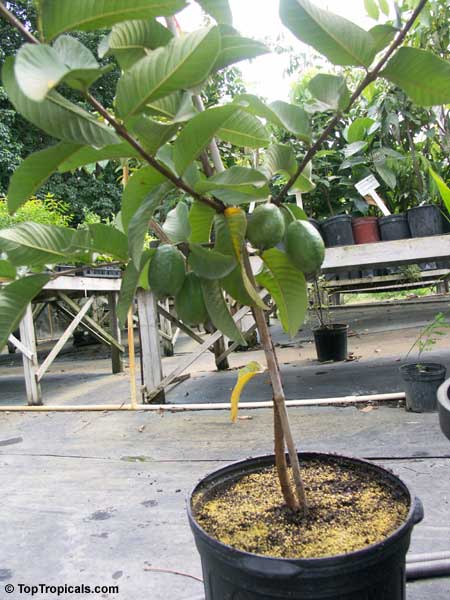
How soon will Guava tree fruit?
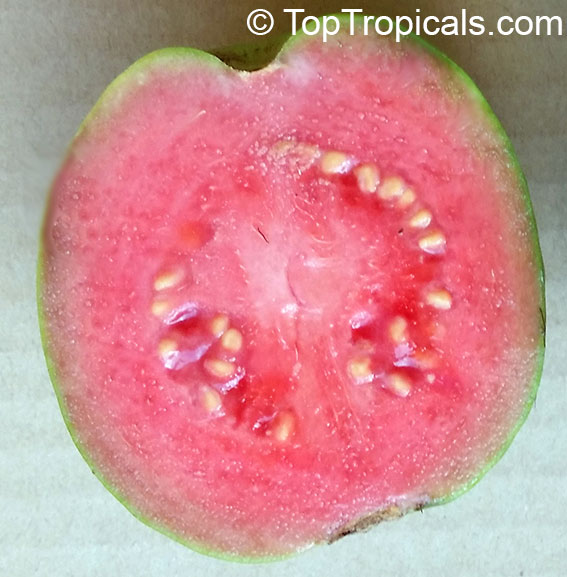
Q: Can you tell me how your Guava trees are propagated? Grown from seed vs. air grafted, etc.? I'm interested especially in the Barbie variety. In particular, I'd like to know how long it takes them to bear fruit - I live in Southern California zone 10b, with good sunlight.

A: Guavas can be propagated by seed, air layers, or grafting. Propagation method depends on the species.
Cattley guavas - Psidium littorale - are usually grown from seeds and start flowering and producing as early as in 2-3 years from seed. Tropical guavas, Psidium guajava - especially named varieties, are propagated usually by air layers, and the rarest varieties like Variegated Honey Moon are often grafted, although they will come true from seed (it's just takes them longer to fruit). Both air-layered and grafted plants start producing right away, usually on the same year of planting or next year, depending on growing conditions.
Barbie Pink is a superior variety, very popular among fruit lovers. It produces large aromatic fruit with a bright pink pulp and very few seeds. This variety is air-layered; in our nursery, these plants start flowering and setting fruit in 3 gal containers.
Plant this tree in full sun and provide regular watering, guavas don't like to dry out. Use fertile soil, with at least 50% of compost, and add some soil conditioning components for better drainage: bark, sand, perlite, etc. Mulch well, just make sure to keep mulch 2-3"away from the trunk. Follow our detailed planting instructions that come with every plant, and you are good to go!

Recommended fertilizers:

Fruit Festival Plant Food - Super Crop Booster
Mango-Food - Smart Release Fruit Tree Booster

Date: 17 Apr 2019

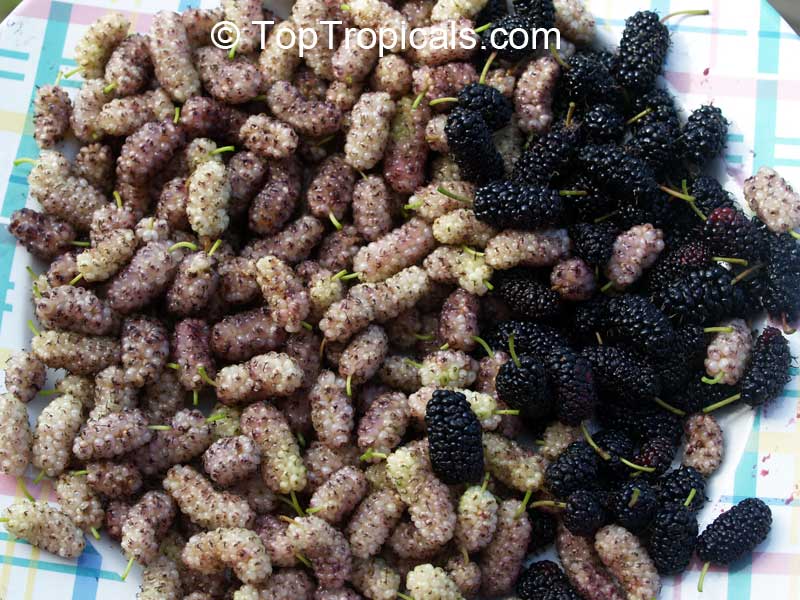
Mulberries - biggest, sweetest, and compact...

TopTropicals.com

Q: What is the difference between Pakistani and Australian Mulberry plants? Would one be better suited for South Florida backyard? Can one be maintained/pruned to be a tall shrub vs a large tree? Which one has the sweetest fruit? Thank you for the previous plants we've purchased from you. They're all doing great.!

A: These two varieties are very similar indeed. Both fruit are very large. Var. Pakistani fruit is a little longer than var. Australia and the tree is a more vigorous grower, but they both are very sweet, even before the fruit fully ripen. Both trees are a good choice and start fruiting at a young age.
We've had Australia in the ground in our garden for 4 years by now and for some reason, it has been very slow growing which is normally not the case with Mulberries. Maybe it is not fully happy with FL humid conditions.
There are two Mulberry varieties that can be maintained as bushes: Issai and Dwarf Everbearing. However, even vigorous Mulberry trees respond well to pruning and can be kept compact for easy harvesting. Just make sure to prune before the flowering season starts; here in S Florida Mulberries start flowering in March, and fruit start ripening during April-May.

Check out our Mulberry trees.

Date: 18 Mar 2019

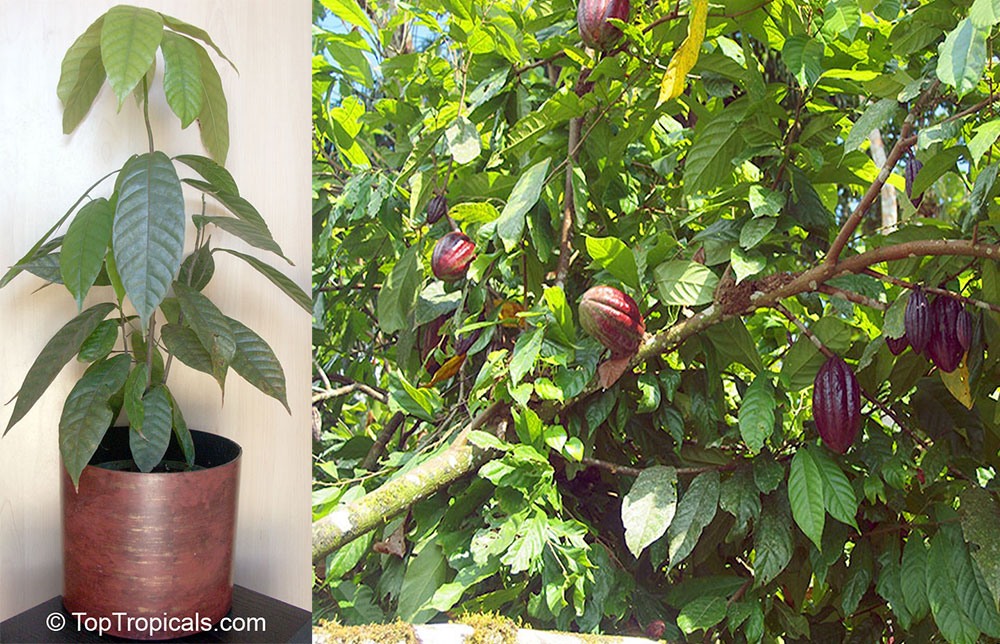
Cocoa plant after winter

TopTropicals.com

Q: I purchased the Theobroma cacao two months ago. The leaves are wilting from the edges. Do you think this from not enough water, too much water or not enough sunlight? I am keeping the plant indoors.

A: During winter time, Cocoa plants even inside our greenhouse look the same. Dry tips of the leaves are normal for this time of the year. It is a combination of lower temperatures and low humidity that causes it. Indoors air humidity is especially low. Weather permitting, bring plant outside in the bright shade, when temperatures are above 65F. Humidifier and water-spraying will help too. You may put the plant on top of a tray with pebbles/water. Do not overwater - extra watering is not a substitute for high humidity. As spring comes, Cocoa plants start looking greener and grow new healthy leaves.

Date: 15 Mar 2019

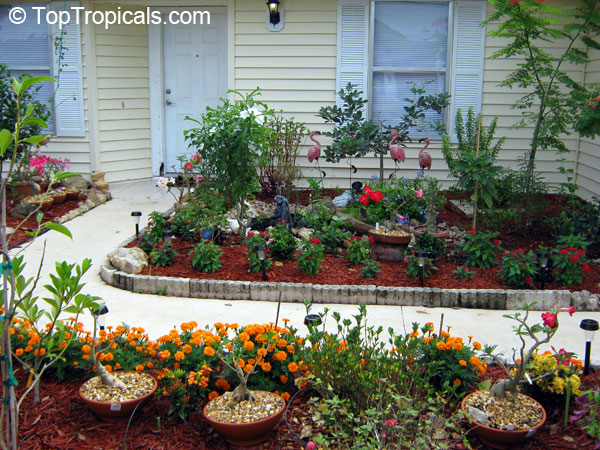
Spring mulching

TopTropicals.com

Q: When do I start re-mulching my garden? Should I wait till summer?

A: It is time now to get ready for the growing season when not only plants start growing, but weeds as well. To protect your garden from unwanted invasives, keep a thick layer of mulch in areas around tree trunks and shrubs.
Heavily mulch your garden at least once a year, at springtime. Add mulch during the year as needed.
After mowing your lawn, use cut grass (hay) as a mulch around trees. Hay is the best natural mulch, it compresses well after the rain or watering and becomes very dense - weeds won't grow through it. You may cover it with some colored mulch of your choice for a more attractive look.
Mulching is also helpful for retaining water for root systems, so plants will require less frequent watering.

Date: 2 Mar 2019

Surprising Violet fragrance of the Blue Lips

TopTropicals.com

By Mark Hooten, the Garden Doc

A few months ago while working among the bewildering array of great plants we grow, I began to notice wafts of a very unique fragrance. The scent seemed somehow familiar, yet for the longest time, I was unable to determine what kind of plant it was emanating from. I knew it was somewhere toward the back of the growing houses but just couldn't determine its source. The fragrance is very distinct and wonderful and could be detected over a large area... That scent is hard to describe, however, I would suggest a mixture of Lavender and old-fashioned florist violets...

Then, a few weeks later, I happened to lean over a grouping of Sclerochiton plants, and THERE IT WAS!!! This might be the first flowering plant I have encountered which I might rate a full 10...

Continue reading...