Garden Blog - Top Tropicals

Date: 18 Jun 2016

New Top Tropicals Video


Top Tropicals Video - Pesticide 101 Safe and Easy. Top Tropicals Plant Clinic with Robert Riefer (Certified Crop Adviser, ISA Certified Arborist). Many people are afraid of using harsh chemicals. We will discuss some pests you may find in your garden and what you can do about them, including using easy and safe household remedies.

Stay updated with TopTropicals Videos by subscribing to our channel at YouTube.com/TopTropicals and get our latest video news of what's fruiting and blooming!

Date: 8 Jun 2016

How to get Clerodendrum to bloom?
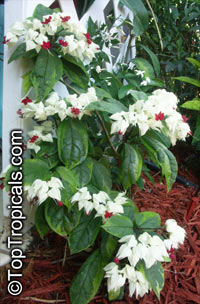
Q: My Clerodendrum thomsoniae is not blooming. Actually it is not doing much of anything except putting out weak growth and small leaves. I purchased this plant May 26. 2015. Over the winter it was in a heated sunroom, at night 60 degrees, where it received some direct sun from the skylights. I reduced the water to prevent excessive leggy growth. I don't see how this plant can take full sun or even part sun. Temps here in Raleigh NC are 80-85 degrees and 65-70 at night, at the moment. I figured I would gradually expose it to more direct sun after being in a sunroom but the leaves burn. I had this plant in San Jose many years ago where it did quite well, blooming with no special treatment. So thought I'd give it a try again. Any advice?

A: Clerodendrums are all time favorites, appreciated by both gardeners and house plant collectors, for their showy, fragrant flowers and very easy culture. When growing Bleeding Heart (Clerodendrum thomsoniae), a few things should be taken in consideration:

1) Temperature.Like most clerodendrums, this plant is semi-decidious outside of tropics and goes dormant in winter. It may lose some or all leaves if temperatures drop below 60-65F. It is not too cold sensitive, the plant can even take some light freeze. However when it is not hot and humid, it slows down metabolism. This means, water should be reduced during cooler months.

2) Light. This plant can grow in both sun and shade like most clerodendrums - this is the beauty of this genus. However like with all flowering plants, more sun promotes more bloom. In shade, it will grow beautiful dark green foliage (leaves will be bigger than in the sun) on the account of flowering; in full sun leaves turn lighter color and sometimes may even get unattractive "faded" look, but flowering will be profuse. Also remember that Arizona full sun is different than New York full sun. Here in Florida, Bleeding Heart can take some full sun, but if exposed to sun all day long, leaves often get sun burn.

3) Acclimation. Also called acclimatization - this is a process when a living organism adjusts to environment changes. Acclimation is always the case when growing plants indoors, even in a sun room. When Spring comes, and especially when we start taking outdoors those plants that have spent a few months indoors, light level increases dramatically, and this may cause leaf loss, and leaf burn. It is not necessarily a bad thing, it is just a mechanism of acclimation. Example: imagine yourself after living in a warm tropical climate, moving to a cold country. For a while your body will feel discomfort from "too much cold", while native residents may feel comfortable. We call it "My blood has thinned after living in Florida" - and this is a physiological fact. And vice versa, if you are a Northerner, moving to hot climate may be a challenge; it will take a while until you get used to hot and humid tropical summers. Same thing with plants: during cooler and darker period, their body (leaves and stems) becomes "winter type", with some serious chemical restructuring. Immediate environment change, like bright light and high temperature, causes a shock to those "winter cells", and as a defense mechanism, the plant gets rid of those useless "winter" leaves, replacing them with new "summer" leaves with completely new chemistry and metabolism.

From what you described, you know your plants, and you know what you are doing. You did everything right by reducing watering in winter and gradually moving the plant into brighter light. You still may see some stress, and this is normal. If you patiently keep changing environment slowly, eventually your plant will generate new healthy "summer" growth, it will also improve more vigorous root grown which will help the plant to establish better and to be stronger. You will see larger, thicker leaves, and definitely some flowers.
Date: 6 May 2016

Taking care of Soursop after shipping

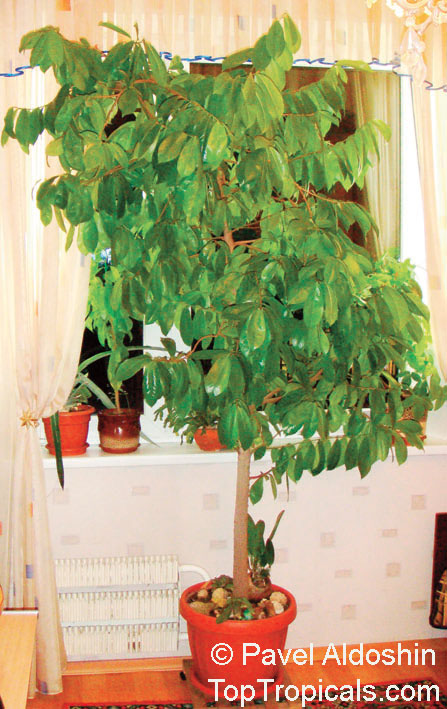
Q: Since I have never grown a soursop tree before I need some pro help. My tree was delivered absolutely beautiful, leaves were a pretty green. I potted it and gave it a good drink of water and put it in a shaded area outside. Then the weather here became cool so I brought it in for a few days until the weather warmed, and it lost all the leaves. Is it in shock and will come around eventually? Will I be able to grow this tree indoors during winter?

A: Soursop - Annona muricata trees are very sensitive to temperature drops. This always causes leaf loss. You seem to be doing everything right. Do not water until soil gets slightly dry; keep it in bright shade. The weather should be good now with high temperatures and humidity rising. No fertilizer until the plant shows active new growth. Be patient with your plant, it should recover soon.

Soursop is an ultra-tropical tree and doesn't take any freeze. If you live in cooler climate, keep the plant in a pot (the good news is, Annonas in general have compact nature and are perfect for container culture). Bring the tree indoors during cold period, providing bright light.

We have very interesting article about growing and fruiting Soursop in apartment. Check out 4534 Tropical Treasures Magazine # 7.

Date: 20 Mar 2016

Easter Lily Vine creates a fragrant privacy fence of virtually unlimited size

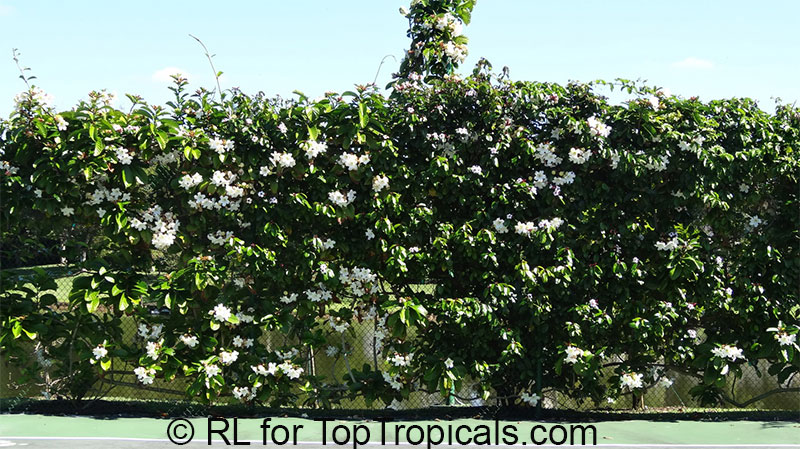
By Ron, South Florida. Easter Lily Vine (Beaumontia grandiflora) is a magnificent woody evergreen climber of unlimited growth potential. A branch of this vine will grow simply until you cut it. I have branches of up to 30 ft. and longer.

I've used two plants to turn a chain-link fence into a privacy screen that is 40 ft. wide by 10 ft. tall, but even a single plant can cover a much wider space if trained properly.

Easter Lily Vine's growth rate is moderate, so it doesn't require constant pruning to keep under control like other vigorous vines. I bought mine in 7 gallon pots, and planted them in the ground immediately. It took about 2 years to completely cover the fence. Since then, I prune it 3-4 times a year.

Keep in mind that these plants are heavy and require a solid structure as support. They twine by nature, but only around items with 3” diameter or more. Mine twined around a near-by lighting pole!

The absolute key in training Easter Lily Vine is to force it to grow horizontally. I recommend planting a young 3 gallon size vine in the ground diagonally, so it grows horizontally. Tie it no more than a foot above ground and let it grow a single branch until the end of the space you want to cover. Then force it to make a U-turn and let it grow the other way. See the following diagram for illustration..

.

See step-by-step full size pictures and the rest of the article...

Date: 13 Mar 2016

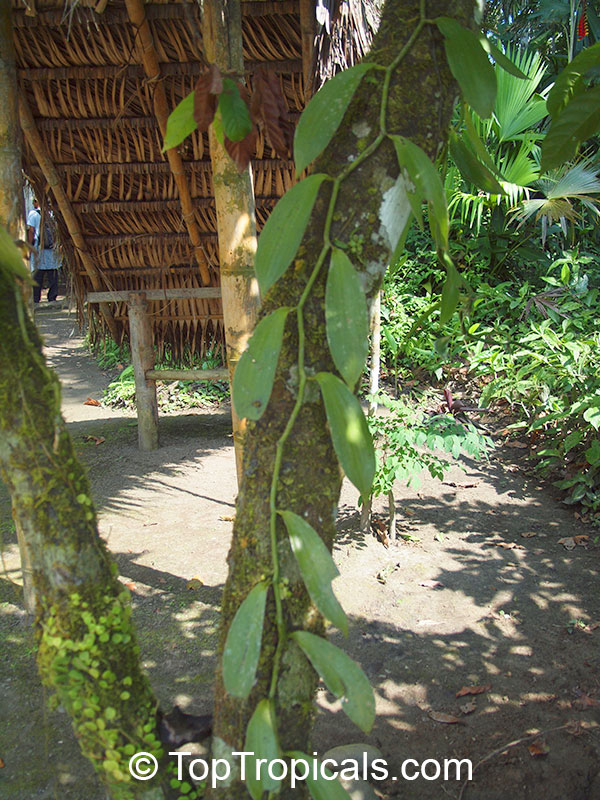
Growing Vanilla Orchid

Q: I want to buy Vanilla orchid and I wonder if I can grow it in my bathroom by the skylight.

A: Growing Vanilla orchid is no different than other orchids. It is very simple. All that the plant needs is a good light, good air humidity, and good porous support.

Light. Grow Vanilla orchid in a very bright light, but protected from direct hot sun.

Air humidity.The higher the air humidity, the better your plant will grow. Many people grow orchids in a bathroom where these plants can enjoy occasional "humidity treats" after showers.

Growing media. Vanilla orchid cuttings are rooted very often in a regular potting mix with high content of pine bark and/or Perlite, Coconut Husk Chips. Once the little plant is well-rooted and starts developing, it will need a special porous surface to climb on and to attach to with developing aerial roots. A log covered with porous bark is used often. Another option is a piece of wood wrapped with a burlap fabric. In the Nature, this plant climbs up high onto trees and attaches to the bark with aerial roots - at this point, it doesn't need those terrestrial roots any more which may even die off. Climbing a porous support is absolutely necessary for your vanilla for setting buds, flowering and producing vanilla beans. If you are lucky to live in frost-free climate, plant you vanilla by a tree that will provide a shady canopy and a great natural climbing surface (bark). You may see the flowers as soon as within 1-2 seasons!